Congenital Malformations Indian Medical PG Practice Questions and MCQs
Practice Indian Medical PG questions for Congenital Malformations. These multiple choice questions (MCQs) cover important concepts and help you prepare for your exams.
Congenital Malformations Indian Medical PG Question 1: Anorectal anomalies are commonly associated with which of the following congenital anomalies?
- A. Cardiac anomalies (Correct Answer)
- B. Duodenal atresia
- C. CNS malformations
- D. Abdominal wall defects
Congenital Malformations Explanation: ***Cardiac anomalies***
- **Cardiac anomalies** occur in approximately 30-50% of patients with **anorectal malformations**, making them the most commonly associated congenital anomaly.
- These can range from simple septal defects to complex **congenital heart diseases**, often requiring surgical intervention.
*Duodenal atresia*
- **Duodenal atresia** is a common gastrointestinal anomaly but is less frequently associated with **anorectal malformations** compared to cardiac anomalies.
- It typically presents with **bilious vomiting** and a "double bubble" sign on X-ray, which is not directly linked to the embryological development of the anorectum.
*CNS malformations*
- **CNS malformations**, such as **spinal dysraphism** (e.g., tethered cord, myelomeningocele), are certainly associated with **anorectal malformations**, particularly in the context of **VACTERL association**.
- While significant, their incidence is generally lower than that of **cardiac anomalies** in this group.
*Abdominal wall defects*
- **Abdominal wall defects** like **omphalocele** or **gastroschisis** are distinct congenital anomalies with different embryological origins than **anorectal malformations**.
- They are not considered a primary or most common associated anomaly with **anorectal malformations**.
Congenital Malformations Indian Medical PG Question 2: A newborn male is noted to have difficulty feeding and "turns blue and chokes when drinking formula." The prenatal records reveal that the amniotic fluid appeared normal on ultrasound. A pediatric feeding tube is passed orally to 20 cm without difficulty, with gastric secretions aspirated. Which of the following is the most likely diagnosis?
- A. Floppy epiglottis
- B. Tracheoesophageal fistula (Correct Answer)
- C. Zenker diverticulum
- D. Congenital heart disease
Congenital Malformations Explanation: ***Tracheoesophageal fistula***
- The combination of **feeding difficulties**, **cyanosis** ("turns blue"), and **choking** in a newborn, along with the ability to pass a feeding tube to 20 cm, strongly suggests a tracheoesophageal fistula (TEF), specifically a type where the **proximal esophagus ends in a blind pouch and the distal esophagus connects to the trachea**.
- The **normal amniotic fluid** on prenatal ultrasound suggests that the fetus was able to swallow amniotic fluid, ruling out esophageal atresia without a fistula as the primary cause of polyhydramnios. Passage of the feeding tube to 20 cm and aspiration of gastric secretions indicates that the stomach is connected to the esophagus, but the reflux of gastric contents during feeding leads to aspiration into the trachea via the fistula.
*Floppy epiglottis*
- **Laryngomalacia**, or "floppy epiglottis," typically causes **stridor** (a high-pitched inspiratory sound), especially when crying or feeding, which is not the primary symptom described here.
- While it can cause some feeding difficulties, **severe cyanosis and recurrent choking** during feeding are more characteristic of aspiration due to a different anatomical defect like TEF.
*Zenker diverticulum*
- A **Zenker diverticulum is a pharyngoesophageal pouch** that typically causes dysphagia, regurgitation of undigested food, and halitosis, primarily in **older adults**.
- It is an acquired condition and **extremely rare in newborns**, making it an unlikely diagnosis for these symptoms in an infant.
*Congenital heart disease*
- While congenital heart disease can cause **cyanosis and feeding difficulties** due to increased metabolic demand or heart failure, it would not typically present with the specific description of **choking during feeding and successful passing of a feeding tube to the stomach with aspirated gastric secretions**.
- The symptoms in this case point more directly to a **problem with the swallowing mechanism or the connection between the esophagus and the trachea**.
Congenital Malformations Indian Medical PG Question 3: Which of the following statements concerning spina bifida is True?
- A. Spina bifida occulta occurs most often at L5-S1 level (Correct Answer)
- B. Chromosomal abnormalities can be identified in approximately 50% of patients
- C. A myelomeningocele is the most common type of spina bifida
- D. Additional congenital abnormalities are rare findings
Congenital Malformations Explanation: **Spina bifida occulta occurs most often at L5-S1 level**
- **Spina bifida occulta** is the mildest form of spina bifida, characterized by an incomplete closure of the vertebral arch without protrusion of the spinal cord or meninges.
- The most common location for spina bifida occulta is the **L5-S1 vertebral level**, which often presents as a skin dimple, tuft of hair, or discolored patch in the lumbar region.
*Chromosomal abnormalities can be identified in approximately 50% of patients*
- **Chromosomal abnormalities** are found in a minority of patients with spina bifida, typically less than 10%, when evaluating for genetic causes.
- While single-gene mutations or environmental factors contribute, spina bifida is most often considered a **multifactorial condition** rather than solely chromosomal.
*A myelomeningocele is the most common type of spina bifida*
- A **myelomeningocele** is the most severe and a common type of spina bifida where the spinal cord and meninges protrude through an opening in the spine.
- However, **spina bifida occulta** is statistically the most common type overall, though it is often asymptomatic and may go undiagnosed.
*Additional congenital abnormalities are rare findings*
- **Additional congenital abnormalities** are not rare; they are frequently associated with spina bifida, particularly with myelomeningocele.
- These can include **hydrocephalus**, **Chiari malformations**, urinary tract anomalies, and orthopedic issues like clubfoot, reflecting a systemic developmental disruption.
Congenital Malformations Indian Medical PG Question 4: Seal like limbs i.e. phocomelia is a specific side effect of -
- A. Doxorubicin
- B. Thalidomide (Correct Answer)
- C. Cyclophosphamide
- D. Terazosin
Congenital Malformations Explanation: ***Thalidomide***
- **Phocomelia**, characterized by severely shortened or absent limbs resembling those of a seal, is a classic and well-documented **teratogenic effect** of thalidomide.
- This drug, when taken during early pregnancy (especially between weeks 4 and 8), disrupts limb bud development.
*Doxorubicin*
- **Doxorubicin** is an **anthracycline antibiotic** used in cancer chemotherapy, known for its significant **cardiotoxicity**, leading to dilated cardiomyopathy.
- While it has various side effects, **phocomelia** is not a reported teratogenic effect of doxorubicin.
*Cyclophosphamide*
- **Cyclophosphamide** is an **alkylating agent** used in chemotherapy and immunosuppression, with notable side effects including **hemorrhagic cystitis** and **myelosuppression**.
- Although it is a teratogen and can cause various fetal malformations, it is not specifically associated with **phocomelia**.
*Terazosin*
- **Terazosin** is an **alpha-1 blocker** primarily used to treat hypertension and benign prostatic hyperplasia (BPH).
- Its main side effects include **orthostatic hypotension** and dizziness; it is not known to be teratogenic or associated with **phocomelia**.
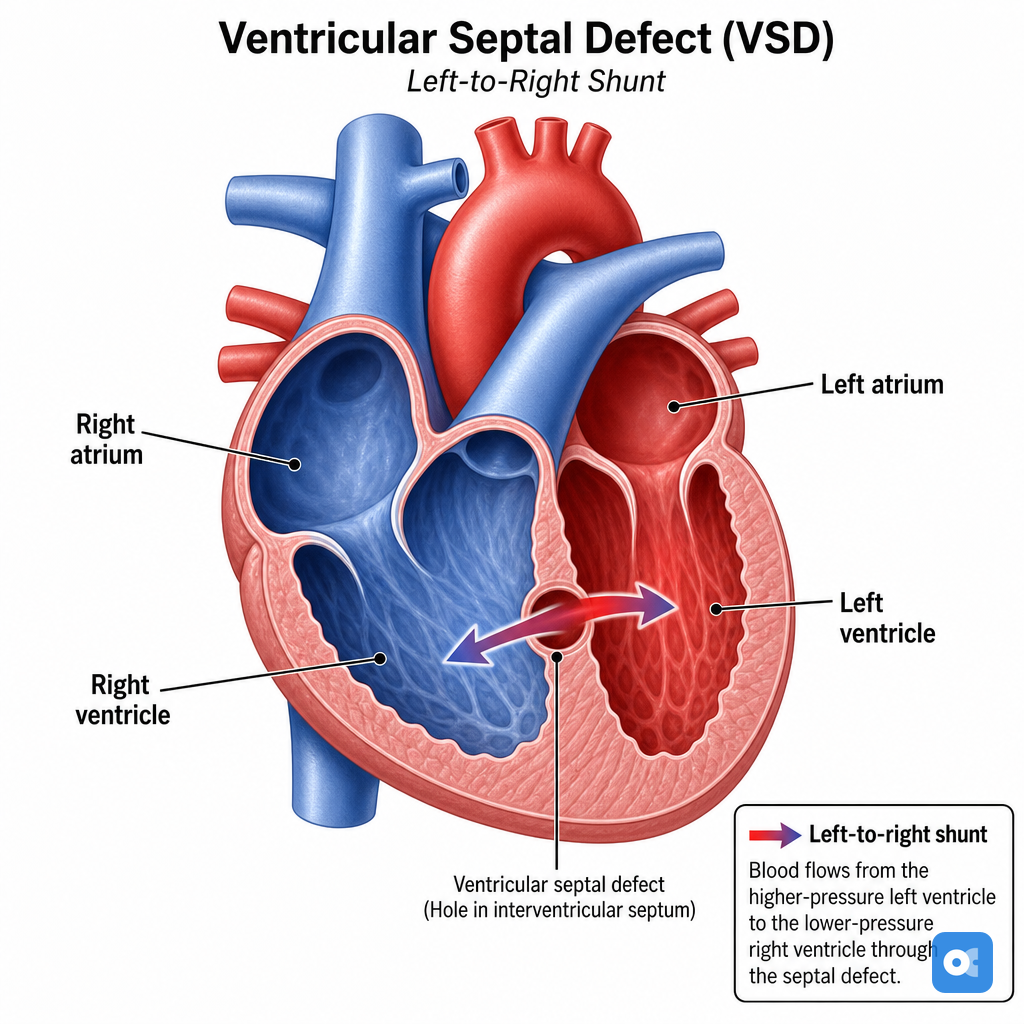
Congenital Malformations Indian Medical PG Question 5: A child presented at 10 weeks with recurrent episode of pneumonia and failure to thrive. X-ray shows cardiomegaly & pulmonary plethora. What is the diagnosis?
- A. VSD (Correct Answer)
- B. TOF
- C. Patent foramen ovale
- D. ASD
Congenital Malformations Explanation: ***VSD***
- **Ventricular septal defect (VSD)** is the most common cause of this presentation in early infancy (symptoms typically appear at **6-10 weeks** of age).
- Large VSDs cause significant **left-to-right shunt** leading to pulmonary overcirculation, resulting in **recurrent pneumonia** and **failure to thrive**.
- **Cardiomegaly** (due to volume overload of left atrium and ventricle) and **pulmonary plethora** (increased pulmonary vascular markings) on X-ray are classic findings.
- The infant may also present with tachypnea, feeding difficulties, and poor weight gain.
*TOF*
- **Tetralogy of Fallot (TOF)** is a **cyanotic heart defect** with right-to-left shunt, presenting with cyanosis and hypoxic spells, not recurrent pneumonia.
- X-ray shows **boot-shaped heart** and **pulmonary oligemia** (decreased pulmonary vascular markings), not pulmonary plethora.
- Does not typically cause failure to thrive in the same manner as acyanotic left-to-right shunt lesions.
*Patent foramen ovale*
- A **patent foramen ovale (PFO)** is a normal variant in infants and typically remains **asymptomatic**.
- Does not cause significant hemodynamic shunting in the absence of elevated right atrial pressure.
- Does not cause **cardiomegaly**, **pulmonary plethora**, recurrent pneumonia, or failure to thrive.
*ASD*
- An **atrial septal defect (ASD)** also causes left-to-right shunt with pulmonary plethora, but the shunt develops **gradually** over time.
- ASD typically presents **later in childhood or adulthood** with milder symptoms (fatigue, exercise intolerance) due to lower pressure gradient across atria.
- **Recurrent pneumonia and failure to thrive at 10 weeks** are uncommon with isolated ASD, as the hemodynamic changes are less pronounced in early infancy compared to VSD.
- When symptomatic in infancy, large ASDs present later (around 6 months to 1 year) rather than at 10 weeks.
Congenital Malformations Indian Medical PG Question 6: All of the following are neural tube defects except:
- A. Holoprosencephaly (Correct Answer)
- B. Encephalocele
- C. Myelomeningocele
- D. Anencephaly
Congenital Malformations Explanation: ***Holoprosencephaly***
- This condition results from the **failure of the prosencephalon (forebrain)** to properly divide into two hemispheres, often leading to facial abnormalities.
- It is considered a **forebrain malformation**, distinct from neural tube closure defects.
*Encephalocele*
- An encephalocele is a **neural tube defect** characterized by the protrusion of brain tissue and meninges through an opening in the skull.
- It results from the **incomplete closure of the neural tube** during embryonic development.
*Myelomeningocele*
- Myelomeningocele is a severe form of **spina bifida**, a neural tube defect where the spinal cord and meninges protrude through an opening in the spine [2].
- This defect arises from the **failure of the neural tube to close completely** in the caudal region [1].
*Anencephaly*
- Anencephaly is a lethal **neural tube defect** characterized by the absence of a major portion of the brain, skull, and scalp [3].
- It occurs due to the **failure of the cranial end of the neural tube to close** [3].
Congenital Malformations Indian Medical PG Question 7: A primary structural defect of an organ resulting from an intrinsically abnormal developmental process is termed as:
- A. Malformation (Correct Answer)
- B. Disruption
- C. Deformation
- D. Association
Congenital Malformations Explanation: ***Malformation***
- Refers to a **primary structural defect** present at birth, arising during development, leading to abnormal organ structure.
- Typically involves intrinsic factors and can affect any organ or system, making it a key category of congenital anomalies.
*Association*
- Describes a **non-random occurrence** of two or more anomalies but does not indicate a structural defect of a specific organ.
- Does not imply a direct defect, as it can occur without an **underlying structural issue** in a particular organ.
*Deformation*
- Refers to a change in the **shape or structure** of a normally formed organ or body part due to an external force rather than an intrinsic defect [1].
- Examples include clubfoot or positional plagiocephaly, which are not classified as malformations [1].
*Disruption*
- Involves the breakdown of an originally normal tissue or organ due to extrinsic factors, leading to secondary structural defects.
- Not inherent to the embryological development process itself, differentiating it from intrinsic faults like malformations.
**References:**
[1] Kumar V, Abbas AK, et al.. Robbins and Cotran Pathologic Basis of Disease. 9th ed. Diseases of Infancy and Childhood, pp. 460-462.
Congenital Malformations Indian Medical PG Question 8: Identify the condition shown in the CT scan image.
- A. None of the options
- B. Dandy-Walker malformation (Correct Answer)
- C. Cerebellar vermis hypoplasia
- D. Mega cisterna magna
Congenital Malformations Explanation: ***Dandy-Walker malformation***
- The image shows an enlarged posterior fossa with **cystic dilation of the fourth ventricle** and **absence/hypoplasia of the cerebellar vermis**, which are classic features of Dandy-Walker malformation.
- The elevated tentorium and upward displacement of the transverse sinuses are also characteristic, contributing to the distinct appearance.
*Cerebellar vermis hypoplasia*
- While cerebellar vermis hypoplasia is a component of Dandy-Walker malformation, it is not the sole, defining feature.
- Dandy-Walker also includes cystic dilation of the fourth ventricle and an enlarged posterior fossa, which are evident in the image and go beyond isolated vermis hypoplasia.
*Mega cisterna magna*
- A **mega cisterna magna** is a benign enlargement of the cisterna magna, which is the space between the cerebellum and the medulla oblongata.
- Unlike in Dandy-Walker malformation, a mega cisterna magna usually does not involve displacement of the tentorium or hypoplasia of the cerebellar vermis, and the fourth ventricle is typically normal in shape and size.
*None of the options*
- The image clearly displays the diagnostic hallmarks of Dandy-Walker malformation, making this option incorrect.
Congenital Malformations Indian Medical PG Question 9: What is the most common variety of mesenteric cyst?
- A. Chylolymphatic (Correct Answer)
- B. Dermoid
- C. Enterogenous
- D. Urogenital remnant
Congenital Malformations Explanation: **Chylolymphatic**
- These cysts originate from **lymphatic tissue** and are the most prevalent type of mesenteric cyst, often containing **chylous fluid**.
- They are typically **thin-walled, unilocular or multilocular**, and can be found anywhere in the mesentery.
*Enterogenous*
- These cysts are **duplications of the alimentary tract** and are lined by **gastrointestinal mucosa**, often presenting with symptoms related to their connection with the bowel.
- They are less common than chylolymphatic cysts and may contain **mucinous material**.
*Dermoid*
- Dermoid cysts are **teratomas** containing various **ectodermal elements** like hair, teeth, or sebaceous material.
- While they can occur in various locations, they are a **very rare** type of mesenteric cyst.
*Urogenital remnant*
- Cysts arising from urogenital remnants are exceedingly rare in the mesentery, as their primary location would be in close proximity to the **genitourinary organs**.
- These cysts typically originate from **embryological structures** that fail to regress completely.
Congenital Malformations Indian Medical PG Question 10: A 5-day-old infant is diagnosed with a non-communicating hydrocephalus. Which of the following is most likely to lead to such a condition?
- A. Disturbances in the resorption of cerebrospinal fluid
- B. Excess production of cerebrospinal fluid
- C. Obstruction in the circulation of the cerebrospinal fluid (Correct Answer)
- D. Increased size of the head
Congenital Malformations Explanation: ***Obstruction in the circulation of the cerebrospinal fluid***
- **Non-communicating hydrocephalus**, by definition, is caused by an **obstruction within the ventricular system** that prevents CSF from reaching the subarachnoid space.
- In a newborn, common causes of such obstruction include **aqueductal stenosis** or malformations like **Dandy-Walker syndrome**.
*Disturbances in the resorption of cerebrospinal fluid*
- This typically leads to **communicating hydrocephalus**, where CSF can flow freely within the ventricles but is not adequately absorbed into the venous system.
- Examples include **arachnoid granulations** dysfunction or **post-meningitic scarring**.
*Excess production of cerebrospinal fluid*
- This is a very rare cause of hydrocephalus, usually associated with conditions like a **choroid plexus papilloma**.
- This would lead to a **communicating hydrocephalus** as the obstruction is not within the ventricular system itself.
*Increased size of the head*
- An **increased head size (macrocephaly)** is a *symptom* or *sign* of hydrocephalus in an infant, not a cause.
- The elevated intracranial pressure from the accumulated CSF leads to the expansion of the skull bones before the sutures fuse.
More Congenital Malformations Indian Medical PG questions available in the OnCourse app. Practice MCQs, flashcards, and get detailed explanations.