Most of the synapses used for signal transmission in the central nervous system are _____ synapses.
#3
Associative learning is linked to _____ and cerebellum
#4
Neural stimulus repeated many times until the subject becomes habituated to the stimulus and ignores it, is known as _____, and is one of the mechanisms involved in synaptic plasticity and learning
#5
Production of EPSPs, occurs after a brief tetanizing train of stimuli in the presynaptic neuron, is known as _____, and is one of the mechanisms involved in synaptic plasticity and learning
#6
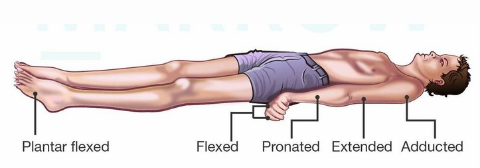
The image shows decerebrate rigidity, in which there is _____ excitation
#7
Clonus is due to sustained hyperactivity of _____ motor neurons.
#8
_____ are sudden, jerky eye movements that occur as the gaze shifts from one object to another, performed to bring image of an object quickly on the fovea.
#9
_____ is the main inhibitory neurotransmitter of the CNS
#10
The _____ and substantia nigra pars compacta are responsible for the synthesis of dopamine
Neuroplasticity Indian Medical PG Flashcards - Medical Study Cards
Master Neuroplasticity with OnCourse flashcards. These spaced repetition flashcards are designed for medical students preparing for NEET PG, USMLE Step 1, USMLE Step 2, MBBS exams, and other medical licensing examinations.
Neuroplasticity Flashcard Deck - 10 Cards
Flashcard 1: Chemical synapses are usually _____directional
Answer: uni
Flashcard 2: Most of the synapses used for signal transmission in the central nervous system are _____ synapses.
Answer: chemical
Flashcard 3: Associative learning is linked to _____ and cerebellum
Answer: amygdala
Flashcard 4: Neural stimulus repeated many times until the subject becomes habituated to the stimulus and ignores it, is known as _____, and is one of the mechanisms involved in synaptic plasticity and learning
Answer: habituation
Flashcard 5: Production of EPSPs, occurs after a brief tetanizing train of stimuli in the presynaptic neuron, is known as _____, and is one of the mechanisms involved in synaptic plasticity and learning
Answer: Post-tetanic Potentiation
Flashcard 6: The image shows decerebrate rigidity, in which there is _____ excitation
Answer: reticulospinal
Flashcard 7: Clonus is due to sustained hyperactivity of _____ motor neurons.
Answer: alpha and gamma
Flashcard 8: _____ are sudden, jerky eye movements that occur as the gaze shifts from one object to another, performed to bring image of an object quickly on the fovea.
Answer: Saccades
Flashcard 9: _____ is the main inhibitory neurotransmitter of the CNS
Answer: GABA
Flashcard 10: The _____ and substantia nigra pars compacta are responsible for the synthesis of dopamine
Answer: ventral tegmentum
Keywords: Neuroplasticity flashcards, medical flashcards, NEET PG preparation, USMLE Step 1 flashcards, Anki alternative, spaced repetition medical, OnCourse flashcards
Want unlimited flashcards?
Get full access to all flashcards, spaced repetition, and progress tracking.