Neurophysiology Indian Medical PG Flashcards - Medical Study Cards
Master Neurophysiology with OnCourse flashcards. These spaced repetition flashcards are designed for medical students preparing for NEET PG, USMLE Step 1, USMLE Step 2, MBBS exams, and other medical licensing examinations.
Neurophysiology Flashcard Deck - 178 Cards
Flashcard 1: The image shows decerebrate rigidity, in which there is _____ excitation
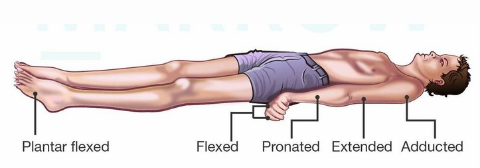
Answer: reticulospinal
Flashcard 2: Clonus is due to sustained hyperactivity of _____ motor neurons.
Answer: alpha and gamma
Flashcard 3: _____ are sudden, jerky eye movements that occur as the gaze shifts from one object to another, performed to bring image of an object quickly on the fovea.
Answer: Saccades
Flashcard 4: _____ is the main inhibitory neurotransmitter of the CNS
Answer: GABA
Flashcard 5: _____ motoneuron lesions may cause increased tone
Answer: Upper
Flashcard 6: In _____ rigidity, the brainstem and rubrospinal pathways are unregulated due to loss of effect of corticospinal tract
Answer: decorticate
Flashcard 7: The _____ and substantia nigra pars compacta are responsible for the synthesis of dopamine
Answer: ventral tegmentum
Flashcard 8: GABA-_____ receptors appear to mediate presynaptic inhibition via a G-protein that produces an increase in K+ conductance.
Answer: B
Flashcard 9: The _____ is responsible for the synthesis of acetylcholine
Answer: basal nucleus of Meynert
Flashcard 10: _____ bladder is seen above S2 level of injury
Answer: Automatic
Flashcard 11: Semantic declarative memory involves _____ cortex and temporal cortex
Answer: prefrontal
Flashcard 12: _____ rigidity is caused due to complete transection at brainstem between superior and inferior colliculus
Answer: Decerebrate
Flashcard 13: Withdrawl reflex:In the _____ reflex, the contraction occurs 0.2-0.5 seconds after flexor reflex in the other limb and the after-discharge is prolonged.
Answer: crossed extensor
Flashcard 14: In both the direct and indirect basal ganglia pathways, neurons from the cerebral cortex lead to _____ of neurons of the striatum
Answer: excitation
Flashcard 15: Dopamine excites the _____ basal ganglia pathway through D1 receptors
Answer: direct
Flashcard 16: Lesion of the _____ area of the hypothalamus results in hyperphagia
Answer: ventromedial
Flashcard 17: _____ of the globus pallidus internus results in inhibition of the ipsilateral ventral lateral (VL) nucleus of the thalamus (basal ganglia pathway)
Answer: Excitation
Flashcard 18: _____ is a controversial term used to describe behavior such as biting, clawing, hissing, arching the back and "violent alternating limb movements" produced in a decorticate animal
Answer: Sham rage
Flashcard 19: Medial motor pathways:_____ reticular nuclei transmit inhibitory signals to the antigravity/extensor muscles by way of the medullary reticulospinal tract, located in the lateral column of the cord.
Answer: Medullary
Flashcard 20: PO2 _____ cerebral perfusion pressure only when < 50 mmHg
Answer: increases
Flashcard 21: The _____ tract carries information for pain and temperature from the body and limbs
Answer: lateral spinothalamic
Flashcard 22: Layers of the cerebellum:The only output from the cerebellar cortex is _____ from the Purkinje cells to the deep cerebellar nuclei.
Answer: inhibitory
Flashcard 23: In the indirect basal ganglia pathway, the neurons of the striatum lead to _____ of neurons of the globus pallidus externus
Answer: inhibition
Flashcard 24: _____ is the main excitatory neurotransmitter of the CNS
Answer: Glutamate
Flashcard 25: _____ is the main inhibitory neurotransmitter of the spinal cord
Answer: Glycine
Flashcard 26: Effects of Various Lesions and Brainstem Transections:Complete transection below medulla with vagi _____ will lead to: cessation of spontaneous respiration
Answer: intact or cut
Flashcard 27: _____ is probably the best known inhibitory neurotransmitter in the brain, especially in the forebrain regions.
Answer: GABA (gamma-amino-butyric acid)
Flashcard 28: What is the function of Dorsomedial thalamic nuclei?_____
Answer: integration
Flashcard 29: The _____ reflex tests nerve roots L3 and L4 (femoral nerve)
Answer: patella
Flashcard 30: Neurotransmitter receptors that act through _____ are called ionotropic receptors.
Answer: ion channels
Flashcard 31: In the direct basal ganglia pathway, the neurons of the striatum lead to _____ of neurons of the globus pallidus internus
Answer: inhibition
Flashcard 32: _____ motoneuron lesions may cause hyper-reflexia
Answer: Upper
Flashcard 33: _____ reflex is a type of polysynaptic reflex.
Answer: Withdrawl
Flashcard 34: The _____ area of the hypothalamus is responsible for hunger
Answer: lateral
Flashcard 35: Episodic Declarative memory involves the _____ and hippocampus for retention.
Answer: medial temporal lobe
Flashcard 36: Dopamine inhibits the _____ basal ganglia pathway through D2 receptors
Answer: indirect
Flashcard 37: Long-term _____ is classically seen in the cerebellum
Answer: depression
Flashcard 38: Sympathetic neurons have _____ pre-ganglionic and long post-ganglionic neurons
Answer: short
Flashcard 39: What is the function of Anterior thalamic nuclei?_____
Answer: alertness and attention
Flashcard 40: _____ binding to the NMDA receptor is essential for the receptor to respond to glutamate
Answer: Glycine
Flashcard 41: In accomodation reflex pathway, the fibres from the parastriate cortex, relay to the _____ nucleus of both sides via the occipitomesencephalic tract and the pontine centres
Answer: Edinger-Westphal
Flashcard 42: If venous pressure exceeds CSF pressure, arachnoid villi _____ the tubules to prevent the entry of blood into the subarachnoid space.
Answer: close
Flashcard 43: Activation of the _____ adrenergic receptor causes contraction of the pupillary dilator muscle, causing mydriasis
Answer: 1
Flashcard 44: The anterior spinothalamic tract carries information for _____ and pressure
Answer: crude (non-discriminative) touch
Flashcard 45: Transcutaneous electrical nerve stimulation acts by inhibition at the _____synaptic level in the dorsal horn
Answer: pre
Flashcard 46: Medial motor pathways:_____ reticular nuclei transmit excitatory signals to the axial muscles of the vertebral column and extensor muscles of limbs by way of the pontine reticulospinal tract, located in the anterior column of the cord.
Answer: Pontine
Flashcard 47: Bilateral lesions of the _____ result in anterograde amnesia, which is the inability to create new memories
Answer: hippocampus
Flashcard 48: One control center for horizontal gaze is located in the _____, which is responsible for ipsi-lateral gaze
Answer: paramedian pontine reticular formation (PPRF)
Flashcard 49: In decorticate rigidity, the lower limbs show _____ due to loss of inhibition by corticoreticular fibres on inhibitory RF of medulla
Answer: extension
Flashcard 50: _____ neurons within the striatum stimulate the indirect basal ganglia pathway
Answer: Cholinergic
Flashcard 51: The _____nergic neurons in pontine reticular formation, on stimulation, induce sleep.
Answer: choli
Flashcard 52: _____ fibres from the pontine nuclei use aspartate as their neurotransmitter
Answer: Mossy
Flashcard 53: Effects of Various Lesions and Brainstem Transections:Complete transection mid-pons with vagi _____ will lead to: apneusis
Answer: cut
Flashcard 54: One control center for horizontal gaze is located in the _____, which is responsible for contra-lateral gaze
Answer: frontal eye field
Flashcard 55: Long-term _____ is classically seen in the hippocampus
Answer: potentiation
Flashcard 56: In _____ rigidity, the upper and lower limbs show extension due to loss of excitation by corticospinal and rubrospinal fibres on flexor alpha-motor neurons of spinal cord; and corticoreticular fibres on reticular formation of medulla.
Answer: decerebrate
Flashcard 57: _____ describes a change from areflexia --> hyporeflexia --> hyperreflexia in patients with spinal cord injuries
Answer: Spinal Shock
Flashcard 58: _____ bladder results from lesions above the sacral spinal cord levels
Answer: Spastic
Flashcard 59: In _____ rigidity, the brainstem pathways are unregulated due to loss of effect of rubrospinal and corticospinal tract
Answer: decerebrate
Flashcard 60: In the indirect basal ganglia pathway, inhibition of the globus pallidus externus leads to _____ of neurons of the subthalamic nucleus
Answer: excitation
Flashcard 61: The _____nergic neurons in posterior hypothalamus, on stimulation, induce arousal.
Answer: histamine
Flashcard 62: _____ of the dorsomedial nucleus of the hypothalamus results in savage behavior and obesity
Answer: Stimulation
Flashcard 63: Resting membrane potential of a _____ is -70 mV
Answer: neuron
Flashcard 64: The _____ area of the hypothalamus is responsible for satiety
Answer: ventromedial
Flashcard 65: Neurotransmitter receptors that act through _____ are called metabotropic receptors.
Answer: second messenger systems
Flashcard 66: Lesions to the _____ may result in:- deficits in verbal memory (ex. word recognition) if the dominant lobe is affected- deficits in nonverbal memory (ex. musical ability) if the nondominant lobe is affected
Answer: temporal lobe
Flashcard 67: The Cushing reaction is a triad of _____, bradycardia, and respiratory depression due to increased intracranial pressure
Answer: hypertension
Flashcard 68: Lesions that involve the _____ cerebellum produce a number of dysfunctions, mostly involving the ipsi-lateral extremities (distal musculature)
Answer: lateral
Flashcard 69: The _____ tract carries information for pressure, vibration, fine (discriminative) touch, and proprioception
Answer: dorsal column-medial lemniscal
Flashcard 70: Withdrawl reflex:The prolonged after discharge in _____ reflex is due to reverberating circuits among the inter-neuronal cells
Answer: crossed extensor
Flashcard 71: Lesions that involve the _____ cerebellum generally result in bi-lateral motor deficits affecting truncal and proximal musculature
Answer: medial
Flashcard 72: Associative learning is linked to _____ and cerebellum
Answer: amygdala
Flashcard 73: _____ cells inhibit deep nuclei of the cerebellum.
Answer: Purkinje
Flashcard 74: Lesion of the _____ (midbrain) results in reduced levels of arousal and wakefulness (i.e. coma)
Answer: reticular activating system
Flashcard 75: In presynaptic facilitation, the _____ released at the axoaxonal ending increases the intraneuronal cAMP levels
Answer: serotonin
Flashcard 76: In _____ rigidity, if the anterior surface of cerebellum is removed the extensor rigidity is exaggerated
Answer: decerebrate
Flashcard 77: The spinocerebellar tracts carry unconscious _____ input from the ipsi-lateral muscle spindles and GTOs to the cerebellum
Answer: proprioceptive
Flashcard 78: The area postrema (chemoreceptor trigger zone) contains _____ receptors which are activated by substance P
Answer: neurokinin 1 (NK1)
Flashcard 79: Effects of Various Lesions and Brainstem Transections:Complete transection mid-pons with vagi _____ will lead to: Regular continued breating
Answer: intact
Flashcard 80: In the indirect basal ganglia pathway, the neurons of the subthalamic nucleus lead to _____ of neurons of the globus pallidus internus
Answer: excitation
Flashcard 81: The _____ of the reticular formation is responsible for synthesis of serotonin
Answer: raphe nucleus
Flashcard 82: Autonomics _____ acetylcholine receptors are found on autonomic ganglia
Answer: Nicotinic
Flashcard 83: Lesions to CN _____ result in loss of the motor limb of the gag reflex
Answer: X (vagus)
Flashcard 84: Simultaneous lesion in both sympathetic and parasympathetic supply of the eye leads to _____-sized pupil that doesn t react to light.
Answer: mid
Flashcard 85: The _____, also known as the vomiting center (located in the medulla) receives main inputs from: 1. GI tract 2. Vestibular system 3. Area postrema (chemoreceptor trigger zone)
Answer: nucleus tractus solitarius
Flashcard 86: Inhibition of _____ proteins inhibits docking of neurotransmitter vesicles and ultimately neurotransmitter release
Answer: SNARE
Flashcard 87: The _____nergic neurons in anterior hypothalamus and adjacent forebrain regions, on stimulation, induce sleep.
Answer: GABA-
Flashcard 88: The _____ is responsible for synthesis of the neurotransmitter GABA
Answer: nucleus accumbens
Flashcard 89: The neurogenic symptoms of hypoglycemia are caused by _____ activation and are mediated via neurotransmitters from sympathetic postganglionic nerve fibers
Answer: sympathoadrenal
Flashcard 90: Procedural/Skills memory (Nondeclarative) is stored in _____, cerebelllum and motor cortex
Answer: striatum
Flashcard 91: Acting via GABA-_____ receptors, GABA increases Cl conductance.
Answer: A
Flashcard 92: _____ of the globus pallidus internus results in excitation of the ipsilateral ventral lateral (VL) nucleus of the thalamus (basal ganglia pathway)
Answer: Inhibition
Flashcard 93: Injury to the brainstem and spinal cord above _____ vertebral level can be rapidly fatal from disruption of cardiorespiratory regulation centers.
Answer: C4
Flashcard 94: Layers of the cerebellum:Stellate, basket, Golgi and Purkinje cells release _____ at their endings.
Answer: GABA (neurotransmitter)
Flashcard 95: Priming and perceptual nondeclarative memory is stored in the _____
Answer: neocortex
Flashcard 96: Neurotransmitter involved in paleo-spinothalamic pain pathway is _____
Answer: substance P
Flashcard 97: The third order neurons of the _____-spinothalamic pathway project to frontal lobe, limbic cortex and insula
Answer: paleo
Flashcard 98: What is the principle of transcranial magnetic stimulation?_____
Answer: Neuronal stimulation by eddy currents
Flashcard 99: The _____-spinothalamic pathway is involved in perception of the affect component of pain
Answer: paleo
Flashcard 100: _____ bladder is controlled by controlled by reflex center of bladder
Answer: Automatic
Flashcard 101: _____ receptors are involved in long-term potentiation.
Answer: NMDA
Flashcard 102: Impulses are transmitted into the bulboreticular area from what 3 areas of the brain?_____
Answer: Cerebellum, Basal ganglia, and Cerebral cortex
Flashcard 103: Optokinetic nystagmus is a _____ nystagmus.
Answer: physiological
Flashcard 104: _____ is the opposite of long-term potentiation, produced by slower stimulation of presynaptic neuron and is one of the mechanisms involved in synaptic plasticity and learning
Answer: Long-term Depression
Flashcard 105: Which descending motor tracts are concerned with rapid skilled movements?_____
Answer: Lateral corticospinal and rubrospinal tracts (2)
Flashcard 106: The command for skilled voluntary movement originates in _____ areas
Answer: cortical association
Flashcard 107: NREM sleep is produced by synchronized synaptic potentials in cortical neurons generated by the rhythmic firing of _____ relay neurons that project to the cortex
Answer: thalamic
Flashcard 108: The axon reflex _____ after total sympathectomy
Answer: persists
Flashcard 109: Layers of the cerebellum:Granule cells release _____ at their endings
Answer: glutamate (neurotransmitter)
Flashcard 110: Neuromodulators typically have actions that are _____ than neurotransmitters.
Answer: slower (faster/slower)
Flashcard 111: The _____ hemisphere is concerned with logical, analytical, sequential thinking, and verbal tasks, such as math, language forms, and philosophy
Answer: categorical
Flashcard 112: What is the function of the neocerebellum?_____
Answer: Planning and programming movements
Flashcard 113: What parts of the brain are particularly sensitive to cyanide toxicity?_____
Answer: Basal ganglia
Flashcard 114: _____ is the opposite of habituation and is one of the mechanisms involved in synaptic plasticity and learning
Answer: Sensitization
Flashcard 115: Most of the synapses used for signal transmission in the central nervous system are _____ synapses.
Answer: chemical
Flashcard 116: Wave III of BERA is produced by the _____
Answer: cochlear nucleus
Flashcard 117: Stretch reflex:Muscle stretch reflex is a _____-synaptic reflex
Answer: mono
Flashcard 118: What is the function of VPM thalamic nuclei?_____
Answer: relays sensations
Flashcard 119: What part of the brain is responsible for the involuntary control of facial muscles in emotional states?_____
Answer: Thalamus
Flashcard 120: Genesis of emotion is by the _____
Answer: limbic system
Flashcard 121: Saccadic movements of the eye are initiated by the _____ lobe
Answer: contralateral frontal
Flashcard 122: What is the major neurotransmitter of the CNS?_____
Answer: Glutamate
Flashcard 123: Vertex waves and mixed frequency waves on EEG are seen in which stage of sleep?_____
Answer: NREM 1
Flashcard 124: Which nucleus of the midbrain influences the spinal motor activity?_____
Answer: Red nucleus
Flashcard 125: Hemiballismus occurs due to involvement of _____
Answer: subthalamic nucleus
Flashcard 126: The interval time between application of a stimulus and the response in a reflex is known as _____
Answer: reaction time
Flashcard 127: Excitatory Postsynaptic Potential (EPSP) is due to the influx of _____ ions
Answer: sodium
Flashcard 128: What 3 pathways provide input to the flocculonodular lobe?_____ from the neck
Answer: Vestibular, visual and somatosensory
Flashcard 129: Renshaw cell inhibition is an example of _____ inhibition.
Answer: feedback
Flashcard 130: Will spinal reflexes be present in brain death?_____
Answer: yes
Flashcard 131: _____ tracts transmit proprioceptive & exteroceptive impulses from muscle spindles, Golgi tendon organ & joint receptors of lower limbs
Answer: Ventral spinocerebellar
Flashcard 132: Major relay of the second order neuron of the _____-spinothalamic pain pathway is reticular nuclei, tectum, periaqueductal region
Answer: paleo
Flashcard 133: Removal of _____ abolishes the sham rage.
Answer: hypothalamus
Flashcard 134: _____ are chemicals released by neurons that have little or no direct effects on their own but can modify the effects of neurotransmitters.
Answer: Neuromodulators
Flashcard 135: Which cerebellar nuclei are responsible for pursuit initiation?_____
Answer: Fastigial nuclei
Flashcard 136: Anterior nucleus of thalamus, which is a component of Papez circuit, which is important for _____ memory.
Answer: short term
Flashcard 137: Basal Ganglia:The _____ circuit plays a major role in cognitive control of motor activity.
Answer: caudate
Flashcard 138: Presynaptic facilitation is due to prolonged opening of _____ channels.
Answer: Ca2+
Flashcard 139: The reticular activating system recieves collaterals from the _____ pathways
Answer: sensory
Flashcard 140: Which type of neurotransmitters have shorter duration of action and short latency?_____
Answer: Nonpeptide
Flashcard 141: Wave VII of BERA is produced by the _____
Answer: medial geniculate body
Flashcard 142: Neural stimulus repeated many times until the subject becomes habituated to the stimulus and ignores it, is known as _____, and is one of the mechanisms involved in synaptic plasticity and learning
Answer: habituation
Flashcard 143: Which cerebellar nuclei are responsible for generation of vertical saccades?_____
Answer: Emboliform and Globose nuclei
Flashcard 144: _____ are sudden, jerky eye movements that occur as the gaze shifts from one object to another, performed to bring image of an object quickly on the fovea.
Answer: Saccades
Flashcard 145: In an automatic bladder, emptying is _____voluntary
Answer: in
Flashcard 146: The lack of _____ signaling promotes the neural fate of the neuroectoderm cells.
Answer: Wnt
Flashcard 147: The process of _____ underlies the ability to discriminate two points applied simultaneously on the skin
Answer: lateral inhibition
Flashcard 148: Patients of MSA-C may show _____ symptoms due to loss of catecholaminergic nuclei of the medulla
Answer: autonomic
Flashcard 149: Slow tracking (pursuit) movements of the eye are initiated by the _____ lobe
Answer: ipsilateral parieto-occipital
Flashcard 150: In feed_____ inhibition, a presynaptic cell excites an inhibitory interneuron which then inhibits the next follower cell.
Answer: forward
Flashcard 151: Neuropeptide Y _____ appetite
Answer: stimulates
Flashcard 152: The _____ cerebral hemisphere is concerned with nonlanguage skills, especially spatial perception and artistic and musical talents.
Answer: representational
Flashcard 153: Chemical synapses are usually _____directional
Answer: uni
Flashcard 154: Inhibitory Postsynaptic Potential (IPSP) is due to the influx of _____ ions
Answer: chloride
Flashcard 155: Non-associative learning is associated with _____
Answer: reflex pathways
Flashcard 156: The predominant neurotransmitter in the pars reticulata of the substantia nigra is _____
Answer: GABA
Flashcard 157: How is the action of nonpeptidehormones terminated?_____
Answer: reuptake by presynaptic neurons
Flashcard 158: _____ theory is based on the inhibition of pain pathway, by local lateral inhibition of interneurons in the spinal cord
Answer: Gate control
Flashcard 159: The gain of the vestibulo-ocular reflex (VOR) is _____
Answer: 1
Flashcard 160: The time taken for the reflex activity to traverse the spinal cord is known as _____
Answer: central delay
Flashcard 161: Neurotransmitter involved in neo-spinothalamic pain pathway is _____
Answer: glutamate
Flashcard 162: Rapidly developing persistent enhancement of the post-synaptic potential response to presynaptic stimulation, after rapidly repeated stimulation of presynaptic neuron, is known as _____, and is one of the mechanisms involved in synaptic plasticity and learning
Answer: long-term potentiation
Flashcard 163: _____ used for pain relief is based on the gate control theory of pain
Answer: Transcutaneous electrical nerve stimulation (TENS)
Flashcard 164: _____ cells may show either depolarization or hyperpolarizationn
Answer: Bipolar
Flashcard 165: Athetosis occurs due to involvement of _____
Answer: globus pallidus
Flashcard 166: Which GABA receptor is ionotropic?_____
Answer: GABA A
Flashcard 167: Blobs in the primary visual cortex are rich in the enzyme _____.
Answer: cytochrome oxidase
Flashcard 168: Production of EPSPs, occurs after a brief tetanizing train of stimuli in the presynaptic neuron, is known as _____, and is one of the mechanisms involved in synaptic plasticity and learning
Answer: Post-tetanic Potentiation
Flashcard 169: What is the function of intralaminar thalamic nuclei?_____
Answer: influence level of conciousness and alertness
Flashcard 170: There is no synaptic delay in _____ synapse
Answer: electrical (chemical/electrical)
Flashcard 171: Which cerebellar lobe is responsible for the smoothening of movements?_____
Answer: Spinocerebellum
Flashcard 172: The reticular activating system is a _____synaptic pathway
Answer: poly
Flashcard 173: What part of the thalamus is involved in processing neurotransmission from the neo-spinothalamic pathway?_____
Answer: Ventrobasal complex
Flashcard 174: Which nerve modifies the electrical activity of the olfactory bulb?_____
Answer: Vagus nerve
Flashcard 175: Waves VI and VII in brainstem evoked response audiometry (BERA) are produced by the _____
Answer: inferior colliculus.
Flashcard 176: _____ is released by the neurons in the nucleus raphe magnus, which is part of the analgesia pathway
Answer: Serotonin
Flashcard 177: Proprioception is carried by _____ fiber.
Answer: A�::Erlanger-Gasser
Flashcard 178: Concentration of _____ ions predominantly affect the RMP in a neuron
Answer: potassium (K+)
Keywords: Neurophysiology flashcards, medical flashcards, NEET PG preparation, USMLE Step 1 flashcards, Anki alternative, spaced repetition medical, OnCourse flashcards