Vascular Pathology Indian Medical PG Flashcards - Medical Study Cards
Master Vascular Pathology with OnCourse flashcards. These spaced repetition flashcards are designed for medical students preparing for NEET PG, USMLE Step 1, USMLE Step 2, MBBS exams, and other medical licensing examinations.
Vascular Pathology Flashcard Deck - 73 Cards
Flashcard 1: What type of arteriolosclerosis is demonstrated in the image below?
_____
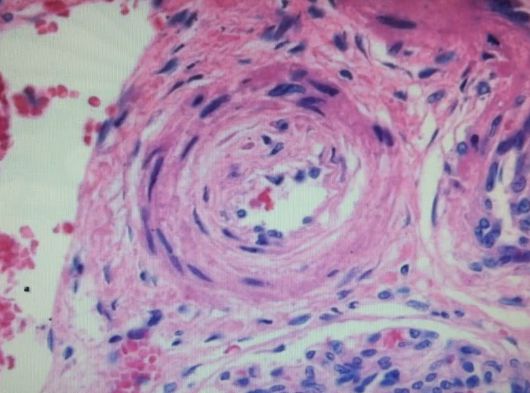
Answer: Hyperplastic arteriolosclerosis
Flashcard 2: What type of arteriolosclerosis is demonstrated in the image below?
_____
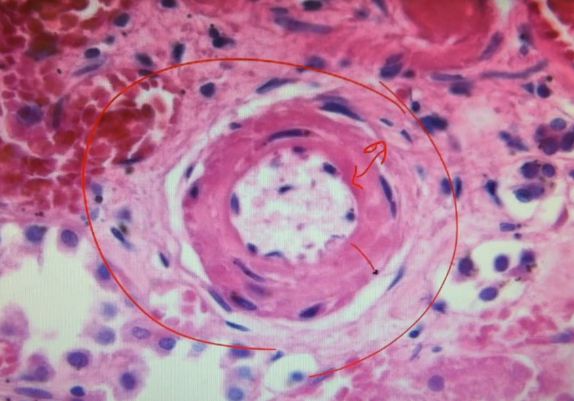
Answer: Hyaline arteriolosclerosis
Flashcard 3: The image shows yellow spots on the inner surface of the aorta, which represent _____
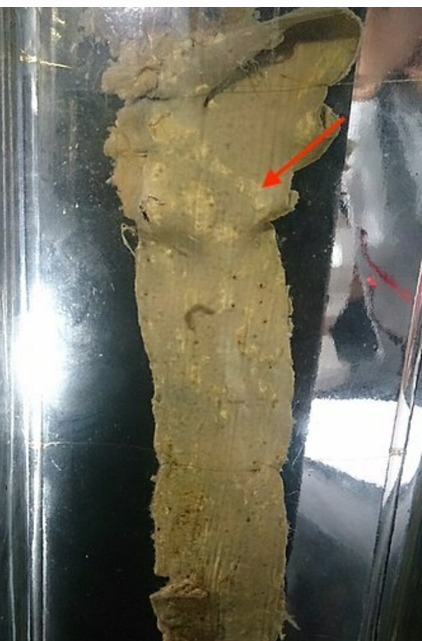
Answer: fatty streaks
Flashcard 4: The given biopsy specimen of radial artery is suggestive of _____ sclerosis.
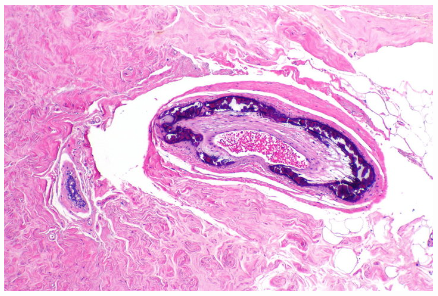
Answer: Monckeberg's
Flashcard 5: The _____ type (Type IV) of Ehlers-Danlos Syndrome that is caused by a deficiency of type III collagen can lead to:- the formation and rupture of aneurysms - rupture of organs (ex. in women the uterus during birth)
Answer: vascular
Flashcard 6: _____ syndrome leads to aneurysm formation due to defective elastin.
Answer: LoeysDietz
Flashcard 7: Buerger disease (thromboangiitis obliterans) is a form of segmenting _____-vessel vasculitis that extends into contiguous veins and nerves
Answer: medium
Flashcard 8: One source of von Willebrand factor (vWF) is from the _____ of endothelial cells
Answer: Weibel-Palade bodies
Flashcard 9: _____ transplant rejection is dominated by arteriosclerosis
Answer: Chronic
Flashcard 10: _____ is a vasculitis that occurs secondary to IgA immune complex deposition
Answer: Henoch-Schonlein purpura
Flashcard 11: _____ arteritis is a granulomatous thickening and narrowing of the aortic arch and proximal great vessels
Answer: Takayasu
Flashcard 12: Vasculitides often present with symptoms of organ ischemia due to _____ of inflamed vessels or luminal narrowing from fibrosis
Answer: thrombosis
Flashcard 13: The intimal plaque that causes atherosclerosis consists of a necrotic lipid core (mostly _____) with a fibromuscular cap
Answer: cholesterol
Flashcard 14: Patients with cryoglobulinemic vasculitis have deposition of immune complexes in the _____, peripheral nervous system, and the kidney
Answer: skin
Flashcard 15: _____ syphilis destroys the vasa vasorum, or blood vessels that supply the vessel wall of the aorta
Answer: Tertiary
Flashcard 16: _____ disseminates upon reaching the blood vessels, resulting in kidney failure
Answer: Angioinvasive aspergillosis
Flashcard 17: A pre-mortem thrombi is distinguishable from a post-mortem thrombi by the presence of _____ and attachment to a vessel wall
Answer: lines of Zahn
Flashcard 18: Diffuse cortical necrosis is likely due to a combination of _____ and DIC
Answer: vasospasm
Flashcard 19: _____ is an uncommon form of arteriolosclerosis that involves calcification of the media of the blood vessel wall
Answer: Monckeberg sclerosis
Flashcard 20: HLA-_____ and HLA-B5 associated with a high risk of Buerger disease
Answer: A9
Flashcard 21: The two underlying pathological processes that are associated with abdominal aortic aneurysm are _____ and atherosclerosis
Answer: chronic transmural inflammation
Flashcard 22: Lipids in the intima of an artery are _____ and then consumed by macrophages via scavenger receptor A receptors
Answer: oxidized
Flashcard 23: Biospy of a patient with giant cell (temporal) arteritis reveals an inflamed vessel with _____ cells and focal granulomatous inflammation
Answer: giant
Flashcard 24: Thoracic aortic aneurysm is classically seen in patients with _____ due to endarteritis of the vasa vasorum
Answer: tertiary syphilis
Flashcard 25: _____ aneurysm involves the pulmonary artery.
Answer: Rasmussen's
Flashcard 26: _____ arteritis is a granulomatous vasculitis that classically involves branches of the carotid artery
Answer: Giant cell (temporal)
Flashcard 27: _____ of medium and large-sized vessels leads to atherosclerosis in diabetic patients
Answer: Non-enzymatic glycosylation
Flashcard 28: _____ tears affect only the intima and inner media (layers) of the aorta and are seen in deceleration trauma.
Answer: Ladder-rung
Flashcard 29: In response to fatty streaks in the intima, there is _____ cell migration/proliferation and extracellular matrix deposition
Answer: smooth muscle
Flashcard 30: Myxomatous degeneration in the tunica media is found in _____, which predisposes to the development of aortic dissections / aortic aneurysms
Answer: cystic medial degeneration
Flashcard 31: _____ and turbulence of blood flow increases risk for thrombosis
Answer: Stasis
Flashcard 32: Plaque rupture from atherosclerosis may result in atherosclerotic _____, which are characterized by cholesterol clefts
Answer: emboli
Flashcard 33: _____ antibodies are associated with Kawasaki's disease
Answer: Anti-endothelial cell
Flashcard 34: What four arteries are most commonly affected by atherosclerosis? _____ > coronary > popliteal > carotid artery
Answer: Lower abdominal aorta
Flashcard 35: _____ embolus is characterized by the presence of cholesterol clefts in the embolus
Answer: Atherosclerotic
Flashcard 36: Thrombosis is characterized by _____, which are alternating layers of platelets/fibrin and RBCs
Answer: lines of Zahn
Flashcard 37: Microscopic polyangiitis is a necrotizing vasculitis that commonly involves the _____, kidneys, and skin
Answer: lungs
Flashcard 38: Fibrinoid necrosis is characteristic of _____ hypertension, vasculitis (e.g. PAN), and preeclampsia
Answer: malignant
Flashcard 39: Causes of late graft failure include _____, atherosclerotic plaque, and aneurysm
Answer: neointimal hyperplasia
Flashcard 40: Hemangiomas most often involve the _____ and liver
Answer: skin
Flashcard 41: _____ aortic aneurysm is associated with cystic medial degeneration (e.g. Marfan syndrome)
Answer: Thoracic
Flashcard 42: _____ is a form of necrotizing, granulomatous vasculitis that classically involves the nasopharynx, lungs, and kidneys
Answer: Granulomatosis with polyangiitis (Wegener)
Flashcard 43: Hereditary Hemorrhagic Telangectasia is caused by disorder of _____ signaling
Answer: TGF-
Flashcard 44: White thrombi are usually seen with a _____ thrombus
Answer: arterial
Flashcard 45: Central penicilliary arteries in the spleen may show concentric intimal and smooth muscle cell hyperplasia in SLE, producing _____ lesions.
Answer: onion-skin
Flashcard 46: Behcet's disease will show a _____ predominant infiltrate in perivascular distribution in small and medium size vessels
Answer: neutrophil
Flashcard 47: Mondor's disease maybe associated with protein _____ deficiency
Answer: C
Flashcard 48: _____ is also known as leukocytoclastic vasculitis
Answer: Microscopic polyangiitis
Flashcard 49: What is the staining done in epitheloid hemangioendothelioma?_____
Answer: Factor VIII
Flashcard 50: _____ is the only vasculitis that can cause hematuria without casts (no glomerulonephritis) due to rupture of microaneurysms
Answer: Polyarteritis nodosa
Flashcard 51: _____ is a vascular tumor derived from supporting cells of the blood vessels
Answer: Hemangiopericytoma
Flashcard 52: Most common vessel involed in Polyarteritis nodosa is _____ artery
Answer: Renal
Flashcard 53: T cells and macrophages are more numerous in which part of an atheromatous plaque?_____
Answer: Shoulder
Flashcard 54: _____ aneurysms are spherical outpouchings involving only a portion of the vessel wall.
Answer: Saccular
Flashcard 55: Chronic Buerger's disease(Thromboangiitis obliterans) may result in _____ of the vessels in majority of the cases.
Answer: recanalisation
Flashcard 56: The endothelial origin of vascular neoplasms can be confirmed using endothelial cell-specific markers such as CD_____ or von Willebrand factor
Answer: 31
Flashcard 57: Incomplete lumen occlusion is usually seen with an _____ thrombus
Answer: arterial
Flashcard 58: What part of the atheromatous plaque shows neovascularization/proliferation of small blood vessels?_____
Answer: Periphery
Flashcard 59: Which vasculitis will show adventitial mononuclear infiltrates with perivascular cuffing of the vasa vasorum?_____
Answer: Takayasu arteritis
Flashcard 60: Red thrombi are usually seen with a _____ thrombus
Answer: venous
Flashcard 61: What is the immune mechanism behind Giant cell arteritis?_____
Answer: T-cell mediated
Flashcard 62: The given biopsy specimen of radial artery is suggestive of _____ sclerosis.
Answer: Monckeberg's
Flashcard 63: _____ aneurysms are diffuse, circumferential dilations involving long vascular segments
Answer: Fusiform
Flashcard 64: Pulmonary capillaritis is a characteristic feature of _____
Answer: microscopic polyangiitis (vasculitis)
Flashcard 65: Which vasculitis will show fragmented neutrophils undergoing apoptosis?_____
Answer: Leukocytoclastic vasculitis
Flashcard 66: Microscopy in Buerger disease shows luminal _____ containing small microabscesses composed of neutrophils
Answer: thrombosis
Flashcard 67: Enlargement of hemangiomas is by _____ rather than neoplasia.
Answer: ectasia
Flashcard 68: What is the most common pathology at the CCA bifurcation?_____
Answer: Atheromas
Flashcard 69: Non-granulomatous inflammation with segmental fibrinoid necrosis is seen in _____.
Answer: Microscopic polyangiitis::Vasculitis
Flashcard 70: Wegener's granulomatosis is a _____ vessel vasculitis.
Answer: small::Size
Flashcard 71: Churg-Strauss syndrome (eosinophilic granulomatosis with polyangiitis) is a _____ vessel vasculitis.
Answer: small::Size
Flashcard 72: Polyarteritis nodosa (PAN) is necrotizing arteritis of the _____-sized blood vessels.
Answer: medium and small::Size
Flashcard 73: Polyarteritis nodosa (PAN) is necrotizing arteritis of the _____-sized blood vessels.
Answer: medium and small::Size
Keywords: Vascular Pathology flashcards, medical flashcards, NEET PG preparation, USMLE Step 1 flashcards, Anki alternative, spaced repetition medical, OnCourse flashcards