Oculoplasty Indian Medical PG Flashcards - Medical Study Cards
Master Oculoplasty with OnCourse flashcards. These spaced repetition flashcards are designed for medical students preparing for NEET PG, USMLE Step 1, USMLE Step 2, MBBS exams, and other medical licensing examinations.
Oculoplasty Flashcard Deck - 69 Cards
Flashcard 1: Blepharophimosis, ptosis, and epicanthus inversus syndrome (BPES) consists of:
Narrow _____
_____
Congenital _____tropion of the lower lid
_____canthus
_____canthus inversus

Answer: palpebral fissure
Flashcard 2: The given image shows Bowman's lacrimal _____.
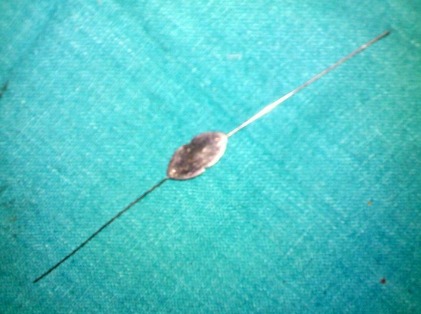
Answer: probe
Flashcard 3: _____ or stye is the staphylococcal infection of hair follicle/Zeis gland/Moll gland.
Answer: Hordeolum externum
Flashcard 4: _____ Jones Dye test differentiates epiphora (overflow of tears) due to a functional obstruction (lacrimal pump failure) or a physical obstruction (absolute/partial obstruction).
Answer: Secondary
Flashcard 5: Epiblepharon is usually _____lateral and affects nasal one-third of the lower lid
Answer: bi
Flashcard 6: The _____ is a chronic non-suppurative lipogranulomatous inflammation of the Meibomian gland.
Answer: Chalazion
Flashcard 7: One of the sequelae of chronic dacryocystitis is _____ formation, which when infected, leads to pyocele formation and finally lacrimal fibrosis.
Answer: mucocele
Flashcard 8: _____ is an acute suppurative inflammation of the meibomian gland
Answer: Hordeolum internum
Flashcard 9: _____ means an increased distance between medial canthi (widened root of the nose) with normal inter-pupillary distance.
Answer: Telecanthus
Flashcard 10: Blepharophimosis, ptosis, and epicanthus inversus syndrome (BPES) consists of:Narrow _____PtosisCongenital ectropion of the lower lidTelecanthusEpicanthus inversus
Answer: palpebral fissure
Flashcard 11: _____ procedure is the treatment of choice for ptosis with poor levator elevation.
Answer: Frontalis sling
Flashcard 12: _____ layer is secreted by the Meibomian, Zeis glands
Answer: Lipid
Flashcard 13: Entropion occurs due to Horizontal lid _____, Vertical lid instability, Over-riding of the pretarsal by the preseptal orbicularis during lid closure and Orbital septum laxity
Answer: laxity
Flashcard 14: Management of districhiasis is by _____ with cryotherapy to the base of the hair follicles.
Answer: lid splitting
Flashcard 15: Treacher Collins syndrome presents with ocular features such as indistinct inferior orbital margin, Coloboma of the _____ and Anti-mongoloid slant
Answer: lower eyelid
Flashcard 16: _____ operation is transverse lid split and everting sutures, done for entropion
Answer: Weiss
Flashcard 17: _____ Jones Dye test differentiates epiphora (overflow of tears) due to obstruction of the lacrimal passages or due to the primary hypersecretion of tears.
Answer: Primary
Flashcard 18: Blepharitis is a _____ inflammation of the lid margins
Answer: chronic
Flashcard 19: Sebaceous cell CA most commonly involves the _____ lid
Answer: upper
Flashcard 20: Treatment of lacrimal sac fibrosis is _____.
Answer: dacryocystectomy
Flashcard 21: Ptosis is drooping of the upper lid to a level that that covers more than _____mm of the superior cornea.
Answer: 2
Flashcard 22: Posterior blepharitis is also known as _____
Answer: mebomianitis
Flashcard 23: _____ refers to the inward rolling and rotation of the lid margin towards the globe.
Answer: Entropion
Flashcard 24: Chalazion is a _____ swelling
Answer: painless (painful/painless)
Flashcard 25: Anterior blepharitis is most commonly caused by _____
Answer: staphylococcus
Flashcard 26: Extra row of eye lashes in distichiasis is due to metaplasia of _____ gland into hair follicle
Answer: meibomian
Flashcard 27: Loss of _____ is seen in chronic blepharitis
Answer: eyelashes (eyelashes/eyebrows)
Flashcard 28: The most common etiological agent for acute and chronic dacryocystitis is _____.
Answer: Staphylococcus aureus
Flashcard 29: _____ ptosis develops due to defects of the levator aponeurosis.
Answer: Aponeurotic
Flashcard 30: Squamous cell CA most commonly involves the _____ lid
Answer: lower
Flashcard 31: _____: Overhanging skin on the upper lids may be mistaken for ptosis
Answer: Dermatochalasis
Flashcard 32: The most common primary malignant tumor of the lid is _____ cell carcinoma.
Answer: basal
Flashcard 33: Intralesional injection of _____ can be used for the rx of Chalazion
Answer: triamcinolone acetate
Flashcard 34: _____ carcinoma constitutes 85 90% of all malignant epithelial eyelid tumors.
Answer: Basal cell
Flashcard 35: Paralytic ectropion is caused by ipsilateral _____ palsy
Answer: facial nerve
Flashcard 36: In _____, a horizontal fold of redundant pretarsal skin and orbicularis muscle extends beyond the eyelid margin and compresses the eyelashes against the globe.
Answer: epiblepharon
Flashcard 37: Phthiriasis palpebrarum is caused by _____
Answer: crab louse
Flashcard 38: Epiblepharon may be associated with congenital _____
Answer: epicanthus
Flashcard 39: Normal value of margin reflex distance for measurement of ptosis is _____ mm.
Answer: 4 5
Flashcard 40: Treatment of lacrimal fistula is _____
Answer: dacryocystorhinostomy (DCR).
Flashcard 41: Blepharitis acarica is caused by _____.
Answer: Demodex folliculorum
Flashcard 42: Sequelae of acute dacryocystitis is a _____
Answer: lacrimal fistula
Flashcard 43: Basal cell CA most commonly involves the _____ lid
Answer: lower
Flashcard 44: _____ is the most common type of ptosis.
Answer: Idiopathic ptosis
Flashcard 45: _____ is the distance between the upper and lower lid margins, measured in the pupillary plane
Answer: Palpebral fissure height
Flashcard 46: Treatment of choice for chalazion is _____
Answer: incision and curettage
Flashcard 47: A patient with ptosis presenting with retraction of the ptotic eyelid on chewing, is diagnosed with _____ phenomenon
Answer: Marcus Gunn jaw-winking
Flashcard 48: Orbital spread of the malignant melanoma necessitates _____
Answer: exenteration
Flashcard 49: Surgical techniques, for treatment of dry eye include punctal occlusion using _____
Answer: silicone plugs
Flashcard 50: Levator function is usually _____ in aponeurotic ptosis
Answer: good (good/poor)
Flashcard 51: Adhesion between the margins of the upper and lower eyelids is called _____.
Answer: ankyloblepharon
Flashcard 52: _____ distance is the distance between the upper lid margin and the corneal reflection of a pen torch held by the examiner on which the patient fixates.
Answer: Margin reflex
Flashcard 53: Upper lid crease is _____ in aponeurotic ptosis
Answer: present
Flashcard 54: In _____ the extent of the palpebral fissure is decreased. (contracted at the outer canthus)
Answer: Blepharophimosis
Flashcard 55: _____ is an inward misdirection of cilia, with the normal position of the lid margin.
Answer: Trichiasis
Flashcard 56: Aponeurotic ptosis is usually seen in the _____
Answer: elderly
Flashcard 57: The second most common primary malignant tumor of the lid is _____ cell carcinoma.
Answer: squamous
Flashcard 58: _____ is the thickening of the tarsal plate
Answer: Tylosis
Flashcard 59: For patients for any cause of acquired ptosis other than Horner's syndrome with moderate ptosis (2 - 4mm), the preferred surgery is _____
Answer: levator resection
Flashcard 60: Entropion most commonly occurs in the _____ lid
Answer: lower
Flashcard 61: Temporary _____ is done for exposure keratitis due to bell's palsy
Answer: tarsorrhaphy
Flashcard 62: _____ procedure is the treatment of choice for Horner's syndrome (
Answer: Fasanella Servat
Flashcard 63: _____ is characterized by the inability to close the eyelids voluntarily.
Answer: Lagophthalmos
Flashcard 64: _____ recession surgery may be done to correct Dalrymple's sign in Graves ophthalmopathy
Answer: Levator palpebrae superioris (LPS)
Flashcard 65: Levator function is considered poor when the upper lid excursion is _____mm or less on Burke's test in Myasthenia
Answer: 4
Flashcard 66: Medial conjunctivoplasty is done in involutional _____.
Answer: ectropion
Flashcard 67: More than 90% of patients with congenital nasolacrimal obstruction undergo spontaneous resolution by _____ year(s) of age.
Answer: 1
Flashcard 68: During incision and curettage for Chalazion, a _____ incision is given for scooping
Answer: vertical
Flashcard 69: Pressure over the lacrimal sac causing regurgitation of mucopurulent discharge from the lower punctum is seen in _____ dacryocystitis
Answer: Chronic
Keywords: Oculoplasty flashcards, medical flashcards, NEET PG preparation, USMLE Step 1 flashcards, Anki alternative, spaced repetition medical, OnCourse flashcards