Neurology Indian Medical PG Flashcards - Medical Study Cards
Master Neurology with OnCourse flashcards. These spaced repetition flashcards are designed for medical students preparing for NEET PG, USMLE Step 1, USMLE Step 2, MBBS exams, and other medical licensing examinations.
Neurology Flashcard Deck - 207 Cards
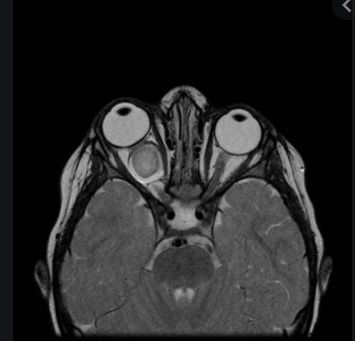
Flashcard 1: Optic nerve glioma (15–40%), a pilocytic astrocytoma, is commonly seen in _____
Answer: neurofibromatosis type 1
Flashcard 2: _____ nerve marked as "D" is involved in Frey's syndrome
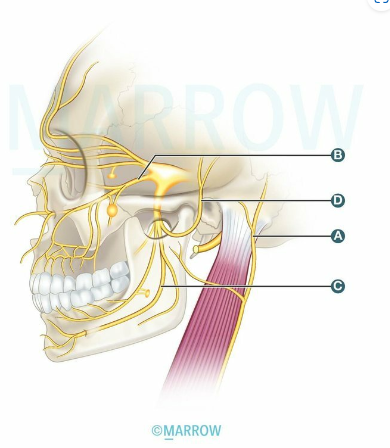
Answer: Auriculotemporal
Flashcard 3: What disease is associated with this spinal cord lesion?
_____
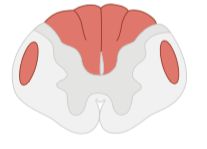
Answer: Subacute combined degeneraton (B12 deficiency)
Flashcard 4: What disease is associated with this spinal cord lesion?
_____
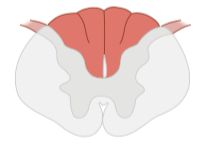
Answer: Tabes dorsalis (tertiary syphilis)
Flashcard 5: _____ is most affected in neurolathyrism
Answer: knee joint
Extra:
Flashcard 6: jerky steps are seen in _____ stage of neurolathyrism
Answer: no stick
Extra:
Flashcard 7: Internuclear ophthalmoplegia results in _____ of the contra-lateral eye
Answer: nystagmus
Flashcard 8: Carpal tunnel syndrome is associated with - _____ (due to edema)- rheumatoid arthritis- hypothyroidism- diabetes mellitus- acromegaly- dialysis-related amyloidosis. It may also be associated with repetitive use
Answer: pregnancy
Flashcard 9: One complication of vitamin _____ deficiency is Wernicke-Korsakoff syndrome
Answer: B1
Flashcard 10: _____ beriberi is characterized by polyneuritis and symmetrical muscle wasting
Answer: Dry
Flashcard 11: Reversible dementia may occur with deficiencies in vitamins _____, B3, and B12
Answer: B1
Flashcard 12: _____ and Breast cancers can produce anti-Yo antibodies which can cause Paraneoplastic Cerebellar Degeneration
Answer: Gynecological
Flashcard 13: In Acoustic neuroma, there is increased _____ latency of wave I-V and increased inter-aural latency of wave V > 0.2ms
Answer: inter-peak
Flashcard 14: Internuclear ophthalmoplegia occurs due to lesion in the _____ of the opposite side of the aBducting eye
Answer: MLF
Flashcard 15: _____ syndrome is characterized by cortical blindness with confabulation
Answer: Anton
Flashcard 16: Tabes dorsalis patients present with the "three P's": _____, pain, and polyuria (incontinence)
Answer: paresthesias
Flashcard 17: The symptoms of _____ may be remembered with the mnemonic 'CTG': C: Cataracts T: Toupee (early balding in men) G: Gonadal atrophy Other symptoms include myotonia, muscle wasting, and arrhythmias
Answer: myotonic dystrophy
Flashcard 18: Myasthenia gravis classically involves the eyes, leading to _____ and diplopia
Answer: ptosis
Flashcard 19: Clinically _____ rigidity is seen in conditions such as uncal herniation
Answer: decerebrate
Flashcard 20: _____ syndrome results from basilar artery stroke
Answer: Millard Gubler
Flashcard 21: Features of Millard Gubler Syndrome: 6th nerve: _____, ipsilateral convergent squint7th nerve: Loss of corneal reflex, ipsilateral paralysis of facial musclesCorticospinal tract: Contralateral hemiplegia of extremities (due to involvement of pyramidal tract).
Answer: Diplopia
Flashcard 22: _____ strokes most commonly involve the lenticulostriate vessels, resulting in small cystic areas of infarction
Answer: Lacunar
Flashcard 23: Internuclear ophthalmoplegia results in inability to _____ the ipsi-lateral eye
Answer: adduct
Flashcard 24: One complication of synkinesis (abnormal nerve regeneration) after facial nerve palsy recovery is Crocodile tear syndrome that occurs during eating, due to a rewiring from the _____ gland to tear glands
Answer: salivary
Flashcard 25: A putamen hemorrhage (ex. rupture of charcot-bouchard microaneurysm on vessels supplying putamen) manifests with:_____ hemiparesis - damage to Internal Capsule / genucontralateral hemisensory loss - damage to thalamusgaze deviation towards side of bleed - damage to frontal eye fields
Answer: contralateral
Flashcard 26: Strokes involving the _____ cerebral artery may cause paralysis and sensory loss of the contra-lateral lower limb
Answer: anterior
Flashcard 27: If a stroke is suspected, _____ is used to exclude hemorrhage before tPA can be given
Answer: noncontrast CT
Flashcard 28: _____ strokes often occur secondary to hyaline arteriolosclerosis, a complication of hypertension, diabetes mellitus, and smoking
Answer: Lacunar
Flashcard 29: _____ hemorrhage is characterized by a yellow (xanthochromic) spinal tap
Answer: Subarachnoid
Flashcard 30: _____ (dementia or delirium) is associated with a normal pattern on EEG
Answer: Dementia
Flashcard 31: Subacute combined degeneration in vitamin B12 deficiency affects the _____, corticospinal tracts, and spinocerebellar tracts
Answer: dorsal columns
Flashcard 32: _____ is a curved bacteria that can precede Guillain-Barre syndrome, characterized by a(n) ascending paralysis
Answer: Campylobacter jejuni
Flashcard 33: _____ syphilis can result in Tabes Dorsalis, or demyelination of the dorsal column and roots
Answer: Tertiary
Flashcard 34: _____, a small-vessel vasculitis, commonly presents with asymmetric multifocal neuropathy, typically manifesting with wrist drop and foot drop
Answer: Eosinophilic granulomatosis with polyangiitis (Churg-Strauss)
Flashcard 35: _____ disease is a degenerative disease of the frontal and temporal cortex
Answer: Pick
Flashcard 36: Cogan's syndrome consists of triad of _____ + deafness + vertigo
Answer: Interstitial keratitis
Flashcard 37: Rapid correction of _____-natremia results in cerebral edema/herniation
Answer: hyper
Flashcard 38: Clawing of the hand is best seen with _____ lesions of the median or ulnar nerves.
Answer: distal
Flashcard 39: _____ lung carcinoma may produce antibodies against presynaptic Ca2+ channels, causing Lambert-Eaton myasthenic syndrome
Answer: Small (oat) cell
Flashcard 40: Wernicke-Korsakoff syndrome is characterized by a triad of _____, ataxia, and confusion
Answer: ophthalmoplegia
Flashcard 41: Pantothenate Kinase Associated Neurodegeneration (PKAN)/Neurodegeneration with brain _____ accumulation (NBIA) is also called as Hallervorden-Spatz disease
Answer: iron
Flashcard 42: _____ is seizure activity for > 5 mins (continuous or intermittent) without fully regaining consciousness between episodes, resulting in brain injury and possibly death
Answer: Status epilepticus
Flashcard 43: Bilateral lesions of the amygdala (and thus _____ syndrome) are associated with HSV-1 encephalitis
Answer: Kluver-Bucy
Flashcard 44: _____ deficiency leads to Segawa syndrome which is also known as Dopamine-responsive dystonia (DRD)
Answer: Tetrahydrobiopterin (BH4)
Flashcard 45: _____ of the nigrostriatal dopamine pathway results in increased extrapyramidal symptoms
Answer: Blockage
Flashcard 46: Internal carotid dissection can present with a tertiary _____, as well as profound neurologic deficits due to infarction of the cerebral hemisphere
Answer: horner syndrome
Flashcard 47: Acute disseminated encephalomyelitis can be seen after infection by _____ / measles, or the rabies / small pox vaccines
Answer: chickenpox
Flashcard 48: Lesions of the _____ cerebellar vermis usually result from medulloblastomas or ependymomas and present with truncal ataxia
Answer: posterior
Flashcard 49: _____ is due to slowly progressing, persistent infection of the brain by measles virus
Answer: Subacute sclerosing panencephalitis (SSPE)
Flashcard 50: _____ seizures are characterized by sudden loss of muscle tone, thus known as 'drop' seizures
Answer: Atonic
Flashcard 51: What movement disorders (2) are associated with Huntington disease? _____ and Athetosis
Answer: Chorea
Flashcard 52: Hemispatial neglect syndrome is caused by lesion to the _____ parietal cortex
Answer: non-dominant
Flashcard 53: _____ motoneuron lesions may cause spastic paralysis
Answer: Upper
Flashcard 54: Vitamin _____ deficiency may result in spastic paresis due to damage to the lateral corticospinal tract of the spinal cord
Answer: B12
Flashcard 55: Takayasu arteritis may present with _____ and neurologic symptoms
Answer: visual
Flashcard 56: CSF analysis in _____ syndrome will reveal albuminocytologic dissociation
Answer: Guillain-Barre
Flashcard 57: _____ is a feature of the lateral medullary syndrome due to the involvement of nucleus ambiguus.
Answer: Dysphagia
Flashcard 58: What opening pressure (lumbar puncture) is associated with viral meningitis? _____ or increased pressure
Answer: Normal
Flashcard 59: _____ syndrome results in symmetric ascending muscle weakness/paralysis (ascending or descending)
Answer: Guillain-Barre
Flashcard 60: Distal tibial nerve lesions present with:- sensory loss over the _____ of the foot- weakness of intrinsic muscles of the foot
Answer: sole
Flashcard 61: _____ breathing is also known as ataxic breathing
Answer: Biot's
Flashcard 62: _____ (TAN) is a demyelinating condition associated with excessive cassava consumption
Answer: Tropical ataxic Neuropathy
Flashcard 63: _____ syndrome also known as 'dementia pugilistica', is a cumulative process and many episodes of minor head injury add up to produce the typical lesions.
Answer: Punch-drunk
Flashcard 64: The hallmark of _____ dysfunction is intention tremor without paralysis or paresis
Answer: cerebellar
Flashcard 65: _____ bladder results from lesions at the level of the sacral spinal cord
Answer: Atonic
Flashcard 66: _____ disease is characterized by periodic sharp wave complexes on EEG
Answer: Creutzfeldt-Jakob
Flashcard 67: The oculocephalic reflex or doll's eye reflex is used to assess the integrity of the cranial nerves III, _____, and VIII.
Answer: VI
Flashcard 68: Mitochondrial myopathies often present with myopathy, _____, and CNS disease
Answer: lactic acidosis
Flashcard 69: Neurofibromatosis type _____ is also known as von Recklinghausen disease
Answer: I
Flashcard 70: Tabes Dorsalis is characterized by loss of _____, with a "high-stepping" gait and foot-slapping
Answer: proprioception
Flashcard 71: Bleeding in a _____ haemorrhage may come from a ruptured aneurysm, cortical arteries or bridging veins.
Answer: subarachnoid
Flashcard 72: _____ lung disease may be caused by poor muscular effort, such as polio, myasthenia gravis and Guillain-Barre syndrome
Answer: Restrictive
Flashcard 73: _____ partial seizures are characterized by impaired consciousness (intact or impaired)
Answer: Complex
Flashcard 74: _____ hydrocephalus often presents with a characteristic magnetic gait
Answer: Normal pressure
Flashcard 75: Lesions of the _____ cerebellar vermis are usually the result of degeneration from alcohol abuse and present with gait ataxia
Answer: anterior
Flashcard 76: _____ seizures are characterized by 3 Hz spike-and-wave discharges on EEG
Answer: Absence
Flashcard 77: _____ syndrome is caused by:- occlusion of the posterior inferior cerebellar artery - most commonly due to traumatic vascular dissection / occlusion of the distal vertebral artery
Answer: Lateral medullary (Wallenberg)
Flashcard 78: As opposed to acute disseminated encephalomyelitis, Guillain Barre develops over the course of _____ to weeks once symptoms begin
Answer: days
Flashcard 79: Therapeutic _____-ventilation may be used to treat acute cerebral edema unresponsive to other interventions
Answer: hyper
Flashcard 80: _____ aneurysms located in the lenticulostriate vessels of the basal ganglia are commonly associated with hypertension
Answer: Charcot-Bouchard
Flashcard 81: Strokes involving the lenticulostriate artery may cause paralysis and sensory loss of the _____-lateral upper limb and face
Answer: contra
Flashcard 82: Brown-Sequard syndrome presents with _____-lateral upper motoneuron signs below the level of the lesion (due to corticospinal tract damage)
Answer: ipsi
Flashcard 83: _____ syndrome seen in excess chronic alcohol consumption is caused by a widespread demyelination of the corpus callosum, optic tracts and cerebellar peduncles.
Answer: Marchiafava-Bignami
Flashcard 84: Paramedian thalamic syndrome is a _____ circulation infarction that occurs due to the involvement of artery of percheron
Answer: posterior
Flashcard 85: Cluster headaches generally last from _____ to 3 hours
Answer: 15 minutes
Flashcard 86: _____ is neurocutaneous disorder associated with bilateral acoustic schwannomas (ear findings)
Answer: Neurofibromatosis II
Flashcard 87: _____ tremors are tremors which disappear on movement and are due to involvement of the substantia nigra and red nucleus
Answer: Resting
Flashcard 88: The wrist will deviate _____ upon flexion in a proximal ulnar nerve lesion.
Answer: radially
Flashcard 89: MERRF is a mitochondrial disorder that presents with _____ seizures and myopathy associated with exercise
Answer: myoclonic
Flashcard 90: Patients with diabetic neuropathy present with a slowly progressive decrease in vibratory sensation, _____, and temperature sensation
Answer: proprioception
Flashcard 91: Strokes involving the middle cerebral artery may cause paralysis and sensory loss of the _____-lateral upper limb and face
Answer: contra
Flashcard 92: Wernicke encephalopathy is characterized by a triad of _____, ophthalmoplegia, and ataxia
Answer: confusion
Flashcard 93: _____ tremors are tremors seen only on activity and occur due to involvement of the cerebellum
Answer: Intentional
Flashcard 94: _____ disease often presents with neuropsychiatric manifestations, due to copper deposition and resultant cystic degeneration in the putamen and other adjacent structures
Answer: Wilson
Flashcard 95: Autonomics _____ is an autoimmune disease due to production of antibodies against post-synaptic nicotinic ACh receptors at motor end plates
Answer: Myasthenia gravis
Flashcard 96: Patients with Refsum disease can present with neurological symptoms; such as issues with _____, additionally patients nearly universally report a profound loss of smell (anosmia)
Answer: balance (ataxia)
Flashcard 97: Charcot-Marie-Tooth disease is a group of nerve disorders caused by defective production of proteins involved in the structure and function of _____ or myelin sheath
Answer: peripheral nerves
Flashcard 98: _____ is a spinal cord lesion most commonly seen with vitamin B12 deficiency
Answer: Subacute combined degeneration
Flashcard 99: _____ disease leads to loss of dreams following occipitotemporal lobe damage
Answer: Charcot Willbrand
Flashcard 100: _____ bladder is seen below S2 level of injury
Answer: Autonomic
Flashcard 101: Hemiballismus results from a lesion to the _____-lateral subthalamic nucleus (e.g. lacunar stroke)
Answer: contra
Flashcard 102: Systemic amyloidosis can result in a peripheral _____ and carpal tunnel syndrome
Answer: neuropathy
Flashcard 103: In addition to respiratory support, Guillain-Barre syndrome may be treated with _____ and IV immunoglobulins
Answer: plasmapheresis
Flashcard 104: First symptom of Moyamoya disease is a _____ or recurrent TIA
Answer: stroke
Flashcard 105: Cavernous sinus syndrome may present with decreased _____ and/or maxillary sensation
Answer: corneal
Flashcard 106: Symptoms of Huntington disease typically manifest between ages _____ and 50
Answer: 20
Flashcard 107: Multiple sclerosis is associated with a sensation of an _____ running down the spine upon neck flexion (Lhermitte phenomenon)
Answer: electric shock
Flashcard 108: _____ is associated with temporal lobe encephalitis
Answer: HSV-1
Flashcard 109: Hypertensive encephalopathy is characterized by a _____ headache and nausea / vomiting followed by nonlocalizing neurologic symptoms
Answer: progressive
Flashcard 110: Vitamin B12 deficiency presents with _____ and subacute combined degeneration (neurologic symptoms)
Answer: paresthesias
Flashcard 111: _____ is a spinal cord lesion that arises with trauma and tumors or in association with Chiari I malformation
Answer: Syringomyelia
Flashcard 112: What type of stroke (hemorrhagic, ischemic) may be treated with thrombolytics, and in what time frame? _____ (if within 3 - 4.5 hours)
Answer: Ischemic
Flashcard 113: Familial cases of _____ may be associated with zinc-copper superoxide dismutase 1 (SOD1) mutations, which leads to free radical injury in neurons
Answer: ALS
Flashcard 114: _____ movements include Ocular flutter, Ocular bobbing, Opsoclonus and Superior oblique myokymia
Answer: Nystagmoid
Flashcard 115: What is the demographic affected by Moyamoya disease?_____
Answer: Bimodal distribution (1st and 4th decades)
Flashcard 116: The earliest cranial nerve to be involved in acoustic neuroma is _____
Answer: 8th>5th
Flashcard 117: What is the single most sensitive test for Myasthenia Gravis?_____
Answer: Single fibre Electromyography
Flashcard 118: What is the most specific test for Myasthenia Gravis?_____
Answer: AChR antibodies
Flashcard 119: _____ (inferior medial pontine) syndrome is most frequently caused by vascular disease or tumors involving the dorsal pons
Answer: Foville
Flashcard 120: Patients with Myasthenia will have _____ insufficiency and ptosis early in the disease
Answer: convergence
Flashcard 121: Painful Horner syndrome, especially of acute onset, should raise the possibility of _____.
Answer: carotid dissection
Flashcard 122: ALS may present with _____ demetia when cerebral cortex is involved
Answer: frontotemporal
Flashcard 123: Dementia with gait disturbances and rigidity would point you to the diagnosis of _____
Answer: dementia with lewy bodies
Flashcard 124: Earliest investigation for evaluation of nerve injuries is _____
Answer: electromyograph
Flashcard 125: In which type of headaches do patients tend to move a lot (even becoming aggressive)?_____
Answer: Cluster headaches
Flashcard 126: What is the most common form of hereditary neuropathy?_____
Answer: Charcot Marie Tooth disease type 1
Flashcard 127: Most common cause of hemifacial spasm is a _____abutting the facial nerve at the cerebellopontine angle
Answer: vascular loop
Flashcard 128: Lithium toxicity, Arnold Chiari malformations, and cerebellar atrophy, are causes of _____beat nystagmus
Answer: down
Flashcard 129: Vogt Koyanagi Harada syndrome is associated with neurological manifestations such as:_____
Answer: Meningism, Encephalopathy, Tinnitus, vertigo, and deafness (3)
Flashcard 130: Which form of trigeminal autonomic cephalalgia is triggered by alcohol?_____
Answer: Cluster headache
Flashcard 131: What should be excluded in all cases of parosmia?_____
Answer: Intracranial tumor
Flashcard 132: Arnold Chiari malformation and demyelination syndromes present as _____ nystagmus
Answer: Periodic alternating
Flashcard 133: Diplopia in myasthenia gravis is frequently _____
Answer: vertical
Flashcard 134: Kurtzke's early disablity status score is used for grading _____
Answer: multiple sclerosis
Flashcard 135: Diabetic gastroparesis occurs due to the involvement of _____
Answer: vagus nerve
Flashcard 136: Bilateral or early onset trigeminal neuralgia is associated with _____
Answer: multiple sclerosis
Flashcard 137: Patients with MSA-P have predominant _____ features in association with the other features of cerebellar dysfunction
Answer: parkinsonian
Flashcard 138: What is the hallmark of idiopathic intracranial hypertension?_____
Answer: elevated CSF opening pressure on lumbar puncture
Flashcard 139: _____ delirium is commonly associated with hepatic and renal encephalopathies.
Answer: Hypoactive
Flashcard 140: _____ cerebral palsy is associated with ataxia
Answer: Extrapyramidal
Flashcard 141: Confirmation of Segawa syndrome is by _____ assay for BH4 and Neopterin,which are significantly low
Answer: CSF
Flashcard 142: Patients with oligodendroglioma commonly present with several years of antecedent neurologic complaints, often including _____.
Answer: seizures
Flashcard 143: Edema in mastoid region is seen in _____, which is a cause of acute inflammatory proptosis
Answer: cavernous sinus thrombosis
Flashcard 144: The definitive diagnosis of ALS requires the demonstration of upper and lower motor neurone degeneration in at least _____ areas
Answer: three
Flashcard 145: Treatment of choice in Wilson's disease with neuropsychiatric manifestation is _____
Answer: Tetrathiomolybdate and Zinc
Flashcard 146: What is the most common inflammatory myopathy in patients >65 years?_____
Answer: Inclusion body myositis
Flashcard 147: How long does it take for neuropraxia to recover?_____
Answer: 3-6 weeks
Flashcard 148: If symptoms of Myasthenia gravis remain restricted to EOMs for >_____ years, then the patient's are said to have ocular MG
Answer: 3
Flashcard 149: The tremor associated with Wilson's disease is called a _____ tremor in which the arms beat in a wide violent arc
Answer: wing beating
Flashcard 150: Parinaud's syndrome presents with _____gaze palsy
Answer: Up
Flashcard 151: What is the EEG finding seen in frontal lobe epilepsy where patients usually have nighttimebicycling movements and seizures in sleep?_____
Answer: Bifrontal spikes
Flashcard 152: What does CADASIL stand for?_____
Answer: Cerebral autosomal dominant arteriopathy with subcortical infarcts and leukoencephalopathy
Flashcard 153: Antibodies to _____ are seen in inclusion body myositis
Answer: cN1A
Flashcard 154: Juvenile Myoclonic Epilepsy is associated with benign generalized myoclonic seizures with a _____ prognosis
Answer: good
Flashcard 155: Which disease has inclusions of androgen receptor?_____
Answer: Spinal bulbar muscular atrophy
Flashcard 156: Atypical absence seizure is typically precipitated by _____
Answer: drowsiness
Flashcard 157: Which focal motor seizure is often refractory to medical rx?_____
Answer: Epilepsia partialis continua
Flashcard 158: All suspected patients of CNS infections with Whipple's disease should routinely undergo a _____ examination by PCR for T. whipplei
Answer: CSF
Flashcard 159: Which inflammatory myopathy has a familial association?_____
Answer: Inclusion body myositis
Flashcard 160: What is the characteristic speech pattern of Multiple system atrophy-C?_____
Answer: Scanning dysarthria
Flashcard 161: Post focal seizure, a patient may develop _____ograde amnesia
Answer: anter
Flashcard 162: _____ bladder is a common finding in multiple sclerosis
Answer: Neurogenic
Flashcard 163: Anton syndrome occurs due to _____ lobe damage
Answer: occipital
Flashcard 164: _____ headaches may be associated with headache free intervals for as long as 1-2 years
Answer: Cluster
Flashcard 165: In INO convergence will be _____
Answer: preserved
Flashcard 166: What is the most common neurological manifestation of Wilson's disease?_____
Answer: Dystonic form
Flashcard 167: The clinical symptoms of Segawa syndrome worsen with _____
Answer: exertion
Flashcard 168: Which gender is more commonly affected in SUNCT/SUNA?_____
Answer: Both
Flashcard 169: _____ test in Myasthenia is used to evaluate levator function by lid excursion
Answer: Burke's
Flashcard 170: _____ constitutes 80% of all cerebellopontine angle tumors and 10% of all the brain tumors.
Answer: Acoustic neuroma
Flashcard 171: Opthalmoplegic migraine means headache associated with _____ palsy.
Answer: third, fourth, and sixth nerve
Flashcard 172: Which form of trigeminal autonomic cephalalgia lasts for 2-30 mins?_____
Answer: Paroxysmal hemicrania
Flashcard 173: What is the EEG finding seen in juvenile myoclonic epilepsy?_____
Answer: 4-6 Hz polyspike and slow-wave pattern
Flashcard 174: Which form of trigeminal autonomic cephalalgia is triggered by touch?_____
Answer: SUNCT/SUNA
Flashcard 175: In INO, nystagmus will be seen in the _____ side eye as the lesion
Answer: opposite
Flashcard 176: Neuropsychiatric symptoms (cognitive decline, restlessness, agitation, visual hallucinations) along with weight gain despite of loss of appetite points to the diagnosis of _____
Answer: hashimoto's encephalopathy
Flashcard 177: Episodic transient obscuration of vision on exertion and on exposure to heat, which recovers on resting or moving away from the heat in an isolated optic neuritis patient is called _____ phenomenon.
Answer: Uhthoff
Flashcard 178: What is the prominent bulbar symptom of Multiple system atrophy-C?_____
Answer: Dysphagia
Flashcard 179: In a postganglionic Horner's syndrome, cocaine instillation _____ lead to dilation of the affected pupil
Answer: will not (will/will not)
Flashcard 180: Causes of bilateral Horner's syndrome include cervical spine injuries and autonomic _____ neuropathy.
Answer: diabetic
Flashcard 181: In a typical brain abscess patient, the glucose in the CSF will be _____
Answer: normal
Flashcard 182: The predominant clinical features of MSA-C are due to _____ dysfunction
Answer: cerebellar
Flashcard 183: In which type of headaches do patients tend to remain motionless?_____
Answer: Migraine
Flashcard 184: EEG shows characteristic periodic sharp wave complexes (bi/triphasic) in _____
Answer: sporadic CJD
Flashcard 185: In an automatic bladder, residual urine is _____
Answer: minimal
Flashcard 186: Reflexes are _____ in myasthenia gravis
Answer: normal
Flashcard 187: What is the characteristic manifestation in adult Moyamoya disease?_____
Answer: hemorrhagic findings
Flashcard 188: _____ nerve is the most common secondarily involved cranial nerve in acoustic neuroma
Answer: 5th
Flashcard 189: What is the typical EEG pattern associated with atypical absence seizures?_____
Answer: 1-2 Hz spike and slow wave pattern
Flashcard 190: Do the stroke-like episodes of MELAS respect vascular territories?_____
Answer: No
Flashcard 191: _____ sign is a brief upshoot of the eyelid as the eyes saccade from depression to the primary position, in Myasthenia Gravis
Answer: Cogan twitch
Flashcard 192: Autonomic symptoms and ocular signs occur _____ in parkinson plus syndromes
Answer: early
Flashcard 193: _____ disease is a form of vascular dementia caused by multifocal vascular diseases like cerebral arteriosclerosis
Answer: Binswanger's
Flashcard 194: _____ is preferred in the management of primary progressive multiple sclerosis (PPMS)
Answer: Ocrelizumab
Flashcard 195: The window period for thrombolysis in case of stroke is _____ hours.
Answer: 4�
Flashcard 196: Transcranial magnetic stimulation can be used for prophylaxis against _____
Answer: migraine.
Flashcard 197: There is a high risk of developing an ischemic stroke after a TIA, especially for the first _____ months following a TIA.
Answer: 3
Flashcard 198: The most common type of HIV-associated peripheral neuropathy is _____ polyneuropathy.
Answer: distal symmetric
Flashcard 199: The standard of treatment for patients of Wernicke's encephalopathy is to give _____ 100 mg intravenously _____ administering _____-containing IV fluids.
Answer: thiamine; before::before/after; glucose
Flashcard 200: _____ aphasia, which is seen with lesions in the _____.
Answer: Anomic; angular gyrus
Flashcard 201: The standard of treatment for patients of Wernicke's encephalopathy is to give _____ 100 mg intravenously _____ administering _____-containing IV fluids.
Answer: thiamine; before::before/after; glucose
Flashcard 202: _____ occurs due to damage to posterior temporal and parietal regions of _____ hemisphere.
Answer: Wernicke s aphasia (WA); dominant::dominant/non-dominant
Flashcard 203: _____ aphasia, which is seen with lesions in the _____.
Answer: Anomic; angular gyrus
Flashcard 204: Perception of pain in an area that lacks sensation is known as _____.
Answer: anesthesia dolorosa
Flashcard 205: _____ occurs due to damage to posterior temporal and parietal regions of _____ hemisphere.
Answer: Wernicke s aphasia (WA); dominant::dominant/non-dominant
Flashcard 206: _____ is a possible complication of Waldenstrom's macroglobulinemia
Answer: Hemiparesis
Flashcard 207: _______ is the drug of choice in cerebral venous thrombosis.
Answer: Heparin
Keywords: Neurology flashcards, medical flashcards, NEET PG preparation, USMLE Step 1 flashcards, Anki alternative, spaced repetition medical, OnCourse flashcards