Which metabolic pathways require an obligate activator? 1. _____2. Urea cycle
#2
The number of insulin receptors is _____ in starvation and decreased in obesity
#3
_____ reactions are chemical reactions that form intermediates of a metabolic pathway.
#4
Glucagon causes _____ fatty acid synthesis and increased lipolysis, which shunts substrates towards gluconeogenesis
#5
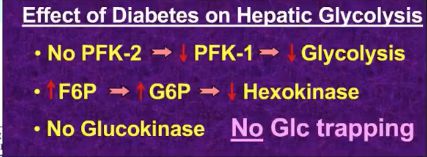
Effect of diabetes on hepatic glycolysis: no answer _____
- No PFK-2 due to lack of insulin
- No glucose trapping in liver leads to elevated blood glucose (hyperglycemia)
#6
_____ deficiency causes a buildup of pyruvate that gets shunted to lactate (via LDH) and alanine (via ALT)
#7
Increased NADH/NAD+ (e.g. due to ethanol) causes increased conversion of _____ -> malate, thus preventing gluconeogenesis
#8
Glucagon acts on the _____ (primarily) and adipose tissue
#9
Thyroid hormone increases the processes of _____, gluconeogenesis, proteolysis, and lipolysis, all of which may provide sources of ATP
Metabolic Regulation: Hormonal Control Indian Medical PG Flashcards - Medical Study Cards
Master Metabolic Regulation: Hormonal Control with OnCourse flashcards. These spaced repetition flashcards are designed for medical students preparing for NEET PG, USMLE Step 1, USMLE Step 2, MBBS exams, and other medical licensing examinations.
Metabolic Regulation: Hormonal Control Flashcard Deck - 9 Cards
Flashcard 1: Which metabolic pathways require an obligate activator? 1. _____2. Urea cycle
Answer: Gluconeogenesis
Flashcard 2: The number of insulin receptors is _____ in starvation and decreased in obesity
Answer: increased
Flashcard 3: _____ reactions are chemical reactions that form intermediates of a metabolic pathway.
Answer: Anaplerotic
Flashcard 4: Glucagon causes _____ fatty acid synthesis and increased lipolysis, which shunts substrates towards gluconeogenesis
Answer: decreased
Flashcard 5: Effect of diabetes on hepatic glycolysis: no answer _____
- No PFK-2 due to lack of insulin
- No glucose trapping in liver leads to elevated blood glucose (hyperglycemia)
Answer: :)
Flashcard 6: _____ deficiency causes a buildup of pyruvate that gets shunted to lactate (via LDH) and alanine (via ALT)
Answer: Pyruvate dehydrogenase
Flashcard 7: Increased NADH/NAD+ (e.g. due to ethanol) causes increased conversion of _____ -> malate, thus preventing gluconeogenesis
Answer: oxaloacetate
Flashcard 8: Glucagon acts on the _____ (primarily) and adipose tissue
Answer: liver
Flashcard 9: Thyroid hormone increases the processes of _____, gluconeogenesis, proteolysis, and lipolysis, all of which may provide sources of ATP
Answer: glycogenolysis
Keywords: Metabolic Regulation: Hormonal Control flashcards, medical flashcards, NEET PG preparation, USMLE Step 1 flashcards, Anki alternative, spaced repetition medical, OnCourse flashcards
Want unlimited flashcards?
Get full access to all flashcards, spaced repetition, and progress tracking.