Xenon is a _____teratogenic inhalational anesthetic
#2
In an non-actively wheezing asthmatic patient, who is hemodynamically stable _____ is the induction agent of choice
#3
Which intravenous anesthetic preserves airway reflexes the best?_____
#4
Thiopentone does not completely supress airway response to laryngoscopy and may lead to _____ in asthmatics
#5
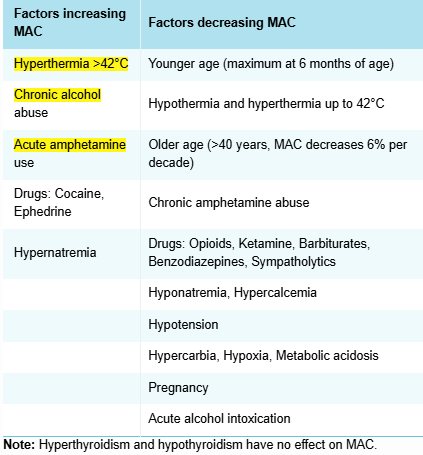
Factors affecting Minimum Alveolar Concentration (MAC): No answer _____
#6
Hyper_____, Hypercalcemia, Hypermagnesemia and HyperH+ (acidosis) will all decrease the minimum alveolar concentration for an anaesthetic agent
#7
_____ administration may lead to salivation and lacrimation which can be prevented by premedication with glycopyrrolate
Hint: IV anesthetic
#8
Hypo_____, hypotension, hyponatremia and hypoxia will all decrease the minimum alveolar concentration for an anaesthetic agent
#9
Inhaled anesthetics with _____ solubility in blood have a slower onset of action
#10
Neuro/Psych _____ and etomidate are IV anesthetics that exert their effects via potentiation of the GABAA receptor complex
Difficult Airway Algorithms Indian Medical PG Flashcards - Medical Study Cards
Master Difficult Airway Algorithms with OnCourse flashcards. These spaced repetition flashcards are designed for medical students preparing for NEET PG, USMLE Step 1, USMLE Step 2, MBBS exams, and other medical licensing examinations.
Flashcard 6: Hyper_____, Hypercalcemia, Hypermagnesemia and HyperH+ (acidosis) will all decrease the minimum alveolar concentration for an anaesthetic agent
Answer: carbia
Flashcard 7: _____ administration may lead to salivation and lacrimation which can be prevented by premedication with glycopyrrolate
Answer: Ketamine
Flashcard 8: Hypo_____, hypotension, hyponatremia and hypoxia will all decrease the minimum alveolar concentration for an anaesthetic agent
Answer: thermia
Flashcard 9: Inhaled anesthetics with _____ solubility in blood have a slower onset of action
Answer: higher
Flashcard 10: Neuro/Psych _____ and etomidate are IV anesthetics that exert their effects via potentiation of the GABAA receptor complex