Head Indian Medical PG Flashcards - Medical Study Cards
Master Head with OnCourse flashcards. These spaced repetition flashcards are designed for medical students preparing for NEET PG, USMLE Step 1, USMLE Step 2, MBBS exams, and other medical licensing examinations.
Head Flashcard Deck - 329 Cards
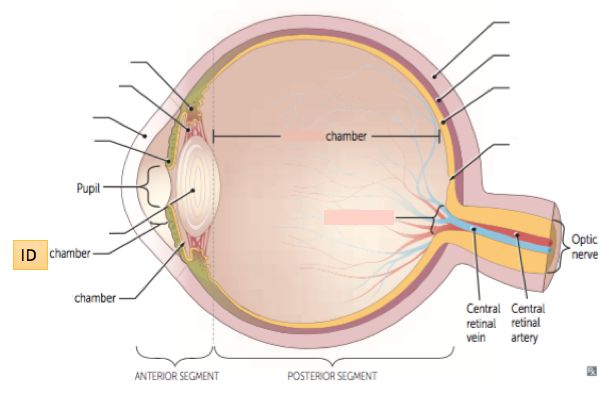
Flashcard 1: ID Chamber: _____
Answer: Anterior chamber
Flashcard 2: The structure marked X in the image is the _____ artery.
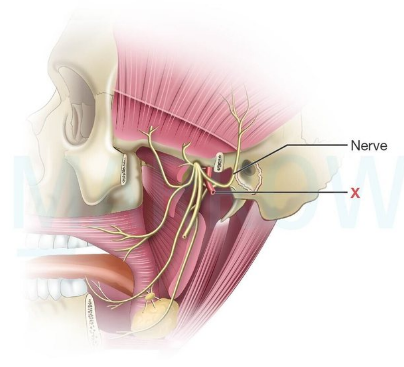
Answer: middle meningeal
Flashcard 3: The muscle marked as '3' in the image is _____
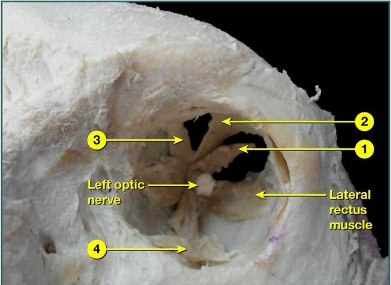
Answer: superior oblique
Flashcard 4: The marked foramen is _____ and the accessory meningeal artery passes through this structure.
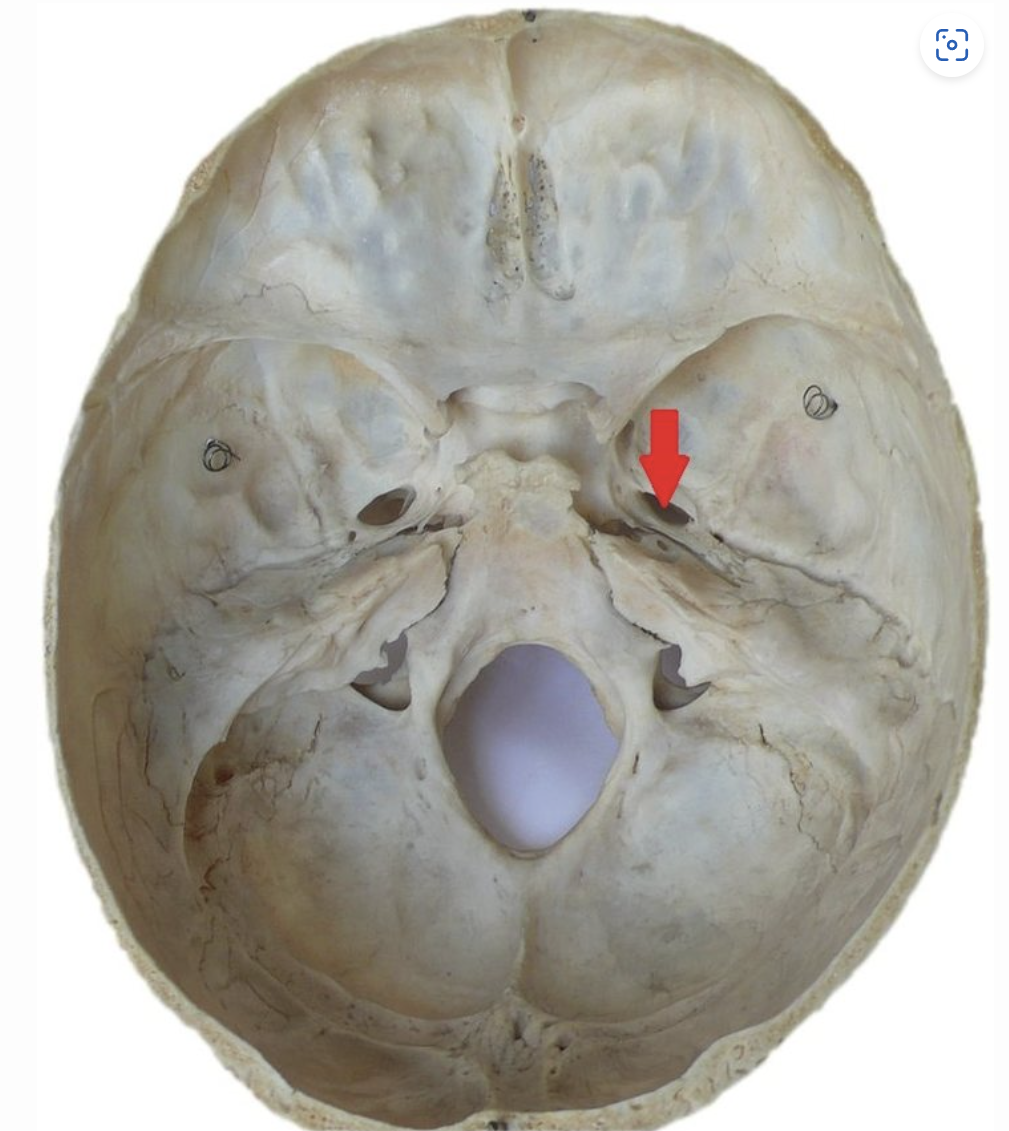
Answer: foramen ovale
Flashcard 5: _____ system of tooth charting:
Number is assigned to each quadrant and that number is placed before tooth's number.
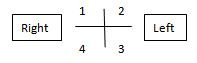
Answer: FDI
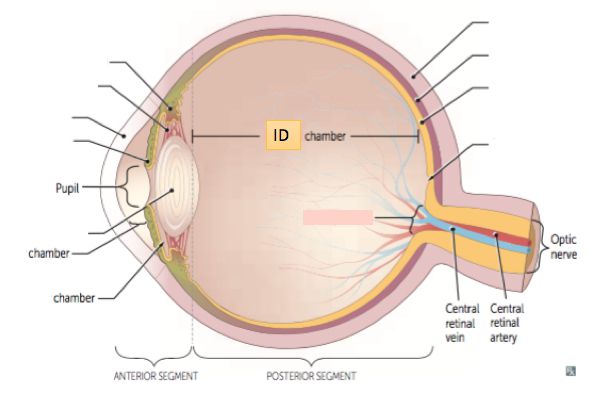
Flashcard 6: ID Chamber: _____
Answer: Vitreous chamber
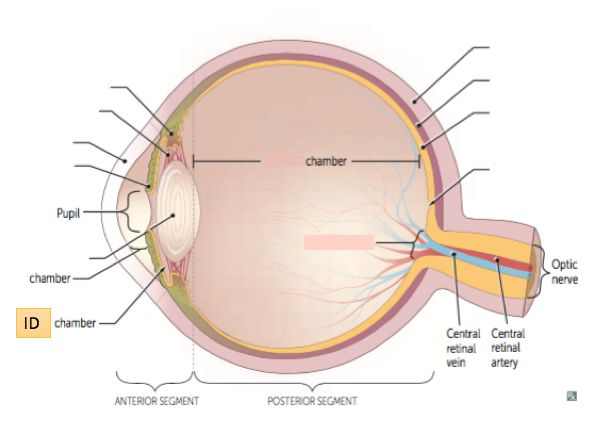
Flashcard 7: ID Chamber: _____
Answer: Posterior chamber
Flashcard 8: Branches of the facial artery: no answer _____
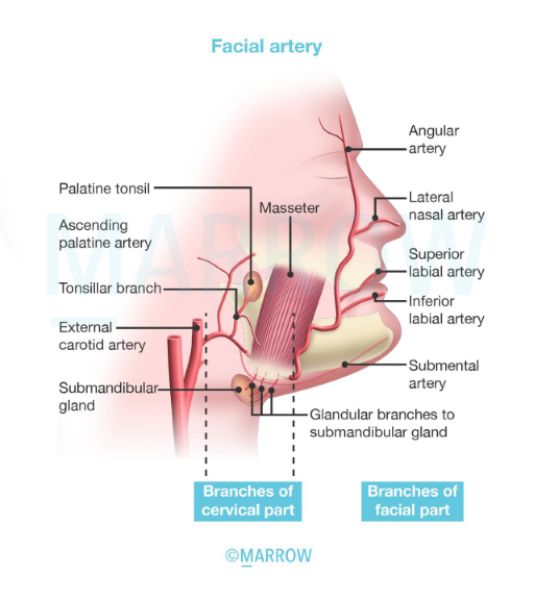
Answer: :)
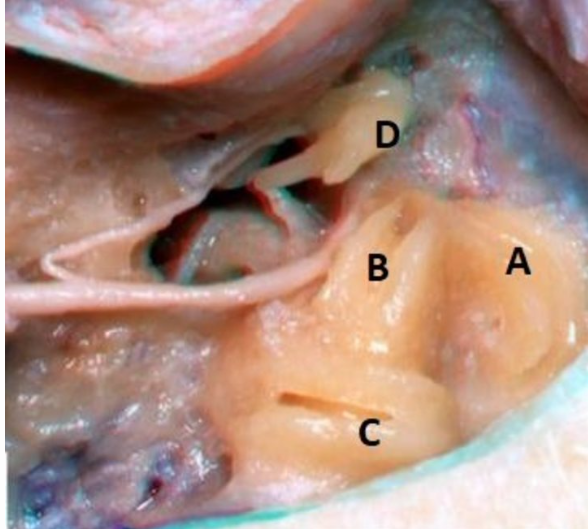
Flashcard 9: The structure B is the _____
Answer: Lateral semicircular canal
Flashcard 10: All muscles of mastication cause _____ of the jaw except: Temporalis
Answer: protrusion
Flashcard 11: Foramen of the skull:Structures passing through _____ include: MALEMandibular division of the fifth cranial nerveAccessory meningeal arteryLesser petrosal nerveEmissary veins
Answer: foramen ovale
Flashcard 12: Evagination of the _____ layer of the tentorium cerebelli at the petrous apex is called Meckel's cave.
Answer: lower
Flashcard 13: A prominent _____ process and suprorbital ridges are more commonly seen in a male skull.
Answer: mastoid
Flashcard 14: The _____ nerve runs downwards and forwards on the surface of the medial pterygoid muscle.
Answer: lingual
Flashcard 15: The angle between the sigmoid sinus plate and tegmen/dural plate is called _____ angle or Citellis angle.
Answer: sinodural
Flashcard 16: Foramen of the skull:Structures passing through _____ include: MENMiddle meningeal arteryPosterior trunk of Middle meningeal veinNervus spinosus - Meningeal branch of the Mandibular nerve
Answer: foramen spinosum
Flashcard 17: Nasolacrimal duct runs _____wards, backwards, and laterally from the lacrimal sac and opens into the inferior meatus.
Answer: down
Flashcard 18: Bony part of external nose consists of: Two _____ bones, Frontal process of maxilla, Nasal process of frontal bone
Answer: nasal
Flashcard 19: Base of the maxillary sinus is towards _____ and apex is directed laterally into the zygomatic process
Answer: lateral wall of nose
Flashcard 20: _____ movements of the jaw take place in the joint space below the articular disc of the temporomandibular joint.
Answer: Rotatory
Flashcard 21: The _____ artery is divided into three parts by the lateral pterygoid muscle.
Answer: maxillary
Flashcard 22: The ciliary body derives its blood supply from the _____ artery and anterior ciliary arteries, which form the major arterial circle at the root of the iris.
Answer: long posterior ciliary
Flashcard 23: _____ is an H shaped sutural junction between four bones of the skull:Frontal boneSquamous part of the temporal boneGreater wing of sphenoid boneParietal bone.
Answer: Pterion
Flashcard 24: The pars _____ of the ciliary body contains approximately 70 finger-like projections called ciliary processes, which are covered by the ciliary body epithelium.
Answer: plicata
Flashcard 25: _____ window is covered by the footplate of stapes.
Answer: Oval
Flashcard 26: The _____ of the orbit is formed by sphenoid and zygomatic bone
Answer: lateral wall
Flashcard 27: The _____ muscle is isolated by having the patient abduct and depress their eye
Answer: inferior rectus
Flashcard 28: The _____ forms the landmark for the second genu of the facial nerve, and houses the vertical segment of facial nerve & the nerve to stapedius
Answer: pyramid
Flashcard 29: Ciliary body consists of an anterior portion called the pars _____ and a posterior portion called the pars plana.
Answer: plicata
Flashcard 30: Venous drainage of the face and scalp:_____ vein joins the maxillary vein to form the retromandibular vein which divides into anterior and posterior divisions.
Answer: Superficial temporal
Flashcard 31: The _____ampullated ends of posterior and superior semicircular canals unite to form a common channel called crus commune.
Answer: non
Flashcard 32: _____, Frontalis and Muller's muscle are the upper lid retractors.
Answer: LPS
Flashcard 33: The _____ fibres of the tensor veli palatini are attached to the lateral lamina of the eustachean tube and contract to open the tubal lumen
Answer: medial
Flashcard 34: Relations of the parotid gland:Posteromedial surface is related to the _____ process, posterior belly of the digastric, styloid process, and the muscles attached to it.
Answer: mastoid
Flashcard 35: From the anterior chamber, some aqueous humor (10%) drains into the _____ and sclera
Answer: uvea
Flashcard 36: Boundaries of the nasal valve:Laterally: Lower border of _____ cartilage and fibrofatty tissue and anterior end of inferior turbinateMedially: Cartilaginous nasal septumCaudally: Floor of the pyriform aperture
Answer: upper lateral
Flashcard 37: Facial vein is valveless and connects to the _____ through the superior ophthalmic vein
Answer: cavernous sinus
Flashcard 38: Action of Lateral pterygoid muscle is _____, protrusion and side to side movement of the jaw.
Answer: depression
Flashcard 39: _____ belly of digastric is supplied by the nerve to mylohyoid and posterior belly is supplied by the facial nerve
Answer: Anterior
Flashcard 40: Interparietal bone of the skull is present between the _____ and the parietal bones.
Answer: occipital
Flashcard 41: The external nose is made up of _____ paired and 1 unpaired cartilage.
Answer: 3
Flashcard 42: Lesser actions of the superior oblique muscle are _____ and intorsion
Answer: abduction
Flashcard 43: Pterion overlies the _____ branch of the middle meningeal artery and lateral fissure of the cerebral hemisphere.
Answer: anterior
Flashcard 44: The _____ artery enters the skull through the foramen spinosum
Answer: middle meningeal
Flashcard 45: The _____ aponeurosis is attached to the superior border of the upper tarsal plate.
Answer: levator palpebrae superioris (LPS)
Flashcard 46: The _____ segment of the facial nerve starts at the level of Processus cochleariformis
Answer: Tympanic
Flashcard 47: Chorda tympani travels _____ to anterior, between malleus and incus in the middle ear
Answer: posterior
Flashcard 48: _____ or limen vestibuli is the junction of the upper and lower lateral cartilages of the nose
Answer: Lime nasi
Flashcard 49: The tonsil is supplied by five arteries:_____ branch of facial artery (the main artery)Ascending palatine branch of facial artery.Ascending pharyngeal branch of external carotid artery.Dorsal lingual branches of lingual artery.Descending palatine branches of maxillary artery.
Answer: Tonsillar
Flashcard 50: Lateral crus of the alar cartilage forms the _____ and medial crus runs in the columella.
Answer: ala
Flashcard 51: CSF _____orrhea is seen in longitudinal fractures of the petrous part of the temporal bone
Answer: ot
Flashcard 52: The _____ is a pouch that ascends forwards from the anterior end of the ventricle of the larynx, between the vestibular fold and thyroid cartilage.
Answer: saccule
Flashcard 53: Sensory supply to middle ear cavity is provided by the _____ branch of the glossopharyngeal nerve
Answer: tympanic
Flashcard 54: _____ sinus, maxillary sinus, anterior ethmoidal sinus open into the middle meatus
Answer: Frontal
Flashcard 55: The _____ of the orbit is formed by frontal and sphenoid bone
Answer: roof
Flashcard 56: Fossa incudis is a depression on the _____ wall of the middle ear which attaches the short process of incus
Answer: posterior
Flashcard 57: Relations of parotid gland:Anteromedial surface is related to the posteroinferior part of the _____, masseter, medial pterygoid, and temporomandibular joint
Answer: mandibular ramus
Flashcard 58: The pre-epiglottic space of boyer is bounded anteriorly by _____ and thyrohyoid membrane, superiorly by hyoepiglottic ligament and posteromedially by the infrahyoid epiglottis and quadrangular membrane.
Answer: thyroid
Flashcard 59: Structures present in parotid gland from superficial to deep are _____ nerve, retromandibular vein, and external carotid artery
Answer: facial
Flashcard 60: Lymphatics of the tongue:_____ part of anterior 2/3rd of tongue drains into U/L submandibular lymph nodes
Answer: Margin
Flashcard 61: CN _____ exits the skull through the foramen ovale
Answer: V3
Flashcard 62: The structures piercing through the buccinator muscle are as follows:_____Buccal branch of the Mandibular nerveMolar mucous glands
Answer: Parotid duct
Flashcard 63: _____ is the site of junction of nasal bone with nasal process of frontal bone.
Answer: Nasion
Flashcard 64: The labyrinth of the inner ear gives two extensions on the medial wall, the _____ and the ponticulus
Answer: subliculum
Flashcard 65: What is the main arterial supply of the tonsils?_____ branch of facial artery
Answer: Tonsillar
Flashcard 66: Passavant ridge is formed by _____ and superior constrictor muscles.
Answer: palatopharyngeus
Flashcard 67: Each sigmoid sinus exits the skull via the _____ as internal jugular veins
Answer: jugular foramen
Flashcard 68: The length of the EAC is _____ of which 8mm is the outer cartilagenous part and 16mm is the inner bony part
Answer: 24mm
Flashcard 69: The _____ semicircular canal is present beneath the arcuate eminence of the petrous temporal bone.
Answer: superior
Flashcard 70: Check ligament of the _____ rectus, lateral horn of the LPS, lockwood's ligament, and lateral palpebral ligament is attached to Whitnall s tubercle.
Answer: lateral
Flashcard 71: 3 paired cartilages of the nose are _____, lower lateral (alar), and lesser alar (sesamoid cartilage).
Answer: upper lateral
Flashcard 72: The transverse diameter of the middle ear at the level of _____, i.e., 2 mm
Answer: mesotympanum
Flashcard 73: Sinus tympani is bound by the _____ superiorly and the subiculum inferiorly
Answer: ponticulus
Flashcard 74: Relations of parotid gland:Superior surface is related to the _____ and posterior part of the temporomandibular joint.
Answer: external acoustic meatus
Flashcard 75: Foramen of the skull:Structures passing through the _____ foramen include:Inferior Petrosal sinus+-Meningeal branch of ascending pharyngeal artery, -Cranial nerves IX,X & XI and Sigmoid Sinus that continues as IJV+Meningeal branch of occipital artery as it passes the foramen(from anterior to posterior)
Answer: jugular
Flashcard 76: Foramen of the skull:Ligaments passing through the anterior part of foramen magnum include:Odontoid process, _____ ligament, alar ligament, membrana tectoria*along with arteries?
Answer: upper band of cruciate
Flashcard 77: _____ palate is mainly supplied by the greater (descending) palatine artery which is a branch of the third part of maxillary artery.
Answer: Hard
Flashcard 78: All the muscles of the soft palate are supplied by the _____, except for tensor veli palatini which supplied by the mandibular nerve.
Answer: pharyngeal plexus
Flashcard 79: The layers of scalp from outward to inward are as follows: SCALPS: _____C: Connective tissue (superficial fascia) with blood vessels and nervesA: Aponeurosis (galea aponeurotica) with occipitofrontalis muscleL: Loose areolar (subaponeurotic) tissueP: Pericranium
Answer: Skin
Flashcard 80: Hiatus semilunaris opens into three-dimensional area called _____ bounded by uncinate process, frontal process of maxilla medially, and lamina papyracea laterally.
Answer: infundibulum
Flashcard 81: _____ canal is located at the petrous apex of the temporal bone and is formed by the Petroclinoid ligament/Gruber's ligament.
Answer: Dorello's
Flashcard 82: Lymphatics of the tongue:_____ part of anterior 2/3rd of tongue drains into B/L jugulodigastric and jugulo-omohyoid lymph nodes
Answer: Central
Flashcard 83: Cephalhematoma is a _____periosteal bleed, whereas subgaleal hematoma is a supraperiosteal bleed (supra/sub)
Answer: sub
Flashcard 84: Relations of parotid gland:Apex is directed _____ and is related to the posterior belly of the digastric and carotid triangle.
Answer: downwards
Flashcard 85: All muscles of mastication cause _____ of mandible except: lateral pterygoid
Answer: elevation
Flashcard 86: _____ palate is supplied by ascending palatine branch of the facial artery, ascending pharyngeal artery and lesser palatine arteries.
Answer: Soft
Flashcard 87: Sub_____ hemorrhage is bleeding in the potential space between the skull/periosteum/and the scalp/galea aponeurosis.
Answer: galeal
Flashcard 88: The _____ of the orbit is formed by ethmoid, sphenoid, maxilla and lacrimal bone
Answer: medial wall
Flashcard 89: The height of the upper tarsal plate is about _____ mm and that of the lower tarsal plate is 4 mm.
Answer: 10
Flashcard 90: _____ is a two-dimensional space bounded by bulla ethmoidalis above and uncinate process of ethmoid bone below
Answer: Hiatus semilunaris
Flashcard 91: The muscles producing extorsion of the eyeball are _____ rectus and inferior oblique.
Answer: inferior
Flashcard 92: Lower tonsillar fossa is related to the _____ process and the glossopharyngeal nerve
Answer: styloid
Flashcard 93: Ligament of _____ is attachment of the vitreous to the posterior capsule of the lens.
Answer: Weigert
Flashcard 94: Foramen of the skull:The _____ nerve and greater petrosal nerve join to form the vidian nerve that passes through the pterygoid canal (present in the floor of sphenoid bone) and end at the pterygopalatine ganglion
Answer: deep petrosal
Flashcard 95: The optic _____ is formed by medially by the body and laterally by the lesser wing of the sphenoid bone.
Answer: canal
Flashcard 96: _____ is a gap present between the base of the skull and the upper border of superior constrictor muscle.
Answer: Sinus of Morgagni
Flashcard 97: _____ of the mandible is caused by lateral pterygoid and suprahyoid muscles
Answer: Depression
Flashcard 98: Structures passing through the sinus of Morgagni: PALETP: _____A: Ascending palatine arteryL: Levator veli palatiniE: Eustachian tubeT: Tensor veli palatini
Answer: Palatine branch of ascending pharyngeal artery
Flashcard 99: The middle ear cleft is made of _____, mastoid air cells and the eustachean tube
Answer: tympanic cavity
Flashcard 100: _____ membrane of the cornea ends peripherally as schwalbe's ring
Answer: Descemet's
Flashcard 101: Facial vein is valveless and connects to the _____ through the inferior ophthalmic vein and deep facial vein
Answer: pterygoid plexus
Flashcard 102: The _____ turbinate(s) articulate with the maxillary bone
Answer: inferior
Flashcard 103: Venous drainage of the face and scalp:The _____ division of the retromandibular vein joins the facial vein to form the common facial vein, which drains into the internal jugular vein.
Answer: anterior
Flashcard 104: The function of temporalis muscle is _____ and retraction of mandible
Answer: elevation
Flashcard 105: The accessory parotid gland is present between the _____ and zygomatic arch
Answer: parotid duct
Flashcard 106: The muscles producing intorsion of the eyeball are _____ rectus and superior oblique.
Answer: superior
Flashcard 107: Terminal branches of ophthalmic artery are _____ (or frontal) artery and thedorsal nasal artery.
Answer: supratrochlear
Flashcard 108: Which arteries are contributing to the Kiesselbach's plexus?_____ artery, Greater palatine artery, Septal branch of superior labial artery and anterior ethmoidal artery
Answer: Sphenopalatine
Flashcard 109: _____ cell (infraorbital ethmoidal air cell) is related to the maxillary sinus
Answer: Haller
Flashcard 110: _____ sinus, maxillary sinus, anterior ethmoidal sinus together form the osteomeatal complex
Answer: Frontal
Flashcard 111: Parotid duct or the _____ duct opens opposite to the 2nd upper molar tooth.
Answer: Stensen's
Flashcard 112: _____ pterygoid muscle is inserted at the pterygoid fovea
Answer: Lateral
Flashcard 113: The pyramid divides the posterior space into a _____ sinus tympani and a lateral facial recess (medial/lateral)
Answer: medial
Flashcard 114: Venous drainage of the face and scalp:_____ and the supraorbital veins join at the medial angle of the eye to form the angular vein, which continues down as facial vein.
Answer: Supratrochlear
Flashcard 115: Posterior wall of the EAC is supplied by the _____ nerve (CN VII) and the Arnold's (Auricular branch of vagus) nerve
Answer: facial
Flashcard 116: _____ or Berger s space is at the center of the hyaloideo-capsular/Weigert's ligament.
Answer: Erggelet s
Flashcard 117: In which layers (3) of the scalp do contusions of the scalp occur?_____, in the temporalis muscle, in the loose areolar tissue between galea aponeurotica and the pericranium.
Answer: Superficial fascia
Flashcard 118: _____ window is covered by the secondary tympanic membrane.
Answer: Round
Flashcard 119: From the anterior chamber, most aqueous humor (90%) drains through the _____ into the canal of Schlemm (scleral venous sinus)
Answer: trabecular meshwork
Flashcard 120: The _____ is a point at the apex of the cochlea where the scala tympani & scala vestibule meet to form a single continuous cavity.
Answer: helicotrema
Flashcard 121: The cavernous sinus drains into:_____ via superior petrosal sinusInternal jugular vein via inferior petrosal sinusPterygoid plexus via emissary veinsSuperior ophthalmic vein
Answer: Transverse sinus
Flashcard 122: External nose has upper _____rd bony part and lower 2/3rd cartilaginous part.
Answer: 1/3
Flashcard 123: CN _____ provides motor innervation to the stylopharyngeus muscle
Answer: IX (glossopharyngeal)
Flashcard 124: The _____ bone and the frontal process of the maxilla separate the lacrimal sac from the middle meatus of the nasal cavity.
Answer: lacrimal
Flashcard 125: Angiofibroma arises from _____ part of nasal cavity close to the superior margin of sphenopalatine foramen
Answer: posterior
Flashcard 126: The sclera is the thinnest _____ to the insertion of the rectus muscles.
Answer: posterior
Flashcard 127: The lateral surface of the tympanic membrane is _____ and the most depressed part of its concavity is called the umbo
Answer: concave
Flashcard 128: The optic _____ is formed by the two roots of the lesser wing of the sphenoid.
Answer: foramen
Flashcard 129: Cochlear duct is connected to the _____ by ductus reunions.
Answer: saccule
Flashcard 130: Length of the eustachian tube: _____ mm where:Bony: 12 mm + Cartilagenous: 24 mm
Answer: 36
Flashcard 131: _____ movements of the jaw take place in the joint space above the articular disc of the temporomandibular joint.
Answer: Sliding/translational
Flashcard 132: Deficiency of the _____ part of the EAC gives rise to the fissures of Santorini
Answer: cartilagenous
Flashcard 133: Parasympathetic pathway of the parotid gland:The _____ nerve passes through the foramen ovale to relay in the otic ganglion
Answer: lesser petrosal
Flashcard 134: _____ pterygoid muscle is innervated by the lateral pterygoid nerve which is a branch of the trigeminal nerve
Answer: Lateral
Flashcard 135: Relations of parotid gland:Superficial surface is related to the skin, superficial fascia, _____ nerve, parotid lymph nodes, and platysma.
Answer: greater auricular
Flashcard 136: The _____ turbinate(s) articulate with the ethmoid bone
Answer: superior and middle
Flashcard 137: _____tympanum contains Head of the malleus, Incudomalleolar joint and Short process and body of incus
Answer: Epi
Flashcard 138: The _____ of the orbit is formed by zygomatic and maxilla bone
Answer: floor
Flashcard 139: CN _____ exits the skull through the foramen rotundum
Answer: V2
Flashcard 140: _____ is that part of the middle ear around the Eustachian tube opening.
Answer: Protympanum
Flashcard 141: Septum proper is an osseocartilaginous framework made up of:_____ or quadrilateral cartilagePerpendicular plate of ethmoidVomerOthers crest of nasal bones, nasal spine of frontal bone, rostrum of sphenoid, crest of palatine bones and the crest maxilla, and the anterior nasal spine of maxilla
Answer: Septal
Flashcard 142: Foramen of the skull:Structures passing through _____ include:Maxillary division of the fifth cranial nerve
Answer: foramen rotundum
Flashcard 143: Deficiency of the _____ part of the EAC gives rise to the fissures of Huschke
Answer: bony
Flashcard 144: Contents of superior orbital fissure: Above the common tendinous ring: LFTS (Superolateral compartment)_____ nerveFrontal nerveTrochlear nerveSuperior opthalmic vein
Answer: Lacrimal
Flashcard 145: The main jaw opener muscles are _____ and geniohyoid
Answer: digastric
Flashcard 146: The petrous, cavernous and intracranial parts of the internal carotid artery are called the _____ because of its sigmoid course.
Answer: carotid siphon
Flashcard 147: Lateral semicircular canal also called _____, lies in the Z axis
Answer: horizontal
Flashcard 148: Dangerous area of nose is bound:Laterally by _____ turbinateMedially by corresponding part of septumAbove by cribriform plate of ethmoid
Answer: superior
Flashcard 149: Vestibule has a(n) spherical recess for lodging the _____
Answer: saccule
Flashcard 150: _____ glands are modified sebaceous glands found in the tarsal plates.
Answer: Meibomian
Flashcard 151: Styloglossus, and mylohyoid are located _____ to hyoglossus muscle
Answer: superficial (deep/superficial)
Flashcard 152: The _____ is the part of the pinna between the tragus and the crus of helix where there is no underlying cartilage
Answer: incisura terminalis
Flashcard 153: _____ papillae are arranged in V-shaped row immediately in front of the sulcus terminalis
Answer: Circumvallate
Flashcard 154: Branches of Mandibular nerve:N. to medial pterygoid supplies which 3 muscles?_____
Answer: Medial Pterygoid,Tensor Tympani, Tensor Veli Palatini muscles
Flashcard 155: Foramen of the skull:Which foramen are present in the petrous temporal bone?_____
Answer: internal auditory foramen
Flashcard 156: The last skull suture to fuse is the _____ suture, which fuses after 80 years of age.
Answer: squamous temporal
Flashcard 157: Glossopharyngeal nerve is located _____ to hyoglossus muscle
Answer: deep (deep/superficial)
Flashcard 158: Hypoglossal nerve is located _____ to hyoglossus muscle
Answer: superficial (deep/superficial)
Flashcard 159: Foramen of the skull:Structures passing through foramen lacerum include: _____
Answer: none
Flashcard 160: Foramen of the skull:Which foramen are present in the middle cranial fossa?_____
Answer: Foramen lacerum
Flashcard 161: _____ suture is present between the two frontal bones
Answer: Metopic
Flashcard 162: Foramen of the skull:Which foramen are present behind the petrous temporal bone?_____
Answer: Jugular foramen and hypoglossal canal
Flashcard 163: The foramen _____ lies superolateral to the pterygoid canal, in the greater wing of the sphenoid.
Answer: rotundum
Flashcard 164: Which structure passes through the mandibular foramen?_____ nerves and vessels
Answer: Inferior alveolar
Flashcard 165: The Pars _____ of the tympanic membrane contains annulus tympanicus
Answer: tensa
Flashcard 166: _____ is most common site for origin of Angiofibroma.
Answer: Sphenopalatine foramen
Flashcard 167: The posterior chamber is filled with _____ humor.
Answer: aqueous
Flashcard 168: _____ papillae are present bilaterally in two zones at the sides of the tongue near the sulcus terminalis.
Answer: Foliate
Flashcard 169: The volume of the orbit is _____ cc.
Answer: 30
Flashcard 170: The _____ portion of ciliary muscles attaches anteriorly to the scleral spur and trabecular meshwork fibers
Answer: outer longitudinal
Flashcard 171: Shortest extraocular muscle: _____
Answer: Inferior oblique
Flashcard 172: _____ are the largest of the pneumatized bones of the midface
Answer: Maxillae
Flashcard 173: Which nerve supplies the concha and post auricular groove of the ear?_____
Answer: Arnold's nerve and Facial nerve
Flashcard 174: _____ or the epitympanum is the part of the middle ear adjacent to its roof.
Answer: Attic
Flashcard 175: Sublingual gland, the deep part of the submandibular gland and duct are located _____ to hyoglossus muscle
Answer: superficial (deep/superficial)
Flashcard 176: Which mastoid air cell is present even in a sclerotic mastoid?_____
Answer: Antrum
Flashcard 177: Narrowest part of middle ear is the _____
Answer: mesotympanum
Flashcard 178: The roof of the middle ear is formed by a thin plate of bone called _____
Answer: tegmen tympani.
Flashcard 179: One of the crypts, situated near the upper part of tonsil is very large and deep and is called _____ or intratonsillar cleft
Answer: crypta magna
Flashcard 180: The nasolacrimal duct is _____ mm long and is the inferior continuation of the lacrimal sac.
Answer: 12 18
Flashcard 181: Maxillary sinus opens into middle meatus at the lower part of _____
Answer: infundibulum
Flashcard 182: The _____ part of the EAC is directed downward, forward and medially
Answer: bony
Flashcard 183: _____ forms the landmark for the 1st genu of the facial nerve and the geniculate ganglion
Answer: Processus cochleariformis
Flashcard 184: _____ is the largest and most constant mastoid air cell.
Answer: Antrum
Flashcard 185: Corneal thickness indirectly reflects _____ function
Answer: endothelial
Flashcard 186: Which structure passes through the mylohyoid groove?_____
Answer: nerve to mylohyoid
Flashcard 187: _____ forms posterior boundary of hiatus semilunaris.
Answer: Bulla ethmoidalis
Flashcard 188: Floor of the sphenoid sinus is related to the _____
Answer: Vidian nerve
Flashcard 189: The structure B is the _____
Answer: Lateral semicircular canal
Flashcard 190: The supraorbital notch transmits the _____ nerves and vessels.
Answer: supraorbital
Flashcard 191: Posterior ciliary vessels are located in the _____ space
Answer: suprachoroid
Flashcard 192: Length of pharynx is _____cm
Answer: 12-14
Flashcard 193: Maxillary sinus is _____ in shape
Answer: pyramidal
Flashcard 194: The eustachean tube opens 1-1.25 cm posterior to the posterior end of _____ turbinate
Answer: Inferior
Flashcard 195: Branches of Mandibular nerve:Buccal nerve of the anterior division supplies the _____
Answer: buccal mucosa (sensory)
Flashcard 196: The skin over the angle of the mandible is innervated by the _____
Answer: great auricular nerve.
Flashcard 197: A cone of light can be seen radiating from the tip of malleus (umbo) to the periphery in the _____ quadrant of the tympanic membrane.
Answer: anteroinferior
Flashcard 198: Internal nasal valve angle is usually _____ degrees
Answer: 10-15
Flashcard 199: The ciliary body extends from the base of the iris and becomes continuous with the choroid at the _____
Answer: ora serrata
Flashcard 200: Chronic granulomatous conditions like lupus, tuberculosis and leprosy cause perforation in the _____ part of the septum
Answer: cartilaginous
Flashcard 201: What are the 2 branches of the ICA given by the petrous part (through the carotid canal)?_____
Answer: Caroticotympanic arteries and artery of pterygoid canal
Flashcard 202: _____ is an elevation just anterior to the attachment of middle turbinate
Answer: Agger nasi
Flashcard 203: Osteomas are most commonly seen in the _____ sinus
Answer: frontal
Flashcard 204: The bulge on the medial wall, called the _____ is due to the basal coil of the cochlea
Answer: promontory
Flashcard 205: Which meningeal layer is usually resistant to spread of the middle ear tumors?_____
Answer: Dura
Flashcard 206: Branches of Mandibular nerve:Inferior alveolar nerve of the posterior division supplies the _____
Answer: lower teeth (sensory)
Flashcard 207: Vestibule is part of _____ labyrinth.
Answer: bony
Flashcard 208: The _____ is the narrowest part of the nose and offers maximum resistance to airflow
Answer: nasal valve
Flashcard 209: What parts of the pinna are devoid of cartilage?_____
Answer: Incisura terminalis and the lobule
Flashcard 210: What angle does the eustachean tube make with horizontal?_____
Answer: 450
Flashcard 211: Above the ponticulus lies the _____ window
Answer: oval
Flashcard 212: The opening of the duct into the inferior meatus is partially covered by a mucosal fold (valve of _____.
Answer: Hasner
Flashcard 213: The _____ separates the tympanic cavity from the middle cranial fossa
Answer: tegmen tympani
Flashcard 214: Anterosuperior border of _____ cartilage forms midline of lower 2/3rd of the dorsum of nose and supports lower 2/3rd of the dorsum of external nose.
Answer: septal
Flashcard 215: The pyramid contains _____ muscle and the tendon leaves the pyramid to attach the neck of the stapes
Answer: stapedius
Flashcard 216: What is the site of origin for ethmoidal polyps?_____
Answer: Lateral wall of nose
Flashcard 217: The lingual nerve and submandibular ganglion are located _____ to hyoglossus muscle
Answer: superficial (deep/superficial)
Flashcard 218: Which artery supplies the facial nerve in the mastoid segment?_____
Answer: Stylomastoid branch of posterior auricular artery
Flashcard 219: Anterior and posterior ethmoid air cells are separated by _____
Answer: basal lamella
Flashcard 220: What are the parts of the bony labyrinth?_____
Answer: Vestibule, Cochlea (scala tympani & scala vestibuli) and 3 semicircular canals (3)
Flashcard 221: The _____pharynx is made of Adenoids, ET opening, Torus tubaris, Fossa of Rossenmuller and PPW
Answer: naso
Flashcard 222: Antero-posterior (AP) diameter of the adult eye is _____ mm.
Answer: 24
Flashcard 223: Deep lingual vein is located _____ to hyoglossus muscle
Answer: superficial (deep/superficial)
Flashcard 224: _____ is the anterior-most air cells of anterior ethmoid air cells.
Answer: Agger nasi
Flashcard 225: When both the right and left _____ contract, they protrude the anterior part of the tongue out of the mouth in the midline
Answer: genioglossi
Flashcard 226: The pars plana is _____mm from the limbus
Answer: 4.5
Flashcard 227: Nasolacrimal duct is bound by the valve of _____ at the inferior turbinate
Answer: hasner
Flashcard 228: Semicircular canals are part of _____ labyrinth.
Answer: bony
Flashcard 229: Where does the Eustachian tube open in the nasopharynx?_____
Answer: behind the posterior end of the inferior turbinate
Flashcard 230: Brow pseudoptosis occurs due to excessive _____ on the brow, or seventh nerve palsy
Answer: skin
Flashcard 231: Facial nerve main trunk lies _____ to the styloid process
Answer: lateral (medial/lateral)
Flashcard 232: Which skull bone houses the inner ear?_____
Answer: Petrous part of temporal bone
Flashcard 233: Anterior and posterior ethmoidal arteries are branches of the _____ carotid artery
Answer: internal
Flashcard 234: The Pars _____ of the tympanic membrane is responsible for transmitting sound
Answer: tensa
Flashcard 235: Lymph from the lateral conjunctiva drains directly into the _____ nodes.
Answer: preauricular
Flashcard 236: Which structure passes through the mental foramen?_____
Answer: mental nerve
Flashcard 237: Colour of the normal tympanic membrane is _____
Answer: pearly grey
Flashcard 238: Facial recess is bound above by the _____
Answer: fossa incudis
Flashcard 239: The aditus lies just _____ the pyramid of the middle ear
Answer: above (below/above)
Flashcard 240: Incudostapedial joint is a _____ joint
Answer: ball and socket (synovial type)
Flashcard 241: The posterior segment is filled with _____ humor.
Answer: vitreous
Flashcard 242: The _____ part of the EAC is directed upward, backward and posteriorly
Answer: cartilagenous
Flashcard 243: The _____pharynx is made of Base of tongue, Pillars, tonsils, PPW
Answer: oro
Flashcard 244: Contents of superior orbital fissure: Below the common tendinous ring: (Inferomedial compartment)_____
Answer: Inferior ophthalmic vein
Flashcard 245: The floor of the middle ear is related to the _____
Answer: internal jugular vein.
Flashcard 246: Processus cochleariformis is related to the tendon of _____
Answer: tensor tympani
Flashcard 247: _____ space is a potential space underneath the epithelium of vocal cords/glottis
Answer: Reinke s
Flashcard 248: Sympathetic supply to the parotid gland is derived from the plexus around the _____ artery.
Answer: internal carotid
Flashcard 249: There are _____ pairs of synovial joints related to the exterior of the skull
Answer: 2
Flashcard 250: At the _____, the retina is the thinnest of all
Answer: ora serrata
Flashcard 251: Lesser alar or _____ cartilage are multiple on each side of the nose, lying above and lateral to the alar cartilage.
Answer: sesamoid
Flashcard 252: _____ originates from the lower border of the zygomatic arch.
Answer: Masseter (muscle)
Flashcard 253: Furuncles are only seen in the _____ part of the EAC
Answer: cartilagenous
Flashcard 254: Flattening of _____ prominence may occur with zygoma #
Answer: malar
Flashcard 255: The _____ are firm, dense plates of fibrous tissue that serve as the structural support of the eyelids.
Answer: tarsal plates
Flashcard 256: Vertical # of the nasal septum is called _____ fracture
Answer: Chevallet
Flashcard 257: Most commonly fractured bone on face is _____ bone
Answer: nasal
Flashcard 258: Which part of ICA gives no branches?_____
Answer: Cervical part
Flashcard 259: The tympanic membrane has a thickness of _____mm.
Answer: 0.1
Flashcard 260: Sphenopalatine foramen situated at posterior end of _____ turbinate.
Answer: middle
Flashcard 261: _____ cartilage of the nose extends from the nasal bone above to alar cartilage below.
Answer: Upper lateral
Flashcard 262: The ends of the tarsal plates form the medial and lateral _____, which are also known as medial and lateral canthal tendons
Answer: palpebral ligaments
Flashcard 263: Which nerve supplies the medial surface and posterior part of lateral surface of the ear?_____
Answer: Great auricular nerve
Flashcard 264: What type of mastoid is characterised by air cells and marrow spaces?_____
Answer: Diploiec
Flashcard 265: The isthumus of the EAC is situated in the _____ part of the EAC
Answer: bony
Flashcard 266: Stylohyoid ligament is located _____ to hyoglossus muscle
Answer: deep (deep/superficial)
Flashcard 267: The lateral surface of the tympanic membrane is supplied by the _____
Answer: auriculotemporal nerve and the Arnold's nerve
Flashcard 268: _____ is the pathway or the connection between mastoid antrum and attic
Answer: Aditus ad antrum
Flashcard 269: Which layer of the scalp is referred to as the dangerous area of the scalp?_____
Answer: Subaponeurotic loose areolar tissue
Flashcard 270: What are the 4 pneumatic bones?_____
Answer: Maxilla, ethmoid, sphenoid and frontal bones
Flashcard 271: Uveal tissue consists of _____
Answer: iris, ciliary body, and choroid.
Flashcard 272: Endolymphatic sac lies between the two layers of dura on the posterior surface of the _____ bone.
Answer: petrous
Flashcard 273: Upper 1/3rd of nasal cavity forms olfactory area which is also known as _____
Answer: dangerous area of nose
Flashcard 274: The _____ portion of ciliary muscles is responsible for accomodation
Answer: inner circular
Flashcard 275: _____ focus of otosclerosis involves only the fissula post fenestrum
Answer: Posterior
Flashcard 276: Facial nerve main trunk lies _____ mm deep to the tympanomastoid suture
Answer: 6-8
Flashcard 277: Anterior wall of the EAC is supplied by the _____ nerve
Answer: auriculotemporal
Flashcard 278: Foramen of the skull:Which foramen are present in the greater wing of sphenoid?_____
Answer: Foramen rotundum, ovale and spinosum
Flashcard 279: Foramen of the skull:The superior part of foramen lacerum is traversed by _____
Answer: internal carotid artery
Flashcard 280: The maxillary artery is ligated at _____
Answer: Pterygopalatine fossa
Flashcard 281: Equatorial diameter of the lens is about _____ mm.
Answer: 9
Flashcard 282: Which muscle plays a role in winking?_____
Answer: Orbicularis oculi
Flashcard 283: Which structure separates the superficial squamosal cells from the deep petrosal cells of the mastoid?_____
Answer: Petrosquamous suture
Flashcard 284: _____ sinus opens into the sphenoethmoidal recess
Answer: Sphenoid
Flashcard 285: Each nasal cavity communicates with the nasopharynx through the posterior nasal aperture or the _____
Answer: choana
Flashcard 286: What is the narrowest part of the eustachian tube?_____
Answer: The junction of bony and cartilagenous part (isthumus)
Flashcard 287: Branches of Mandibular nerve:Muscular branches of the anterior division supply the _____ muscles
Answer: Lateral pterygoid and masseter (2)
Flashcard 288: _____ is the dense bony labyrinth of the inner ear that surrounds the cochlea, the vestibule, and the semicircular canals.
Answer: Otic capsule
Flashcard 289: _____ mm of the cornea is naturally covered by upper eyelid
Answer: 2
Flashcard 290: Unpaired cartilage of the nose is the anterosuperior border of _____
Answer: septal cartilage
Flashcard 291: Sphenoid sinus occupies the _____ of the sphenoid
Answer: body
Flashcard 292: Longest extraocular muscle: _____
Answer: Superior oblique
Flashcard 293: _____ is the innermost layer of the sclera, facing the choroid (suprachoroidal space).
Answer: Lamina fusca
Flashcard 294: On the _____ side of the pinna the skin is loosely attached to the perichondrium and pinchable
Answer: medial (lateral/medial)
Flashcard 295: Genioglossus, Middle constrictor, and Inferior longitudinal muscles of the tongue are located _____ to hyoglossus muscle
Answer: deep (deep/superficial)
Flashcard 296: Lymphatics of the tongue:Root of tongue drains into _____ lymph nodes
Answer: B/L upper deep cervical
Flashcard 297: Glomus tumors are paragangliomas of the glomus bodies found in the _____.
Answer: mastoid
Flashcard 298: The sclera is maximally thick around the _____
Answer: optic nerve
Flashcard 299: A small flap of mucosa (_____ valve) overhangs the junction of the common canaliculus and the lacrimal sac and prevents the reflux of tears into the canaliculi.
Answer: Rosenmller
Flashcard 300: The tympanic membrane subtends an angle of _____0 with horizontal
Answer: 55
Flashcard 301: Cochlear duct is part of _____ labyrinth.
Answer: membranous
Flashcard 302: _____ sinus is also known as antrum of Highmore.
Answer: Maxillary
Flashcard 303: Lingual artery is located _____ to hyoglossus muscle
Answer: deep (deep/superficial)
Flashcard 304: The tympanic membrane has an area of _____mm2.
Answer: 90
Flashcard 305: Inverted papilloma arises from the _____ of the nose
Answer: lateral wall
Flashcard 306: The Pars _____ of the tympanic membrane is also called as Shrapnell's membrane
Answer: flaccida
Flashcard 307: Ciliary body is approximately _____ mm in anteroposterior dimension.
Answer: 6 6.5
Flashcard 308: Maxillary sinus opens into middle meatus at the _____, in its medial wall.
Answer: infundibulum
Flashcard 309: _____ nerve loops around the submandibular duct
Answer: Lingual
Flashcard 310: The anterior 2/3rds of the tongue is demarcated from the posterior 1/3rd by _____.
Answer: sulcus terminalis
Flashcard 311: The medial surface of the tympanic membrane is supplied by the _____
Answer: Jacobson's nerve
Flashcard 312: The fovea is situated about _____ disc diameters (3 4 mm) away from the temporal margin of the optic disc.
Answer: 2
Flashcard 313: Facial nerve main trunk emerges from _____ foramen under the posterior belly of digastric
Answer: Stylomastoid
Flashcard 314: Otosclerosis involves the _____ layer of the otic capsule
Answer: enchondral
Flashcard 315: Below the subiculum lies the _____ window
Answer: round
Flashcard 316: The equator is _____mm from the limbus
Answer: 14
Flashcard 317: _____ sinus opens into the superior meatus
Answer: Posterior ethmoidal
Flashcard 318: Parotid duct pierces the buccinator at the level of the _____ molar tooth.
Answer: 3rd upper
Flashcard 319: _____ pterygoid muscle _____ the mandible.
Answer: Lateral; depresses
Flashcard 320: _____ may cause mechanical obstruction to frontal sinus drainage and lead to frontal sinusitis
Answer: Agger nasi
Flashcard 321: _____ pterygoid muscle _____ the mandible.
Answer: Lateral; depresses
Flashcard 322: 'Conley's pointer' is related to the _____ of external acoustic canal.
Answer: tragus
Flashcard 323: Trotter s triad involves _____ division of Vth nerve
Answer: Mandibular
Flashcard 324: The marked foramen is _____ and the _____ passes through this structure.
Answer: foramen ovale; accessory meningeal artery
Flashcard 325: Actions of _____ muscle includes elevation of the mandible, jaw protrusion and _____(side to side) movements.
Answer: medial pterygoid; grinding
Flashcard 326: The marked foramen is _____ and the _____ passes through this structure.
Answer: foramen ovale; accessory meningeal artery
Flashcard 327: The superior labial artery supplies the nasal _____
Answer: septum::septum/lateral wall
Flashcard 328: All the muscles of the soft palate are supplied by the pharyngeal plexus, except _____ which is supplied by the nerve to _____, a branch of the mandibular nerve.
Answer: tensor veli palatini; medial pterygoid
Flashcard 329: All the muscles of the soft palate are supplied by the pharyngeal plexus, except _____ which is supplied by the nerve to _____, a branch of the mandibular nerve.
Answer: tensor veli palatini; medial pterygoid
Keywords: Head flashcards, medical flashcards, NEET PG preparation, USMLE Step 1 flashcards, Anki alternative, spaced repetition medical, OnCourse flashcards