Clinical Anatomy Indian Medical PG Flashcards - Medical Study Cards
Master Clinical Anatomy with OnCourse flashcards. These spaced repetition flashcards are designed for medical students preparing for NEET PG, USMLE Step 1, USMLE Step 2, MBBS exams, and other medical licensing examinations.
Clinical Anatomy Flashcard Deck - 215 Cards
Flashcard 1: _____ represents the classical location of femoral hernia
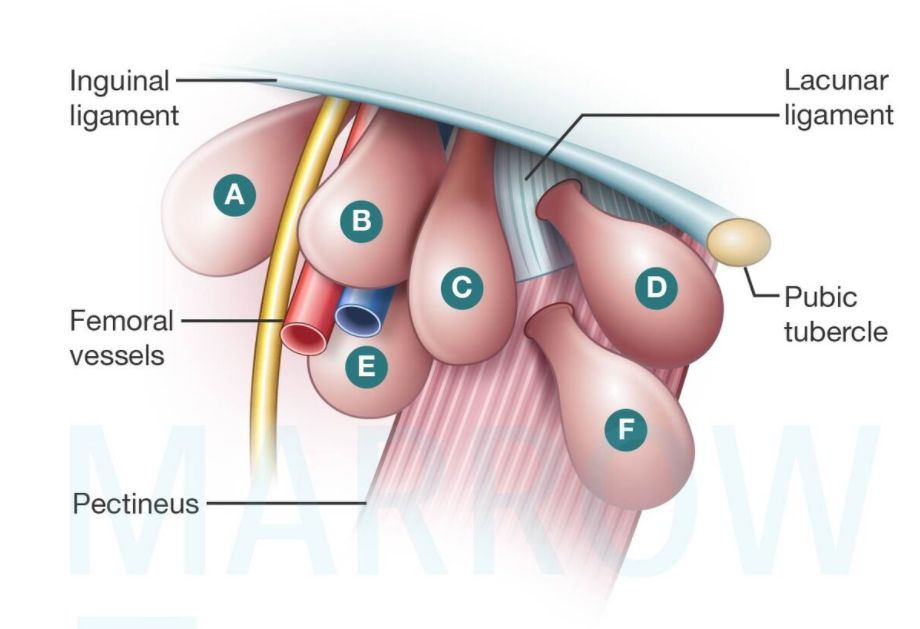
Answer: C
Flashcard 2: _____ system of tooth charting:
Number is assigned to each quadrant and that number is placed before tooth's number.
Answer: Modified FDI
Flashcard 3: _____ femoral hernia is lateral to the femoral artery
Answer: Hasselbach's
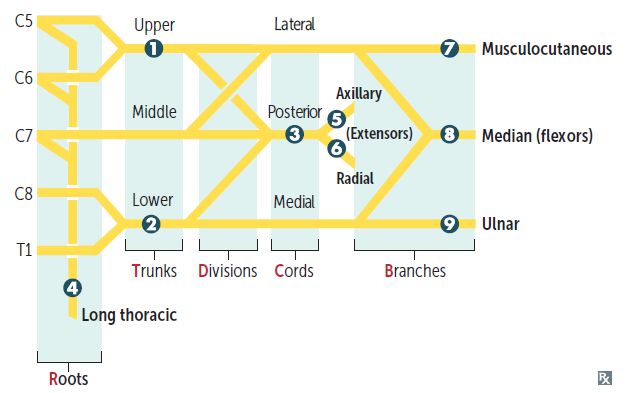
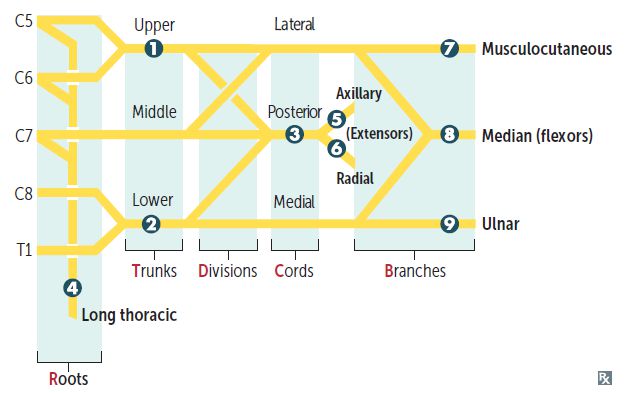
Flashcard 4: A lesion to #_____ would result in deltoid paralysis.
Answer: 5 (axillary nerve injury)
Flashcard 5: A lesion to #2 would result in _____
Answer: Klumpke palsy (total claw hand)
Flashcard 6: A lesion to #_____ (C5-C7) would result in winged scapula.
Answer: 4 (long thoracic nerve injury)
Flashcard 7: A lesion to #1 (upper trunk injury) would result in _____
Answer: Erb palsy ("waiter's tip.")
Flashcard 8: _____ femoral hernia is under the pectineus fascia
Answer: Cloquet's
Flashcard 9: A proximal lesion to #_____ would result in "Pope's blessing", loss of sensation in _____ nerve distribution
Answer: 8 (proximal median nerve injury)
Flashcard 10: A lesion to #_____ would result in difficulty flexing elbow and variable loss of sensation
Answer: 7 (musculocutaneous nerve injury)
Flashcard 11: 0d74f88efb864526b2dd6ddd48c02015-ao-1
Answer:
Extra:
Flashcard 12: anti rabies vaccine is always given in _____ region
Answer: deltoid
Extra:
Flashcard 13: 61b7ac26929c41bcb8bca9ea5fd0ef5b-ao-3
Answer:
Extra:
Flashcard 14: 50315340d809457bbc2d620b9b62c732-ao-1
Answer:
Extra:
Flashcard 15: _____ was the author of 1st book on scientific medicine
Answer: andreas vesalius
Extra:
Flashcard 16: Temporomandibular disorder (TMD) can arise from problems involving:- temporomandibular _____ derangement- pathologic contraction of muscles of mastication- mandibular nerve hypersensitivity
Answer: joint
Flashcard 17: A long thoracic nerve lesion presents with: #1 - inability to abduct arm above _____#2 - inability to anchor scapula to thoracic cage
Answer: horizontal position
Flashcard 18: Injury to the _____ nerve presents as: 1. flattened deltoid (appearance)2. loss of arm abduction at shoulder (>15) (action)3. loss of sensation over the deltoid muscle and lateral arm (sensation)
Answer: axillary (C5-C6)
Flashcard 19: Injury to the _____ nerve presents as decreased medial thigh sensation and adduction.
Answer: obturator
Flashcard 20: Repetitive pronation / supination of the forearm can result in a _____ nerve palsy due to irritation by the superficial and deep parts of the supinator muscle
Answer: deep radial
Flashcard 21: Extravasated urine in urethral injury cannot pass into the medial thigh below _____ line due to the firm attachment of Colles' fascia to the fascia lata.
Answer: Holden's
Flashcard 22: Lesions to CN _____ result in shoulder droop on the ipsi-lateral side of the lesion
Answer: XI (accessory)
Flashcard 23: Injury to the _____ nerve (C5-C6) is commonly due to:- fracture at the surgical neck of the humerus - anterior dislocation of the humerus
Answer: axillary
Flashcard 24: A lesion to #_____ (C5-C7) would result in winged scapula.
Answer: 4 (long thoracic nerve injury)
Flashcard 25: Vernet syndrome, which presents with dysfunction of cranial nerves _____, 10, and 11, is due to lesions of the jugular foramen
Answer: 9
Flashcard 26: Wrist slash injuries:A deep laceration on the _____ side of the wrist may injure the ulnar artery, ulnar nerve, and flexor carpi ulnaris tendon.
Answer: ulnar
Flashcard 27: Injury to the _____ nerve presents as loss of sensation on the dorsum of the foot and foot drop (motor).
Answer: common peroneal
Flashcard 28: _____ syndrome is a spinal cord lesion due to compression of spinal roots from L2 and below
Answer: Cauda equina
Flashcard 29: _____ (distortion of the hand) is most apparent when making a fist, and is due to a proximal median nerve lesion.
Answer: "Pope's blessing" hand (aka hand of benediction)
Flashcard 30: _____ result from portosystemic shunting between the left colic vein (portal) and retroperitoneal (of Retzius) (systemic) veins
Answer: Descending colon varices
Flashcard 31: If a patient is _____ during aspiration, an abscess may form in the posterior segment of the right upper lobe of the lung
Answer: lying on their right side
Flashcard 32: Irritation of the phrenic nerve can refer pain to the _____ shoulder region (Kehr sign) and cause hiccups
Answer: C3-C5
Flashcard 33: Sites of choice for an intraosseous access includes proximal _____, distal femur, the distal end of radius or ulna
Answer: tibia
Flashcard 34: Injury to the _____ nerve presents as decreased thigh flexion and leg extension
Answer: femoral
Flashcard 35: _____ hematoma is due to rupture of the middle meningeal artery (branch of maxillary artery)
Answer: Epidural
Flashcard 36: _____ syndrome is due to compression of the ulnar nerve at the wrist or hand.
Answer: Guyon canal
Flashcard 37: A lesion to #_____ would result in deltoid paralysis.
Answer: 5 (axillary nerve injury)
Flashcard 38: The two most common places of fracture in the orbit are the _____ and the orbital floor
Answer: medial wall
Flashcard 39: In a(n) _____ nerve injury, sensation is lost over the medial 1 1/2 fingers, including the hypothenar eminence.
Answer: ulnar
Flashcard 40: The left renal vein can become compressed between the _____ and SMA as it crosses the midline
Answer: aorta
Flashcard 41: Respiratory papillomatosis most commonly involves the _____ and glottic regions of larynx
Answer: supraglottic
Flashcard 42: The _____ and radius is in alignment in isolated lunate dislocation
Answer: capitate
Flashcard 43: The _____ reflex tests nerve roots S1 and S2 (tibial nerve)
Answer: Achilles
Flashcard 44: Inflammation of the _____ pleura, gallbladder, fibrous pericardium, and mediastinal pleura refer pain to the right shoulder via the phrenic nerve (C3-C5)
Answer: diaphramatic
Flashcard 45: _____ result from portosystemic shunting between the left gastric (portal) and esophageal branch of the azygos (systemic) veins
Answer: Esophageal varices
Flashcard 46: Loss of the _____ and supraspinatus in Erb palsy result in aDduction of the arm.
Answer: deltoid
Flashcard 47: A _____ is a collection of synovial fluid in the popliteal fossa in the gastrocnemius-semimembranous bursa.
Answer: Baker cyst
Flashcard 48: Loss of muscle action in an _____ nerve injury includes loss of:1. wrist flexion2. flexion of medial fingers (4th and 5th digits)3. abduction AND adduction of fingers (interossei)4. medial 2 lumbricals (4th and 5th digits)
Answer: ulnar
Flashcard 49: The lateral femoral cutaneous nerve is commonly injured (meralgia paresthetica) due to _____, obesity or pregnancy
Answer: tight clothing
Flashcard 50: If a patient is _____ during aspiration, an abscess may form in the superior segment of the right lower lobe of the lung
Answer: supine
Flashcard 51: Injury to the _____ nerve presents as difficulty climbing stairs and rising from a seated position due to loss of hip extension.
Answer: inferior gluteal
Flashcard 52: _____ result from portosystemic shunting between the short gastric veins (portal) and inferior phrenic (systemic) vein
Answer: Gastric (fundal) varices
Flashcard 53: Lumbar puncture is usually performed between _____ and L5
Answer: L3
Flashcard 54: A lesion to #_____ would result in Erb palsy ("waiter's tip.")
Answer: 1 (upper trunk injury)
Flashcard 55: The _____ reflex tests nerve roots C7 and C8 (radial nerve)
Answer: triceps
Flashcard 56: In a cervical or lumbar disc herniation, the disc typically herniates into the _____, affecting the inferior nerve
Answer: vertebral canal
Flashcard 57: _____ (condition) is due to compression of the lower trunk (roots C8-T1) and subclavian vessels
Answer: Thoracic outlet syndrome
Flashcard 58: Loss of muscle action in a _____ nerve injury includes loss of:1. wrist flexion2. flexion of lateral fingers (2nd and 3rd digits)3. thumb opposition (not thumb flexion)4. lateral 2 lumbricals (2nd and 3rd digits)
Answer: median
Flashcard 59: _____ pouch is seen in the gallbladder, serves as a potential space for gallstones to get lodged.
Answer: Hartmanns
Flashcard 60: Injury to the _____ nerve presents as decreased anterior and lateral thigh sensation.
Answer: lateral femoral cutaneous
Flashcard 61: In sialolithiasis, a single stone is more common in the _____, specifically in the wharton duct
Answer: submandibular gland
Flashcard 62: _____ muscle is not pierced when paracentesis is performed using the midline approach.
Answer: Transversus abdominis
Flashcard 63: _____ (gender) have increased risk for UTI due to a relatively short urethra
Answer: Females
Flashcard 64: Radial Head Subluxation impinges the _____ nerve, causing weakness of most of the posterior forearm extensors
Answer: deep radial
Flashcard 65: Gastric _____ (erosions or ulcers) may extend into and beyond the submucosa
Answer: ulcers
Flashcard 66: Seminiferous tubules, _____ chamber of the eye, the cornea and the brain are immunologically privileged sites
Answer: anterior
Flashcard 67: _____ fractures of the temporal bone are more common than transverse
Answer: Longitudinal
Flashcard 68: Which areas of the spinal cord are spared in a complete occlusion of the anterior spinal artery? _____ and Lissaeur's tract
Answer: Dorsal column
Flashcard 69: Muscles lost in Erb palsy include: 1. _____2. supraspinatus3. infraspinatus4. biceps brachii
Answer: deltoid
Flashcard 70: A cricothyrotomy establishes an airway between the cricoid and thyroid cartilages and requires an incision through (superficial to deep):1) skin2) _____ fascia3) investing and pretracheal fascial layers of the deep cervical fascia 4) cricothyroid membrane
Answer: superficial cervical
Flashcard 71: A proximal lesion to #_____ would result in "Pope's blessing", loss of sensation in median nerve distribution
Answer: 8 (proximal median nerve injury)
Flashcard 72: Intramuscular injections in the buttocks should be given in the _____ quadrant (specifically the von Hochstetter triangle) to avoid injury to the superior gluteal nerve
Answer: anterolateral
Flashcard 73: Disc herniation at _____ level will involve the gluteus medius and muscles of the anterior compartment of the leg
Answer: L4-L5
Flashcard 74: GI tract diverticula classically arise where the _____ perforates the muscularis externa (weak point in colonic wall)
Answer: vasa recta
Flashcard 75: The optimal site for obtaining vascular access in the lower extremity during cardiac catheterization is the _____ artery below the inguinal ligament
Answer: femoral
Flashcard 76: Normal Left ventricle thickness is _____ to 1.5 cm
Answer: 1.3
Flashcard 77: Loss of the _____ (muscle) in Erb palsy results in medial rotation of the arm.
Answer: infraspinatus
Flashcard 78: Foot drop is characterized by loss of _____ and dorsiflexion (movements) of the foot.
Answer: eversion
Flashcard 79: _____ neuroma may occur due to the entrapment of branches of medial plantar nerve.
Answer: Mortons
Flashcard 80: Loss of the _____ in Erb palsy results in extension and pronation of the forearm.
Answer: biceps brachii
Flashcard 81: Carpal tunnel syndrome is due to entrapment of the _____ nerve between the transverse carpal ligament and the carpal bones
Answer: median
Flashcard 82: Nevus of Ota is distributed along the _____ and the second branches of the trigeminal nerve.
Answer: first
Flashcard 83: Which muscle layers are cut through while entering the pleural cavity for inserting an intercoastal drain?_____ and the intercostals.
Answer: serratus anterior
Flashcard 84: _____ result from portosystemic shunting between the superior rectal (portal) and middle/inferior rectal (systemic) veins
Answer: Anorectal varices
Flashcard 85: Posterolateral instability of the knee joint occurs when there is damage to the _____ collateral ligament, popliteofibular ligament and popliteus tendon.
Answer: lateral
Flashcard 86: _____ cell (sphenoethmoidal cell) is surgically important as internal carotid artery may be related to its lateral wall
Answer: Onodi
Flashcard 87: Injury to the _____ nerve (C5-C7 (nerve roots)) is commonly due to upper trunk compression.
Answer: musculocutaneous
Flashcard 88: A lesion to #_____ would result in "Saturday night palsy" (wrist drop).
Answer: 6 (radial nerve injury)
Flashcard 89: The superior gluteal nerve is commonly injured due to _____ injection to the upper medial gluteal region (iatrogenic).
Answer: intramuscular
Flashcard 90: Wrist slash injuries:A deep laceration on the _____ side of the wrist may injure the radial artery, median nerve, flexor carpi radialis tendon, and palmaris longus tendon
Answer: radial
Flashcard 91: A lesion to #_____ would result in Klumpke palsy (total claw hand)
Answer: 2
Flashcard 92: Injury to the _____ nerve presents as decreased sensation of upper anterior thigh and an absent cremasteric reflex.
Answer: genitofemoral
Flashcard 93: _____ nerve (C5-T1) injury is commonly due to:- anteromedial supracondylar fracture of the humerus (proximal lesion)- carpal tunnel syndrome (distal lesion)- wrist laceration (distal lesion)
Answer: Median
Flashcard 94: A lesion to #_____ would result in difficulty flexing elbow and variable loss of sensation
Answer: 7 (musculocutaneous nerve injury)
Flashcard 95: _____ (condition) is due to a lesion of the long thoracic nerve that supplies the serratus anterior
Answer: Winged scapula
Flashcard 96: Glomus tumors are found in 2 sites: Glomus _____ and Glomus tympanicum
Answer: jugulare
Flashcard 97: Basilar skull fractures most often follow traumatic head injuries and commonly involve the _____ segment of the temporal bone
Answer: petrous
Flashcard 98: Proximal tibial nerve lesions present with:- foot _____flexion- foot everted at rest- loss of foot inversion- weakness of the extrinsic muscles of the foot
Answer: dorsi
Flashcard 99: Compression of the axilla (resulting in radial nerve injury) can occur due to improper use of _____ or sleeping with an arm over a chair (aka Saturday night palsy).
Answer: crutches
Flashcard 100: _____ syndrome is characterized by the compression of the sciatic nerve by the piriformis muscle
Answer: Pyriformis
Flashcard 101: _____ (condition) is due to traction or tear of the upper trunk (C5-C6 roots).
Answer: Erb palsy
Flashcard 102: When the acoustic neuroma affects the _____ fibers of the facial nerve, there will be hypoaesthesia of the posterior meatal wall
Answer: sensory
Flashcard 103: Syringomyelia most commonly occurs at spinal cord levels _____ - T1
Answer: C8
Flashcard 104: The _____ nerve is commonly injured due to- trauma - compression of the lateral aspect of the leg (ex Cast) - a fibular neck fracture
Answer: common peroneal
Flashcard 105: The _____ kidney is preferred for transplantation because the left renal vein is longer.
Answer: left
Flashcard 106: Disc herniation at _____ level will involve the gluteus maximus and muscles of the posterior and lateral compartment of the leg
Answer: L5-S1
Flashcard 107: _____ syndrome leads to atrophy of the thenar eminence, but spares sensation because the palmar cutaneous branch enters the hand external to the carpal tunnel
Answer: Carpal tunnel
Flashcard 108: Which regions of the colon are most vulnerable to hypoxia/ischemia? _____ and rectosigmoid junction
Answer: Splenic flexure
Flashcard 109: The _____ nerve may be transected during ligation of the superior thyroid artery during thyroid surgery
Answer: superior laryngeal
Flashcard 110: The _____ reflex tests nerve roots C5 and C6 (musculocutaneous nerve)
Answer: biceps
Flashcard 111: Injury to the _____ nerve results in:1. "ape hand / median claw" (appearance)2. loss of thenar muscles (action)3. no loss of sensation (sensation)
Answer: recurrent branch of the median
Flashcard 112: The _____temporal quadrant is the most exposed to trauma
Answer: infero
Flashcard 113: Establishment of the age of _____ years can be done by evaluation of the medial end of the clavicle
Answer: 22+
Flashcard 114: Patients with a supra_____ VSD of any size are advised to get VSDs surgically closed
Answer: cristal
Flashcard 115: Forearm space of parona can get infected from the _____ bursa
Answer: ulnar
Flashcard 116: Why does frontal trauma NOT cause occipital contrecoup injuries?_____
Answer: because the occipital skull is relatively flat and smooth.
Flashcard 117: Dacryocystitis is the inflammation of the lacrimal _____
Answer: sac
Flashcard 118: Compression of Baxter's nerve by the deep fascia that covers _____ is implicated to be a possible cause of chronic heel pain and plantar fasciitis.
Answer: abductor hallucis (muscle)
Flashcard 119: The most common site of a sebaceous cyst is _____ of the ear
Answer: postauricular sulcus
Flashcard 120: C_____ injury leads to decreased sensation over the lateral aspect of the neck and inferiorly over clavicles down to the rib space
Answer: 4
Flashcard 121: _____ femoral hernia is under the pectineus fascia
Answer: Cloquet's (F)
Flashcard 122: Keratic precipitates are proteinaceous cellular deposits occurring at the _____ of the cornea
Answer: endothelium
Flashcard 123: Most specific nerve involved in HZO is the _____ nerve
Answer: nasociliary
Flashcard 124: _____ is a common site for carcinoma in nasopharynx.
Answer: Fossa of Rossenmuller
Flashcard 125: Sensory abnormalities involving _____ are commonly seen in neurogenic thoracic outlet syndrome.
Answer: T1 (dermatome)
Flashcard 126: _____ Mediastinal Goiter are supplied by superior and inferior thyroid arteries
Answer: Secondary
Flashcard 127: The right _____ vein is the most preferred for central venous cannulation.
Answer: internal jugular
Flashcard 128: Fracture of _____ is the most common fracture leading to CSF rhinorrhea.
Answer: cribriform plate of ethmoid
Flashcard 129: The surgical demarcation between level III and level IV in the neck is the horizontal line along the inferior border of _____
Answer: cricoid cartilage
Flashcard 130: The most common site of ectopic parathyroid gland in recurrent or persistent hyperparathyroidism is _____
Answer: paraoesophageal
Flashcard 131: Herpes zoster ophthalmicus is an acute infection of the _____ ganglion of the fifth cranial nerve by the varicella-zoster virus.
Answer: Gasserian
Flashcard 132: Ameloblastoma arises most commonly from the _____
Answer: mandible
Flashcard 133: What is the most common type of disc prolapse in terms of location of disc herniation?_____
Answer: Paracentral
Flashcard 134: What is responsible for causing difficulty in passage of catheter through the cystic duct, during cholangiography?_____
Answer: Spiral valves of Heister
Flashcard 135: Which artery is the artery of epistaxis in Kiesselbach's plexus?_____
Answer: Sphenopalatine artery
Flashcard 136: C_____ injury leads to decreased sensation over the anterior aspect of the neck
Answer: 3
Flashcard 137: _____ is the most common site of epistaxis in children and young adults.
Answer: Little s area
Flashcard 138: Which thoracic muscles are not pierced when doing pleural tapping in the midaxillary line?_____
Answer: Transversus thoracis
Flashcard 139: Commonest site of origin for nasopharyngeal carcinoma is the _____
Answer: fossa of Rosenmller.
Flashcard 140: Superficial sensory branch of the _____ nerve is most commonly used for nerve biopsy in neuritic leprosy.
Answer: radial
Flashcard 141: A black eye may be from fracture of the floor _____ cranial fossa
Answer: anterior
Flashcard 142: The _____ on the posterior abdominal wall is the usual site chosen for transplantation of the kidney.
Answer: iliac fossa
Flashcard 143: Deformity of which ligament can lead to instability and deformity of tarsometatarsal joint?_____
Answer: Lisfranc ligament
Flashcard 144: Which recurrent laryngeal nerve is more prone to injury?_____
Answer: Left>Right
Flashcard 145: An infection in the Thenar space can spread to the _____ bursa
Answer: radial
Flashcard 146: _____ represents the classical location of femoral hernia
Answer: C
Flashcard 147: Which branch of the middle meningeal artery is most commonly involved in EDH?_____
Answer: Posterior branch
Flashcard 148: Which dermatome is most commonly affected in shingles?_____
Answer: Thoracic
Flashcard 149: Anaesthesia in the distribution of the _____ nerve may occur with zygoma #
Answer: infraorbital
Flashcard 150: Gunshot wounds of the temporal bone frequently result in loss of a _____ segment of the facial nerve
Answer: mastoid
Flashcard 151: What are the main collateral channels in IVC obstruction?_____
Answer: Azygous and hemizygous veins and vertebral venous plexuses (3)
Flashcard 152: Post tonsillectomy hemorrhage is commonly venous in origin, from the _____ vein.
Answer: paratonsillar/ external palatine
Flashcard 153: Jugular vein can bear the weight of upto _____ kgs in hanging
Answer: 2
Flashcard 154: Duodenal villous adenomas are commonly found around the _____ and are premalignant
Answer: ampulla of Vater
Flashcard 155: What is the most common location of hydatid cyst?_____
Answer: Liver>Lung
Flashcard 156: Which nerve is responsible for referred otalgia in tonsillitis?_____
Answer: Glossopharyngeal nerve
Flashcard 157: The most common site of an orbital blow out fracture is the _____ of the orbit.
Answer: floor
Flashcard 158: Laryngeal cysts are seen arising from _____.
Answer: Aryepiglottic folds
Flashcard 159: Calf level perforators- _____ perforator veins
Answer: Cockett
Flashcard 160: Ductal adenocarcinomas arise most commonly in the _____ of the pancreas.
Answer: head
Flashcard 161: SCFE presents as tenderness in _____ triangle
Answer: Scarpa's
Flashcard 162: Mucocele presents as a swelling in the _____ quadrant of the orbit.
Answer: superomedial
Flashcard 163: _____ is the second most frequently fractured facial bone.
Answer: Zygoma
Flashcard 164: Hangman's fracture is a fracture of pars interarticularis of _____
Answer: axis (C2).
Flashcard 165: Aortomeseteric angle is reduced to _____ degrees in SMA syndrome
Answer: 25
Flashcard 166: Crocodile tears occur due to faulty regeneration of parasympathetic fibers of _____ nerve
Answer: facial
Flashcard 167: Anesthesia of the cheek is very common, in blowout fractures due to the involvement of _____ nerve
Answer: infraorbital
Flashcard 168: Scalp bleeding is predominantly _____
Answer: arterial
Flashcard 169: _____ system of tooth charting: Number is assigned to each quadrant and that number is placed before tooth's number.
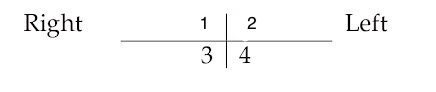
Answer: FDI
Flashcard 170: Which lymph node is enlarged in tonsillitis and base of tongue CA?_____
Answer: Jugulodigastric
Flashcard 171: _____ Mediastinal Goiter arise from Ectopic Thyroid tissue in chest
Answer: Primary
Flashcard 172: _____ syndrome includes features of superior orbital fissure syndrome, along with features of optic nerve involvement
Answer: Orbital apex
Flashcard 173: Collection of blood between periosteum of skull and scalp galeal aponeurosis is a _____
Answer: subgaleal hematoma
Flashcard 174: What is the wetting used in typical embalming fluid?_____
Answer: Glycerin
Flashcard 175: Foramen of _____ acts as a pathway for the spread of infections and tumors of the canal to the deep lobe of parotid.
Answer: Huschke
Flashcard 176: _____ femoral hernia is lateral to the femoral artery
Answer: Hasselbach's (A)
Flashcard 177: _____ abscess, can occur as a complication of mastoiditis, which forms due to infection of the air cells, at the posterior root of the zygoma
Answer: Zygomatic
Flashcard 178: Biopsy of the _____ (to examine minor salivary glands) is essential for the diagnosis of Sjgren syndrome
Answer: lip
Flashcard 179: Ewing's sarcoma arises from the _____ (not diaphysis) of the bone
Answer: bone marrow
Flashcard 180: _____ femoral hernia is anterior to the femoral vessels
Answer: Velpeau's (B)
Flashcard 181: The _____ vein is considered the most suitable vein for total parenteral nutrition
Answer: subclavian
Flashcard 182: In a patient with crocodile tears syndrome, the lesion is located _____ to the geniculate ganglion.
Answer: proximal
Flashcard 183: Le Fort I is a _____ # of the maxilla
Answer: transverse
Flashcard 184: Emphysema of the eyelids occurs more frequently with _____ wall fractures of the orbit
Answer: medial
Flashcard 185: At which point is the recurrent laryngeal nerve at the highest risk for injury during thyroid surgery?_____
Answer: At the level of Berry's ligament as it enters the larynx
Flashcard 186: Frey's syndrome is because of aberrant innervation of _____ nerve
Answer: auriculotemporal
Flashcard 187: What is the site of origin of antrochoanal polyp?_____
Answer: Mucosa of maxillary antrum
Flashcard 188: The earliest muscle to be involved in Volkmann's ischemic contracture is the _____
Answer: flexor digitorum profundus.
Flashcard 189: _____ index measures the transverse diameter of body of S1/whole width of sacrum
Answer: Corporobasal
Flashcard 190: Lupus of the larynx involves the _____ part of the larynx.
Answer: anterior
Flashcard 191: Occipital blow often leads to _____ fractures of the temporal bone
Answer: transverse
Flashcard 192: _____ haematoma does not show any colour change
Answer: Subgaleal (Layer of skull)
Flashcard 193: A site with an underlying bone is _____ likely to bruise.
Answer: more (more/less)
Flashcard 194: Radial bursa is drained by incision on _____ margin of thenar eminence
Answer: medial
Flashcard 195: Blowout fractures refer to isolated fractures of the _____
Answer: orbital floor
Flashcard 196: Larynx can be moved passively from side to side over the vertebrae giving a grating sensation called _____
Answer: laryngeal crepitus
Flashcard 197: Increased incidence of ischio-rectal fossa infection is due to _____
Answer: poor blood supply.
Flashcard 198: The tissue most resistant to knife penetration is the _____ (apart from bone or calcified cartilage).
Answer: skin
Flashcard 199: The _____ is an imaginary line joining the insertions of the four recti and is an important anatomical landmark when performing surgery.
Answer: spiral of Tillaux
Flashcard 200: Foramen of _____ acts as a pathway for the spread of parotid or superficial mastoid infections to the canal or vice versa.
Answer: Santorini
Flashcard 201: Bruising behind the ear may indicate a fracture of the _____ cranial fossa
Answer: middle
Flashcard 202: Which intercostal nerve is often the source of referred cardiac pain?_____
Answer: Intercostobrachial nerve
Flashcard 203: Murphy's point corresponds to the _____ rib tip intersection with _____ border of rectus.
Answer: 9th rib tip, right lateral border of rectus
Flashcard 204: McBurney's point lies at junction of _____ and _____ thirds of spino-umbilical line.
Answer: Lateral and middle
Flashcard 205: The _____ artery is palpated in infants to check for pulselessness before initiating CPR
Answer: brachial
Flashcard 206: The _____ is the landmark for the pudendal nerve block.
Answer: ischial spine
Flashcard 207: Schatzki's ring is associated with _____ hernia of the stomach
Answer: hiatus
Flashcard 208: Thoracic outlet syndrome (TOS) is a neurovascular syndrome caused due to the compression of the _____ trunk of brachial plexus (C8 and T1) and _____ vessels
Answer: lower; subclavian
Flashcard 209: The _____ quadrant of abdomen is preferred for paracentesis
Answer: left lower
Flashcard 210: External laryngocele that herniates through the _____ membrane to appears as a swelling in the neck.
Answer: thyrohyoid
Flashcard 211: _____ is the narrowest part of the ureter and most likely site for stone to lodge.
Answer: Vesicoureteric junction
Flashcard 212: The electrode of a cochlear implant is placed in the scala _____
Answer: tympani.
Flashcard 213: The structure marked as 1 is the _____ which is removed in infundibulotomy(FESS).
Answer: uncinate process
Flashcard 214: The lymphatic spread of testicular tumors is to the _____ lymph nodes.
Answer: para-aortic
Flashcard 215: The vascular pedicle for the latissimus dorsi (LD) flap is based on the _____ artery
Answer: thoracodorsal
Keywords: Clinical Anatomy flashcards, medical flashcards, NEET PG preparation, USMLE Step 1 flashcards, Anki alternative, spaced repetition medical, OnCourse flashcards