Back
Weech Formula for Weight and Height: Pediatrics High-Yield Guide for NEET PG and USMLE (2026)
Master the Weech Formula for pediatric weight and height assessment. Complete guide with calculations, clinical applications, exam tips, and practice questions for NEET-PG and USMLE 2026.
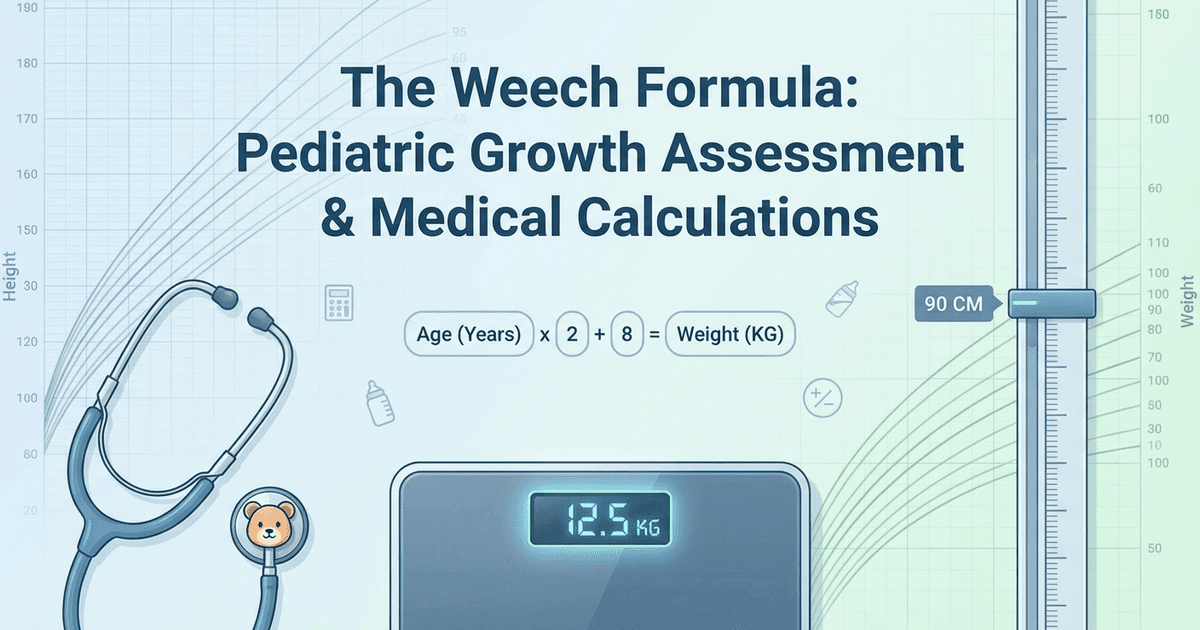
Weech Formula for Weight and Height: Pediatrics High-Yield Guide for NEET PG and USMLE (2026)
The Weech Formula is a fundamental pediatric assessment tool that every medical student preparing for NEET-PG and USMLE must master. This simple yet powerful formula allows rapid estimation of expected weight and height in children aged 1-10 years, making it an essential component of pediatric examinations and clinical practice.
With pediatrics comprising 8-10% of NEET-PG questions and being a core component of USMLE Step 2 CK, understanding growth assessment formulas like Weech can significantly boost your exam performance. This comprehensive guide covers everything you need to know about the Weech Formula, its clinical applications, limitations, and high-yield exam pearls.
What is the Weech Formula?
The Weech Formula is a mathematical tool used to estimate the expected weight and height of children between 1-10 years of age. Developed as a quick bedside calculation method, it provides healthcare providers with baseline expectations for pediatric growth parameters.
The Weech Formula Components
The formula consists of two primary calculations:
For Weight:
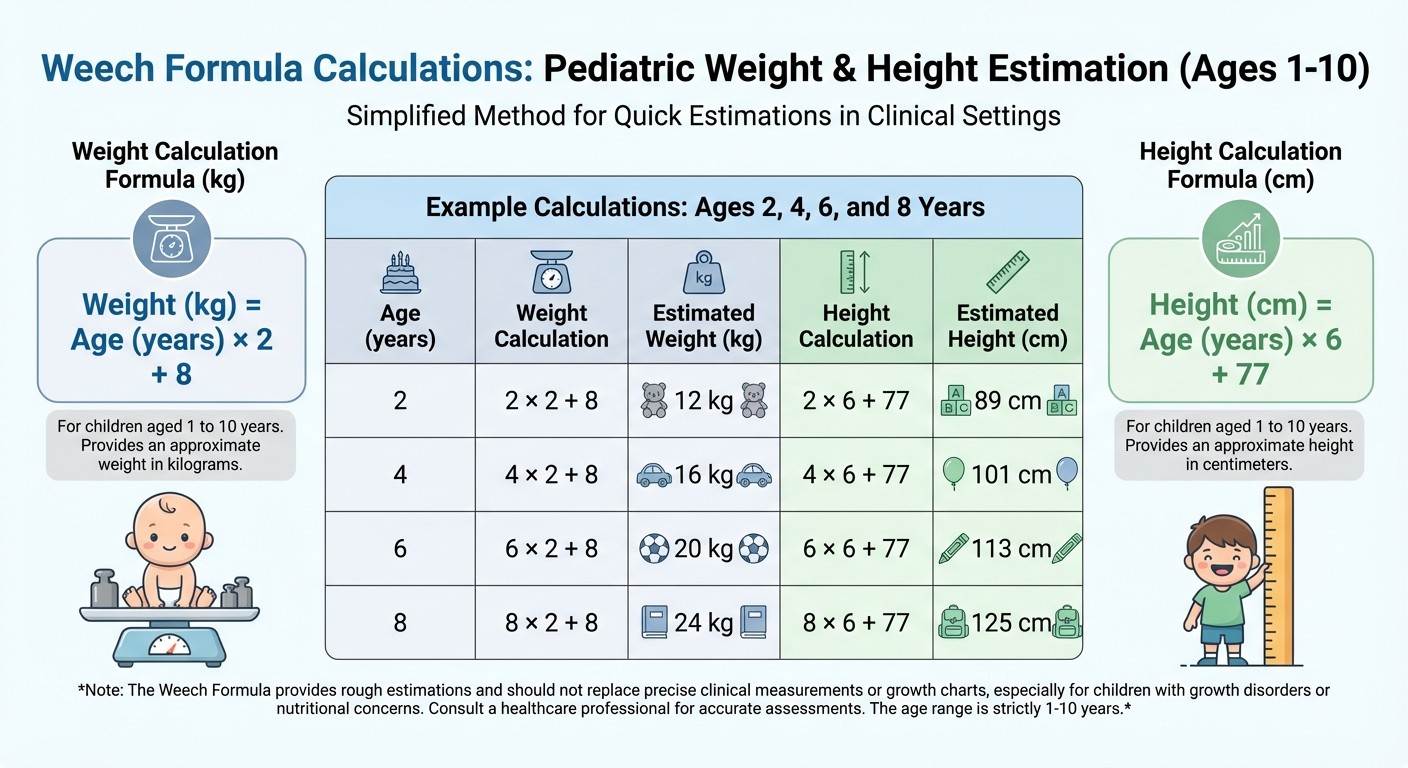
Weight (kg) = Age (years) × 2 + 8
For Height:
Height (cm) = Age (years) × 6 + 77
These formulas provide approximate values that should always be compared with standardized growth charts for comprehensive assessment.
Detailed Weech Formula Calculations
Weight Calculation Breakdown
The weight formula Weight (kg) = Age (years) × 2 + 8 is based on the average weight gain pattern in healthy children:
Age (Years) | Calculation | Expected Weight (kg) |
|---|---|---|
1 | (1 × 2) + 8 | 10 kg |
2 | (2 × 2) + 8 | 12 kg |
3 | (3 × 2) + 8 | 14 kg |
4 | (4 × 2) + 8 | 16 kg |
5 | (5 × 2) + 8 | 18 kg |
6 | (6 × 2) + 8 | 20 kg |
7 | (7 × 2) + 8 | 22 kg |
8 | (8 × 2) + 8 | 24 kg |
9 | (9 × 2) + 8 | 26 kg |
10 | (10 × 2) + 8 | 28 kg |
Height Calculation Breakdown
The height formula Height (cm) = Age (years) × 6 + 77 reflects typical linear growth patterns:
Age (Years) | Calculation | Expected Height (cm) |
|---|---|---|
1 | (1 × 6) + 77 | 83 cm |
2 | (2 × 6) + 77 | 89 cm |
3 | (3 × 6) + 77 | 95 cm |
4 | (4 × 6) + 77 | 101 cm |
5 | (5 × 6) + 77 | 107 cm |
6 | (6 × 6) + 77 | 113 cm |
7 | (7 × 6) + 77 | 119 cm |
8 | (8 × 6) + 77 | 125 cm |
9 | (9 × 6) + 77 | 131 cm |
10 | (10 × 6) + 77 | 137 cm |
Clinical Applications of the Weech Formula
Emergency Department Usage
In emergency settings, the Weech Formula serves multiple critical functions:
1. Rapid Triage Assessment: Quick identification of children with significant growth deviations
2. Medication Dosing: When scales are unavailable, estimated weight guides drug calculations
3. Equipment Selection: Appropriate sizing for medical devices and procedures
4. Initial Screening: Identifies patients requiring detailed nutritional assessment
Routine Pediatric Care
The formula assists in:
Well-child visits: Screening tool for growth abnormalities
Nutritional counseling: Baseline for dietary interventions
Parental education: Helping families understand normal growth expectations
Follow-up planning: Establishing monitoring schedules for at-risk children
High-Yield Exam Tips for NEET-PG and USMLE
Common Question Patterns
NEET-PG typically tests:
1. Direct formula application
2. Identification of growth abnormalities
3. Comparison with Indian growth standards
4. Emergency medication dosing scenarios
USMLE Step 2 CK focuses on:
1. Clinical vignettes requiring rapid assessment
2. Differential diagnosis of failure to thrive
3. Nutritional intervention planning
4. Family counseling scenarios
Memory Mnemonics
For Weight Formula (Age × 2 + 8):
"Weech Weight: Two times age plus Eight"
"Weight goes up by TWO every year after EIGHT"
For Height Formula (Age × 6 + 77):
"Height grows Six cm yearly after Seventy-Seven"
"Six and seventy-seven for height calculation"
Key Exam Pearls
1. Age Range: Only valid for 1-10 years (critical limitation)
2. Gender Neutrality: Doesn't account for male/female differences
3. Population Variance: Based on Western populations; may need adjustment
4. Emergency Use: Primary application in urgent care settings
5. Screening Tool: Not diagnostic; requires correlation with growth charts
Limitations and Considerations
Age Restrictions
The Weech Formula should not be used for:
Infants under 1 year: Rapid growth changes make formula inaccurate
Children over 10 years: Puberty significantly alters growth patterns
Premature infants: Corrected gestational age needed
Children with chronic diseases: Growth may be significantly altered
Population Variability
Important considerations include:
Ethnicity: Formula based on Caucasian populations
Socioeconomic factors: Nutrition access affects accuracy
Geographic location: Regional growth patterns vary
Genetic factors: Family height/weight patterns influence individual growth
Practice Questions and Clinical Scenarios
Question 1: Direct Application
A 6-year-old child presents to the emergency department. Using the Weech Formula, what would be the expected weight and height?
Answer:
Weight = (6 × 2) + 8 = 20 kg
Height = (6 × 6) + 77 = 113 cm
Question 2: Clinical Correlation
A 4-year-old child weighs 12 kg. How does this compare to Weech Formula expectations, and what additional assessment is needed?
Answer:
Expected weight = (4 × 2) + 8 = 16 kg
Actual weight (12 kg) is 25% below expected
Requires detailed nutritional assessment and growth chart plotting
Consider failure to thrive evaluation
Question 3: Emergency Dosing
In an emergency where a 5-year-old's exact weight is unknown, what dose of acetaminophen (15 mg/kg) would you calculate using Weech Formula?
Answer:
Estimated weight = (5 × 2) + 8 = 18 kg
Acetaminophen dose = 18 kg × 15 mg/kg = 270 mg
Always verify with actual weight when available
Conclusion and Clinical Takeaways
The Weech Formula remains an invaluable tool in pediatric medicine, offering quick and reliable estimates for weight and height in children aged 1-10 years. For medical students preparing for NEET-PG and USMLE examinations, mastering this formula is essential for both exam success and future clinical practice.
Key Takeaways:
Memorize both formulas: Weight = Age × 2 + 8; Height = Age × 6 + 77
Understand limitations: Age range 1-10 years, population variance, screening tool only
Practice calculations: Regular mental math exercises improve speed and accuracy
Integrate with growth charts: Always correlate with standardized references
Recognize clinical applications: Emergency dosing, triage, screening
Ready to master pediatric growth assessment? Explore our comprehensive pediatric growth and development lessons and practice with targeted pediatric MCQs on Oncourse. Our platform offers unlimited access to high-yield content, AI-powered learning assistance, and personalized study plans designed specifically for NEET-PG and USMLE preparation.
Take your pediatric knowledge to the next level with our growth charts and monitoring flashcards and join thousands of medical students achieving their exam goals with Oncourse's comprehensive study resources.