Back
USMLE Step 2 CK Tutoring in 2026: Do You Really Need a Human Tutor or Is AI Prep Enough?
Compare USMLE Step 2 CK tutoring vs AI-adaptive prep in 2026. Discover when human tutors are worth $200-400/hour and when AI prep platforms provide better ROI for most students.
USMLE Step 2 CK Tutoring in 2026: Do You Really Need a Human Tutor or Is AI Prep Enough?
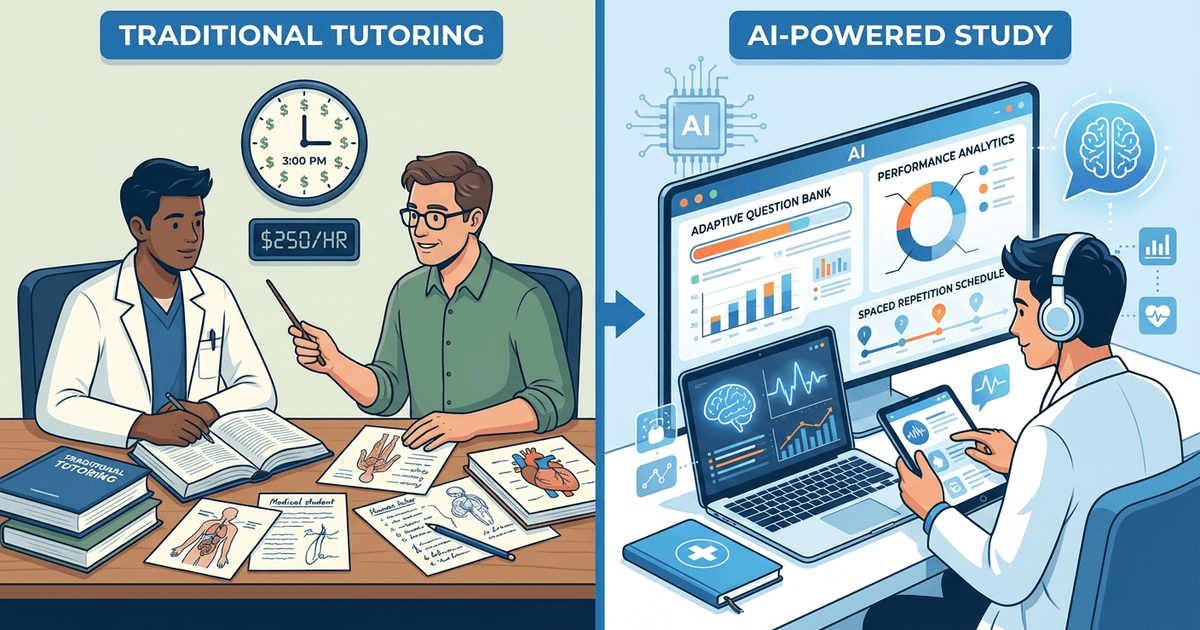
You are probably staring at your NBME scores wondering if dropping $250-400 per hour on a USMLE Step 2 CK tutor is worth it. The math is brutal: 20 hours of tutoring costs $5,000-8,000. That is rent money. Car payment money. "I could buy a decent laptop" money.
Here is what nobody tells you: most Step 2 CK tutors spend 60% of the session doing things AI can now do better. They review your practice test results, identify weak areas, and create study schedules. The remaining 40% — clinical reasoning, differential diagnosis frameworks, and exam strategy — is where human expertise actually matters.
The question isnt whether tutors are good. The question is whether AI-adaptive prep can replace most of what they do at a fraction of the cost.
The Real Cost of USMLE Step 2 CK Tutoring
Private USMLE Step 2 CK tutors charge $200-400 per hour in 2026. Top-tier tutors who scored 270+ typically command $300-350 per session. Most students need 15-25 hours of tutoring, making the total cost $4,500-8,750.
Tutor Type | Hourly Rate | Typical Hours Needed | Total Cost |
|---|---|---|---|
Resident/Recent Graduate | $200-250 | 20-25 hours | $4,000-6,250 |
High-Scoring Tutor (260+) | $280-350 | 15-20 hours | $4,200-7,000 |
Top Tier (270+) | $350-400 | 15-18 hours | $5,250-7,200 |
That is before you factor in scheduling headaches. Good tutors book out 3-4 weeks in advance. You cant get help when you need it most — right after bombing a practice test or struggling with a specific topic.
What Tutors Actually Do (And What AI Does Better)
Performance Analysis and Weak Area Identification
What tutors do: Review your NBME and UWorld performance, create spreadsheets tracking your scores by system, and identify patterns in your mistakes. What AI does: Oncourse's adaptive question bank tracks every question attempt in real-time, automatically identifying weak domains like cardiology or psychiatry and adjusting question weighting accordingly. Instead of waiting a week between tutor sessions to get this feedback, you get it after every study block. Winner: AI. No contest. Oncourse's performance analytics dashboard shows subject-wise percentage correct, time-per-question trends, and predicted score trajectory — giving you the same diagnostic clarity a tutor provides after reviewing your NBMEs, but updated automatically after every session.
Study Schedule Creation and Adjustment
What tutors do: Build 6-8 week study plans, allocate time per subject based on your weaknesses, and adjust the schedule based on your progress. What AI does: Adapts your study plan continuously. Struggling with infectious disease? The algorithm increases ID questions and schedules more frequent review. Crushing cardiology? It maintains your strength while focusing time elsewhere. Winner: AI. Human tutors update schedules weekly at best. AI adjusts after every session.
Spaced Repetition and Review Planning
What tutors do: Manually track which topics you have mastered and create "hit lists" of concepts to review before exam day. What AI does: Oncourse's spaced repetition system automatically schedules review of missed concepts at optimal intervals — no need for a tutor to manually build review lists. High-yield weaknesses resurface exactly when your brain is ready to consolidate them. Winner: AI. Humans cant compete with algorithmic precision for spaced repetition timing.
Where Human Tutors Still Win
Clinical Reasoning and Differential Diagnosis
The best Step 2 CK tutors dont just explain answers — they teach you how to think like a resident. When you see "chest pain in a 45-year-old diabetic," they walk you through the systematic approach: rule out MI first, consider PE, think about aortic dissection, then work through the bread-and-butter diagnoses.
This clinical reasoning framework is harder to learn from explanations alone. You need someone to interrupt your thought process and ask: "Why did you jump to pneumonia instead of considering PE first?"
Exam Strategy and Time Management
Tutors who recently took Step 2 CK know the current exam patterns. They teach you when to change your answer (almost never), how to flag questions effectively, and which cases deserve 2 minutes versus 30 seconds.
More importantly, they help you develop confidence. Step 2 CK is as much a mental game as a knowledge test. Good tutors teach you how to trust your clinical instincts and move on from difficult questions.
Personalized Motivation and Accountability
AI doesnt call you out when you are procrastinating. It doesnt ask why you skipped your study plan yesterday or help you push through the motivation dip at week 4 of dedicated study.
Some students need external accountability to stay on track. If you are someone who needs check-ins and gentle pressure, a tutor provides value that AI cant replicate.
The Hybrid Approach: Best of Both Worlds
Here is the strategy that makes financial sense: use AI for the bulk of your prep, then add targeted tutoring for specific needs.
Phase 1: AI-Driven Foundation (Weeks 1-4)
Use adaptive question banks for daily practice
Let AI identify your weak areas automatically
Follow AI-generated study schedules
Cost: $29-49/month for premium AI prep platforms
Phase 2: Targeted Tutoring (Weeks 5-6)
5-8 tutor sessions focused on clinical reasoning gaps
Work through your most challenging cases together
Fine-tune exam strategy and timing
Cost: $1,000-2,400 for focused tutoring
Total cost: $1,100-2,500 versus $4,500-8,750 for full tutoring.
When You Probably Need a Tutor
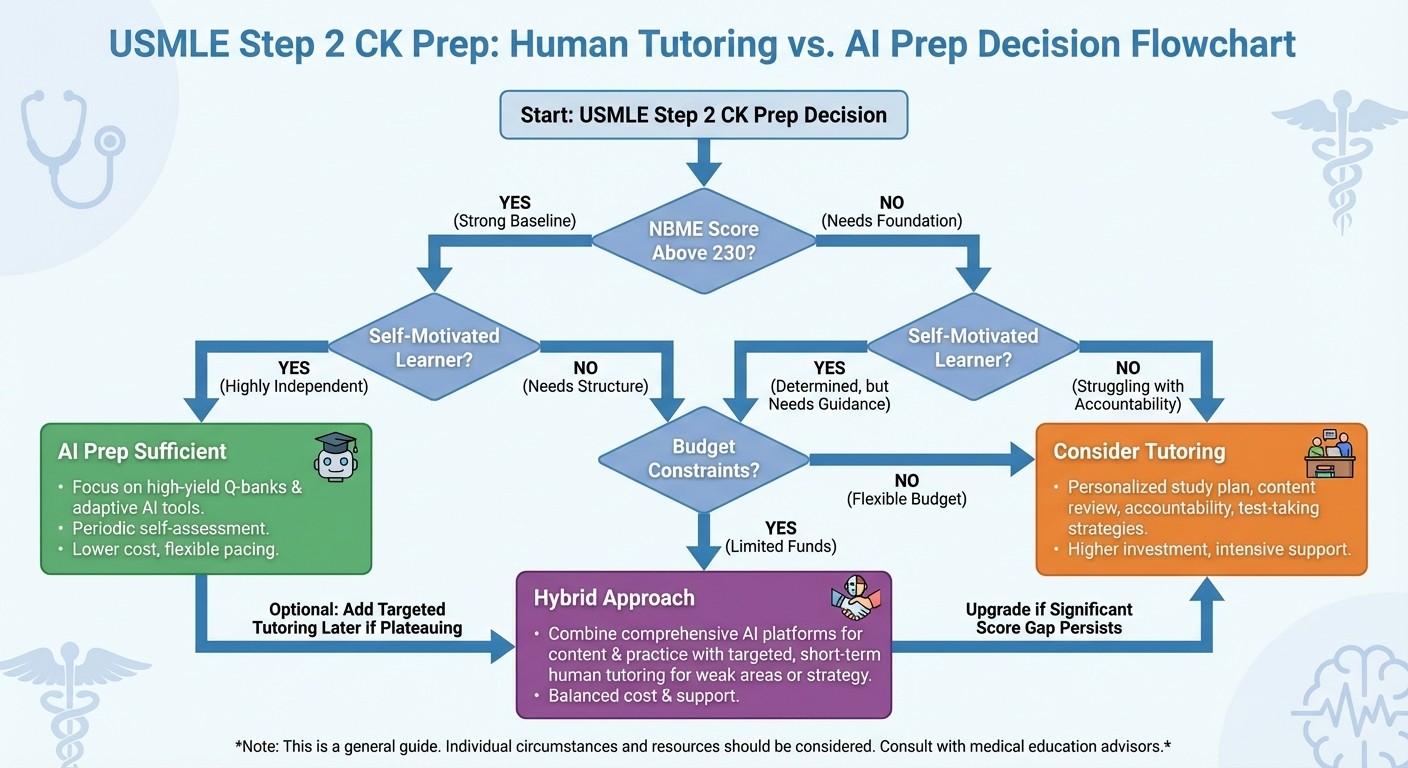
You are Scoring Below 220 on Practice Tests
If your NBME scores are consistently under 220, you likely have fundamental knowledge gaps that need systematic addressing. A good tutor can diagnose whether you are missing basic concepts or struggling with test-taking strategy.
You Have Severe Test Anxiety
Some students know the material but freeze during timed practice. Tutors can help you develop coping strategies and build confidence through gradual exposure to test conditions.
You Learn Better Through Verbal Discussion
If you are an auditory learner who processes information better through conversation, written explanations from AI might not stick. You need someone to talk through complex cases with you.
English Isnt Your First Language
While this article isnt IMG-specific, students who are less comfortable with medical English often benefit from tutors who can help parse complex question stems and teach efficient reading strategies.
When AI Prep Is Sufficient
You are Already Scoring 230+ on Practice Tests
If your foundation is solid, you dont need someone to re-teach you cardiology. You need targeted practice on your weak spots and efficient review of missed concepts. AI excels at this type of adaptive reinforcement learning.
You are Self-Motivated and Disciplined
AI-adaptive prep works best for students who can stick to study schedules without external pressure. If you are comfortable adjusting your own study plan based on performance data, you can skip the accountability aspect of tutoring.
You Have Limited Budget
Not everyone has $6,000 sitting around for tutoring. AI prep gives you 80% of the benefit at 10% of the cost. For most students, that math works out.
You Need Flexible Scheduling
Medical students and residents have unpredictable schedules. AI is available at 2 AM when you finish a shift. Tutors are not.
How to Evaluate AI-Powered Prep Platforms
Not all AI study tools are created equal. Here is what separates effective AI prep from glorified question banks with chatbot features:
Adaptive Algorithm Sophistication
The platform should adjust question difficulty and topic distribution based on your performance patterns — not just serve random questions from categories you got wrong.
Granular Performance Tracking
Look for detailed analytics that show improvement trends, time-per-question by topic, and score predictions. Surface-level "% correct by subject" isnt enough.
Quality of Explanations
AI explanations should go beyond restating the correct answer. The best platforms explain why wrong answers are wrong and provide clinical context for the correct choice.
Integration of Learning Modalities
Effective platforms combine questions, flashcards, and spaced repetition. Questions identify gaps, flashcards reinforce concepts, and spaced repetition ensures long-term retention.
Self-Study vs Tutor: The Performance Data
Students using AI-adaptive prep platforms report average score improvements of 25-35 points over 6-8 weeks of dedicated study. Students working with tutors report similar improvements: 30-40 points on average.
The key difference isnt the final score — it is the cost per point gained:
AI prep: ~$40-60 per point improvement
Private tutoring: ~$150-250 per point improvement
For most students, the ROI favors AI prep unless you have specific learning needs that require human intervention.
Making Your Decision: A Framework
Ask yourself these questions:
1. Am I scoring 230+ on practice tests? If yes, AI prep is probably sufficient.
2. Do I struggle with test-taking strategy more than content knowledge? If yes, consider targeted tutoring sessions.
3. Can I afford 15-20 hours of tutoring without financial stress? If no, focus on AI prep.
4. Do I need external accountability to stay motivated? If yes, budget for some human support.
5. Am I comfortable with technology-driven learning? If no, traditional tutoring might be a better fit.
The Bottom Line
USMLE Step 2 CK tutoring isnt automatically worth the cost in 2026. AI-adaptive prep platforms now handle most of what tutors traditionally provided — performance analysis, schedule optimization, and spaced repetition — at a fraction of the price.
Tutoring still makes sense for students who need clinical reasoning coaching, have severe test anxiety, or require external motivation. But for most Step 2 CK candidates, especially those already scoring above 230, AI prep provides better value.
The smartest approach? Start with AI-adaptive prep for your foundation, then add 5-8 targeted tutor sessions if you hit specific roadblocks. You will save thousands while getting the personalized support where it actually matters.
Frequently Asked Questions
How much does USMLE Step 2 CK tutoring cost in 2026?
Private tutors charge $200-400 per hour, with most students needing 15-25 hours of tutoring. Total costs range from $4,000-8,750 depending on the tutor's experience and your preparation needs.
Can AI prep really replace a human tutor for Step 2 CK?
AI excels at performance tracking, adaptive question delivery, and spaced repetition scheduling. However, human tutors are still better for clinical reasoning coaching, exam strategy, and motivation. The best approach combines both.
What NBME score indicates I need a tutor vs AI prep?
If you are consistently scoring below 220, consider tutoring for systematic knowledge gap analysis. Above 230, AI-adaptive prep is usually sufficient. Between 220-230, evaluate your specific weak areas.
How do I know if an AI prep platform is actually adaptive?
Look for platforms that adjust question difficulty and topic weighting based on your performance patterns, provide granular analytics, and modify study schedules automatically. Simple question banks with basic tracking arent truly adaptive.
Is the hybrid approach really cost-effective?
Yes. Using AI prep for weeks 1-4, then adding 5-8 targeted tutor sessions costs $1,100-2,500 total versus $4,500-8,750 for full tutoring. You get most of the benefit at much lower cost.
What if I am not comfortable with technology-based learning?
If you strongly prefer human interaction and verbal explanations, traditional tutoring might be worth the extra cost. However, most modern AI platforms are user-friendly and many students adapt quickly to the format.
Prepare smarter with Oncourse AI — adaptive MCQs, spaced repetition, and AI explanations built for USMLE Step 2 CK. Download free on Android and iOS.