Back
USMLE Step 2 CK Tutoring in 2026: Do You Actually Need It, or Can AI Replace It?
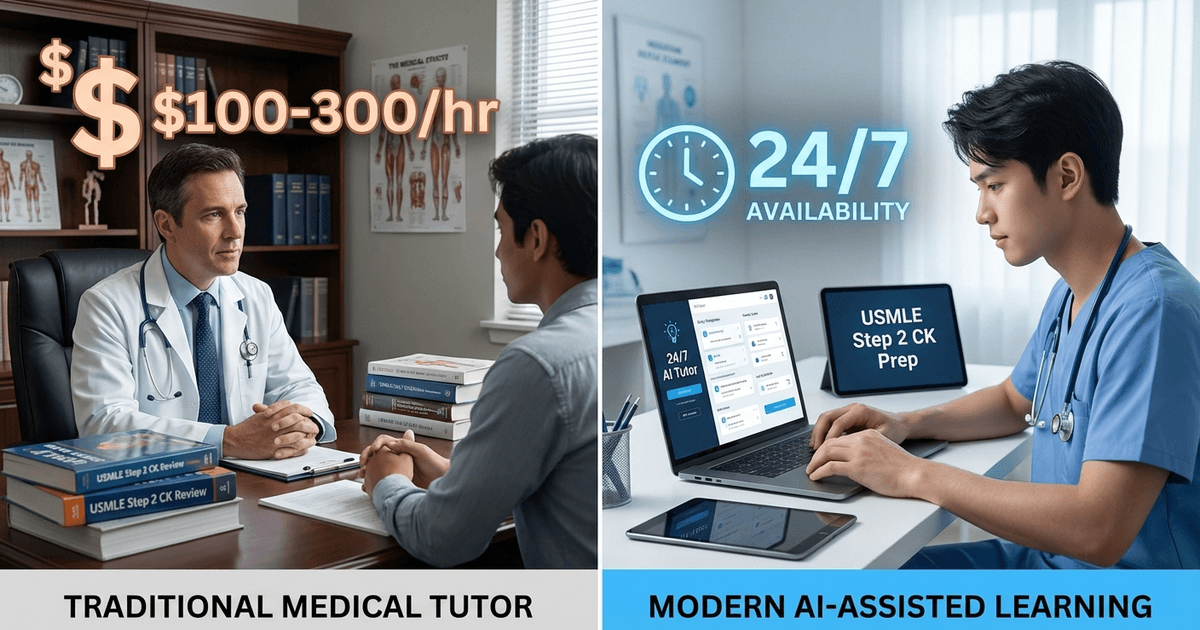
Traditional tutoring costs $100-300/hour. AI-powered prep adapts 24/7 for a fraction of the cost. Here's a clear decision framework for when tutoring adds real value vs. when AI is the smarter choice for Step 2 CK.
USMLE Step 2 CK Tutoring in 2026: Do You Actually Need It, or Can AI Replace It?
You are probably staring at Step 2 CK prep options right now, wondering if you should shell out $150-300 per hour for a private tutor. The math is brutal — even 10 sessions costs $1,500-3,000. Meanwhile, AI-powered platforms that adapt to your exact weak spots cost a fraction of that and never sleep.
Here's what most students dont realize: traditional tutoring works for specific situations, but AI has fundamentally changed what "personalized medical exam prep" means. The real question isnt whether tutoring works — its whether it works better than what you can already access 24/7 on your laptop.
This isnt about choosing sides. Its about understanding when each approach genuinely makes sense for your situation, your timeline, and your wallet.
The Tutoring Reality Check: When $200/Hour Actually Pays Off
Step 2 CK tutoring typically runs $100-300 per hour in 2026, with most experienced tutors charging $150-250. Package deals exist, but you are still looking at $2,000-4,000 for comprehensive prep.
When Tutoring Genuinely Helps
Catastrophic Knowledge Gaps
If you scored below 200 on practice NBMEs consistently, you might have fundamental clinical reasoning gaps that need human intervention. A good tutor can identify whether you are missing basic pathophysiology, struggling with clinical decision-making, or simply need better test-taking strategies.
Severe Test Anxiety
Some students freeze during timed conditions despite knowing the material cold. Experienced tutors can work through anxiety management techniques and help you practice under pressure. AI cant replicate the human element of talking you through panic responses.
Accountability Issues
If you cant stick to a study schedule without external pressure, a tutor provides structure. Weekly sessions force you to show up prepared and maintain momentum. This matters more for students who have repeatedly failed to self-study effectively.
Need for Real-Time Feedback on Clinical Reasoning
Explaining your diagnostic process out loud to another human remains valuable. A tutor can catch subtle errors in your clinical thinking that you might miss when studying alone.
The Tutoring Trap
Most students assume tutoring is automatically better because its expensive and "personalized." But traditional tutoring has serious limitations:
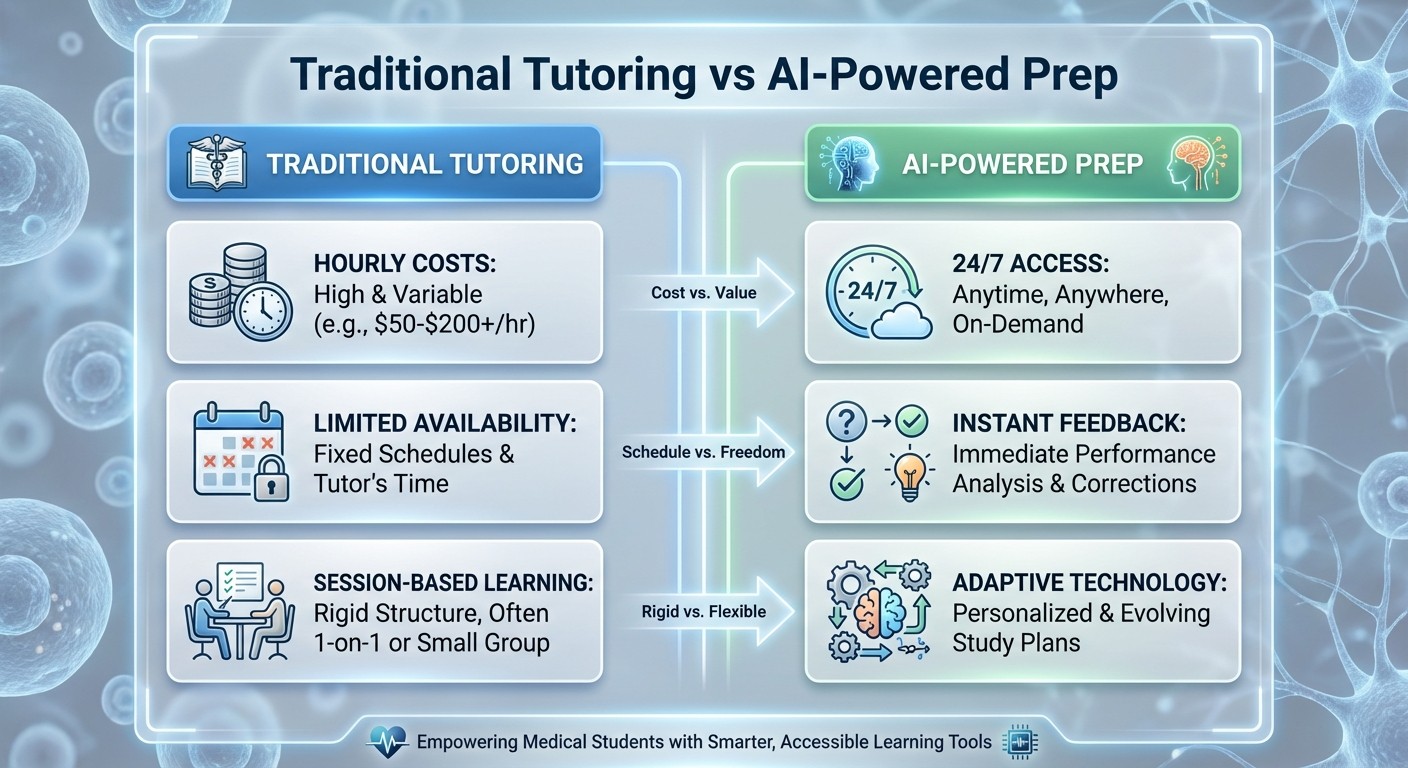
Session-Based Learning: You only get help during scheduled hours
One-Size-Fits-All Explanations: Even good tutors cant adapt their teaching style instantly to match how you learn best
Limited Question Volume: You cant afford enough hours to review hundreds of practice questions with a tutor
No Spaced Repetition: Tutors dont track which concepts you forget and bring them back at optimal intervals
How AI Has Changed Medical Exam Prep
AI-powered prep platforms in 2026 do things that were impossible even 2 years ago. The technology has moved beyond simple question banks into genuine adaptive learning.
What AI Does That Tutors Cannot
24/7 Availability for Concept Clarification
When you hit a confusing cardiology case at 2 AM, you can immediately ask an AI tutor to explain the underlying mechanism, walk through the differential, or clarify why specific treatments are chosen. With Rezzy's lesson chat feature, you get instant explanations that adapt to your level — whether you need basic concepts or advanced clinical pearls.
Immediate Feedback on Every Question
Traditional Qbank explanations tell you the right answer. AI explanation chat tells you why your specific wrong choice was tempting, what clinical reasoning led you astray, and how to avoid similar traps. This happens automatically for every question — not just the ones you discuss with a tutor.
Adaptive Spaced Repetition
AI tracks exactly which cardiology concepts you missed 3 weeks ago and brings them back when you are most likely to forget them. It identifies patterns — like consistently missing questions about heart failure management — and adjusts your daily practice accordingly.
Case-Based Clinical Reasoning Practice
Platforms like Oncourse now offer AI-guided clinical rounds that simulate Step 2 CK scenarios. You work through patient cases step-by-step, making diagnostic and treatment decisions with immediate feedback. This mimics the case-based teaching that tutors provide, but you can run 5-10 cases per session instead of 1-2.
Personalized Study Plans Based on Performance Data
AI analyzes your performance across thousands of practice questions to identify exactly which internal medicine subspecialties need attention. Instead of generic study schedules, you get daily plans that focus on your actual weak areas.
Real-World AI Advantages
The numbers matter. Students using adaptive AI platforms often practice 40-60 questions daily with detailed explanations — thats more feedback in one day than most tutoring packages provide in weeks.
When you get a complex nephrology question wrong, AI explanation chat immediately breaks down why each distractor was written to confuse you, what the question stem was actually testing, and how to recognize similar patterns. Do this across 50 questions daily, and you are getting tutor-level insight at scale.
The Decision Matrix: When to Choose What
Use this framework to decide whether you need tutoring, AI prep, or both:
Your Situation | Recommendation | Why |
|---|---|---|
NBME scores 240+, need score optimization | AI-powered prep only | You understand concepts; you need volume and pattern recognition |
NBME scores 200-240, solid foundation | AI-powered prep with targeted tutoring | Use AI for daily practice; tutor for specific weak subjects |
NBME scores below 200, major gaps | Start with tutoring, then transition to AI | Build foundation first, then scale with AI |
Strong self-discipline, limited budget | AI-powered prep only | You can maintain momentum without external accountability |
Poor study habits, need accountability | Tutoring + AI combination | Human accountability + AI volume |
Limited prep time (8 weeks) | AI-powered prep only | You need maximum question exposure in minimum time |
Test anxiety issues | Tutoring for anxiety management + AI for content | Address psychological barriers while building knowledge |
The Smart Money Approach
Most successful Step 2 CK students in 2026 use a hybrid model:
1. AI for daily practice — 40-60 questions daily with immediate explanations and adaptive review
2. Targeted tutoring — 3-5 sessions focused on specific weak areas identified by AI analytics
3. AI for final review — Spaced repetition of missed concepts in the last 4 weeks
This approach costs $500-800 total instead of $3,000+ for comprehensive tutoring, while providing more total practice volume.
Step 2 CK Self-Study with AI: What Actually Works
If you choose the AI-powered route, here's what high-scorers actually do:
Daily Practice Structure
Morning: 20-30 timed questions across mixed subjects
Afternoon: Review all explanations using AI chat for unclear concepts
Evening: Target weak areas identified by adaptive algorithms
Using AI for Clinical Reasoning
When you encounter complex internal medicine cases, dont just read the explanation. Use AI clinical rounds to work through similar scenarios interactively. Ask follow-up questions: "What if the patient also had diabetes?" or "How would management change if this was an elderly patient?"
Maximizing AI Explanations
Instead of accepting the first explanation, dig deeper. If a cardiology question confused you, ask the AI to explain the underlying physiology differently, provide memory devices, or show you how to eliminate wrong choices systematically. This turns every wrong answer into a mini-tutoring session.
Pattern Recognition Training
AI platforms track which question types consistently trip you up. If you miss psychiatry questions about medication side effects, the system will serve you more similar questions until you master the pattern. This targeted practice is more efficient than random review.
When Tutoring Is Worth the Investment
Despite AI advantages, certain situations still justify tutoring costs:
You Need Human Accountability
If you have repeatedly failed to maintain study schedules, external pressure might be necessary. Some students need the social commitment of showing up prepared for someone else.
Complex Test-Taking Strategy Issues
Students who understand content but consistently choose wrong answers might have strategy problems that require human observation. A tutor can watch you work through questions and identify subtle errors in your approach.
Severe Clinical Reasoning Gaps
If practice questions consistently confuse you because you dont understand how clinical medicine works, not just what facts to memorize, you might need someone to teach you systematic approaches to patient care.
Time-Sensitive Retake Situations
Students retaking Step 2 CK with limited time might benefit from a tutor who can quickly identify exactly what went wrong the first time and create a focused remediation plan.
The AI-Native Approach: Oncourse for Step 2 CK
For students choosing AI-powered prep, platforms matter. Generic question banks with basic explanations arent the same as adaptive AI that actually learns your patterns.
Oncourse provides the complete AI tutoring experience: Rezzy functions as your always-available tutor, answering specific questions about complex cases or walking you through clinical reasoning in real time. When you practice questions and get them wrong, explanation chat breaks down not just the right answer, but why your specific choice was tempting and how to avoid similar traps.
The clinical rounds feature simulates the case-based teaching that expensive tutors provide — you work through patient presentations step-by-step, making diagnostic and management decisions with immediate AI feedback. This builds the clinical thinking that Step 2 CK specifically tests.
Students using this approach often find they can practice 50+ questions daily with tutor-level explanations, identify their weak areas automatically, and get targeted review without any human scheduling constraints.
Making the ROI Decision
Run the numbers for your specific situation:
Traditional Tutoring Path:
15 sessions × $200/hour = $3,000
Limited to tutor's schedule and pace
Covers maybe 200-300 questions in detail
AI-Powered Path:
Quality platform subscription: $50-100/month
Available 24/7, adapts to your pace
Covers 2,000+ questions with detailed explanations
Total cost for 3-month prep: $150-300
Hybrid Approach:
AI platform subscription: $200
5 targeted tutoring sessions: $1,000
Total: $1,200 with maximum flexibility
For most students, the AI-first approach provides better question volume, more consistent feedback, and significantly lower cost. Add targeted tutoring only for specific gaps that human insight can uniquely address.
Frequently Asked Questions
Can AI really replace the personalization of human tutoring?
Modern AI adaptation goes beyond what most human tutors provide. While tutors give generic explanations, AI platforms analyze your specific error patterns across thousands of questions and personalize daily practice accordingly. You get explanations tailored to exactly why you made each mistake.
How do I know if I need tutoring or can succeed with AI prep alone?
Take 2-3 practice NBMEs first. If you score consistently above 220 and understand most explanations when you read them, AI prep will likely be sufficient. If you score below 200 or frequently feel confused about basic clinical reasoning, consider starting with tutoring.
What about accountability — wont I slack off without a tutor?
AI platforms now include daily goals, streak tracking, and performance analytics that provide accountability. Many students find the data-driven feedback more motivating than weekly check-ins with tutors. However, if you have a history of abandoning study plans, human accountability might still be necessary.
Is AI-powered prep as effective for clinical reasoning as working with experienced physicians?
AI clinical case simulations have become sophisticated enough to replicate the case-based teaching that physician tutors provide. The advantage is volume — you can work through 5-10 cases daily instead of 1-2 per tutoring session. For pure clinical reasoning practice, AI often provides more repetitions.
How much can I realistically save by choosing AI over tutoring?
Comprehensive tutoring packages cost $2,000-4,000. Quality AI platforms cost $150-300 for complete prep. Even adding 5 targeted tutoring sessions keeps total costs under $1,500. Most students save $1,500-2,500 by using AI as their primary prep method.
What if I try AI prep and it doesnt work for me?
Start with AI prep early in your study timeline. If you arent seeing score improvements after 4-6 weeks of consistent practice, you can always add tutoring for specific weak areas. This approach lets you test AI effectiveness while keeping tutoring as a backup option.
The bottom line: Step 2 CK prep in 2026 isnt about choosing the most expensive option. Its about matching your prep method to your specific situation, learning style, and budget. For most students, AI-powered platforms now provide better question volume, more consistent feedback, and significantly lower cost than traditional tutoring.
Prepare smarter with Oncourse AI — adaptive MCQs, spaced repetition, and AI explanations built for USMLE Step 2 CK. Download free on Android and iOS.