Back
FMGE 2024-2025 Pass Percentage: What the Data Reveals and How to Beat the Odds on Your First Attempt
FMGE pass rate stays at 10-15%. Discover why 90% of students fail and the proven first-attempt strategy that separates successful candidates from repeat attempts in 2024-2025.
FMGE 2026 Pass Percentage: What the Data Reveals and How to Beat the Odds on Your First Attempt
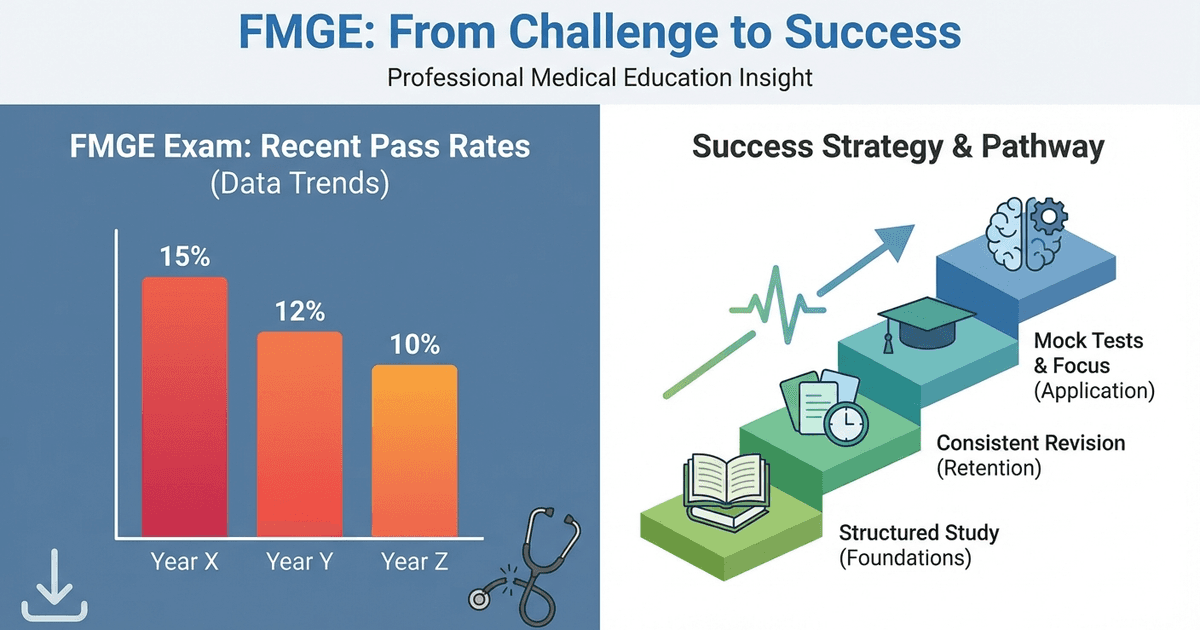
You probably just checked the latest FMGE results. The numbers hit hard — only 10-15% passed this session. If you are staring at a failed attempt or preparing for your first try, you are wondering what separates the 10% who make it from the 90% who dont.
Here is what the data actually tells us: FMGE isnt just tough because of the content. It punishes specific preparation mistakes that most students repeat session after session. The pass percentage hasnt budged above 15% in recent cycles not because the exam got harder, but because most candidates approach it the same way their seniors did — and failed.
300 MCQs across 19 subjects in 4.5 hours. That gives you 54 seconds per question, including the time to mark your answer. The students who clear FMGE in their first attempt dont just know more — they know what to prioritize and have trained their recall speed to match the exam's brutal pace.
Understanding FMGE Pass Percentage Trends 2024-2025
The Numbers That Matter
The FMGE passing rate has consistently remained in the 10-15% range across recent sessions. This low percentage isnt accidental — it reflects the National Board of Examinations' strategy to maintain strict quality control for foreign medical graduates entering Indian practice.
Session | Approximate Pass Rate | Total Candidates | Qualifying Score |
|---|---|---|---|
December 2024 | 12-14% | ~15,000 | Variable (percentile-based) |
June 2024 | 10-13% | ~18,000 | Variable (percentile-based) |
December 2023 | 11-15% | ~16,500 | Variable (percentile-based) |
The exact FMGE cut off marks vary each session because scoring follows a percentile system rather than fixed marks. The top 10-15% of candidates qualify, regardless of absolute scores. This means you are not just competing against the syllabus — you are competing against every other candidate that day.
Why Most Students Fail: The Data Points to Three Patterns
Pattern 1: Subject Imbalance
Analysis of failed attempts shows most candidates score well in 12-14 subjects but completely bomb 3-5 subjects. FMGE rewards broad competency across all 19 subjects rather than deep expertise in favorites.
Pattern 2: Speed vs Accuracy Trade-off
Candidates who attempt all 300 questions average 52% accuracy. Those who attempt only 280 questions achieve 68% accuracy but miss out on easy marks in unattempted questions. The sweet spot is 290+ attempts with 60%+ accuracy.
Pattern 3: Retention Gaps
The 19-subject span means topics studied in month 1 fade by month 6. Most students front-load Anatomy and Physiology, then struggle to recall basic concepts when practicing integrated clinical questions later in their prep.
Subject-wise FMGE Pass Rate Analysis
Breaking down performance by subject reveals where most students lose crucial marks:
High-Failure Subjects (where 70%+ students score below average):
Pharmacology: Drug interactions and mechanism questions
Pathology: Histopathology images and disease correlations
Forensic Medicine: Legal aspects and toxicology
Community Medicine: Epidemiology calculations and health programs
Moderate-Difficulty Subjects (40-60% students struggle):
Internal Medicine: Clinical correlation heavy
Surgery: Procedure indications and complications
Pediatrics: Growth charts and vaccination schedules
Gynecology: Hormonal disorders and contraception
Relatively Safer Subjects (most students score average or above):
Anatomy: Direct recall, less interpretation needed
Physiology: Concept-based but predictable patterns
Biochemistry: Pathway questions with standard formats
The trick isnt avoiding hard subjects — its ensuring your weak subjects dont drop below 40% while pushing strong subjects above 70%.
Why FMGE Difficulty Has Increased Over Recent Years
Question Pattern Evolution
FMGE 2024-2025 sessions show a clear shift toward:
1. Integrated Questions: Instead of asking "Name the nerve supplying biceps," questions now present clinical scenarios requiring you to connect anatomy, physiology, and pathology knowledge.
2. Image-Heavy Sections: Histopathology slides, radiological images, and clinical photographs now constitute 25-30% of questions. Students who relied purely on text-based preparation struggle here.
3. Evidence-Based Options: Answer choices increasingly include recent guideline updates, making outdated preparation materials a liability.
4. Calculation-Based MCQs: Pharmacokinetics, biostatistics, and community medicine now feature more numerical problems requiring actual calculation, not just concept recognition.
These changes explain why traditional "read and repeat" strategies that worked for seniors no longer guarantee success. The exam tests application speed, not just retention depth.
High-Yield Strategy: How to Beat FMGE on Your First Attempt
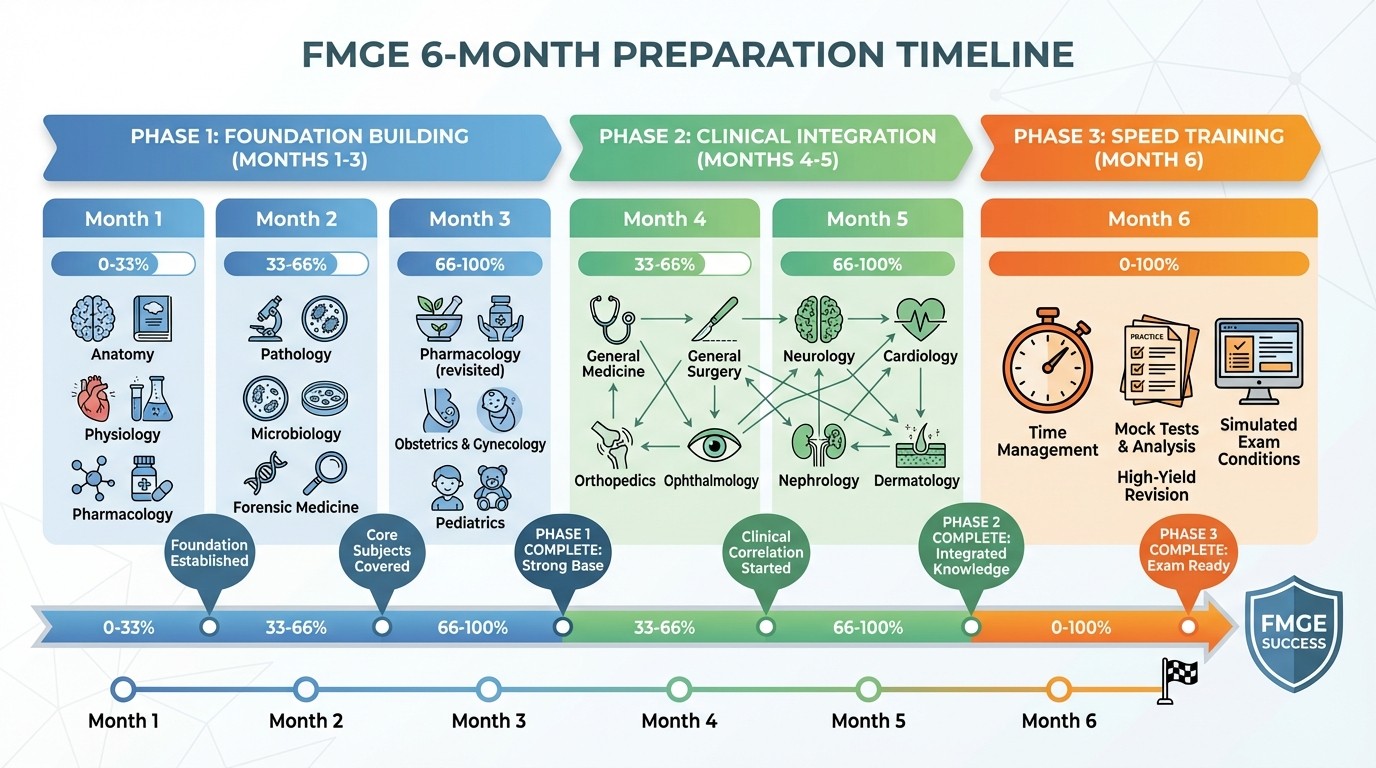
Phase 1: Foundation Building (Months 1-3)
Subject Prioritization Matrix
Start with subjects that have the highest return on time invested:
Week 1-4: Core Physiology + Anatomy
Cardiovascular system (high-yield, appears in multiple clinical contexts)
Nervous system (anatomy-physiology integration heavy)
Respiratory system (calculation questions likely)
Week 5-8: Pathology Foundation
Basic pathological processes (inflammation, neoplasia, cell injury)
Cardiovascular pathology (links to physiology concepts)
Respiratory pathology (common in clinical scenarios)
Week 9-12: Pharmacology Framework
ANS drugs (mechanism + clinical use patterns)
CVS drugs (builds on previous physiology/pathology knowledge)
CNS drugs (mechanism focus, less clinical correlation needed initially)
During this phase, use spaced repetition to prevent early topics from fading. Oncourse AI's Synapses feature calculates optimal review intervals based on your recall performance — so if you keep missing CVS physiology concepts, those cards surface more frequently until they stick.
Phase 2: Clinical Integration (Months 4-5)
Subject Pairing Strategy
Study related subjects together to build integrated understanding:
Internal Medicine + Pathology: Disease mechanisms with clinical presentations
Surgery + Anatomy: Surgical anatomy with procedure indications
Pediatrics + Pharmacology: Drug dosing and pediatric-specific considerations
Gynecology + Biochemistry: Hormonal pathways with clinical disorders
High-Frequency Topic Clusters
Focus 60% of your time on topics that appear in 15+ questions annually:
Cardiovascular emergencies and drug management
Respiratory failure and mechanical ventilation
Infectious diseases and antibiotic selection
Acid-base disorders and electrolyte imbalances
Cancer screening and treatment protocols
For complex factual clusters like first-line TB drugs or criteria for metabolic syndrome, generate personalized mnemonics rather than rote repetition. This turns passive review into active retrieval practice.
Phase 3: Speed and Accuracy Training (Month 6)
Timed Practice Protocol
Week 1-2: 50-question sets in 45 minutes (54 seconds per question)
Week 3-4: 100-question sets in 90 minutes (realistic exam pressure)
Week 5-6: Full 300-question mocks in 4.5 hours (exact exam conditions)
Error Analysis Framework
Track your mistakes in three categories:
1. Knowledge gaps: You didnt know the concept (requires more study) 2. Recall failures: You knew it but couldnt access it quickly (needs more practice) 3. Silly errors: Misread question or marked wrong option (needs attention training)
Most first-attempt failures come from category 2 — students know the material but cant retrieve it fast enough under pressure.
Smart Resource Allocation
The 60-30-10 Rule
60% time on moderate-yield topics you can realistically master
30% time on high-yield topics you already know well (to ensure no silly mistakes)
10% time on low-yield topics only if you have extra bandwidth
Avoid These Common Time Traps:
Spending weeks perfecting embryology details (contributes 5-8 questions max)
Over-preparing favorite subjects where you already score 80%+
Chasing every recent research update instead of mastering established concepts
With 19 subjects and limited preparation time, Oncourse AI's Daily Plan uses your MCQ performance data to automatically shift time allocation toward subjects where you are weakest, ensuring no critical area gets neglected before exam day.
Subject-wise Preparation Strategy for FMGE 2026
High-Impact Subjects (25-30% of total marks)
Internal Medicine
Focus: Clinical decision-making and drug selection
Question pattern: Case-based scenarios with investigation interpretation
Preparation tip: Practice diagnostic algorithms for common presentations (chest pain, breathlessness, fever)
Time allocation: 15% of total study time
Surgery
Focus: Indications, contraindications, and complications
Question pattern: Clinical scenarios requiring surgical vs conservative management decisions
Preparation tip: Master pre-operative assessment and post-operative care protocols
Time allocation: 12% of total study time
Pharmacology
Focus: Mechanism of action and drug interactions
Question pattern: Clinical pharmacology with real prescription scenarios
Preparation tip: Group drugs by mechanism rather than alphabetical classification
Time allocation: 10% of total study time
Moderate-Impact Subjects (15-20% of total marks)
Pathology
Focus: Disease mechanisms and histopathological correlation
Question pattern: Image-based questions with clinical context
Preparation tip: Use visual resources for histopathology slides
Time allocation: 8% of total study time
Anatomy
Focus: Applied anatomy with clinical relevance
Question pattern: Cross-sectional anatomy and radiological correlation
Preparation tip: Connect anatomical structures to common clinical procedures
Time allocation: 8% of total study time
Foundation Subjects (10-15% of total marks each)
Physiology, Biochemistry, Pediatrics, Gynecology
Strategy: Master high-frequency concepts thoroughly rather than covering everything superficially
Practice approach: Use these subjects to practice FMGE biochemistry concepts and physiology integration
Common FMGE Preparation Mistakes to Avoid
Mistake 1: Treating It Like MBBS Finals
FMGE tests clinical application speed, not just concept knowledge. Many students spend months creating beautiful notes and summaries — then struggle to retrieve information quickly during the actual exam.
Solution: Replace passive reading with active recall from day 1. Test yourself constantly rather than just reviewing material.
Mistake 2: Subject Isolation
Studying subjects in complete isolation makes integrated clinical questions impossible to solve. When a question combines cardiology, pharmacology, and pathology, students panic because they never practiced connecting these domains.
Solution: After month 3, always study related subjects in pairs. Practice integrated medical questions that combine multiple subjects.
Mistake 3: Perfectionism Paralysis
Trying to master every topic perfectly means never getting enough practice with exam-style questions. Students spend 4 months studying and only 2 months practicing — then wonder why they cant finish the exam on time.
Solution: Aim for 70% mastery across all subjects rather than 95% mastery in half the subjects.
Mistake 4: Ignoring Speed Training
Many students can solve FMGE questions accurately when given unlimited time. But 54 seconds per question changes everything. Without speed practice, even well-prepared students run out of time.
Solution: Start timed practice by month 4, not in the final week.
FMGE Cut Off Analysis: Understanding the Scoring System
How FMGE Scoring Actually Works
Unlike fixed-percentage exams, FMGE uses a percentile-based system. This means:
Your absolute score matters less than your relative rank
The passing threshold adjusts based on overall candidate performance
A score of 180/300 might pass in a tough session but fail in an easier one
Percentile Patterns from Recent Sessions
December 2024 Session:
90th percentile: ~75% accuracy (225/300 marks)
85th percentile: ~72% accuracy (216/300 marks)
80th percentile: ~68% accuracy (204/300 marks)
Qualifying percentile: ~85-90th percentile
Target Score Strategy:
Aim for 70%+ accuracy consistently in practice tests. This usually translates to qualifying percentile even in competitive sessions.
Subject-wise Contribution to Cut Off
Not all subjects contribute equally to reaching the cut off:
High-weightage subjects (where toppers score 80%+):
Anatomy, Physiology, Biochemistry
Strategy: Secure maximum marks here to compensate for tougher clinical subjects
Variable-difficulty subjects (where even toppers score 60-75%):
Internal Medicine, Surgery, Pharmacology
Strategy: Focus on high-frequency topics rather than comprehensive coverage
Low-predictability subjects (where scores vary widely):
Forensic Medicine, Community Medicine
Strategy: Master basic concepts but dont over-invest time
Mock Test Strategy for FMGE Success
Progressive Difficulty Approach
Months 1-3: Subject-wise Tests
25-50 questions per subject
Untimed initially, then 30-45 seconds per question
Focus: Identifying knowledge gaps early
Months 4-5: Mixed Subject Tests
100-150 questions combining 4-5 subjects
Timed: 90-120 minutes
Focus: Building integrated thinking and speed
Month 6: Full-Length Mocks
Complete 300-question tests
Exact exam timing: 4.5 hours
Focus: Stamina building and final optimization
Mock Test Analysis Protocol
After each mock test:
1. Immediate Review (same day): Note questions where you were completely clueless
2. Subject-wise Analysis (next day): Calculate accuracy percentage per subject
3. Topic-wise Drill (within 2 days): Practice 20-30 additional questions on weak topics identified
4. Retention Check (after 1 week): Retry 10 questions you got wrong to verify learning
This systematic approach ensures mock tests become learning tools, not just assessment exercises.
Dont just take random tests — practice with FMGE-specific question banks that match the current exam pattern and difficulty level.
Final Month Strategy: Maximizing Your FMGE Score
Week 1: Intensive Review
Morning (3 hours): Weak subject focus using spaced repetition
Afternoon (2 hours): High-yield topic revision
Evening (2 hours): 100-question mixed practice tests
Week 2: Speed Optimization
Morning (3 hours): Full 300-question mock under exact exam conditions
Afternoon (2 hours): Error analysis and concept clarification
Evening (1 hour): Quick revision of frequently missed topics
Week 3: Confidence Building
Morning (2 hours): Subject-wise tests in your strongest areas
Afternoon (2 hours): Clinical scenario practice (Internal Medicine + Surgery focus)
Evening (1 hour): Rapid-fire MCQ practice for speed maintenance
Week 4: Maintenance Mode
Morning (1 hour): Light revision, no new topics
Afternoon (1 hour): 50-question practice test (easy to moderate difficulty)
Evening (30 minutes): Relaxation and mental preparation
Exam Day Execution Strategy
Time Management:
Questions 1-100: 90 minutes (54 seconds average, includes easy questions you finish quickly)
Questions 101-200: 90 minutes (maintain pace, dont get stuck)
Questions 201-300: 90 minutes (final push, guess intelligently if needed)
Buffer: 30 minutes for review and difficult questions
Question Approach:
1. Read options first for direct factual questions
2. Identify key clinical features in scenario-based questions
3. Eliminate obviously wrong options before choosing
4. Mark difficult questions and return if time permits
Mental Game:
Expect 40-50 questions you find genuinely difficult — this is normal
Dont panic if you encounter unfamiliar topics — focus on questions you can solve
Trust your preparation and avoid second-guessing correct instincts
Frequently Asked Questions
What is the exact FMGE pass percentage for 2024-2025?
The FMGE passing rate has consistently remained between 10-15% across recent sessions, including 2024-2025. The exact percentage varies each session due to the percentile-based scoring system, but typically 12-14% of candidates qualify.
How is FMGE cut off marks determined each session?
FMGE doesnt have fixed cut off marks. Instead, it uses a percentile-based system where the top 10-15% of candidates qualify regardless of absolute scores. This means the cut off adjusts based on overall candidate performance each session.
Is 6 months enough time to prepare for FMGE?
Yes, 6 months is adequate for FMGE preparation if you follow a structured approach. Focus 60% of time on high-yield topics, use active recall methods, and start timed practice by month 4. Many successful candidates clear FMGE in 5-6 months of focused preparation.
Which subjects carry the highest weightage in FMGE?
Internal Medicine and Surgery combined typically contribute 25-30% of questions. Pharmacology, Pathology, and Anatomy each contribute 10-15%. However, since you need broad competency across all 19 subjects, dont neglect any subject completely.
How many hours per day should I study for FMGE?
Aim for 8-10 hours daily including active practice. Structure it as 6 hours of subject study, 2 hours of question practice, and 1-2 hours of revision. Quality matters more than quantity — focused 8 hours beats distracted 12 hours.
What is the best strategy if I failed FMGE on my first attempt?
Analyze your performance subject-wise to identify specific weaknesses. Most failed attempts show 3-5 subjects scoring below 40%. Focus your re-preparation on these weak areas while maintaining strong subjects through spaced repetition using flashcards. Consider switching from passive reading to active recall methods.
---
Prepare smarter with Oncourse AI — adaptive MCQs, spaced repetition, and AI explanations built for FMGE success. Download free on Android and iOS.