Back
USMLE Step 1 Prep Course Comparison 2026: Free vs Paid Options for IMGs
Compare free vs paid USMLE Step 1 prep courses for IMGs. Learn what works, what wastes time, and how to choose the right resources for your budget and timeline in 2026.
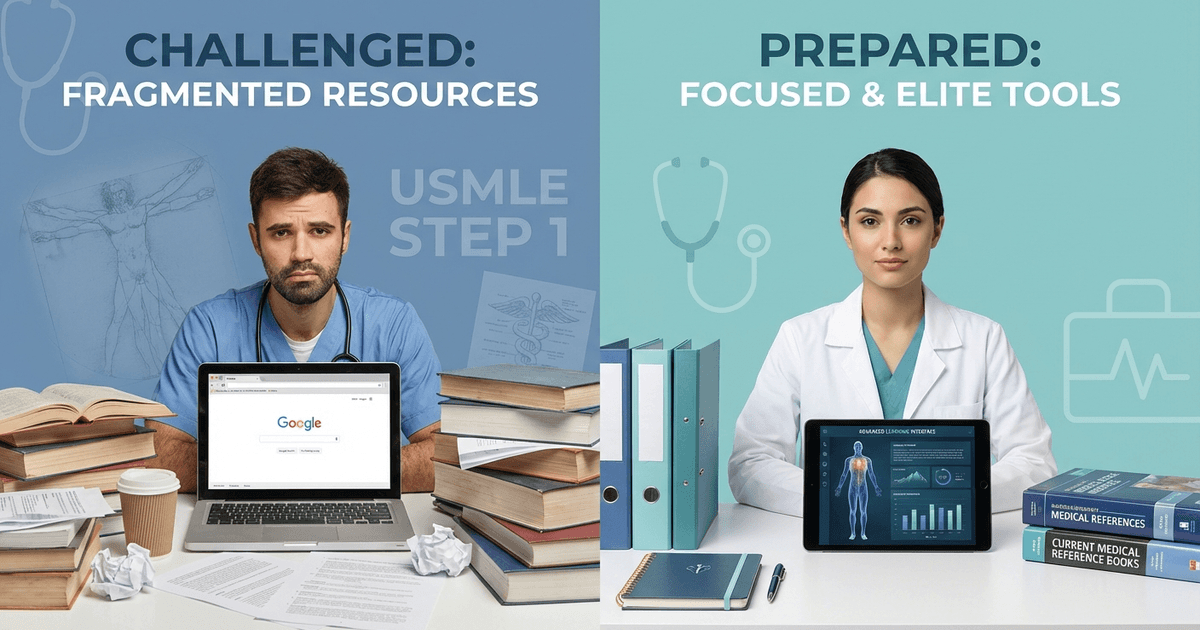
USMLE Step 1 Prep Course Comparison 2026: Free vs Paid Options for IMGs
You are probably scrolling through Reddit threads right now, seeing IMGs debate whether free resources are "enough" for Step 1. Some swear by free YouTube videos and open-access question banks. Others insist you need a $2,000+ prep course to crack 220+.
Here is the truth: most free resources will get you to the finish line, but they wont optimize your path there. As an IMG, you dont have the luxury of inefficient study methods. You have limited time, limited clinical exposure, and unlimited pressure to score competitively on your first attempt.
After tracking what actually worked for thousands of IMGs who scored 230+ on Step 1, the answer isnt purely about free vs paid. It is about understanding exactly what each option gives you — and what gaps you will need to fill yourself.
Why Most Free Resources Fall Short for IMGs (The Hidden Costs)
Free sounds perfect until you realize what you are really paying: time, efficiency, and often your first attempt.
The biggest free resources — YouTube lectures, free question banks, and open-access study guides — share the same fundamental weakness: they were built for US medical students with existing clinical foundations. They assume you can connect basic science to clinical reasoning naturally. Most IMGs cant.
The Clinical Integration Gap
Take Khan Academy's free MCAT content or YouTube pathology lectures. They explain mechanisms beautifully. They dont teach you how to spot those mechanisms in a 4-line clinical vignette while managing time pressure. You end up knowing the Krebs cycle perfectly but missing the muscle weakness question because you couldnt connect the dots fast enough.
Free resources also lack adaptive learning. They show you content in a fixed sequence, regardless of whether you have mastered it or still struggle. You spend equal time on topics you know and topics that will sink your score. The result? 18-week study plans instead of 14 weeks, burnout instead of confidence.
The Question Quality Problem
Most free question banks contain 500-2,000 questions. UWorld has 3,700+ questions with detailed explanations written by US physicians. Free questions often lack the clinical nuance that separates a 210 from a 240. They teach you to recognize patterns, not to think through complex scenarios.
The math is brutal: if free questions cover 60% of testable concepts and paid questions cover 85%, that 25% gap represents 70 points on your actual exam. For IMGs targeting residency matches, that difference matters significantly.
What Paid Courses Actually Offer (Beyond Content)
Paid USMLE prep courses dont just give you better content — they structure your entire learning process. Here is what you are really paying for:
Personalized Learning Pathways
Quality paid courses analyze your performance continuously and adjust your study plan. Weak in cardiology? You get more cardiology questions, targeted video reviews, and spaced repetition cards focused on your specific gaps. Strong in pharmacology? The system moves you past basic concepts to higher-order thinking.
This matters enormously for IMGs because your knowledge gaps are different from US students. You might excel in theoretical pathology but struggle with US healthcare system questions. A good paid course identifies and fixes these gaps efficiently.
Professional Question Writers
Paid question banks employ US physicians who understand both the content and the test-taking strategies needed for Step 1. They write questions that match the actual exam style, difficulty, and clinical reasoning patterns. Oncourse AI takes this further with AI-powered explanations that adapt to your specific learning style and knowledge level.
Time Optimization
The best paid courses save you 4-6 weeks compared to purely free preparation. They eliminate the endless research phase ("Which resources should I use?"), the trial-and-error phase ("Why am I not improving?"), and the panic phase ("I need to postpone my exam"). For working IMGs or those with visa timelines, this time savings alone justifies the cost.
How AI-Based Prep Changes Everything
Traditional prep courses — even expensive ones — follow a one-size-fits-all curriculum. AI-based preparation platforms like Oncourse AI fundamentally change this approach for IMGs.
Instead of forcing you through 20 weeks of predetermined content, AI identifies your specific knowledge patterns within days. It recognizes that you excel in anatomy but struggle with clinical correlations. It adapts question difficulty based on your real-time performance, not your week in the program.
More importantly, AI explanations scale to your level. If you miss a cardiology question, the system can determine whether you need basic arrhythmia review or advanced electrophysiology concepts. Traditional courses give you the same explanation regardless of why you got it wrong.
For IMGs using Oncourse AI, this means faster identification of knowledge gaps through adaptive questioning and personalized study recommendations that evolve as you improve. The platform's AI tutor, Rezzy, provides instant clarification on complex concepts without waiting for office hours or forum responses.
Budget-Based Recommendations for IMGs
Your budget situation determines your optimal prep strategy. Here are the proven approaches:
Under $100: Strategic Free + Minimal Paid
Core Strategy: Use free content for knowledge building, invest minimally in high-impact paid resources.
Free: Khan Academy for basic sciences, YouTube pathology lectures
Paid: UWorld Question Bank ($200+ for 6 months) — non-negotiable for competitive scores
Supplement: Oncourse AI free tier for adaptive practice and AI explanations
This approach works if you have strong self-discipline and 16+ weeks to study. You will spend significant time researching and organizing resources, but can achieve passing scores with persistence.
$200-500: Balanced Approach
Core Strategy: Invest in proven question bank and adaptive AI tools.
Primary: UWorld Question Bank + Oncourse AI premium subscription
Support: First Aid USMLE Step 1 (physical book)
Weak Areas: Subject-specific resources (Pathoma for pathology, Sketchy for microbiology)
Most successful IMGs fall into this category. The combination of UWorld's comprehensive questions and Oncourse AI's personalized learning creates an efficient 12-14 week timeline.
$500-1500: Premium Optimization
Core Strategy: Add live instruction and advanced analytics.
Foundation: UWorld + Oncourse AI premium
Live Learning: Kaplan or Princeton Review live online courses
Analytics: Detailed performance tracking and tutoring hours
Practice: Multiple practice exam series (NBME, UWorld, Kaplan)
This level provides live instructor support for complex topics and real-time feedback on your progress. Ideal for IMGs who need external accountability or have struggled with self-directed study before.
$1500+: Comprehensive Support
Core Strategy: Full-service preparation with personal tutoring.
Everything above plus:
Personal tutoring: 1-on-1 sessions for weak areas
Study scheduling: Professional study plan management
Application support: Residency application guidance
Only necessary if you have failed previous attempts or need extensive clinical knowledge building. Most IMGs achieve excellent scores without this investment level.
Free Options That Actually Work for IMGs
Not all free resources waste your time. Here are the specific free tools that complement paid preparation effectively:
Anki Flashcards (Free Spaced Repetition)
Download pre-made Step 1 decks like "Anking" or create your own from missed questions. Anki costs nothing but provides sophisticated spaced repetition algorithms. Use it for high-yield facts and quick reviews, not for learning new concepts.
Khan Academy MCAT Content (Free Foundation Building)
Their organ systems videos provide excellent basic science foundations if you have knowledge gaps from medical school. Use these during your first 2-3 weeks only — dont get stuck in endless video watching.
Reddit USMLE Communities (Free Strategy)
r/step1 and r/IMGreddit provide real IMG experiences and score reports. Read success stories to understand timelines and resource combinations. Avoid endless debates about resource quality — most work if used correctly.
Free Practice Exams
NBME provides free practice questions (limited quantity). UWorld offers a free trial. Use these to establish baseline scores and identify major knowledge gaps before investing in paid resources.
The key with free resources: use them strategically to complement paid tools, not as your primary study method.
Making the Smart Choice for Your Situation
Your optimal prep course depends on three factors: timeline, budget, and learning style.
Choose mostly free resources if: You have 18+ weeks to study, strong self-discipline, and significant budget constraints. Accept that you will spend extra time researching and organizing your study plan. Choose balanced free/paid if: You have 12-16 weeks to study and can invest $300-500. This combination provides efficiency without breaking the bank. Most successful IMGs follow this path. Choose premium paid options if: You have limited time (under 12 weeks), need external accountability, or have failed previous attempts. The structured support justifies the higher cost. Never choose: Expensive courses without proven IMG success rates, free-only approaches if you need to pass quickly, or any resource without practice questions as the primary component.
Remember: Step 1 rewards pattern recognition and clinical reasoning, not just content knowledge. Whatever combination you choose, ensure 60-70% of your study time involves answering practice questions, not passive review.
The goal isnt to use every resource perfectly — it is to use the right combination efficiently enough to pass on your first attempt. For most IMGs, that means strategic investment in proven question banks while leveraging free resources for knowledge gaps and review.
Check out our comprehensive best USMLE Step 1 prep courses guide for detailed reviews of specific paid courses and their IMG success rates.
Frequently Asked Questions
Can I pass USMLE Step 1 using only free resources?
Yes, but it requires 16-20 weeks of disciplined study and strong self-assessment skills. Most IMGs who pass with free-only resources supplement with at least UWorld question bank ($200+). Pure free approaches work better for IMGs with strong clinical backgrounds or unlimited study time.
What is the minimum budget needed for competitive Step 1 scores?
Around $300-400 covers UWorld question bank and basic supplemental resources. Adding an AI-powered platform like Oncourse AI ($50-100/month) optimizes your efficiency significantly. This budget typically produces 220+ scores with 12-14 weeks of focused study.
How do I know if I need a paid course vs self-study?
Take a diagnostic practice exam first. If you score below 150, consider structured paid courses for foundation building. Scores of 150-180 benefit from hybrid approaches (paid question banks + free content). Scores above 180 can often succeed with strategic free resources plus targeted paid supplements.
Do expensive prep courses guarantee better scores?
No. Course effectiveness depends on your learning style, timeline, and consistency. Many IMGs score 230+ using $300-500 budgets. The key is choosing resources that match your specific knowledge gaps and study habits, not necessarily the most expensive options.
Is it worth waiting for free resources to improve?
Free resources evolve slowly and rarely match the clinical focus needed for Step 1. If you are ready to study now, invest in proven paid resources rather than waiting. The time cost of delayed preparation usually exceeds the financial cost of quality materials.
How do AI-powered prep platforms compare to traditional courses?
AI platforms like Oncourse AI adapt to your learning patterns in real-time, while traditional courses follow fixed curricula. For IMGs with diverse backgrounds, AI provides more efficient identification of knowledge gaps and personalized study paths. Traditional courses offer more live instruction but less customization.
Prepare smarter with Oncourse AI — adaptive MCQs, spaced repetition, and AI explanations built for USMLE Step 1. Download free on Android and iOS.