USMLE Step 2 CK Score for Family Medicine Residency: What You Need in 2026
Complete guide to USMLE Step 2 CK score requirements for family medicine residency in 2026. Average scores, competitive ranges for US/IMG/DO students, and program-specific expectations.

USMLE Step 2 CK Score for Family Medicine Residency: What You Need in 2026
You are staring at your USMLE Step 2 CK score report, heart racing. That three-digit number determines whether your family medicine residency dreams move forward or hit a wall. Family medicine is known as one of the more "IMG-friendly" specialties, but what does that actually mean for your Step 2 CK score in 2026?
The truth is more nuanced than "just pass." While family medicine programs generally have lower score cutoffs than competitive specialties like dermatology or orthopedics, they still want residents who can handle the breadth of primary care medicine. Your Step 2 CK score signals your clinical reasoning ability across every system — exactly what family medicine demands.
Here's what the data shows: matched family medicine residents scored an average of 247 on Step 2 CK in recent match cycles. But averages dont tell the whole story. DO students, Caribbean graduates, and repeat test-takers face different benchmarks. Program tiers matter too — university-based programs in major cities have different expectations than community hospitals in rural areas.
This guide breaks down exactly what Step 2 CK score you need for family medicine residency in 2026, based on applicant type, program competitiveness, and geographic preferences. No generic advice — just the numbers that matter for your specific situation.
Understanding Family Medicine Residency Competitiveness
Family medicine occupies a unique position in the residency match landscape. With over 4,000 positions available annually and a match rate consistently above 90% for US medical graduates, it appears less competitive than subspecialties. However, this accessibility masks important score expectations that vary dramatically by program type.
University-based family medicine programs in academic medical centers typically attract residents interested in research, teaching, or fellowship training. These programs often prefer Step 2 CK scores of 250+ and look for candidates with strong clinical grades and research experience. They want residents who can contribute to quality improvement projects and potentially pursue fellowships in sports medicine, geriatrics, or hospice care. Community-based programs focus primarily on clinical training and often serve diverse patient populations. These programs may be more flexible with Step 2 CK scores, particularly if other application components demonstrate strong clinical skills and community commitment. Oncourse's adaptive question bank helps students targeting community programs focus on high-yield primary care scenarios that mirror real clinical encounters. Rural family medicine programs actively seek residents committed to practicing in underserved areas. These programs often prioritize mission alignment over pure academic metrics, though they still expect Step 2 CK scores that demonstrate clinical competence. Many offer loan forgiveness programs and emphasize procedural training like obstetrics, emergency medicine, and minor surgery.
The specialty's emphasis on longitudinal patient care means programs want residents who can manage chronic diseases, coordinate care across multiple specialties, and handle undifferentiated presentations — all areas heavily tested on Step 2 CK.
Step 2 CK Score Benchmarks by Applicant Type
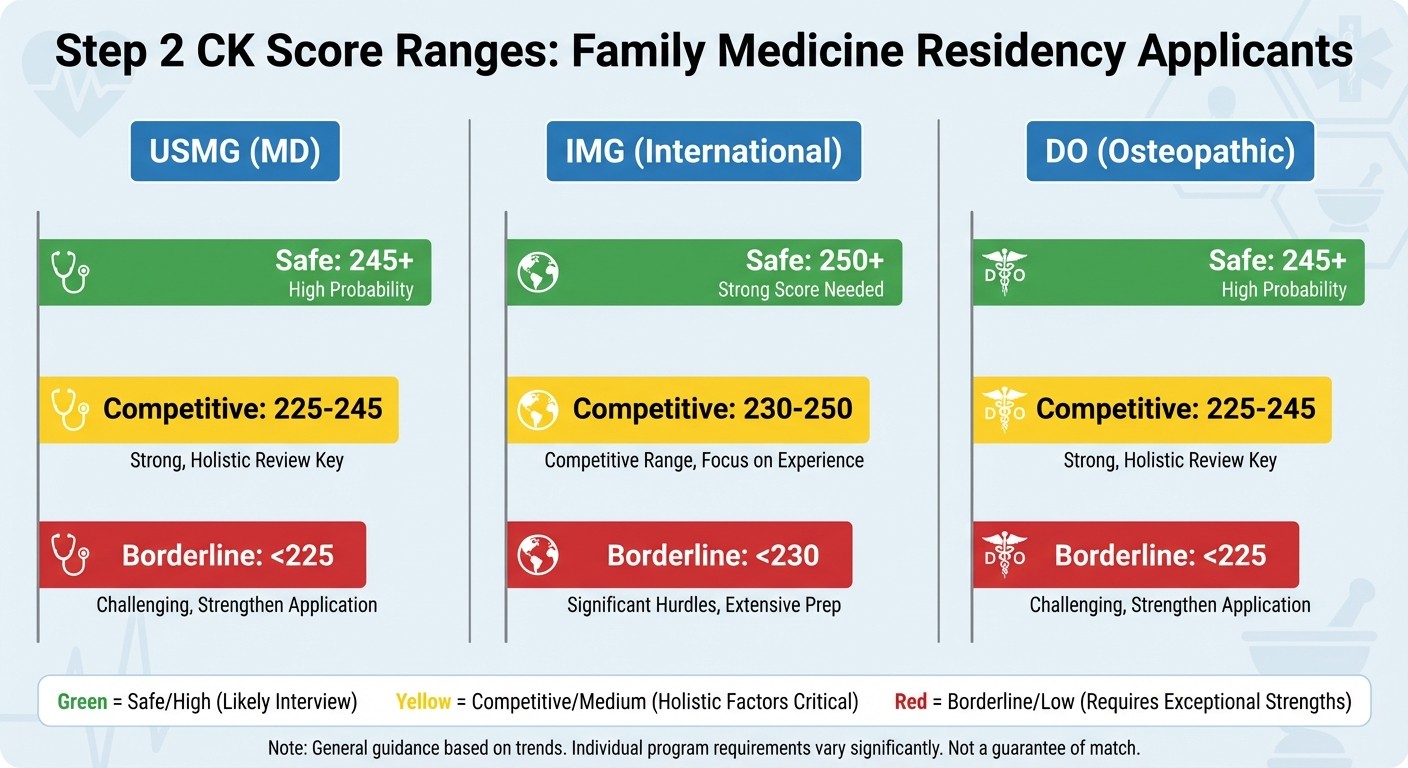
US Medical Graduates (USMGs)
US medical graduates enjoy significant advantages in the family medicine match. The average matched USMG scored 247 on Step 2 CK, but this includes high scorers who could have matched into more competitive specialties.
Safe zone: 240+
Scores above 240 virtually guarantee interviews at most family medicine programs, assuming other application components meet basic standards. These candidates have flexibility to be selective about geographic preferences and program features.
Competitive zone: 220-239 This represents the majority of successfully matched USMGs. Programs focus more heavily on clinical grades, letters of recommendation, and personal statement. Students can use Oncourse's performance analytics to identify weak areas in family medicine-relevant topics like chronic disease management and preventive care. Borderline zone: 200-219
Still viable for family medicine match, but requires strategic application planning. Target community and rural programs, emphasize clinical experiences in primary care, and consider applying broadly geographically.
International Medical Graduates (IMGs)
IMGs face higher Step 2 CK expectations due to increased competition for the same positions. Recent match data shows successful IMG candidates averaging 252 on Step 2 CK — notably higher than their USMG counterparts.
Safe zone: 260+
High scores open doors to competitive university programs and desirable geographic locations. These candidates can be more selective in their applications.
Competitive zone: 245-259
Represents the sweet spot for most IMG applicants. Combined with strong USCE (US clinical experience) and research, these scores lead to successful matches. Oncourse's spaced repetition engine helps retain family medicine-specific content like preventive screening guidelines and chronic disease protocols through exam day.
Borderline zone: 230-244
Requires exceptional strength in other application areas. Focus on extensive USCE, strong clinical letters, and demonstrated commitment to family medicine through volunteering or research.
High-risk zone: Below 230
Extremely challenging for IMG applicants. Consider retaking Step 2 CK if possible, or exploring other pathways like preliminary medicine followed by reapplication.
DO Students
DO students benefit from their own match (AOA) plus access to the ACGME match, providing multiple pathways to family medicine residency. Average Step 2 CK scores for matched DO students hover around 243.
Safe zone: 250+
Opens doors to both AOA and ACGME programs, including competitive university-based positions.
Competitive zone: 230-249
Solid positioning for most family medicine programs. DO students' clinical training often aligns well with family medicine's emphasis on holistic patient care.
Borderline zone: 210-229
Still viable, particularly for AOA family medicine programs that value DO clinical philosophy. Consider highlighting osteopathic manipulative medicine experience if applicable.
Program Tier Analysis and Geographic Considerations
Academic Medical Centers
University-based family medicine programs typically cluster around major medical centers and emphasize research, teaching, and subspecialty exposure. These programs often prepare residents for fellowships or academic careers.
Step 2 CK expectations: 250+ for USMGs, 260+ for IMGs
Key characteristics:
Research opportunities and protected academic time
Fellowship preparation in sports medicine, geriatrics, or palliative care
Teaching responsibilities with medical students
Urban settings with diverse patient populations
Examples include programs at universities like University of Colorado, University of Washington, and University of North Carolina. Competition is significant, but these programs often offer superior benefits and career advancement opportunities.
Community-Based Programs
Community programs focus on clinical excellence and often serve as safety nets for their regions. They emphasize practical primary care skills and frequently offer more procedural training.
Step 2 CK expectations: 230+ for USMGs, 245+ for IMGs
Key characteristics:
Heavy clinical volume across all age groups
Procedural training (colonoscopy, skin procedures, joint injections)
Less research emphasis, more patient care focus
Often better work-life balance
These programs may be more flexible with scores if applicants demonstrate genuine interest in community practice and have strong clinical evaluations.
Rural and Underserved Programs
Programs serving rural or underserved populations actively recruit residents committed to practicing in these areas post-graduation. They often offer loan forgiveness and emphasize broad-scope practice.
Step 2 CK expectations: 220+ for USMGs, 240+ for IMGs
Key characteristics:
Broad scope of practice including obstetrics and emergency medicine
Loan forgiveness programs
Strong emphasis on mission alignment
Procedural training to support independent practice
These programs may prioritize personal connection to rural medicine over pure academic metrics, though clinical competence remains essential.
How to Interpret Your Step 2 CK Score
Understanding where your score positions you requires more than comparing against national averages. Context matters — particularly your overall application strength and target programs.
Score Percentiles and What They Mean
Step 2 CK scores follow a normal distribution with a mean around 243 and standard deviation of approximately 22 points. Here's how key percentiles translate to family medicine competitiveness:
Score Range | Percentile | Family Medicine Competitiveness |
|---|---|---|
270+ | 95th+ | Overqualified — consider more competitive specialties |
260-269 | 85th-94th | Highly competitive for any family medicine program |
250-259 | 65th-84th | Competitive for academic programs, safe for community |
240-249 | 40th-64th | Safe for community programs, competitive for some academic |
230-239 | 20th-39th | Viable with strong application, target community/rural |
220-229 | 5th-19th | High risk, requires exceptional other factors |
Below 220 | <5th | Consider retaking or alternative pathways |
First Attempt vs. Repeat Scores
Programs view first-time passes more favorably than repeat attempts, even if the final score is identical. A 250 on first attempt carries more weight than a 250 after initially failing.
For repeat test-takers:
Target 20+ points above minimum requirements for your applicant category
Be prepared to explain the circumstances leading to your initial attempt
Emphasize growth and what you learned from the experience
Consider taking Step 3 early to demonstrate continued competence
Score Trends and Step 1 Correlation
Programs increasingly rely on Step 2 CK for screening since Step 1 became pass/fail. However, they may still consider patterns across all USMLE attempts.
Upward trend (Step 1 pass → High Step 2 CK): Demonstrates growth and strong clinical knowledge. Very favorable for all programs. Flat trend (Step 1 pass → Moderate Step 2 CK): Expected pattern. Other application factors become more important. Concerning patterns (Multiple attempts, declining scores): Requires strong explanations and exceptional performance in other areas.
Beyond the Numbers: What Else Matters
While Step 2 CK scores provide an important screening tool, family medicine programs evaluate applicants holistically. Understanding how your score fits within your complete application helps with realistic program targeting.
Clinical Grades and Shelf Exam Performance
Family medicine programs pay close attention to clerkship grades, particularly in internal medicine, family medicine, pediatrics, and psychiatry rotations. Strong clinical grades can offset borderline Step 2 CK scores, while poor grades may require higher test scores to compensate.
Honor grades in relevant clerkships demonstrate clinical excellence beyond test-taking ability. Programs want residents who excel in patient care, not just on exams. During clinical rotations, students using Oncourse's adaptive question bank often find that focusing on primary care scenarios improves both shelf exam performance and clinical reasoning skills. Consistent performance across multiple clerkships indicates reliable clinical competence. A single poor grade due to specific circumstances is more forgivable than a pattern of below-average performance.
Research and Scholarly Activity
Family medicine research differs from other specialties, often focusing on population health, health services research, and community-based studies rather than bench science or clinical trials.
Relevant research topics include:
Quality improvement projects in primary care settings
Studies on health disparities and social determinants
Research on chronic disease management or preventive care
Medical education studies, particularly those involving primary care
Publication requirements vary by program tier. Academic programs may expect peer-reviewed publications, while community programs value research experience and presentation of findings.
Letters of Recommendation
Strong letters from family medicine physicians, internal medicine attendings, or other primary care specialties carry the most weight. Letters should address clinical skills, professionalism, and dedication to primary care medicine.
Avoid generic letters that could apply to any specialty. The best letters include specific examples of patient care excellence, teamwork, and growth during clinical rotations.
Personal Statement and Mission Alignment
Family medicine programs seek residents genuinely committed to primary care practice. Personal statements should demonstrate understanding of the specialty's breadth and challenges, not just mention "continuity of care" and "treating the whole patient."
Effective personal statements include:
Specific experiences that led to interest in family medicine
Understanding of the specialty's role in healthcare systems
Career goals that align with family medicine practice
Awareness of current challenges in primary care
Strategic Application Planning Based on Your Score
High Scorers (250+): Maximizing Options
Students with Step 2 CK scores above 250 have the luxury of choice in family medicine applications. However, this advantage comes with strategic decisions about program selection and future goals.
Consider your long-term plans:
Academic track: Target university programs with strong research opportunities
Fellowship preparation: Choose programs with subspecialty rotations and fellowship match track records
Geographic preferences: Apply broadly to competitive markets like California, New York, and Massachusetts
Rural commitment: Explore programs with loan forgiveness if you're genuinely interested in underserved practice
Application strategy:
Apply to 15-20 programs with a mix of academic and community options
Include some "reach" programs in highly desirable locations
Use performance analytics from your Step 2 CK prep to identify clinical strengths that align with specific programs
Interview preparation:
Programs may question why you chose family medicine over more competitive specialties. Prepare authentic responses that demonstrate genuine interest rather than portraying family medicine as a backup plan.
Moderate Scorers (230-249): Building a Balanced List
This score range requires careful program selection and attention to application strength beyond test scores. Most successful applicants in this range match into solid community-based programs with good training and career prospects.
Geographic considerations:
Competitive markets (CA, NY, MA): Apply to several programs but include backup options
Moderate markets (TX, FL, NC): Good balance of competitiveness and options
Less competitive markets (Midwest, Mountain West): Consider for geographic diversity
Program selection strategy:
Apply to 20-25 programs with heavy emphasis on community-based options
Include some rural programs if you're genuinely interested in that practice style
Research program-specific strengths that align with your interests
Strengthening your application:
Students in this score range benefit from maximizing other application components. Oncourse's spaced repetition system helps ensure your Step 2 CK knowledge translates to strong clinical performance during away rotations and interviews.
Lower Scorers (220-229): Focused Strategy Required
Success with Step 2 CK scores in this range requires strategic thinking and often geographic flexibility. However, family medicine's broad availability means matching is still very possible with the right approach.
Essential strategies:
Apply broadly: 25-30 programs across multiple geographic regions
Target community and rural programs: These often prioritize mission fit over pure academic metrics
Consider DO programs if you're a DO student — they may be more score-flexible
Emphasize clinical excellence: Strong clerkship grades become critical differentiators
Application timing:
Apply early in the season and be responsive to interview invitations. Programs may offer interviews to lower scorers who demonstrate genuine enthusiasm and quick response times.
Geographic flexibility:
Consider programs in less competitive locations. Rural programs in particular often prioritize commitment to their mission over test scores, especially if you have rural connections or demonstrate genuine interest in underserved practice.
Very Low Scorers (Below 220): Alternative Pathways
Step 2 CK scores below 220 make direct entry into family medicine residency challenging but not impossible. This situation requires honest assessment of your full application and potentially considering alternative pathways.
Consider retaking Step 2 CK:
Target a 30+ point improvement
Focus preparation on high-yield family medicine topics
Allow adequate preparation time (3-4 months minimum)
Explore preliminary/transitional year positions:
Gain additional clinical experience
Demonstrate excellence in intern-level responsibilities
Reapply with stronger overall profile
International opportunities:
Some Caribbean or international programs may offer more score flexibility, though this requires careful research into program quality and future career implications.
Preparing for Step 2 CK Success in Family Medicine
High-Yield Topics for Family Medicine Applicants
Family medicine Step 2 CK preparation should emphasize breadth over depth, mirroring the specialty's comprehensive approach to patient care. Certain topics appear frequently and align with family medicine practice patterns.
Primary care medicine fundamentals:
Chronic disease management (diabetes, hypertension, hyperlipidemia)
Preventive care guidelines and screening recommendations
Mental health in primary care settings
Geriatric medicine and age-appropriate care
Women's health and reproductive medicine
Ambulatory care scenarios:
Step 2 CK increasingly emphasizes outpatient management, which aligns perfectly with family medicine training. Focus on questions involving chronic disease monitoring, medication adjustments, and patient education.
Ethics and patient communication:
Family medicine programs value residents who excel in patient relationships. Ethics questions on Step 2 CK often mirror situations encountered in primary care practice, such as informed consent, capacity assessment, and advance directives.
Students using Oncourse's adaptive question bank find that focusing on these family medicine-heavy topics naturally improves their Step 2 CK performance while building knowledge directly applicable to residency training.
Study Timeline and Strategy
12 weeks before exam:
Complete initial content review using high-yield resources
Begin systematic question practice with focus on family medicine topics
Establish baseline performance using Oncourse's analytics to identify weak areas
8 weeks before exam:
Intensive question practice (80-120 questions daily)
Focus on ambulatory medicine and chronic disease management
Review missed questions thoroughly with emphasis on clinical reasoning
4 weeks before exam:
Simulate actual test conditions with full-length practice exams
Activate spaced repetition for family medicine-tagged content
Fine-tune weak areas identified through performance tracking
1 week before exam:
Light review of high-yield facts and guidelines
Focus on test-taking strategy rather than new content learning
Ensure adequate rest and stress management
Leveraging Technology for Efficient Preparation
Modern Step 2 CK preparation benefits significantly from adaptive learning technologies that adjust to your specific weaknesses and learning patterns.
Adaptive question banks identify knowledge gaps more efficiently than random question practice. When students focus on family medicine-relevant topics like primary care ethics and preventive medicine, they build expertise directly applicable to their future specialty while improving test performance. Performance analytics help track improvement over time and identify persistent weak areas. Students targeting family medicine residency can use these insights to benchmark their readiness against program-reported score averages and set realistic target scores. Spaced repetition algorithms ensure long-term retention of key concepts through exam day. Family medicine content like chronic disease management protocols and preventive screening guidelines benefits particularly from this approach, as these topics appear frequently throughout the exam. Oncourse's cardiovascular flashcards exemplify how spaced repetition helps retain complex drug interactions and treatment protocols.
Frequently Asked Questions
What's the minimum Step 2 CK score for family medicine residency?
There's no official minimum, but practical cutoffs exist. US medical graduates rarely match below 220, while international graduates typically need 240+ to be competitive. However, these are guidelines — exceptional strength in other areas can sometimes compensate for lower scores.
Do family medicine programs screen applications by Step 2 CK score?
Many programs use score cutoffs for initial screening, particularly larger programs receiving hundreds of applications. Academic programs often set higher cutoffs (240-250) than community programs (220-230). However, some programs review applications holistically without strict score thresholds.
Is Step 2 CK more important than Step 1 for family medicine?
Yes, since Step 1 became pass/fail in 2022. Family medicine programs now rely heavily on Step 2 CK for academic screening, making it the most important standardized test score in your application. Strong Step 2 CK performance can offset other application weaknesses.
Should I retake Step 2 CK if I scored below my target?
Consider retaking if your score is significantly below competitive ranges for your applicant type and target programs. However, retaking carries risks — a lower second score looks worse than a moderate first score. Generally, retake only if you scored below 220 as a US graduate or below 240 as an international graduate.
How do family medicine programs weight Step 2 CK compared to clinical grades?
Both are important, but their relative weight depends on the program. Academic programs may emphasize test scores more heavily, while community programs often prioritize clinical performance and interpersonal skills. Strong clinical grades can partially offset borderline Step 2 CK scores, especially if they're in relevant rotations like internal medicine or family medicine clerkships.
When should I take Step 2 CK if I'm applying for family medicine residency?
Take Step 2 CK early enough to receive scores before submitting your ERAS application in September. Most students take the exam in late spring or early summer of their fourth year. Having your score available strengthens your application and allows programs to screen you appropriately for interviews.
---
Your Step 2 CK score opens doors, but family medicine residency success depends on much more than a three-digit number. Programs seek residents who demonstrate genuine commitment to primary care medicine, excellent clinical skills, and the interpersonal qualities essential for long-term patient relationships.
Prepare smarter with Oncourse AI — adaptive MCQs, spaced repetition, and AI explanations built for USMLE Step 2 CK. Download free on Android and iOS.