Back
NBME Practice Exams Explained: What They Are, How to Use Them, and Which Ones to Take for USMLE Step 1 and Step 2 CK (2026)
Complete guide to NBME practice exams for USMLE Step 1 and Step 2 CK in 2026. Learn which forms to take, how to interpret scores, optimal timing, and strategic remediation.

NBME Practice Exams Explained: What They Are, How to Use Them, and Which Ones to Take for USMLE Step 1 and Step 2 CK (2026)
You are staring at a 7-block, 280-question beast called USMLE Step 1. Or maybe its clinical cousin, Step 2 CK. Either way, you need to know if you are ready before stepping into that Prometric center. That is where NBME practice exams come in — the gold standard for gauging USMLE readiness.
NBME practice exams are not just another question bank. They are created by the same people who write your actual USMLE. The National Board of Medical Examiners (NBME) uses retired real exam questions and writes new ones using identical blueprints, scoring algorithms, and statistical rigor as the live test. When you take an NBME, you are getting the closest thing to a dress rehearsal for exam day.
But here is where most students mess up: they treat NBMEs like UWorld. Take one, get bummed about the score, then move on. Wrong approach. NBMEs are diagnostic tools that reveal exactly where your knowledge gaps live. Used correctly, they can tell you when you are ready to schedule your exam and which subjects need emergency intervention.
This guide breaks down everything you need to know about NBME practice exams in 2026 — which forms to take, how to interpret your scores, when to take them in your timeline, and how to use results strategically for targeted remediation.
What Are NBME Practice Exams?
NBME practice exams are official self-assessment tools created by the National Board of Medical Examiners — the same organization that develops the actual USMLE. Think of them as the most accurate practice tests available for Step 1 and Step 2 CK.
Here is what makes NBMEs special:
Authentic Question Style: Every question follows the exact same format, length, and clinical vignette structure as real USMLE questions. No weird formatting or unrealistic scenarios. Statistical Rigor: NBME uses psychometric analysis to ensure each question performs similarly to live exam questions. They track difficulty levels, discrimination indices, and content distribution. Real Score Prediction: Unlike other practice tests, NBME scores correlate strongly with actual USMLE performance. Your NBME three-digit score gives you a realistic prediction of your exam day score. Official Content Blueprint: Questions cover the same organ systems, disciplines, and competencies as the real exam in identical proportions.
NBMEs come in two main flavors:
Comprehensive Basic Science Self-Assessment (CBSSA) for Step 1
Comprehensive Clinical Science Self-Assessment (CCSSA) for Step 2 CK
Each exam mimics the actual test length — 200 questions for Step 1 CBSSAs and 318 questions for Step 2 CK CCSSAs.
Free vs Paid NBME Forms: What's Available in 2026
The NBME offers both free and paid practice options, though the free content is limited:
Free Options
Free 120: The only completely free NBME resource. Contains 120 Step 1 questions divided into three 40-question blocks. Updated in February 2024 with fresh questions. Perfect for familiarizing yourself with NBME question style before investing in paid forms. USMLE Sample Questions: The USMLE website provides sample questions for both Step 1 and Step 2 CK, though these are limited in number and dont provide scoring.
Paid NBME Forms
Step 1 (CBSSA Forms): Seven different forms available as of 2026, numbered Forms 25-31. Each costs around $60 and provides 200 questions with detailed score reporting. Step 2 CK (CCSSA Forms): Multiple forms available, each containing 318 questions for approximately $60. Bundle Discounts: NBME periodically offers 3-form bundles at discounted rates. Bundle promotions typically run 2-3 times per year with savings of $20-30.
Each paid form includes:
Timed or self-paced testing options
Detailed score report with three-digit prediction
Performance breakdown by content area
Answer explanations through the INSIGHTS dashboard
Probability of passing estimation
Most students should plan on taking 3-4 NBMEs during their prep — one early baseline, 1-2 during mid-preparation, and one final assessment 1-2 weeks before the exam.
Step 1 NBME Forms Breakdown (CBSSA)
The Comprehensive Basic Science Self-Assessment (CBSSA) forms are purpose-built to mirror Step 1. Here is what you need to know about each:
Available Forms (2026)
Forms 25-31: Seven current forms, with Form 31 being the newest
Retired Forms: Older forms (20-24) are no longer available for purchase but may circulate offline
Format Options
Standard-Paced: 4 blocks of 50 questions each, with 1 hour 15 minutes per block. This mimics real exam timing and should be your default choice 2-3 weeks before test day. Self-Paced: Same 200 questions but with 5 hours per 50-question block. Use this option early in prep when you want to think through questions methodically rather than practice time management.
Question Distribution
Each CBSSA follows the Step 1 content blueprint:
Biochemistry & Nutrition: ~12%
Microbiology & Immunology: ~12%
Pathology: ~18%
Pharmacology: ~12%
Physiology: ~16%
Anatomy & Embryology: ~8%
Behavioral Sciences: ~8%
Genetics: ~6%
Other Basic Science Topics: ~8%
Which Forms to Take
Early Prep (Baseline): Form 25 or 26. These tend to have slightly more straightforward questions, making them good for initial assessment. Mid-Prep: Forms 27-29. Mix of difficulty levels that represent typical Step 1 challenge. Pre-Exam: Form 30 or 31. The newest forms with question styles most similar to current Step 1 patterns.
Most students see score improvements of 10-20 points between forms as their knowledge solidifies, assuming 4-6 weeks between assessments.
Step 2 CK NBME Forms Breakdown (CCSSA)
The Comprehensive Clinical Science Self-Assessment (CCSSA) forms mirror Step 2 CK's clinical focus. Here is the breakdown:
Available Forms (2026)
Multiple CCSSA forms are available, though NBME doesnt number them like Step 1 forms. They are simply labeled as different "forms" within the CCSSA system.
Format Structure
318 Questions: Divided into 8 blocks of ~40 questions each Standard Timing: 1 hour 15 minutes per block Self-Paced Option: Available with extended time limits
Content Areas
Each CCSSA follows Step 2 CK blueprints:
Internal Medicine: ~22%
Surgery: ~16%
Pediatrics: ~15%
Psychiatry: ~12%
Obstetrics/Gynecology: ~12%
Emergency Medicine: ~8%
Family Medicine: ~8%
Other Clinical Areas: ~7%
Clinical Competencies Tested
Patient Care: ~65%
Medical Knowledge: ~20%
Practice-Based Learning: ~8%
Systems-Based Practice: ~4%
Professionalism: ~2%
Interpersonal Communication: ~1%
The questions heavily emphasize diagnosis, treatment decisions, and next best steps rather than basic science mechanisms. Expect multi-step clinical scenarios with labs, imaging, and patient presentations.
Free 120: What It Is and How to Use It
The Free 120 is your gateway drug to NBME-style questions. Updated in February 2024, it contains 120 Step 1 questions that exemplify current NBME question writing.
What's Included
3 blocks of 40 questions each
Question styles identical to paid NBMEs
Answer explanations available online
No scoring — you count correct answers yourself
How to Use Free 120 Effectively
Timing Practice: Set a timer for exactly 1 hour per 40-question block. This gives you 1.5 minutes per question — same as the real exam. Style Familiarization: Pay attention to how NBME phrases questions differently than UWorld. NBME tends to be more direct, with shorter stems and fewer red herrings. Baseline Assessment: Take it early in prep to gauge your starting point. Count correct answers and use online score calculators for rough three-digit estimates. Final Tune-Up: Retake 1-2 weeks before your exam. You should aim for 70%+ correct (roughly 84+ questions out of 120) to feel confident about passing Step 1.
Free 120 Score Interpretation
While the Free 120 doesn't provide official scoring, you can estimate:
60% (72/120): Borderline passing range
70% (84/120): Solid passing range
80% (96/120): High-scoring range
Remember: the Free 120 tends to be slightly easier than paid NBMEs, so add a 5-10 point buffer when estimating your readiness.
How NBME Scores Correlate to Actual USMLE Scores
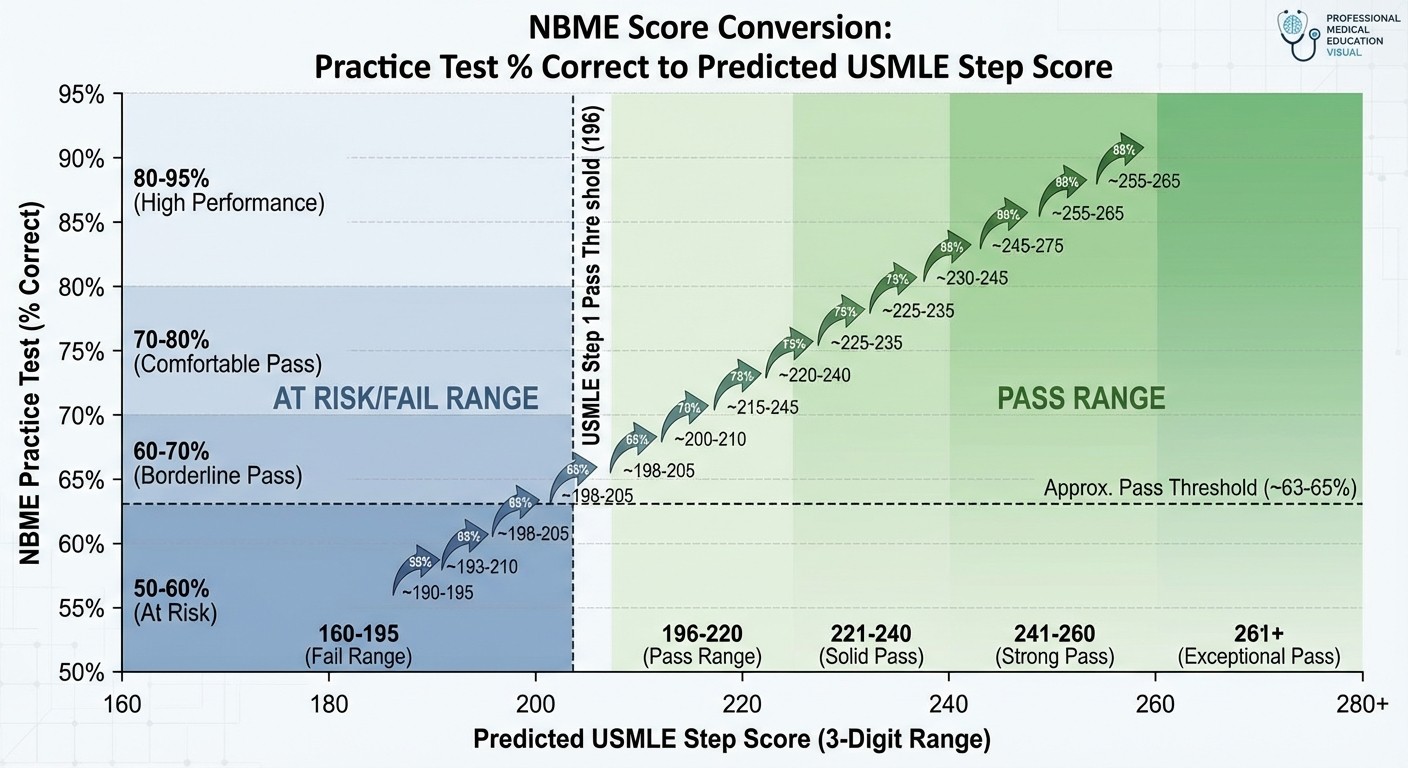
This is where NBMEs earn their reputation as the most accurate USMLE predictors. Understanding score correlation helps you make smart decisions about when to schedule your exam.
Step 1 Score Correlation
NBME Step 1 forms (CBSSA) typically correlate within 10-15 points of actual Step 1 scores. The correlation coefficient hovers around 0.85-0.90, meaning NBME scores explain 85-90% of the variance in actual scores.
Typical Correlation:
NBME 240 = Step 1 235-245
NBME 220 = Step 1 215-225
NBME 200 = Step 1 195-205
Factors Affecting Correlation:
Timing: NBMEs taken within 4 weeks of the exam correlate most strongly
Form Selection: Newer forms (29-31) correlate better than older ones
Individual Performance: Some students consistently over/underperform relative to NBMEs
Step 2 CK Score Correlation
CCSSA forms show similar correlation strength with Step 2 CK, typically within 10-20 points of actual performance.
Key Differences from Step 1:
Step 2 CK scores tend to run 10-20 points higher than NBME predictions
Clinical experience affects correlation — students with more clinical rotations often outperform NBME predictions
CCSSA forms emphasize diagnosis/treatment decisions heavily, matching Step 2 CK priorities
Score Conversion Formulas
Rough Step 1 Conversion: Predicted Score = 0.85 × (NBME Score) + 40 Rough Step 2 CK Conversion: Predicted Score = 0.90 × (NBME Score) + 25
These formulas provide ballpark estimates but shouldnt replace careful analysis of your performance trends across multiple assessments.
When NBME Scores Are Most Predictive
2-4 weeks before exam: Highest correlation
Multiple forms: Average of 2-3 recent NBMEs beats any single score
Consistent performance: Scores within 10 points across forms indicate stable knowledge
If your NBME scores vary by more than 20 points between forms, you likely have unstable knowledge in key areas and should delay your exam until performance stabilizes.
When to Start Taking NBMEs in Your Timeline
Timing your NBMEs strategically maximizes their diagnostic value while avoiding score demoralization early in prep.
Optimal NBME Timeline
Week 2-4 of Prep: Take your first NBME as a baseline
Use Free 120 or cheapest CBSSA form
Self-paced timing acceptable
Goal: Identify major knowledge gaps, not predict readiness
Expect scores 40-60 points below your target
After an NBME reveals weak subjects, Oncourse adaptive engine automatically adjusts difficulty and topic weighting based on performance, surfacing more targeted questions until mastery is reached
Week 8-12 of Prep: Mid-preparation assessment
Take NBME under timed conditions
Should see 20-40 point improvement from baseline
Use results to adjust study priorities for remaining weeks
If score is <200, consider extending prep timeline
Week 16-20 of Prep: Final preparation check
Take NBME 3-4 weeks before scheduled exam
Timed conditions mandatory
Should be within 15-20 points of target score
Use Oncourse performance analytics dashboard to cross-reference NBME feedback with subject-specific performance data for precision remediation
Week 22-24 of Prep: Final assessment
Take newest NBME form 1-2 weeks before exam
Timed conditions only
Should meet or exceed target score consistently
NBMEs test retention of high-yield facts, so use Oncourse integrated spaced repetition to review flagged concepts at optimal intervals
Red Flags in Your NBME Timeline
Stagnant Scores: If scores dont improve between NBMEs separated by 4+ weeks, you are not learning efficiently. Consider changing study methods or getting tutoring. Volatile Performance: Score swings >25 points between forms suggest unstable knowledge. Delay exam until performance stabilizes. Consistent Underperformance: If multiple NBMEs are 20+ points below your target 2 weeks before the exam, postpone and extend prep.
NBME Frequency Guidelines
Maximum: One NBME every 3-4 weeks to allow knowledge consolidation
Minimum: Three total NBMEs during prep (baseline, mid-prep, final)
Optimal: Four NBMEs spaced evenly throughout prep timeline
Taking NBMEs too frequently (weekly) leads to question familiarity bias and doesnt allow sufficient time for knowledge gains between assessments.
How to Analyze NBME Results Beyond the Score
Your three-digit NBME score gets the attention, but the real value lies in performance breakdowns that reveal exactly where knowledge gaps exist.
Using the INSIGHTS Dashboard
NBME's INSIGHTS platform provides detailed analytics:
Content Area Performance: Shows your percentage correct in each major subject compared to other test-takers. Look for subjects where you are >2 standard deviations below average — these need immediate attention. Question-Level Analysis: Review every question with detailed explanations for both correct and incorrect answers. Pay special attention to questions you got right but for wrong reasons. Time Management Data: Tracks seconds spent per question. Flag questions taking >3 minutes — these indicate knowledge gaps that lead to overthinking.
Strategic Question Review Process
Wrong Answers (Priority 1): Review every incorrect answer, but focus on:
Questions you narrowed down to 2 choices but picked wrong
Topics appearing in multiple wrong answers
Basic concepts you should have known cold
Lucky Guesses (Priority 2): Questions you got right through elimination rather than knowledge. These represent unstable knowledge that could fail under pressure. Time Sinks (Priority 3): Correct answers that took >2.5 minutes suggest inefficient knowledge retrieval. Practice similar questions for faster pattern recognition.
Content Gap Analysis
High-Yield Subjects: If you miss >30% in Pathology, Pharmacology, or Physiology on Step 1, these need intensive remediation before your next NBME. Low-Yield but Testable: Missing 50% in Anatomy might be acceptable if other subjects are strong, but missing 50% in Pathology is a red flag. Pattern Recognition: Look for patterns across organ systems. Struggling with renal questions in both Pathology and Pharmacology suggests fundamental physiology gaps.
Creating Your Remediation Plan
Subject Prioritization: Focus remediation time based on:
1. Content area weight on exam (Pathology > Anatomy)
2. Your performance gap (20% vs 60% correct)
3. Improvement potential (factual recall vs complex reasoning)
Resource Allocation: After identifying weak subjects through NBME analysis:
Dedicate 40-50% of study time to weakest 2-3 subjects
Use active recall methods for factual gaps
Practice more questions in weak areas
Consider focused review books for major deficiencies
Progress Tracking: Schedule your next NBME 4-6 weeks out, focusing remediation on areas identified in current analysis. Track improvement in problem subjects to ensure intervention is working.
Combining NBMEs with Other Resources
NBMEs work best as part of an integrated study strategy, not as standalone assessments. Here is how to combine them with other high-yield resources:
NBME + Question Banks
UWorld Integration: Use UWorld for learning and NBMEs for assessment. After each NBME, create custom UWorld sets focused on your weak subjects identified in NBME analysis. Question Bank Rotation:
Primary bank (UWorld): 70% of question practice
Secondary bank (Amboss/Kaplan): 20% for additional exposure
NBME assessment: 10% for progress tracking
Timing Strategy: Complete 1-2 UWorld passes before your first NBME, then use NBMEs to guide targeted review of weak UWorld subjects.
NBME + Anki/Spaced Repetition
Post-NBME Protocol: After each NBME, create Anki cards for:
Every fact you missed
Diseases/mechanisms from wrong answer choices
High-yield points from question explanations
Maintenance Schedule: Review NBME-derived cards daily until your next assessment. This ensures weak areas stay active in memory between NBMEs.
NBME + Review Books
Targeted Reading: Use NBME results to guide First Aid or Pathoma focus. If you miss 40% of Cardiology questions, dedicate extra time to those chapters. Active Integration: After reading review material for weak NBME subjects, immediately practice related questions to reinforce concepts.
Resource Timeline Strategy
Weeks 1-8: Focus on learning (UWorld, review books, videos) Week 4: First NBME baseline Weeks 8-16: Targeted remediation based on NBME results Week 12: Second NBME assessment Weeks 16-20: Final remediation and practice tests Week 18: Third NBME (final check) Weeks 20-24: Maintenance and confidence building Week 23: Final NBME assessment
This timeline ensures NBMEs guide your resource allocation rather than competing with them for study time.
Common Mistakes Students Make with NBMEs
Avoid these frequent NBME missteps that can derail your prep strategy:
Taking NBMEs Too Early
The Mistake: Taking an NBME after 2-3 weeks of study, getting a low score, and getting demoralized. Why It Backfires: Early NBMEs reflect your baseline knowledge, not learning trajectory. Low scores are expected and normal. Better Approach: Wait until you have completed at least one pass of your primary question bank before taking your first scored NBME.
Focusing Only on the Score
The Mistake: Getting fixated on the three-digit score while ignoring content breakdown and question analysis. Why It Matters: The score predicts readiness, but content analysis tells you how to get ready. Better Approach: Spend equal time reviewing wrong answers and planning remediation as you do analyzing your score.
Taking NBMEs Too Frequently
The Mistake: Taking NBMEs weekly or bi-weekly to "track progress." Why It Backfires: Knowledge consolidation takes weeks, not days. Frequent testing measures test-taking familiarity rather than learning. Better Approach: Space NBMEs 4-6 weeks apart to allow meaningful knowledge gains between assessments.
Ignoring Time Management Data
The Mistake: Not paying attention to time spent per question or finishing with lots of time remaining. Why It Matters: Real USMLE timing is tight. If you are finishing NBMEs with 30+ minutes per block remaining, you are either not reading carefully or working too quickly. Better Approach: Practice finishing each NBME block with 2-5 minutes remaining — optimal for real exam pacing.
Using Old or Unofficial Forms
The Mistake: Taking retired NBME forms or bootleg versions found online. Why It's Problematic: Scoring algorithms change, and retired questions may not reflect current exam emphasis. Better Approach: Stick to current official forms available through the NBME website, even if they cost more.
Not Adjusting Study Plans Based on Results
The Mistake: Taking multiple NBMEs but continuing the same study routine regardless of results. Why It's Inefficient: NBMEs are diagnostic tools that should reshape your preparation focus. Better Approach: Dedicate 48 hours after each NBME to revising your study plan based on content gaps identified.
Panic-Scheduling After Bad Scores
The Mistake: Getting a lower NBME score than expected and immediately rescheduling the exam without addressing underlying issues. While Sometimes Necessary: Make sure you understand why performance dropped and have a concrete plan to improve before setting a new exam date. Better Approach: Give yourself at least 4 weeks of focused remediation before making scheduling decisions based on a single NBME score.
Frequently Asked Questions
How accurate are NBME practice exams compared to the real USMLE?
NBME practice exams are the most accurate predictors available, typically correlating within 10-15 points of actual Step 1 scores and 10-20 points of Step 2 CK scores. The correlation coefficient is around 0.85-0.90, meaning your NBME performance explains 85-90% of the variance in real exam scores. However, accuracy increases when NBMEs are taken within 4 weeks of your actual exam date.
Which NBME form should I take first?
For Step 1, start with Form 25 or 26 as your baseline assessment. These tend to have slightly more straightforward question styles. For Step 2 CK, any current CCSSA form works well for initial assessment. Take your first NBME after completing at least one pass through your primary question bank to ensure meaningful results.
How many NBMEs should I take during my USMLE prep?
Most successful students take 3-4 NBMEs total: one baseline assessment early in prep, 1-2 during mid-preparation, and one final assessment 1-2 weeks before the exam. Taking more than one NBME per month can lead to question familiarity bias without allowing sufficient time for knowledge consolidation between assessments.
What NBME score do I need to pass Step 1 or Step 2 CK?
For Step 1 (pass/fail since 2022), aim for NBME scores consistently above 200. For Step 2 CK, target NBME scores of 220+ to feel confident about passing (real passing score is typically around 214). However, these are rough guidelines — your target should be 20-30 points above the minimum passing score to account for score variation.
Should I take NBMEs under timed or self-paced conditions?
Use self-paced timing only for your very first NBME when learning question styles. After that, always use timed conditions to practice time management. The real USMLE gives you exactly 1.25 minutes per question, and learning to work within these constraints is crucial for success.
How long should I wait between NBME assessments?
Wait at least 4-6 weeks between NBMEs to allow meaningful knowledge gains. Taking NBMEs more frequently measures test familiarity rather than actual learning. Use the interim weeks for focused study on weak areas identified in your previous NBME results.
Looking to maximize your USMLE performance? Check out our comprehensive guides for Step 1 exam preparation and Step 2 CK preparation for additional strategic insights.
Prepare smarter with Oncourse AI — adaptive MCQs, spaced repetition, and AI explanations built for USMLE Step 1 and Step 2 CK. Download free on Android and iOS