USMLE Question Bank: How to Practice the Questions That Expose Weak Areas
Learn how to use your USMLE question bank strategically to identify weak areas across Step 1, Step 2 CK, and Step 3. Master timed vs tutor modes, error analysis, and targeted review plans.

USMLE Question Bank: How to Practice the Questions That Expose Weak Areas
You probably opened your USMLE question bank this morning, saw that 67% correct from yesterday's block, and wondered if you should be happy or worried. Here's what you should actually be asking: which 33% of mistakes are exposing the gaps that'll cost you points on test day?
Most students treat their question bank like a slot machine — random blocks, check the score, move on. But the students who jump 40+ points in their final month? They turn every missed question into a diagnostic tool that reveals exactly where their reasoning breaks down.
Your question bank isnt just practice. Its the most precise weak-area detector you have. The trick is knowing how to read what its telling you.
Why Weak-Area Detection Beats Random Practice
NBME doesnt create 280 random questions for Step 1 or 318 for Step 2 CK. They systematically test your ability to recognize patterns, eliminate traps, and make decisions under time pressure. Every question they write is designed to expose a specific type of thinking error.
When you get a question wrong, youre not just missing a fact — youre revealing a blind spot in how you process clinical information. Maybe you consistently fall for "classic presentation" traps in psychiatry. Maybe you miss the subtle lab values that distinguish similar endocrine disorders. Maybe you make great differential diagnoses but struggle to pick the next best step.
These patterns are your roadmap to a higher score. But only if you know how to find them.
Setting Up Your Question Bank for Diagnostic Feedback
Timed vs Tutor Mode: When to Use Each
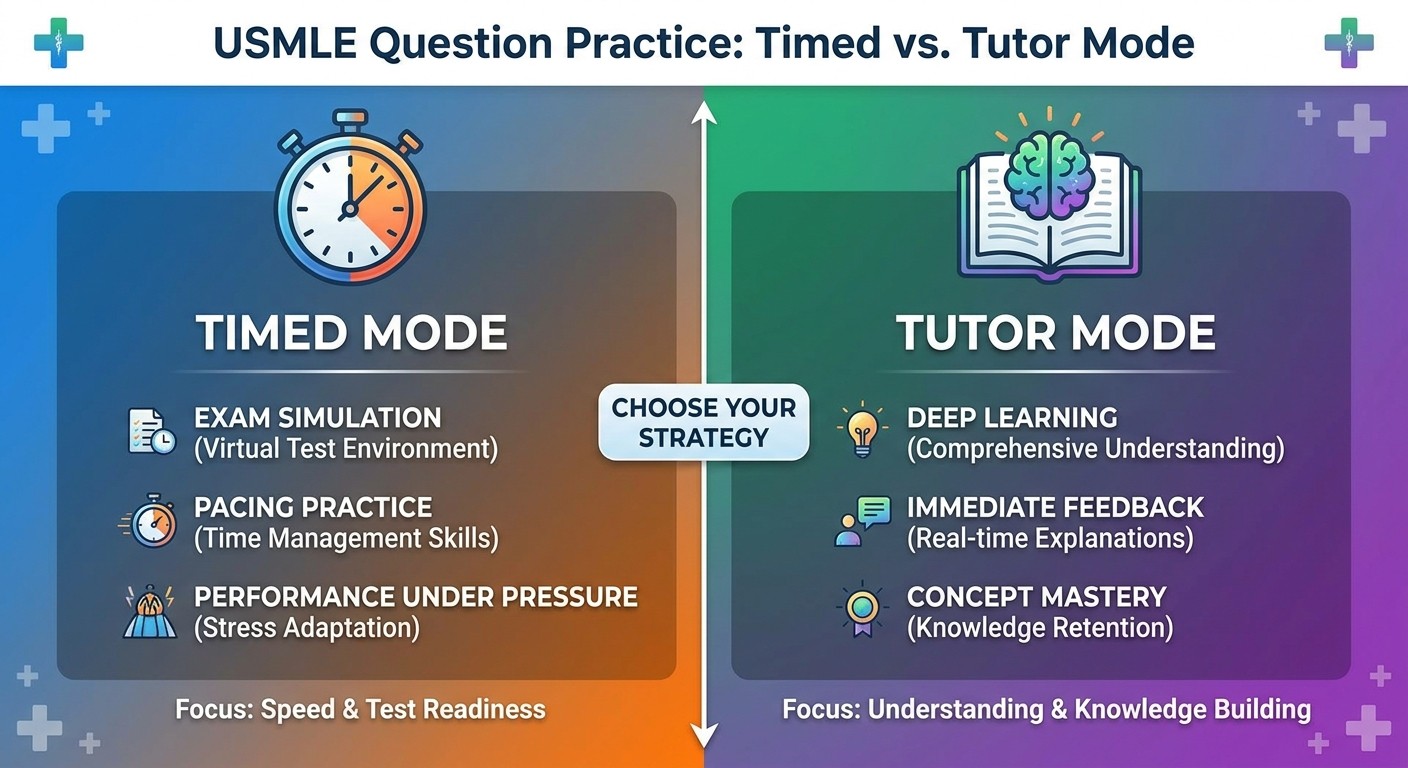
Early Phase (First 4-6 weeks of dedicated study):
70% tutor mode, 30% timed blocks
Use tutor mode to build pattern recognition without time pressure
Take short timed sets (10-20 questions) to start building pace
Mid Phase (Weeks 6-10):
50% tutor mode, 50% timed blocks
Timed blocks reveal time management issues and decision-making under pressure
Tutor mode for targeted weak-area drilling
Final Phase (Last 3-4 weeks):
80% timed blocks, 20% targeted tutor review
Full 40-question blocks in exam conditions
Use remaining tutor time only for persistent weak spots
The key insight: timed mode shows you what breaks down under pressure. Tutor mode shows you what you actually understand. You need both data points.
The 5-Step Weak Area Analysis System
Step 1: Tag Every Error by Type
Not all mistakes are created equal. For every question you miss or guess on, categorize the error:
Knowledge Gap: You simply didnt know the content Reasoning Error: You knew the facts but applied them wrong Distractor Trap: You fell for a convincing wrong answer Time Pressure: You rushed and made a careless mistake Misread Stem: You answered a different question than asked
Track these categories over 100 questions. If 60% of your errors are knowledge gaps in cardiology, thats different from 60% being distractor traps across all systems.
Step 2: Map Errors by System and Presentation
Your question bank analytics will show system-level performance (cardiology 73%, endocrine 52%). But go deeper:
Step 1: Track by basic science mechanism (pharmacology, pathology, physiology)
Step 2 CK: Track by clinical presentation (chest pain, shortness of breath, altered mental status)
Step 3: Track by management decision (admission vs discharge, first-line vs second-line therapy)
Create a simple spreadsheet. After every block, log your 3-4 worst-performing areas. Patterns will emerge within a week.
Step 3: Analyze Your Guess Pattern
Questions you guess on are as important as questions you miss. Guessing reveals uncertainty — and uncertainty reveals incomplete pattern recognition.
When you guess and get it right, ask: "What made me unsure?" When you guess and get it wrong: "What would have pointed me to the right answer?"
These uncertain questions show you concepts that are half-formed in your brain. One good explanation often converts a guess into confident knowledge.
Step 4: Review Incorrect and Guessed Questions Within 24 Hours
The best question banks make this easy with filtering options. But heres the review system that actually sticks:
For each missed question:
1. Re-read the stem. What did you miss the first time?
2. Identify the key discriminating fact that makes one answer correct
3. List why each wrong answer is wrong (not just why the right answer is right)
4. Write one sentence about what this question teaches you
This 2-minute process per question is what separates students who improve from students who plateau.
Step 5: Convert Analysis into Action
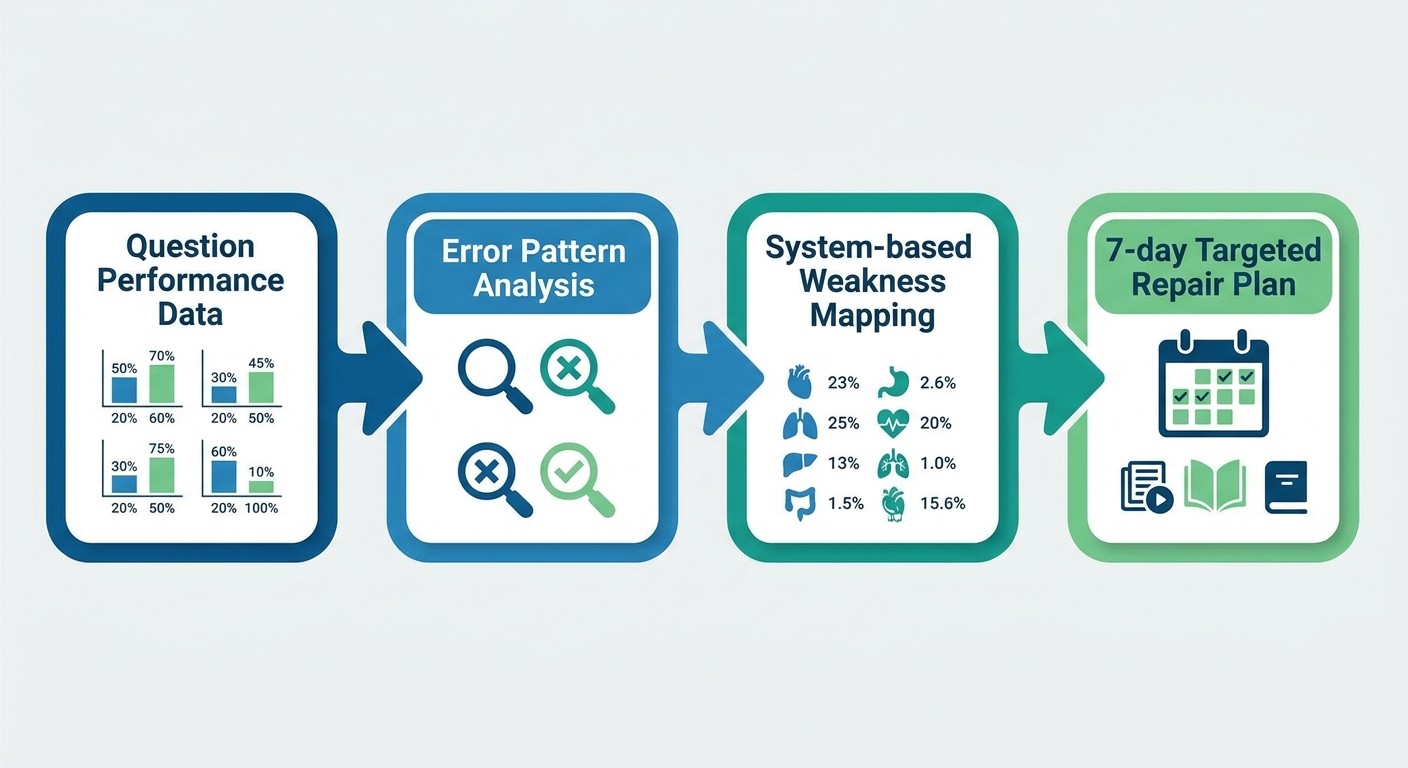
Every Sunday, look at your weeks error data and create next weeks targeted practice plan:
Worst system: 50% of next weeks questions from this area
Worst error type: Adjust your review process (more reasoning practice, more content review, etc.)
Persistent weak spots: Schedule specific content review before more questions
Using Mixed vs Targeted Blocks Strategically
Targeted Blocks (Subject-Specific):
Best for: Newly identified weak areas, post-content review reinforcement
When: After youve studied a topic, not before
Goal: Build confidence and pattern recognition in one domain
Mixed Blocks (Random):
Best for: Testing recall across systems, mimicking exam conditions
When: Final 4 weeks of prep, after targeted work
Goal: Simulate test-day cognitive load and decision-making
The common mistake is doing only mixed blocks too early. You end up guessing across multiple systems instead of building solid knowledge in any single area.
For Step 1, targeted blocks help you master pathophysiology mechanisms. For Step 2 CK, they help you recognize clinical presentations. For Step 3, they help you practice management decisions in specific specialties.
Leveraging AI for Question Analysis
Modern question banks increasingly offer AI-powered explanations that can dig deeper into your specific mistakes. Oncourse AI's adaptive question bank helps students drill weak systems and recurring question patterns instead of only completing random blocks.
When you miss a question about beta-blocker mechanisms, you can ask Oncourse's Rezzy AI tutor why the correct answer is right, why distractors are wrong, and what clue should have changed your answer choice — getting personalized explanations that prevent similar mistakes.
Common Question Bank Mistakes That Hide Weak Areas
Mistake 1: Chasing High Completion Numbers
Doing 3,000 questions badly teaches you less than doing 1,500 questions with systematic review. Your goal isnt completion — its pattern recognition.
Mistake 2: Only Reviewing Incorrect Answers
Questions you got right by guessing are teaching opportunities. They reveal shakier knowledge that could break down under pressure.
Mistake 3: Studying Content After Missing Questions
If you miss a cardiology question, dont immediately go read a cardiology textbook. First figure out if it was a knowledge gap, reasoning error, or trap. Different problems need different solutions.
Mistake 4: Ignoring Time Distribution
If you spend 3 minutes on easy questions and 30 seconds on hard ones, your accuracy data is meaningless. Track time per question to identify pacing issues.
Sample Weekly Practice Cadence
Monday: 40-question mixed block (timed), review all questions Tuesday: Targeted block on weakest system from Monday (tutor mode) Wednesday: 40-question mixed block (timed), focus on 2nd weakest system Thursday: 20 questions from most-missed topics (tutor mode) Friday: 40-question mixed block (timed), full review Saturday: Targeted practice on persistent weak spots Sunday: Analytics review and next week planning
This gives you 180 questions per week with systematic weak-area targeting. Adjust the ratio based on your phase of prep.
Final 2-Week Review Strategy
Two weeks before your exam, your question bank becomes pure diagnostics:
Week -2: Full-length practice exams only. No new content review. Pure pattern recognition and endurance testing. Week -1: Short blocks (20-25 questions) on your 3-4 persistent weak areas. Think of these as final calibration, not learning. Days -3 to -1: No new questions. Review only your most-missed question explanations from the past month.
The goal is confidence and pattern recognition, not cramming new facts.
Building Your Weak-Area Dashboard
The most successful students create a simple tracking system:
System | Questions Done | % Correct | Error Type | Next Action |
|---|---|---|---|---|
Cardio | 127 | 73% | Reasoning | Practice ECG interpretation |
Endocrine | 89 | 52% | Knowledge | Review diabetes management |
Psych | 76 | 81% | Traps | Study distractor patterns |
Update this weekly. Your dashboard should drive your study decisions, not your gut feeling about what you need to work on.
Performance analytics automatically track these patterns in platforms like Oncourse AI, turning your question performance into a visual map of weak subjects, accuracy trends, and review priorities without manual logging.
Frequently Asked Questions
How many questions should I complete before analyzing weak areas?
Start analyzing after 200-300 questions. You need enough data for patterns to emerge, but dont wait too long. Early identification of weak areas gives you more time to address them systematically.
Should I repeat questions I got wrong?
Yes, but not immediately. Wait 1-2 weeks, then redo missed questions in timed mode. If you get them right quickly, the pattern stuck. If you miss them again, thats a true weak area requiring content review.
What if my USMLE question bank shows weak areas in multiple systems?
Focus on the worst 2-3 systems first. Trying to fix everything simultaneously leads to shallow learning. Master your weakest areas completely before moving to moderately weak ones.
How do I know if a question bank is effectively identifying my weak areas?
Look for adaptive questioning that surfaces similar question types when you miss one, detailed performance breakdowns by topic and reasoning type, and explanations that address why you chose wrong answers, not just why the right answer is correct.
Is 70% accuracy on my question bank good enough for USMLE?
Accuracy matters less than improvement trajectory. A student improving from 55% to 70% is in better shape than someone stuck at 75%. Focus on your error analysis and weak-area targeting rather than absolute percentages.
When should I switch from targeted to mixed practice blocks?
Make the switch when you can hit 75%+ accuracy on targeted blocks in your formerly weak areas. Mixed blocks test whether your knowledge transfers across contexts — the ultimate test of understanding.
---
Your USMLE question bank is the most precise diagnostic tool in your prep arsenal. But only if you use it like a diagnostic tool instead of a completion checklist. Every missed question is data. Every guess is insight. Every pattern you identify is points on test day.
Prepare smarter with Oncourse AI — adaptive MCQs, spaced repetition, and AI explanations built for USMLE. Download free on Android and iOS.