Back
How to Get US Clinical Experience (USCE) as an IMG in 2026: The Complete Matchability Guide
Complete guide for IMGs seeking US clinical experience in 2026. Learn about USCE types, ECFMG requirements, program applications, and how to present clinical rotations on ERAS for maximum matchability.
How to Get US Clinical Experience (USCE) as an IMG in 2026: The Complete Matchability Guide
You are probably staring at ERAS deadlines and wondering how you'll compete without US clinical experience. The harsh reality? After Step 1 went pass/fail in 2022, USCE has become the differentiator that program directors rely on to separate competitive IMGs from the rest.
Here's the number that matters: 75% of matched IMGs have at least 12 weeks of USCE. Without it, you are essentially applying with one hand tied behind your back. But here's what most guides won't tell you — getting quality USCE isn't about sending 200 cold emails or paying $5,000 for a guaranteed spot. It's about understanding exactly what program directors want to see and positioning yourself strategically.
This guide breaks down every aspect of securing meaningful US clinical experience in 2026, from ECFMG requirements to crafting the perfect cold email, to presenting your rotations on ERAS in a way that screams "competent resident material."
What Counts as USCE (And What Doesn't)
Not all clinical experiences are created equal. Program directors can spot filler rotations from a mile away. Here's what actually moves the needle:
Types That Matter Most
Sub-Internships (Acting Internships)
The gold standard. You function as an intern under supervision, writing notes, presenting cases, and making clinical decisions. These carry the most weight because they demonstrate you can handle resident responsibilities. Typically 4 weeks, competitive to get, and expensive ($2,000-$4,000).
Clinical Externships
You are part of the medical team with hands-on patient care responsibilities. Less intensive than sub-internships but still valuable for demonstrating clinical competence. Usually 4-8 weeks, cost varies ($500-$2,500).
Observerships (Clinical Observerships)
You shadow attending physicians and residents. Limited hands-on involvement but good for networking and understanding US healthcare systems. Easier to obtain, 2-4 weeks typical, costs $500-$1,500.
What Program Directors Actually Look For
1. Direct patient interaction — not just shadowing
2. Documentation responsibilities — writing notes, presenting cases
3. Integration with the medical team — being included in rounds and decisions
4. Duration — minimum 4 weeks to demonstrate commitment and learning curve
5. Quality of letter of recommendation — attendings who can speak to your clinical skills
Research rotations and volunteer experiences don't count as USCE unless they include significant clinical components with patient interaction.
Why USCE Became Non-Negotiable After 2022
Step 1 pass/fail changed everything. Program directors lost their primary numerical filter for IMG competency. They now rely heavily on:
Step 2 CK scores (your new Step 1)
US clinical experience (proof you can function in the US healthcare system)
Strong letters of recommendation from US physicians
The data is clear: Match rates for IMGs with USCE are 65% higher than those without. It's not just about demonstrating clinical skills — it's about proving you understand US medical culture, communication styles, and healthcare systems.
When preparing for Step 2 CK alongside USCE pursuits, Oncourse's AI-powered question bank adapts to the weak areas you identify during clinical rotations. The specialty-aligned quizzes mirror what attendings will quiz you on during rounds, creating a feedback loop between studying and clinical exposure.
ECFMG Certification and Visa Requirements
ECFMG Requirements for USCE
You need ECFMG certification before starting any USCE. This requires:
Passing USMLE Step 1 and Step 2 CK
OASIS verification of medical education credentials
ECFMG certificate issuance
Processing time: 2-6 weeks after Step 2 CK results if all documents are ready.
Visa Options for USCE
B-1/B-2 Tourist Visa
Most common for observerships. Cannot receive payment, must be educational. Duration: up to 6 months.
J-1 Visa (Educational Exchange) Required for hands-on externships and sub-internships. Sponsored by ECFMG or individual institutions. Allows clinical responsibilities and modest stipends.
Start visa applications 3-4 months before planned rotation dates. Processing times have increased post-COVID.
How to Find USCE Programs: The Strategic Approach
1. Start with Specialty-Specific Programs
Different specialties have different USCE cultures:
Internal Medicine: Most opportunities, highly competitive programs prefer IMGs with research connections Family Medicine: IMG-friendly, many community programs accept international students Psychiatry: Growing acceptance of IMGs, observerships widely available Pediatrics: Competitive, prefer candidates with prior pediatric experience Surgery: Limited opportunities, heavily favor research involvement Emergency Medicine: Few IMG positions, mostly observerships
2. Target Community Hospitals First
Academic medical centers get 500+ applications per spot. Community hospitals receive 50-100. Your odds are dramatically better at:
Non-university teaching hospitals
Community health centers
Rural hospitals with residency programs
Hospitals in less desirable locations (but still ACGME-accredited)
3. The Cold Email Strategy That Works
90% of IMG cold emails get deleted. Here's the template that doesn't:
Subject: Medical Graduate Research Collaboration - [Your Name] - [Specific Dates] Body:
"Dear Dr. [Name],
I am contacting you regarding potential clinical observation opportunities in [specific department] at [hospital name]. I am an ECFMG-certified physician from [country] with strong interest in [specific area within their specialty].
My background includes [1-2 specific clinical experiences relevant to their work]. I am particularly interested in observing [specific procedure/condition they specialize in] as it relates to my research interest in [relevant topic].
I am available for a [specific timeframe, e.g., 4-week rotation] starting [specific month]. I would welcome the opportunity to contribute to ongoing research projects and am prepared to cover all associated costs.
Could we arrange a brief call to discuss potential opportunities?
Best regards,
[Your name]
[Your credentials]
[Phone number]"
Key points:
Specific dates and duration
Mention their specialty area specifically
Offer research contribution
Professional but not overly formal
Include your phone number
4. Leverage Your Medical School Network
Contact your medical school's international affairs office. Many have established partnerships with US hospitals that aren't publicly advertised. Alumni networks are goldmines — reach out to graduates who matched into US residencies.
Making the Most of Your USCE
Week 1: Establish Your Value
Arrive early, stay late
Volunteer for additional cases
Prepare presentations on relevant topics
Ask thoughtful questions during rounds
Weeks 2-3: Integrate and Contribute
Take detailed notes on interesting cases
Offer to research topics that come up
Build relationships with residents (they'll be your future colleagues)
Document everything for your ERAS application
Week 4: Secure Your Letter
Request your letter of recommendation in person
Provide the attending with a draft that highlights specific contributions
Exchange contact information for future questions
During rotations, use Oncourse's Ask AI to deep-dive clinical cases you encounter. Turn real patient encounters into study material — reinforce both clinical knowledge and exam prep simultaneously.
Timeline for IMGs: When to Start Pursuing USCE
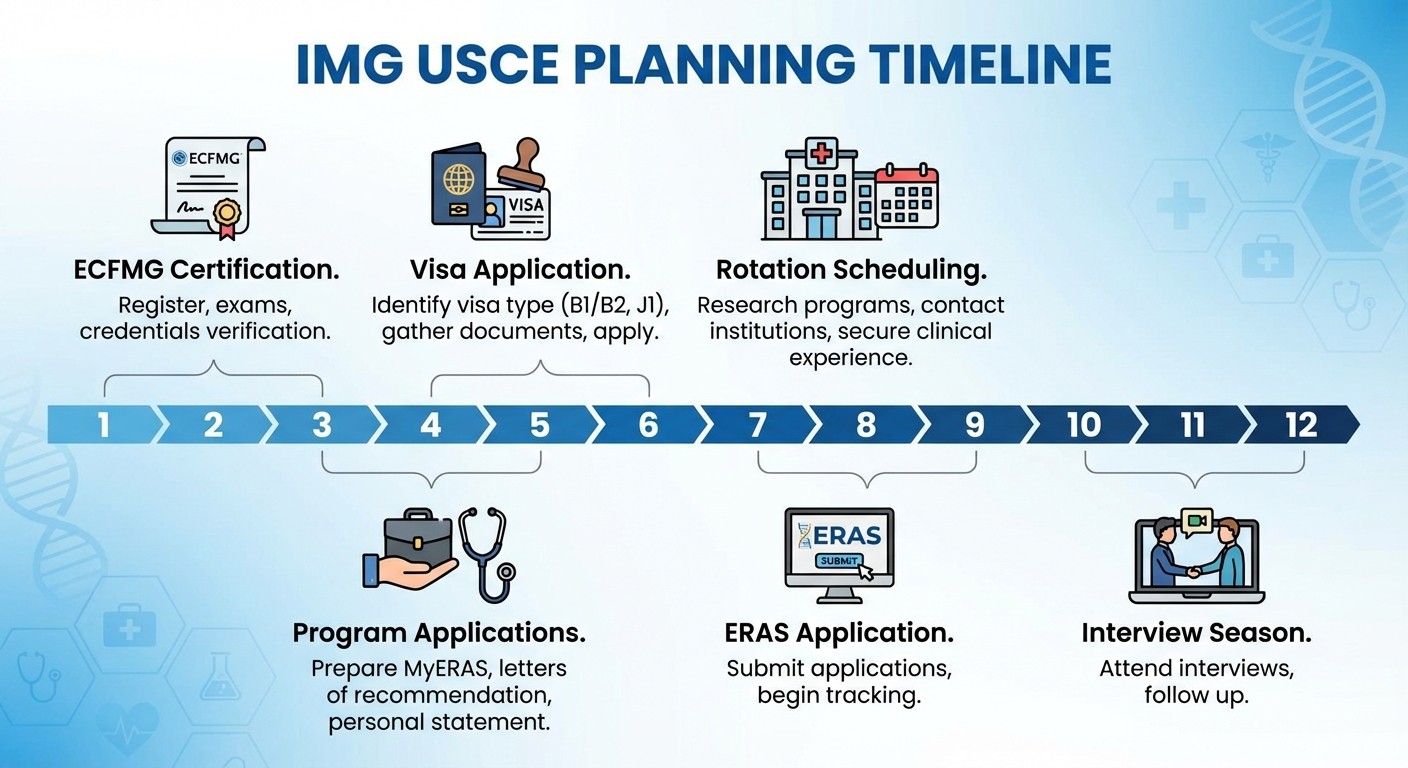
18 Months Before Match
Complete Step 1
Begin researching USCE programs
Start building research connections
12 Months Before Match
Take Step 2 CK
Apply for ECFMG certification
Submit initial USCE applications
9 Months Before Match
Receive ECFMG certification
Apply for appropriate visa
Confirm rotation schedules
6-3 Months Before Match
Complete USCE rotations
Secure letters of recommendation
Document experiences for ERAS
The earlier you start, the more options you'll have. Popular programs fill up 12+ months in advance.
Use Oncourse's performance analytics dashboard to track your mock exam scores by specialty. This data helps you identify which clinical areas need reinforcement before your rotation starts — so you can focus-fire weak specialties and arrive prepared.
Red Flags to Avoid
Program Red Flags
Guarantees of letters of recommendation before meeting you
Requests for large upfront payments (>$3,000)
No clear clinical responsibilities outlined
Non-ACGME accredited hospitals
No physician supervision mentioned
Your Application Red Flags
Applying to 50+ programs (shows desperation)
Requesting only observerships (shows unwillingness to take on responsibility)
Inflexible with dates (shows poor planning)
No clear specialty focus (shows lack of direction)
How to Present USCE in Your ERAS Application
Work and Volunteer Experience Section
Format:
```
Position: Clinical Extern in Internal Medicine
Organization: [Hospital Name]
Location: [City, State]
Start/End Dates: MM/YYYY - MM/YYYY
Hours per Week: 40-50
Supervisor: Dr. [Name], MD
Description: Participated in daily rounds, patient interviews, and case presentations under attending physician supervision. Managed 8-12 patients daily, wrote progress notes, and presented cases to medical team. Contributed to quality improvement project on medication reconciliation.
```
Key Description Elements
1. Specific responsibilities — not just "observed" 2. Patient numbers — how many patients you managed 3. Integration with team — presenting, contributing to decisions 4. Additional projects — research, quality improvement, education
Letters of Recommendation Strategy
Request letters within 2 weeks of rotation completion
Provide attending with bullet points of your contributions
Include specific cases you managed or presentations you gave
Follow up politely if letter is delayed
Specialty-Specific USCE Tips
Internal Medicine
Focus on subspecialty clinics (cardiology, gastroenterology, pulmonology). Demonstrate broad knowledge and enthusiasm for complex medical cases. Research quality improvement projects.
Family Medicine
Emphasize interest in preventive care and community health. Rural family medicine programs are particularly IMG-friendly. Show cultural competency and communication skills.
Psychiatry
Mental health rotations in community settings count. Emphasize cultural sensitivity and communication abilities. Many programs value diverse perspectives IMGs bring.
Surgery
Research publications are almost mandatory. Observerships in OR plus research involvement. Consider preliminary surgery year programs as backup.
Pediatrics
Prior pediatric experience (even from home country) helps significantly. Emphasize vaccine schedules, developmental milestones, and family communication.
Emergency Medicine
Very limited IMG spots. Focus on trauma centers or academic EDs. Observerships only — hands-on experience rare for IMGs.
Frequently Asked Questions
How many weeks of USCE do I need to be competitive?
Minimum 12 weeks across 2-3 specialties for competitive specialties like internal medicine. Family medicine and psychiatry may accept candidates with 8 weeks. Surgery requires 16+ weeks plus research.
Can I do USCE before taking Step 2 CK?
You need ECFMG certification, which requires passing both Step 1 and Step 2 CK. Some observerships accept students before Step 2 CK, but hands-on experiences require full certification.
How much should I budget for USCE?
Budget $2,000-$5,000 per 4-week rotation including program fees, housing, travel, and living expenses. Observerships cost less ($500-$1,500), sub-internships cost more ($3,000-$7,000).
Should I do USCE in my target specialty only?
No. One rotation in your target specialty, one in internal medicine (if not your target), and one elective that demonstrates breadth. Program directors want to see you can handle different clinical environments.
What if I can't get letters of recommendation from USCE?
This significantly hurts your application. Always discuss letter expectations before starting rotations. If an attending can't write a strong letter, it may indicate insufficient clinical involvement during your rotation.
Can I do USCE at the same hospital where I want to match?
Yes, but don't rely solely on this strategy. Many hospitals have rules against preferencing their own USCE students. Use rotations to demonstrate competency, not to expect preferential treatment.
The Bottom Line on USCE Success
USCE isn't just about checking boxes for your residency application. It's about proving you can function effectively in the US healthcare system and building the clinical foundation you'll need as a resident. The IMGs who succeed approach USCE strategically — they target appropriate programs, maximize their clinical learning, and leverage each rotation to build toward their ultimate goal of matching into residency.
The process is challenging, expensive, and time-consuming. But for IMGs serious about matching in 2026, it's not optional. Start early, be strategic about program selection, and use each rotation as an opportunity to prove you belong in US medicine.
Prepare smarter with Oncourse AI — adaptive MCQs, spaced repetition, and AI explanations built for USMLE success. Download free on Android and iOS.