Back
UKMLA Revision: Build an Adaptive Plan With Oncourse AI
Build a data-driven UKMLA revision plan that adapts to your weak areas. Complete guide covering AKT knowledge gaps, CPSA skills practice, diagnostic analysis, and 6-week adaptive preparation strategy with AI-powered daily planning.

UKMLA Revision: Build an Adaptive Plan With Oncourse AI
You are staring at the GMC Content Map. 430 conditions. 212 clinical presentations. Two separate assessments (AKT and CPSA) that test completely different skills. Your exam is in 8 weeks, and you need a revision plan that actually adapts to where you are weak.
Most UKMLA candidates make the same mistake: they treat revision like a checkbox exercise. Study cardiology for 3 days, respiratory for 3 days, tick the boxes, hope for the best. But UKMLA doesnt work that way. The AKT tests pattern recognition across clinical presentations. The CPSA tests whether you can actually function as a safe doctor.
This is where adaptive revision changes everything. Instead of following a rigid timetable, you build a system that identifies your weak areas in real-time and adjusts your daily study plan accordingly. By the end of this guide, you'll have a complete framework for UKMLA revision that turns diagnostic data into targeted practice.
What UKMLA Revision Should Prioritise
UKMLA revision is not medical school revision. You arent learning topics from scratch – you are sharpening clinical reasoning under time pressure.
The AKT tests application, not memory. Questions present clinical vignettes where you must select the most appropriate next step, investigation, or management. Success depends on recognizing patterns quickly and avoiding common distractors. The CPSA tests professional competence. You need structured communication, safe clinical examination, and the ability to make decisions with incomplete information. No amount of MCQ practice prepares you for explaining a diagnosis to a concerned relative.
AKT Priority Areas (Based on 2026 Content Map)
High-yield systems that appear frequently:
Cardiovascular: Acute coronary syndromes, heart failure, arrhythmias (15-20% of questions)
Respiratory: Asthma, COPD, pneumonia, pulmonary embolism (12-15% of questions)
Neurology: Stroke, seizures, headache, altered consciousness (10-12% of questions)
Emergency Medicine: Sepsis, shock, trauma, toxicology (10-12% of questions)
Mental Health: Depression, anxiety, psychosis, capacity (8-10% of questions)
CPSA Priority Skills
Essential competencies tested across stations:
Communication: History taking, explaining diagnoses, consent discussions
Clinical Skills: Focused examinations, interpreting findings, safety checks
Professional Behaviour: Ethical reasoning, teamwork, managing uncertainty
Clinical Reasoning: Differential diagnosis, investigation planning, risk assessment
Separating AKT Knowledge from CPSA Performance
The biggest UKMLA revision mistake is mixing AKT and CPSA preparation. They require completely different skill sets and practice methods.
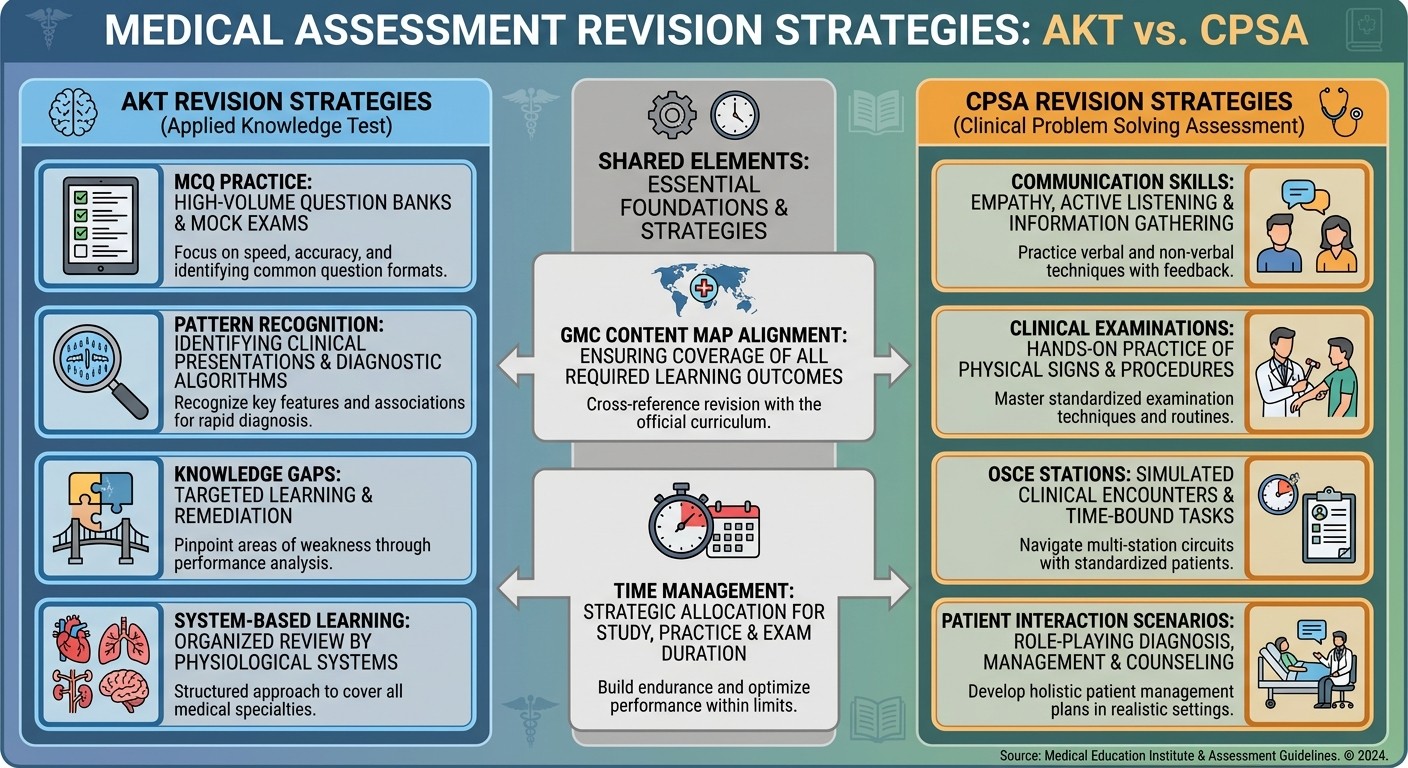
AKT Revision Focus
Pattern Recognition: Practice identifying clinical presentations from vignettes. You need to recognize acute MI within 20 seconds of reading "crushing chest pain, sweating, ECG changes." Guideline Knowledge: NICE guidelines drive most management questions. Learn the stepped approaches for asthma, heart failure, depression, and diabetes management. Time Management: 72 seconds per question across 200 questions. You cannot deliberate – you must recognize and move. Distractor Analysis: Wrong answers often include reasonable alternatives. Practice eliminating plausible but incorrect options.
CPSA Revision Focus
Structured Communication: Develop frameworks for common scenarios. Every history follows the same pattern: introduction, open questions, systems review, closing summary. Physical Examination: Practice complete but focused examinations. You need smooth technique under observation, not just knowledge of what to examine. Professional Skills: Communication with colleagues, breaking bad news, obtaining consent, handling difficult situations. Station Management: Each CPSA station has specific time limits and assessment criteria. Practice pacing and hitting required checkpoints.
The Oncourse AI Daily Plan separates these skill types automatically, ensuring your AKT pattern recognition practice doesnt interfere with CPSA communication development.
Running a Baseline Diagnostic Week
Before building your adaptive plan, you need accurate data on your current performance. A diagnostic week identifies exactly where you are weak across all UKMLA domains.
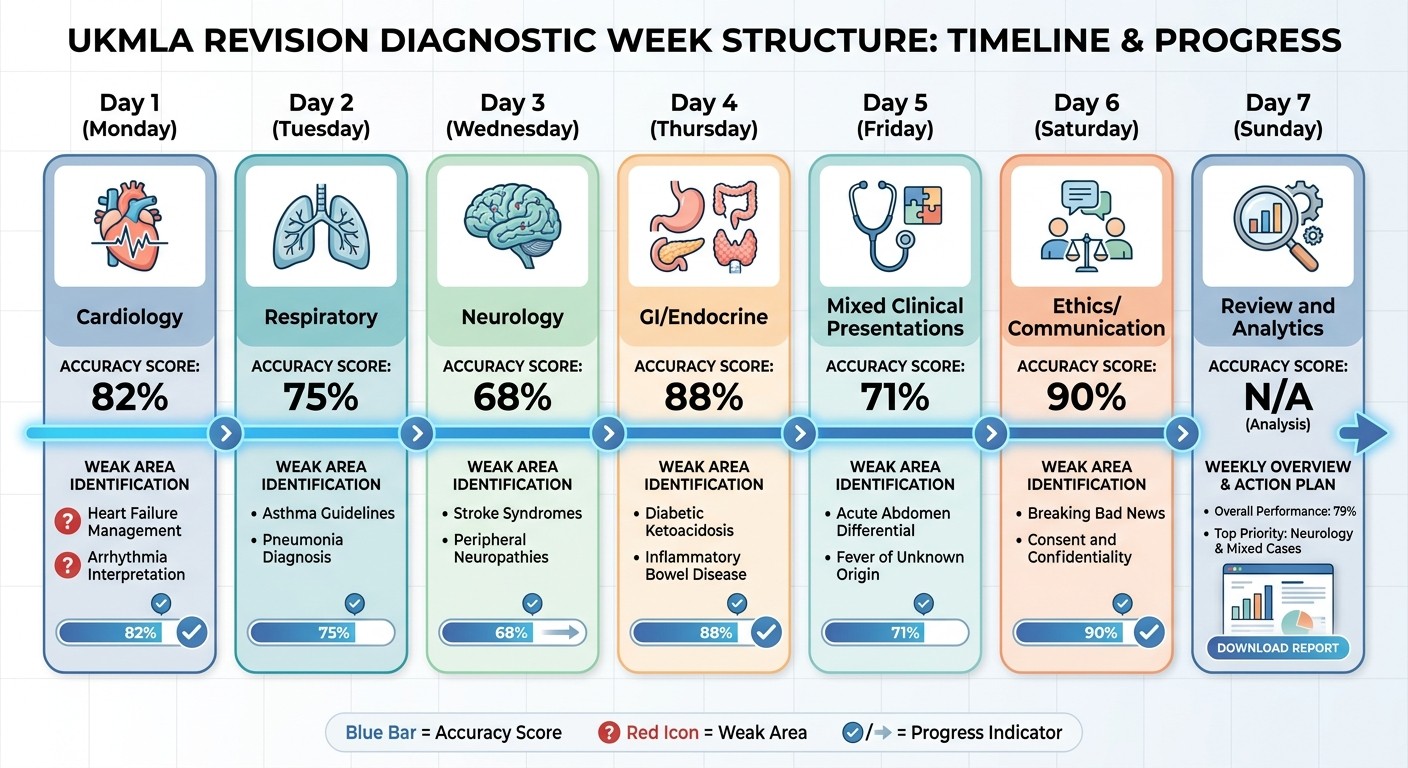
Day 1-4: System-Based Assessment
Day 1: Cardiovascular (50 questions)
Focus: ACS, heart failure, arrhythmias, hypertension
Target: Identify knowledge gaps vs. application errors
Track: Time per question, accuracy by subtopic
Day 2: Respiratory (50 questions)
Focus: Asthma, COPD, infections, pleural disease
Watch for: Investigation selection errors, management step confusion
Day 3: Neurology (50 questions)
Focus: Stroke, seizures, headache, consciousness disorders
Common traps: Imaging timing, thrombolysis criteria
Day 4: Emergency/Acute Medicine (50 questions)
Focus: Sepsis, shock, toxicology, trauma
Critical: Safety protocols, escalation decisions
Day 5-6: Clinical Presentations
Day 5: Mixed Presentations (100 questions)
Present symptoms without obvious system clues
Test pattern recognition speed
Identify presentation types you consistently miss
Day 6: Professional/Communication (50 questions)
Ethics, consent, communication scenarios
Often neglected but worth 15-20% of AKT
Day 7: Analysis and Planning
Review your diagnostic week data:
Strong areas: >75% accuracy, consistent timing
Moderate areas: 60-75% accuracy, some hesitation
Weak areas: <60% accuracy, slow or incorrect reasoning
Your diagnostic week reveals more than overall percentage scores. Look for patterns: Do you miss investigation timing? Management steps? Safety protocols? Communication scenarios?
Grouping Weak Areas by Clinical Systems
Once you have diagnostic data, group your weaknesses logically for targeted revision.
System-Based Grouping
Cardiovascular Weaknesses
Acute presentations: ACS, arrhythmias, heart failure
Chronic management: Hypertension, prevention, medication reviews
Investigations: ECG interpretation, echo findings, troponin timing
Respiratory Weaknesses
Acute presentations: Pneumonia, PE, pneumothorax, asthma attacks
Chronic management: COPD, ILD, monitoring, rehabilitation
Investigations: CXR interpretation, spirometry, blood gases
Presentation-Based Grouping
Chest Pain Presentations
Cardiac: ACS variants, stable angina, pericarditis
Respiratory: PE, pneumothorax, pleurisy
MSK: Costochondritis, rib fractures
GI: Reflux, oesophageal spasm
This approach mirrors how UKMLA questions present – by symptom, not by system.
Safety-Critical Grouping
Red Flag Recognition
Immediate danger: Anaphylaxis, severe sepsis, major trauma
Time-critical: Stroke thrombolysis, STEMI, meningitis
Safeguarding: Child protection, domestic violence, self-harm
Performance analytics within Oncourse identify these safety-critical gaps automatically, flagging questions where delayed recognition could impact patient safety.
Converting Missed Questions into Revision Queues
Every missed question should generate targeted revision, not just a repeat attempt. This is where most candidates waste time – they re-read explanations without addressing the underlying gap.
Error Classification System
Type 1: Knowledge Gap
You didnt know the guideline, investigation, or management step
Solution: Focused reading + spaced repetition of the concept
Follow-up: Related questions on the same topic within 48 hours
Type 2: Application Error
You knew the knowledge but applied it incorrectly
Solution: Practice similar clinical scenarios + pattern recognition
Follow-up: Varied presentations of the same underlying concept
Type 3: Time Pressure Error
You would have gotten it right with more time
Solution: Timed practice blocks + elimination technique practice
Follow-up: Speed drills on similar question types
Type 4: Misreading Error
You answered the wrong question or missed key details
Solution: Active reading practice + question stem analysis
Follow-up: Careful review of question stems before options
Building Your Revision Queue
For each missed question, add to your queue:
1. Immediate Review: Full explanation, guideline check, concept mapping
2. 24-Hour Follow-up: 2-3 questions on the same concept
3. 1-Week Review: Mixed questions including this concept
4. 2-Week Review: Similar presentations with different management
The Oncourse AI question bank automatically builds these revision queues based on your error patterns, ensuring you see missed concepts at optimal intervals for long-term retention.
Balancing Timed MCQs with CPSA Practice
AKT preparation and CPSA preparation require different practice schedules and mental approaches.
Daily Time Allocation
AKT-Focused Days (4 days/week)
90 minutes: Timed question blocks (100-120 questions)
60 minutes: Review and analysis of missed questions
30 minutes: Targeted reading on weak areas identified
CPSA-Focused Days (2 days/week)
60 minutes: Communication scenarios with feedback
45 minutes: Physical examination practice
45 minutes: Professional skills scenarios (ethics, consent, teamwork)
Mixed Review Days (1 day/week)
45 minutes: AKT questions on CPSA-relevant topics
45 minutes: CPSA stations covering AKT knowledge areas
30 minutes: Week review and plan adjustment
Preventing Skill Interference
AKT Skills: Speed, pattern recognition, elimination, medical knowledge CPSA Skills: Communication, empathy, structure, professional behaviour
These can conflict if practiced simultaneously. AKT training rewards fast, decisive thinking. CPSA requires patience, active listening, and thorough communication.
Separate your practice sessions completely. Never attempt CPSA scenarios immediately after AKT speed practice.
Building Weekly Review Cycles
Adaptive revision requires regular performance analysis and plan adjustment. Weekly reviews prevent you from persisting with ineffective strategies.
Weekly Review Framework
Sunday Analysis Session (45 minutes)
1. Performance Metrics Review (15 minutes)
- Overall accuracy trends across systems
- Time per question improvements
- Weak area progression tracking
2. Error Pattern Analysis (15 minutes)
- Most frequent error types this week
- Persistent weak areas needing strategy change
- New weak areas emerging from advanced practice
3. Plan Adjustment (15 minutes)
- Increase focus on persistently weak areas
- Reduce time on mastered topics
- Adjust daily practice balance (AKT vs CPSA)
Performance Tracking Metrics
AKT Progress Indicators
Accuracy by system (target: >80% on weak areas)
Average time per question (target: <60 seconds)
Consistency across question types
Improvement rate on repeated concepts
CPSA Progress Indicators
Station completion within time limits
Communication checklist completion rates
Professional behaviour consistency
Patient feedback scores (in practice sessions)
Using Oncourse AI's performance dashboard, these metrics update automatically after each practice session, making weekly reviews data-driven rather than guesswork.
6-Week Adaptive Revision Plan
This plan adjusts based on your diagnostic week results. Higher intensity on weak areas, maintenance on strong areas.
Weeks 1-2: Foundation Phase
Week 1: Weak Area Intensive
70% time on lowest-scoring systems from diagnostic week
30% mixed practice to maintain strong areas
Daily: 100 AKT questions + targeted reading
2x/week: CPSA communication practice
Week 2: Application Building
60% weak areas, 40% mixed practice
Focus on question types you consistently miss
Daily: 120 AKT questions + review
3x/week: CPSA skills practice
Weeks 3-4: Integration Phase
Week 3: Cross-System Practice
Mixed questions presenting similar symptoms across systems
Practice clinical reasoning under time pressure
Daily: 150 AKT questions (timed blocks)
3x/week: Full CPSA station circuits
Week 4: Performance Optimization
Fine-tune timing and accuracy
Address remaining weak areas with targeted practice
Daily: 150-180 questions + thorough review
Daily: 1-2 CPSA stations with feedback
Weeks 5-6: Exam Readiness
Week 5: Full Simulation
Complete AKT mock exams (200 questions, 2.5 hours)
Full CPSA circuits (8-12 stations)
Review only persistent errors
Focus on exam day strategy
Week 6: Final Preparation
Maintain skills with moderate practice
Review safety-critical topics
Light practice to maintain confidence
Exam logistics and strategy refinement
Final 14-Day Review Strategy
The final two weeks before UKMLA require a different approach. You are no longer learning – you are maintaining performance and building confidence.
Days 14-8: Active Maintenance
Daily Practice Volume
AKT: 100 questions maximum
CPSA: 2-3 stations maximum
Focus: Previously weak areas only
No new topic learning
Review Priorities
1. Safety-critical presentations requiring immediate recognition
2. Common management algorithms (asthma, ACS, sepsis)
3. Communication frameworks for CPSA stations
4. Professional scenarios (consent, breaking bad news)
Days 7-3: Confidence Building
Daily Practice Volume
AKT: 50 questions maximum
CPSA: 1-2 familiar stations
Focus: Topics you handle confidently
Reinforce success patterns
Mental Preparation
Review your diagnostic improvement since week 1
Practice exam day timing and logistics
Prepare backup strategies for difficult questions
Maintain normal sleep and exercise routines
Days 2-1: Final Preparation
Day Before AKT
20-30 familiar questions for confidence
Review key algorithms and safety protocols
No new learning or analysis
Focus on exam logistics and mental preparation
Day Before CPSA
Brief communication practice (15 minutes maximum)
Review professional behaviour checklist
Mental rehearsal of station approach
Early sleep and exam day preparation
Common UKMLA Revision Mistakes
Learning from typical errors saves weeks of inefficient preparation.
Mistake 1: Rigid System-by-System Study
The Problem: Studying cardiology for 2 weeks, then respiratory for 2 weeks ignores how UKMLA questions actually present. The Solution: Study by clinical presentation (chest pain, breathlessness, collapse) that can arise from multiple systems.
Mistake 2: Passive Question Bank Usage
The Problem: Doing 200 questions daily without analysis. High volume, low learning. The Solution: Fewer questions with thorough review. Every missed question should generate targeted follow-up practice.
Mistake 3: Treating AKT and CPSA as the Same Exam
The Problem: Using MCQ knowledge for OSCE stations, or expecting CPSA communication skills to help with AKT speed. The Solution: Completely separate practice schedules and skill development approaches.
Mistake 4: Ignoring Time Management
The Problem: Practicing questions without time pressure, then struggling with exam day pacing. The Solution: All practice after week 2 should be timed. Build speed gradually but consistently.
Mistake 5: Inadequate Error Analysis
The Problem: Reading explanations once and moving on. Missing the underlying pattern of errors. The Solution: Classify every error by type and create targeted practice queues for each error pattern.
Mistake 6: Perfectionism in Strong Areas
The Problem: Spending excessive time on topics you already handle well, neglecting persistent weak areas. The Solution: Maintain strong areas with light practice. Intensive effort goes to weak areas only.
When you combine Oncourse AI's adaptive question selection with spaced repetition for missed concepts, these common mistakes become impossible – the system automatically prevents inefficient practice patterns.
Frequently Asked Questions
How long should UKMLA revision take?
8-12 weeks of focused preparation is typically sufficient for most candidates. PLAB candidates may need 12-16 weeks due to differences in UK clinical practice. The diagnostic week helps determine your specific timeline needs.
Should I focus more on AKT or CPSA preparation?
Both are required to pass, but AKT typically needs more hours due to the breadth of knowledge required. Allocate roughly 70% of time to AKT, 30% to CPSA, adjusting based on your baseline performance.
How many questions should I do daily?
Start with 100-120 questions daily during foundation weeks, increasing to 150-180 during intensive weeks. Quality of review matters more than quantity – fewer questions with thorough analysis beats high volume with superficial review.
What if my weak areas dont improve after 2-3 weeks?
Persistent weak areas usually indicate a strategy problem, not just knowledge gaps. Switch from passive reading to active practice: find similar questions, practice with timer pressure, or seek different explanation sources for the same concepts.
How do I know if Im ready for the exam?
Target metrics: >80% accuracy on previously weak systems, <60 seconds average per AKT question, consistent CPSA station completion within time limits. Mock exam performance should be comfortable, not borderline.
Can I use UKMLA revision for PLAB as well?
UKMLA content maps to PLAB requirements, but PLAB has different question styles and clinical focus areas. UKMLA preparation provides excellent foundation knowledge, but youll need PLAB-specific practice for optimal performance.
---
Prepare smarter with Oncourse AI – adaptive MCQs, spaced repetition, and AI explanations built for UKMLA. Download free on Android and iOS.