Medical Exam Spaced Repetition: Why Oncourse AI Schedules Reviews Before You Forget
Learn how Oncourse AI uses spaced repetition to schedule medical exam reviews before concepts fade, improving retention by 78% compared to cramming and fixed revision timetables.

Medical Exam Spaced Repetition: Why Oncourse AI Schedules Reviews Before You Forget
You have been reviewing that same pharmacology chapter for the third time this week, yet somehow the ACE inhibitor side effects still feel fuzzy when they appear in practice questions. Sound familiar? You are experiencing the reality that medical exam prep built on passive reading and cramming fights against how your brain actually retains information.
Medical exam spaced repetition changes this entirely. Instead of fighting the forgetting curve, you work with your brain's natural memory patterns. Research across 21,415 medical learners shows spaced repetition improves exam performance by 78% compared to traditional study methods. But here's the catch: timing matters more than how often you review.
This is why Oncourse AI schedules your reviews before concepts fade, not after you have already forgotten them.
What Spaced Repetition Actually Means in Medical Exam Prep
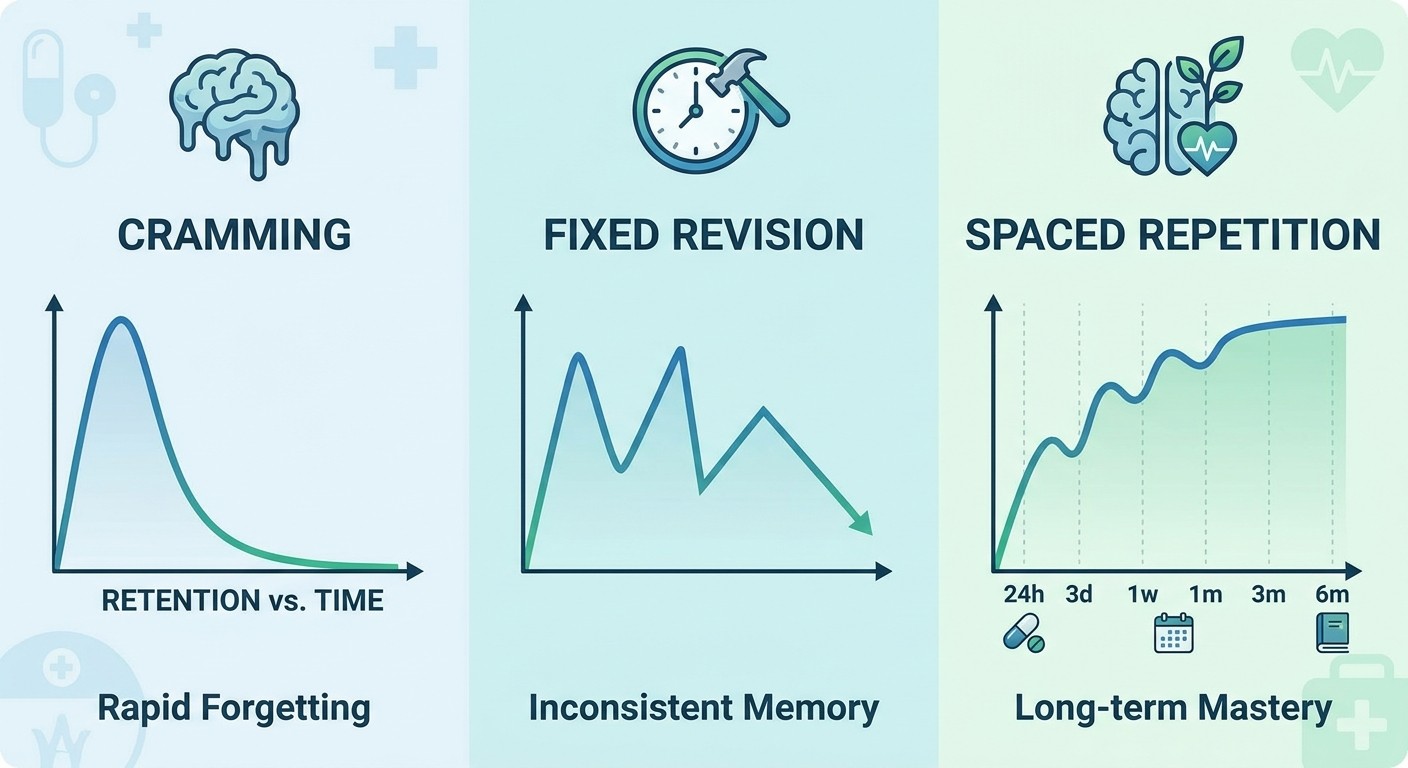
Spaced repetition isnt just reviewing things multiple times. Its reviewing specific concepts at precisely calculated intervals that align with your forgetting curve. The Ebbinghaus forgetting curve shows that without reinforcement, you lose roughly 50% of new information within 24-48 hours, and up to 80% within a week.
For medical exam preparation, this means that single-pass review sessions - reading Harrison's once, watching a pharmacology video series straight through, or cramming pathology notes the night before your test - work against your brain's retention patterns.
Real spaced repetition follows this pattern:
First review: 1 day after initial learning
Second review: 3 days later
Third review: 1 week later
Fourth review: 2 weeks later
Fifth review: 1 month later
Each successful recall pushes the next review interval further out. Each failed recall brings the next review closer. This adaptive timing prevents the forgetting curve from winning.
But medical exam content isnt just vocabulary cards. You need spaced repetition that handles complex case scenarios, drug mechanisms, diagnostic algorithms, and anatomical relationships. When you miss a question about heart failure management, you need the system to connect that missed concept to related topics like diuretics, ACE inhibitors, and ejection fraction calculations.
This is where AI scheduling becomes essential. Your brain cant track optimal review timing for 20,000+ medical concepts while youre actively learning new material every day.
Why Review Timing Matters More Than Simply Rereading Notes
Traditional medical exam prep follows a predictable pattern: learn new content, review once during the weekend, then cram everything again before the exam. This approach ignores the critical window where memory consolidation actually happens.
Memory consolidation occurs during the first 24-72 hours after learning. During this period, your brain decides whether information deserves long-term storage or should be discarded. Without strategic review during this window, medical concepts get filed as "temporary information" and fade rapidly.
Consider this scenario: You study cardiac arrhythmias on Monday. Without any review, by Friday you will remember roughly 20% of the specific details. But if you review the key points on Tuesday (1 day later) and Thursday (3 days later), your retention jumps to 80% by Friday.
The difference compounds over weeks. Students using traditional study methods often find themselves "relearning" concepts they studied just two weeks earlier. Students using proper spaced repetition build cumulative knowledge where each topic reinforces related topics.
Research from Boonshoft School of Medicine tracked first-year students using spaced repetition versus traditional methods. The spaced repetition group scored 6-12% higher on all major exams, with the largest gains appearing on comprehensive exams that tested material from multiple weeks.
This performance gap emerges because spaced repetition creates what cognitive scientists call "desirable difficulties." Each time you successfully recall a concept after a delay, you strengthen the memory trace more than immediate repetition would. Your brain literally builds stronger neural pathways when it has to work to retrieve information.
The timing precision also matters for medical exams specifically. NEET-PG, USMLE, and UKMLA test concepts in unpredictable combinations. You might see a cardiology question that requires pharmacology knowledge, anatomy understanding, and pathophysiology reasoning all at once. Spaced repetition helps you maintain this interconnected knowledge over months of preparation, rather than losing pieces as you learn new sections.
How Spaced Repetition Differs From Cramming and Fixed Revision Timetables
Most medical students default to one of two approaches: intensive cramming sessions or rigid revision timetables. Both ignore how memory actually works.
Cramming concentrates all review into short, high-intensity periods right before exams. While cramming can improve immediate performance, retention drops dramatically within days. A study of USMLE Step 1 performance found that students who crammed showed 40% knowledge retention two weeks post-exam, compared to 85% retention among students using spaced repetition.
Cramming also creates interference effects in medical learning. When you try to absorb cardiology, pulmonology, and endocrinology all in one weekend, similar concepts blur together. You might confuse beta-blocker mechanisms with calcium channel blockers, or mix up insulin types with their timing profiles.
Fixed revision timetables avoid cramming but miss personalization. A typical revision schedule might allocate every Sunday to reviewing the previous week's content, regardless of which topics you have mastered and which remain weak.
This approach treats all medical concepts equally, spending as much time reviewing topics you know well as topics that consistently trip you up. Research from medical education shows that learners need 3-5x more exposures to master difficult concepts compared to straightforward ones.
Fixed timetables also cant adjust to your learning pace. If you master cardiac cycle physiology quickly but struggle with renal physiology, a rigid schedule will under-review your weak areas while over-reviewing your strong areas.
Adaptive spaced repetition solves both problems. Instead of cramming everything at once or reviewing everything equally, it prioritizes concepts based on:
How well you know each topic (performance data)
How recently you last reviewed it (timing data)
How difficult the concept typically is (complexity weighting)
How frequently it appears on your target exam (yield weighting)
When you consistently answer cardiology questions correctly, the system extends intervals between cardiology reviews. When you miss pharmacology questions, it schedules more frequent pharmacology sessions. The result is a study plan that focuses your limited time on concepts that need attention while maintaining topics you have already learned.
How Oncourse AI Schedules Reviews Before Concepts Fade
Oncourse AI approaches medical exam spaced repetition differently than generic flashcard apps. Instead of treating every medical concept as an isolated fact, the system understands the interconnected nature of medical knowledge and schedules reviews accordingly.
The Oncourse adaptive daily plan analyzes your performance across questions, lessons, and flashcards to predict when specific concepts will fade from memory. Rather than using fixed intervals, it calculates personalized review timing based on:
Performance patterns: If you consistently nail cardiology MCQs but struggle with endocrinology, your next cardiology review gets pushed out while endocrinology reviews come more frequently. Concept difficulty: Complex pathophysiology concepts get shorter intervals than straightforward anatomy facts, because research shows intricate concepts fade faster than simple associations. Interconnected topics: When you miss a question about heart failure, the system doesnt just schedule a heart failure review. It also queues up related concepts like ACE inhibitors, diuretics, and cardiac output calculations, because these topics reinforce each other. Exam proximity: As your target exam approaches, intervals tighten to ensure high-yield concepts stay fresh. The system automatically shifts from long-term retention focus to exam-ready recall in your final weeks.
This personalized timing prevents the common scenario where you spend hours reviewing topics you already know while neglecting areas that need attention. Instead of reviewing everything equally, you get a daily plan that maximizes your time investment.
The system also adapts based on your recent activity. If you have been doing well on practice tests, it extends some review intervals to free up time for new content. If you have hit a performance plateau, it increases review frequency to solidify your foundation before moving forward.
How Synapses Turns Weak Concepts Into Connected Review Prompts
Medical knowledge doesnt exist in isolation. Understanding heart failure requires connecting pathophysiology, pharmacology, diagnostic imaging, and treatment protocols. When you miss a heart failure question, you need to review not just the immediate concept but the entire knowledge network.
Synapses handles this by creating memory links between related concepts. When you struggle with a specific topic, it doesnt just add that topic to your review queue. It maps the connections and schedules reviews for related concepts that support understanding.
Here's how it works: You miss a question about diabetic ketoacidosis management. Instead of just scheduling a DKA review, Synapses connects this to insulin types, acid-base physiology, fluid replacement protocols, and electrolyte monitoring. Your next few review sessions include these supporting concepts in a logical sequence.
The connection mapping also works in reverse. When you master a difficult concept, Synapses identifies other concepts that become easier once you understand the foundation. Master cardiac output calculations, and suddenly heart failure pathophysiology, exercise physiology, and shock management concepts become more accessible.
This connected approach matches how medical exams actually test knowledge. NEET-PG questions often combine 2-3 different topics in a single scenario. USMLE Step 1 integrates basic science concepts with clinical applications. By reviewing connected concepts together, you build the integrated understanding these exams require.
The memory links also help with long-term retention. When you review isolated facts, you rely on rote memorization. When you review connected concepts, each piece of knowledge reinforces the others, creating more durable memory networks.
How Active Recall and Spaced Review Work Together
Spaced repetition without active recall is just delayed reading. Active recall without spaced repetition fades quickly. Medical exam success requires both techniques working together.
Active recall means retrieving information from memory rather than passively reviewing notes. Instead of reading about beta-blockers again, you close your notes and try to list their mechanisms, indications, and side effects from memory. This retrieval process strengthens memory formation more than passive review. Spaced review provides the timing framework that makes active recall effective long-term. Without spacing, active recall sessions cluster together and lose effectiveness. Without active recall, spaced sessions become passive reading that feels productive but builds weak memories.
The combination creates what researchers call "testing effects." Each time you successfully retrieve medical information during a spaced session, you strengthen the memory more than the initial learning episode. Failed retrievals are equally valuable - they identify gaps before they appear on actual exams.
For medical exam preparation, this means:
During flashcard reviews: Try to recall the answer before flipping the card, even if you think you know it
During question practice: Attempt the question without immediately checking explanations, even for topics you have studied recently
During spaced lessons: Pause periodically to summarize key points from memory before continuing
Research from medical education shows that students using combined active recall and spaced repetition score 15-20% higher on retention tests compared to students using either technique alone.
The Rezzy AI tutor supports this approach by turning explanations into retrieval opportunities. Instead of just providing answers, it prompts you to explain concepts back, identify related topics, and predict how variations might appear on exams.
Using Daily Practice History to Decide What to Review Next
Most medical students guess what to review next based on gut feeling or rigid schedules. Effective spaced repetition uses performance data to make these decisions systematically.
Your daily practice history reveals patterns you might not notice consciously. You might feel confident about cardiology overall but consistently miss questions about specific arrhythmias. You might think youre weak in pharmacology but actually just need to review drug interactions, not basic mechanisms.
Oncourse AI tracks these performance patterns across different question types, topics, and difficulty levels. The system builds a detailed map of your knowledge strengths and gaps, then uses this data to prioritize your review sessions.
The decision algorithm considers:
Recent performance trends: If your nephrology scores have declined over the past week, nephrology concepts get higher priority in upcoming reviews, even if you previously scored well in this area. Time since last exposure: Topics you havent seen in two weeks get boosted in priority, regardless of past performance, because forgetting accelerates without reinforcement. Question type patterns: If you consistently miss case-based questions but handle direct fact questions well, the system schedules more scenario-based review sessions. Error type analysis: Missing a question due to knowledge gaps triggers different review than missing due to misreading or calculation errors. The system adjusts accordingly.
This data-driven approach prevents common mistakes like over-reviewing favorite topics while neglecting difficult areas, or assuming recent good performance means a topic no longer needs attention.
The daily recommendations adapt as your exam approaches. During early preparation, the system optimizes for long-term retention with longer intervals. In the final weeks, it shifts to shorter intervals and higher-yield topics to ensure exam-day recall.
Combining Spaced Repetition With Question Banks and Mini-Mocks
Spaced repetition works best when integrated with your other study activities, not as an isolated add-on. Most medical students use question banks and practice tests as separate activities from their review sessions, missing opportunities for reinforcement.
Question bank integration: When you miss questions during practice sessions, those specific topics should feed directly into your spaced repetition schedule. Instead of just marking questions for later review, the system should automatically adjust your upcoming review priorities based on recent missed questions.
For example, if you miss three nephrology questions during today's practice session, your spaced repetition system should include more nephrology content in tomorrow's reviews, even if nephrology wasnt originally scheduled until next week.
Mini-mock integration: Regular practice tests reveal knowledge gaps that might not appear during isolated question practice. After each mini-mock, your spaced repetition system should analyze the results and adjust upcoming review sessions to target the demonstrated weak areas.
The key is treating your entire study system as interconnected rather than separate activities. Your question practice, review sessions, and mock exams should all feed data to your spaced repetition scheduler.
This integration also prevents the common problem where students practice questions extensively but never systematically review their mistakes. Research shows that students who systematically review missed questions using spaced repetition retain 60% more knowledge from their question practice compared to students who just mark questions for later review.
Timing considerations: Schedule question practice sessions right before spaced review sessions when possible. This sequence lets you identify knowledge gaps during question practice, then immediately address them during your review session while the gaps are fresh in your memory.
Common Spaced Repetition Mistakes to Avoid
Even well-intentioned medical students often implement spaced repetition incorrectly, limiting its effectiveness. Here are the most frequent errors:
Reviewing Everything Equally
The mistake: Spending equal time reviewing topics you know well and topics where you consistently struggle. This feels fair but wastes time on areas that dont need attention while under-serving areas that do. The fix: Use performance data to weight your reviews. Topics where you consistently score below 70% should get 2-3x more review time than topics where you consistently score above 85%.
Resetting the Review Plan Too Often
The mistake: Starting fresh with a new spaced repetition plan every few weeks, usually after a poor practice test or when switching to a new study resource. The fix: Commit to your spaced repetition system for at least 4-6 weeks before making major changes. Short-term performance dips are normal as your brain adapts to the new review patterns.
Ignoring Explanations During Reviews
The mistake: Treating spaced repetition sessions as quick recall checks without engaging with the underlying concepts. This works for simple facts but fails for medical concepts that require understanding. The fix: During each review, dont just check if you remember the answer. Confirm that you understand why the answer is correct and could explain it to someone else. When you cant explain a concept clearly, flag it for deeper study before the next review.
Leaving Weak Subjects Until the End
The mistake: Using spaced repetition only for topics you find interesting or easy, while planning to "tackle the hard stuff later" during dedicated review periods. The fix: Start your most challenging subjects first in your spaced repetition system. These topics need the longest exposure time to develop solid understanding. Your strongest subjects can be added to the system later since they require fewer repetitions to maintain.
Focusing Only on Facts, Not Application
The mistake: Using spaced repetition primarily for memorization (drug names, normal values, anatomy labels) while neglecting clinical reasoning and application skills. The fix: Include scenario-based review items in your spaced repetition system. Review case scenarios, diagnostic algorithms, and treatment decision trees using the same spacing principles you apply to factual content.
Sample 2-Week Spaced Repetition Workflow for Medical Exam Students
Here's how an effective spaced repetition system looks in practice for a medical exam student preparing for NEET-PG, USMLE, or similar comprehensive exams:
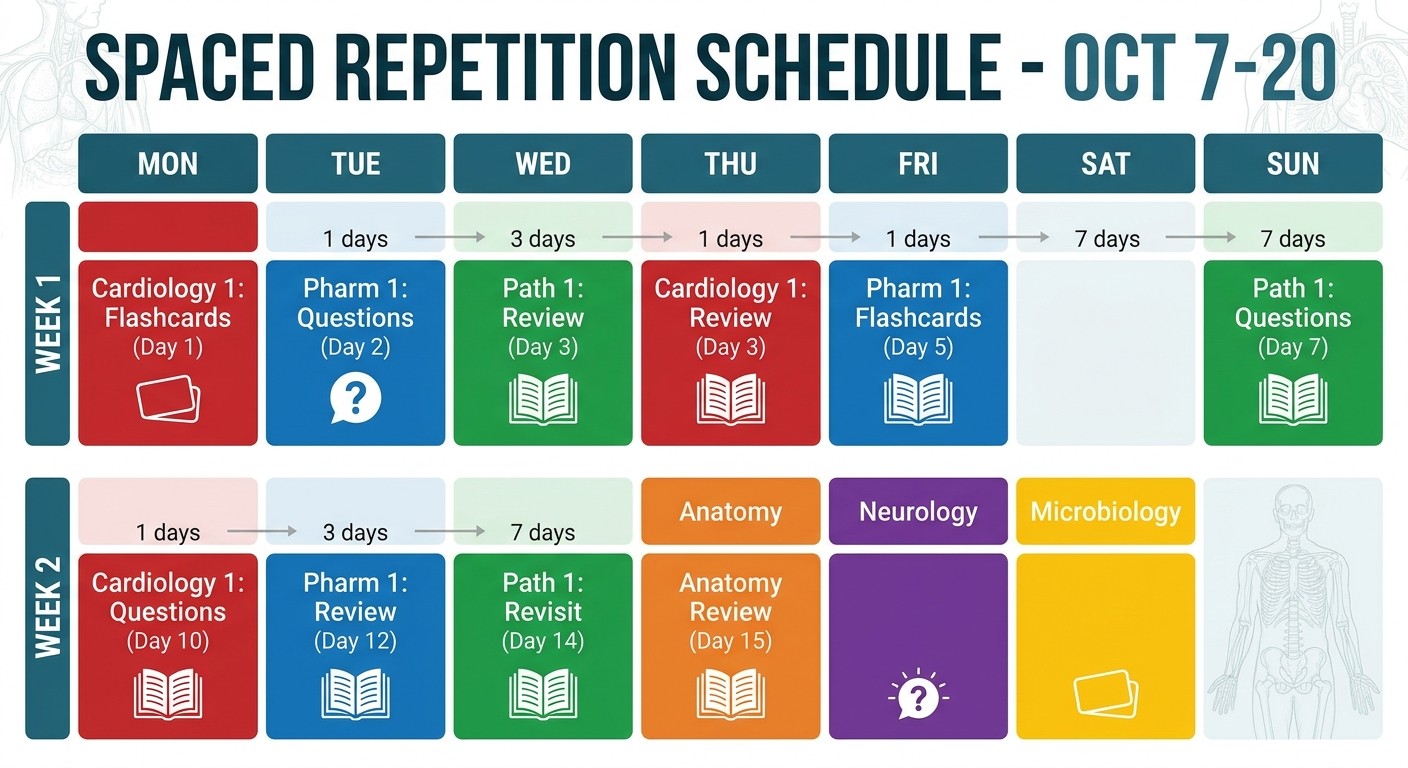
Week 1: Building the Foundation
Day 1 (Monday)
Morning: New content study (2 hours) - Cardiovascular pathophysiology
Evening: Spaced review (30 minutes) - Topics from 3 days ago, 1 week ago
Day 2 (Tuesday)
Morning: New content study (2 hours) - Cardiac pharmacology
Evening: Spaced review (30 minutes) - Yesterday's cardiovascular pathophysiology + older topics
Day 3 (Wednesday)
Morning: Question practice (1 hour) - Mixed cardiology MCQs
Afternoon: New content study (2 hours) - Respiratory pathophysiology
Evening: Spaced review (30 minutes) - Day 1 cardio concepts + older topics
Day 4 (Thursday)
Morning: New content study (2 hours) - Respiratory pharmacology
Evening: Spaced review (45 minutes) - Day 2 cardiac pharm + Day 1 cardio pathophys + older topics
Day 5 (Friday)
Morning: Question practice (1 hour) - Mixed cardio + respiratory MCQs
Afternoon: New content study (2 hours) - Renal pathophysiology
Evening: Spaced review (45 minutes) - Day 3 respiratory + Day 2 cardiac + older topics
Weekend Review Sessions
Saturday: Longer spaced review (90 minutes) covering Week 1 topics at Day 3-4 intervals
Sunday: Mini-mock exam (2 hours) + analysis + scheduling reviews for missed topics
Week 2: Expanding and Reinforcing
Day 8 (Monday)
Morning: New content study (2 hours) - Renal pharmacology
Evening: Spaced review (30 minutes) - Week 1 topics now at 1-week intervals + recent topics
Day 9 (Tuesday)
Morning: Question practice (1 hour) - Mixed renal MCQs
Afternoon: New content study (2 hours) - Endocrine pathophysiology
Evening: Spaced review (45 minutes) - Day 8 renal + Week 1 cardio topics + recent items
Day 10 (Wednesday)
Morning: New content study (2 hours) - Endocrine pharmacology
Evening: Spaced review (45 minutes) - Day 9 endocrine + Day 8 renal + Week 1 respiratory
The pattern continues with each day incorporating:
New content learning (maintaining forward progress)
Recent topic reviews (1-3 day intervals for consolidation)
Older topic reviews (1-2 week intervals for maintenance)
Question practice that feeds back into the review scheduler
Key principles in this workflow:
1. Adaptive intervals: Topics you master quickly get longer intervals; struggling topics get more frequent reviews
2. Mixed practice: Each review session includes topics from different time periods
3. Performance feedback: Question practice results directly influence upcoming review priorities
4. Sustainable pace: 30-90 minutes of spaced review daily, not overwhelming marathon sessions
5. Forward momentum: New content study continues while the spaced system maintains older learning
This creates a compound effect where your knowledge base grows steadily while previous learning stays accessible for exam day.
Frequently Asked Questions
How long should each spaced repetition session last?
Aim for 30-60 minutes per session for optimal retention. Sessions shorter than 20 minutes dont allow enough time for meaningful review, while sessions longer than 90 minutes often lead to mental fatigue that reduces effectiveness. Most successful medical exam students settle into 45-minute sessions that cover 20-30 concepts with active recall.
Can I use spaced repetition for clinical reasoning, not just facts?
Absolutely. Include case scenarios, diagnostic algorithms, and treatment decision trees in your spaced repetition system. Review clinical vignettes using the same spacing intervals you use for factual content. The key is testing your reasoning process, not just your ability to recognize the correct answer.
What happens if I miss several days of spaced repetition reviews?
Dont restart your entire system. Instead, prioritize the most important missed reviews based on how long its been since you last saw each topic. Topics you havent reviewed in over a week should get immediate attention, while topics missed by only 1-2 days can wait until tomorrow. Most effective systems build in some flexibility for missed sessions.
Should I create my own flashcards or use pre-made content?
Both approaches have value. Pre-made content covers standard medical knowledge efficiently and saves time. Custom flashcards help you target your specific weak areas and learning style. The most effective approach combines both: use high-quality pre-made content for broad coverage, then create custom cards for topics you consistently struggle with.
How do I know if my spaced repetition system is working?
Track your performance on practice questions over time. You should see gradual improvement in both accuracy and speed, especially on topics youve been reviewing consistently. Also monitor how well you retain information between study sessions - if you find yourself constantly "relearning" concepts, your intervals might be too long or youre not using active recall effectively.
Can spaced repetition replace other study methods entirely?
No. Spaced repetition excels at maintaining and reinforcing knowledge, but you still need initial learning through lectures, textbooks, or videos. Think of spaced repetition as your retention system that works alongside other learning methods, not as a replacement for them.
---
Medical exam preparation doesnt have to be a cycle of learning, forgetting, and relearning the same concepts repeatedly. Spaced repetition helps you build knowledge that compounds over time rather than fading between study sessions.
The key is using a system that understands medical knowledge as interconnected concepts, not isolated facts, and can adapt to your individual learning patterns rather than following rigid schedules.
Prepare smarter with Oncourse AI — adaptive MCQs, spaced repetition, and AI explanations built for medical exams. Download free on Android and iOS.