Back
UKMLA Mock Exam: Use Oncourse AI to Practice the Questions That Expose Weak Areas
Transform UKMLA mock exams from score checks into diagnostic systems. Learn how to identify weak clinical areas, target revision, and improve AKT performance systematically.

UKMLA Mock Exam: Use Oncourse AI to Practice the Questions That Expose Weak Areas
You probably think mock exams are about getting a score. Check if you're "ready." See how you stack up. That mindset will waste months of prep time.
UKMLA mock exams arent score tests - they're diagnostic systems. Every wrong answer points to a gap. Every timing struggle reveals a knowledge retrieval issue. Every "lucky guess" that worked masks a concept you dont actually understand.
The AKT has 200 questions across 15 clinical domains in 3 hours. Thats 54 seconds per question, including time to read, think, and mark. You cant afford to guess your way through weak areas and hope they dont show up on exam day.
This guide shows you how to turn mock exam results into a precise targeting system for your final weeks of prep.
Why Standard Mock Exam Approaches Miss the Mark
Most students treat mock exams like practice tests. Take it, get a percentage, feel good or bad, move on. This approach ignores the real value.
Your first UKMLA mock score doesnt predict your final result. Your ability to identify and fix weak areas does.
The AKT tests clinical reasoning across cardiovascular (~12-15%), respiratory (~10-12%), gastroenterology (~8-10%), neurology & psychiatry (~10-12%), and 11 other domains. A 70% overall score might hide catastrophic gaps in emergency medicine or complete confusion about prescribing principles.
Mock exams reveal three types of problems:
Knowledge gaps: you dont know the clinical facts
Application failures: you know the facts but cant apply them to scenarios
Test-taking errors: you know the answer but pick the wrong option
Standard percentage scoring lumps all three together. Targeted weak area analysis separates them.
The Diagnostic Mock Exam System
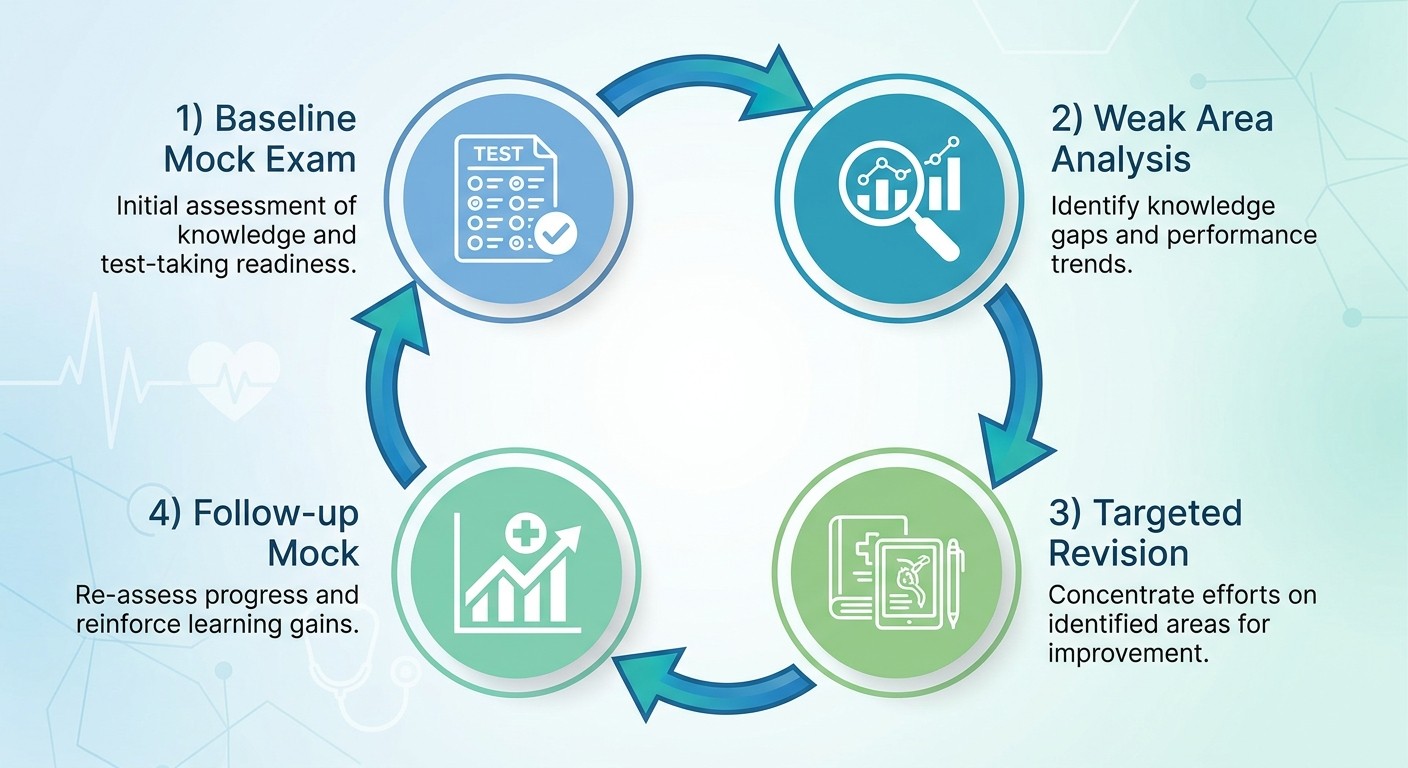
Step 1: Baseline Mock Under Real Conditions
Take your first full 200-question mock exactly like the real AKT:
3 hours total timing
No breaks except what youll get on exam day
Computer screen, not printed questions
No reference materials, no notes
Dont aim for a specific score. Aim for realistic data about where you stand right now.
The Oncourse AI question bank provides mock-style practice that mimics AKT clinical vignettes, letting you identify weak clinical topics before they become exam day surprises. Questions are tagged by domain and presentation type, making weak area analysis straightforward.
Step 2: Question-by-Question Review Session
This is where most students go wrong. They check their score and move on. Instead, spend 2-3 hours reviewing every single question:
For correct answers: can you explain why the other options were wrong? If not, you guessed correctly but dont understand the concept. For incorrect answers: categorize the error:
Didnt know the clinical fact (knowledge gap)
Knew the fact but misapplied it (reasoning error)
Knew the right answer but clicked wrong (test-taking mistake)
For questions you skipped: usually signals weak familiarity with that clinical presentation
Document everything. Create a simple spreadsheet with columns for question number, domain, your answer, correct answer, and error type.
Step 3: Domain and System Tagging
The UKMLA content map covers 15 clinical domains. After your review, count your errors by domain:
Cardiovascular: ___ errors out of ___ questions
Respiratory: ___ errors out of ___ questions
Emergency/Acute Care: ___ errors out of ___ questions
Professional Capabilities: ___ errors out of ___ questions
This reveals your statistical weak areas. If you missed 8 out of 12 cardiology questions but only 2 out of 15 respiratory questions, theres your priority list.
Performance analytics in platforms like Oncourse automatically track these domain breakdowns, converting your mock performance into visible systems and topics that need targeted work.
Step 4: Clinical Reasoning Pattern Analysis
Look for reasoning patterns across your wrong answers:
Diagnostic reasoning failures: do you consistently miss the key clinical feature that points to the diagnosis? Investigation selection errors: do you order the right tests but for the wrong reasons? Management confusion: do you know what to do but not when to do it? Guideline gaps: do you miss questions that require specific NICE or GMC guidance?
These patterns matter more than individual question mistakes. If you consistently struggle with interpreting clinical presentations, thats a different problem than occasionally forgetting a drug dose.
Converting Mock Results into Study Actions
Week-by-Week Weak Area Cycles
Dont try to fix everything at once. Pick your 2-3 worst-performing domains and cycle through them:
Week 1: Focus entirely on your weakest domain. If cardiology was your disaster area, spend the week on acute coronary syndromes, heart failure management, arrhythmia interpretation, and hypertension guidelines. Week 2: Target your second-weakest area while doing light review of Week 1 material. Week 3: Address your third priority while reviewing Weeks 1-2. Week 4: Second mock exam to measure improvement.
For each weak area, use a three-part approach:
1. Study the core concepts (UKMLA lessons for systematic review)
2. Practice targeted questions in that domain
3. Connect knowledge to clinical scenarios
The adaptive daily plan feature converts these weak-area signals into a practical daily revision schedule, automatically adjusting based on your performance patterns.
Timing and Pacing Adjustments
Your mock exam also reveals pacing issues. Track your time per question during the review:
Questions taking >90 seconds usually indicate knowledge gaps (you're thinking too hard)
Questions taking <30 seconds often indicate either confident knowledge or random guessing
Consistent slow pace in specific domains shows retrieval issues
Practice timed question blocks in your weak areas. If emergency medicine questions consistently slow you down, do focused 25-question emergency blocks with 22-minute time limits.
Second Mock Comparison Strategy
Four weeks after your baseline mock, take a second full exam. This isnt just another score check - its a measurement of targeted improvement.
Compare domain-by-domain performance:
Cardiology: baseline 58% → second mock 78% (targeted study worked)
Respiratory: baseline 71% → second mock 68% (maintained, acceptable)
Neurology: baseline 45% → second mock 61% (improved but still weak)
Your second mock results guide your final 2-3 weeks of prep. Domains that improved significantly can shift to maintenance review. Domains that remained weak need continued focus.
The question review process becomes faster the second time because youre looking for specific patterns rather than general mistakes.
Final Week Mock Integration
In your final week before the AKT, use shorter mock sections (50-100 questions) rather than full 200-question exams. This serves two purposes:
1. Maintenance of strong areas: quick review to keep your improved domains sharp
2. Final weak area targeting: concentrated practice in any remaining problem areas
Dont take a full mock 2-3 days before your exam. The score will either make you overconfident or anxious, and you wont have time to act on weak areas anyway.
Instead, use your mock exam data to create a final review priority list. If your second mock showed persistent struggles with prescribing questions, spend those final days on drug interactions, contraindications, and dosing principles rather than reviewing topics youre already comfortable with.
Common Mock Exam Mistakes to Avoid
Mistake 1: Taking too many mocks without analysis. Five mocks with no review teach you nothing. Two mocks with thorough analysis teach you everything. Mistake 2: Focusing on overall percentage instead of domain breakdown. A 73% overall score means nothing if you're getting 45% in emergency medicine. Mistake 3: Reviewing only wrong answers. Understanding why right answers are correct builds pattern recognition. Mistake 4: Ignoring timing data. If you're consistently slow in certain domains, thats a separate issue from knowledge gaps. Mistake 5: Changing study plans based on one mock result. Look for patterns across multiple practice sessions before making major adjustments.
Frequently Asked Questions
How many UKMLA mock exams should I take during preparation?
Take 2-3 full mocks maximum, spaced 3-4 weeks apart. Focus on thorough analysis rather than quantity. Each mock should generate 2-3 weeks of targeted study based on the weak areas it reveals.
What percentage should I aim for in my first UKMLA mock exam?
Your first mock percentage doesnt matter - the weak area data does. Students who score 65% with clear patterns often improve more than those who score 75% but cant identify specific gaps.
Should I review correct answers during mock exam analysis?
Yes, always review correct answers. If you cant explain why the other three options are wrong, you guessed correctly but dont understand the underlying concept. This reveals knowledge gaps that might appear in differently worded questions.
How do I know if my weak areas are knowledge gaps or test-taking problems?
Knowledge gaps show up as consistent errors in specific domains across multiple questions. Test-taking problems are random mistakes scattered across different topics, often involving misreading questions or time pressure errors.
Can I use UKMLA mock exams effectively without expensive question banks?
Yes, but targeted weak area analysis becomes harder. Use the free official AKT practice papers from UK-MLA for baseline assessment, then supplement with domain-specific practice in your identified weak areas.
What should I do if my second mock exam shows no improvement?
Analyze whether you addressed actual weak areas or just studied randomly. Check if your practice questions matched the clinical reasoning style of UKMLA vignettes. Consider whether youre dealing with knowledge gaps versus application problems - they require different study approaches.
Turn Mock Exams into Precision Targeting Systems
UKMLA mock exams work when you treat them as diagnostic tools, not score predictors. Every wrong answer contains information about gaps in your clinical knowledge or reasoning. Every timing struggle reveals retrieval issues that targeted practice can fix.
The systematic approach - baseline mock, detailed review, domain analysis, targeted cycles, comparison mock - converts weeks of unfocused studying into precision targeting of your actual weak areas.
Your AKT performance depends on clinical reasoning across 15 domains in 54 seconds per question. You cant afford to guess your way through weak areas and hope they dont matter.
Prepare smarter with Oncourse AI — adaptive MCQs, spaced repetition, and AI explanations built for UKMLA success. Download free on Android and iOS.