USMLE Step 1 Flashcards: How to Build Daily Recall Loops with Oncourse AI
Master USMLE Step 1 with daily recall loops that convert missed questions and weak concepts into targeted spaced repetition. Build automatic retrieval for 90-second questions.
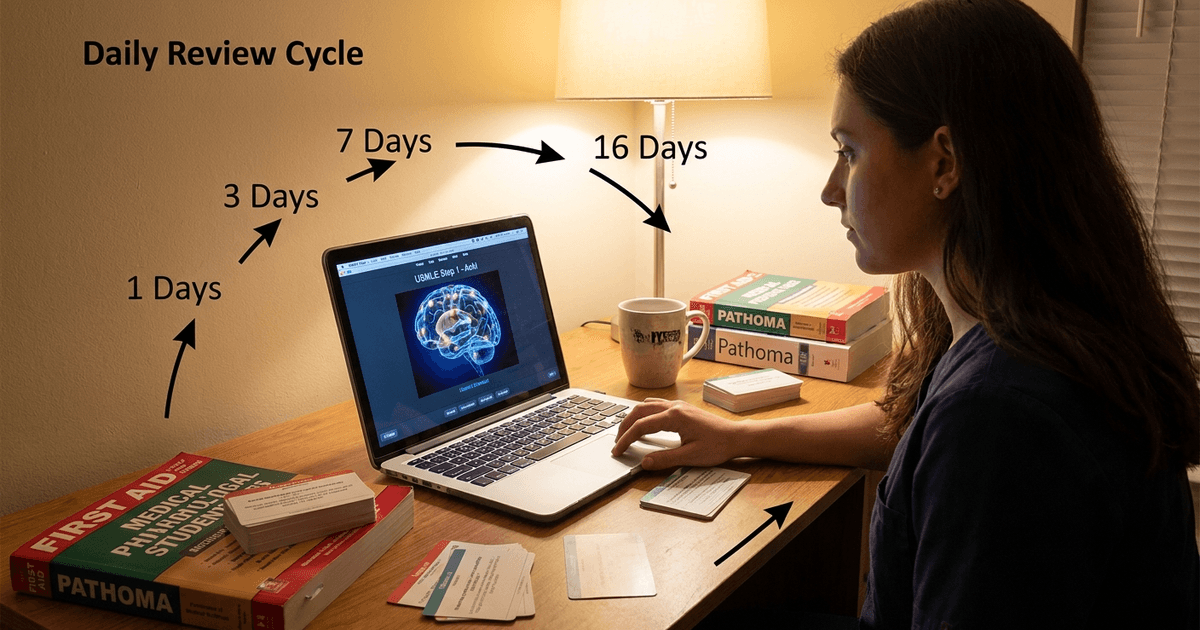
USMLE Step 1 Flashcards: How to Build Daily Recall Loops with Oncourse AI
You just finished a 40-question UWorld block. Score: 67%. Again.
The frustrating part? You recognized half those concepts. You'd seen them before, studied them, even got similar questions right last week. But when it counted, under timed pressure, that knowledge just wasn't there when you needed it.
Sound familiar? You're dealing with a retrieval problem, not a knowledge problem. The solution isn't cramming more content—it's building daily recall loops that turn passive recognition into active, reliable recall.
USMLE Step 1 rewards students who can retrieve the right information in 90 seconds, not those who can recognize it given unlimited time. This guide will show you how to convert your missed questions, weak concepts, and repeated NBME patterns into a systematic daily review system that builds the kind of automatic recall Step 1 demands.
Why Traditional Flashcard Approaches Fail for Step 1
Most students approach Step 1 flashcards wrong. They download massive premade decks (30,000+ cards), attempt to review 200-400 cards daily, and burn out within weeks. Or they create random flashcards from textbooks without any strategic focus.
Here's the problem: USMLE Step 1 isn't testing your ability to recall isolated facts. It's testing your ability to rapidly recognize clinical patterns, apply mechanisms to new scenarios, and eliminate distractors under time pressure.
Effective Step 1 flashcards need to:
Target your actual weak areas (not generic "high-yield" lists)
Test application, not just recognition (mechanism + clinical scenario)
Create retrieval pathways that work under pressure
Build concept clusters that help with pattern recognition
The Daily Recall Loop System
A daily recall loop is a structured approach to converting your performance gaps into targeted, spaced repetition cycles. Instead of reviewing random cards, you're systematically reinforcing exactly what your brain needs most.
Here's how it works:
Step 1: Daily Gap Identification (15 minutes)
Every study session, you're generating data about your weak areas:
UWorld incorrect answers (the obvious ones)
Questions you got right but guessed (the dangerous ones)
Topics you answered slowly (>2 minutes = knowledge gap)
Repeated error patterns across NBMEs
Don't let this data disappear. At the end of each study session, spend 15 minutes identifying your 3-5 biggest gaps from that day.
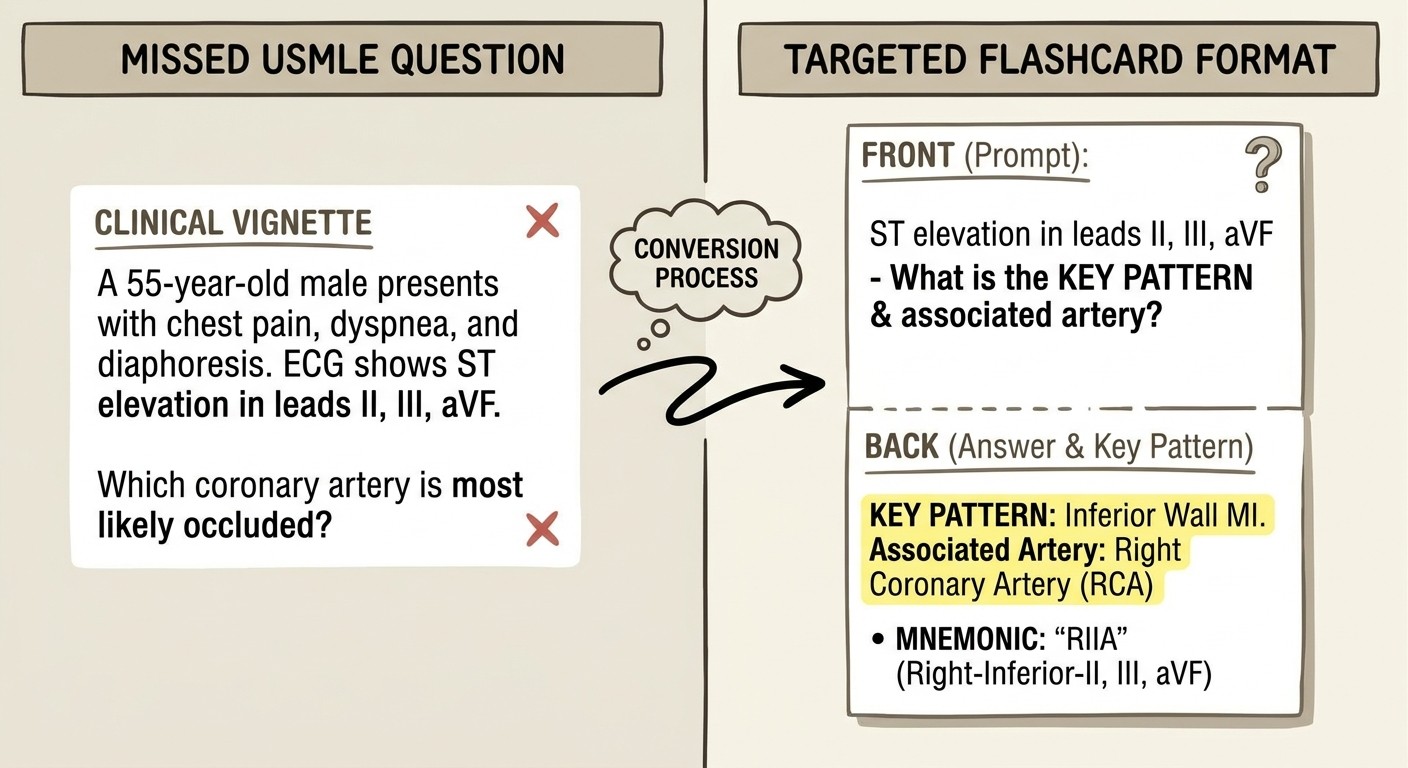
Step 2: Convert Gaps into Recall Cards (20 minutes)
For each gap, create 2-3 targeted flashcards that test the specific knowledge retrieval you need. Not the entire topic—just the missing link.
Example: You missed a question about nephritic vs nephrotic syndrome
Instead of: "What is nephritic syndrome?"
Create: "Young patient with hematuria, proteinuria <3g/day, HTN, oliguria → [syndrome] → [most likely cause]"
This tests pattern recognition (clinical presentation), classification (nephritic), and next-step reasoning (post-infectious GN) in one card.
Step 3: Daily Review Cycles (30-45 minutes)
Your daily flashcard routine should follow this priority system:
Priority 1: Yesterday's misses (5-10 cards)
These are the concepts you struggled with most recently. Review them first when your brain is freshest.
Priority 2: Weak area rotations (10-15 cards)
Cycle through your identified weak systems on a rotating basis. Monday = cardiology weak spots, Tuesday = renal, Wednesday = pharmacology mechanisms, etc.
Priority 3: Previous cycle reinforcement (15-20 cards)
Cards you got right 3-7 days ago. These need spaced reinforcement before they fade.
Priority 4: Long-term maintenance (5-10 cards)
Concepts you mastered weeks ago but need periodic reinforcement.
Never exceed 50 cards per day. Quality of retrieval practice beats quantity every time.
Step 4: Performance Tracking and Adjustment
Track your card performance weekly:
Immediate recall rate (answered correctly in <15 seconds)
Pattern recognition rate (identified the clinical syndrome quickly)
Application success (got similar questions right in practice)
If a concept keeps showing up as a miss after 5+ reviews, the problem isn't repetition—it's understanding. Go back to primary sources, not more flashcards.
Converting NBME Patterns into High-Yield Cards
NBME loves testing the same clinical patterns in slightly different ways. Once you identify these patterns, you can create flashcards that capture the essential recognition elements.
High-Yield Pattern Categories
1. Diagnostic Triads
Classic presentations that appear repeatedly:
"Middle-aged smoker + weight loss + new cough → [concern] → [next step]"
"Young athlete + syncope during exercise → [concern] → [diagnostic test]"
2. Mechanism-to-Clinical Cards
Connect basic science to clinical presentations:
"ACE inhibitor mechanism → [side effect] → why contraindicated in [condition]"
3. Differential Elimination Cards
Practice the elimination process:
"Chest pain + ST elevation + [specific ECG finding] → rule out [A], [B], [C] → most likely [D]"
4. Treatment Algorithm Cards
Step-by-step management:
"Acute MI confirmed → immediate management (4 steps) → [drug 1], [drug 2], [procedure], [drug 3]"
The key is making each card test the specific cognitive step where you're getting stuck, not generic knowledge recall.
Leveraging Oncourse AI for Smarter Flashcard Creation
While building your daily recall loops, Oncourse's Synapses feature can accelerate your pattern recognition development. When you encounter a complex topic like "causes of metabolic acidosis," Synapses helps you connect related concepts (MUDPILES mnemonic, anion gap calculation, compensation mechanisms) into memorable clusters. This concept-linking approach builds the kind of interconnected knowledge that Step 1 questions actually test.
For spaced repetition scheduling, Oncourse's adaptive algorithm tracks which concepts you're struggling with most and surfaces them in your daily question practice. Instead of manually scheduling card reviews, the platform identifies your weak areas from performance data and keeps those topics in rotation until you demonstrate consistent mastery.
When you're analyzing your practice performance, Oncourse's analytics dashboard shows exactly which topics should become flashcards next. Rather than guessing what to study, you get data-driven recommendations based on your actual error patterns and knowledge gaps.
Building Your 7-Day Flashcard Routine
Here's a practical weekly schedule that embeds flashcard creation and review into your existing Step 1 prep:
Monday-Wednesday-Friday: Active Creation Days
Complete your usual question blocks (40 questions)
Spend 20 minutes converting misses into 5-7 targeted cards
Review yesterday's cards (10 minutes)
Review weekly weak area rotation (15 minutes)
Tuesday-Thursday-Saturday: Review and Reinforcement Days
Complete question blocks
Extended flashcard review session (45 minutes)
Focus on cards from the past week that need reinforcement
Test recall speed and pattern recognition
Sunday: Weekly Analysis and Planning
Review the week's performance data
Identify the top 3 systems/topics for next week's focus
Create 10-15 high-yield cards for upcoming weak areas
Plan the next week's rotation schedule
This schedule ensures you're constantly feeding new content into your recall loops while maintaining previously learned concepts through spaced repetition.
Advanced Techniques: From Recall to Recognition Speed
Once your basic recall loops are established, focus on these advanced techniques to build Step 1-level speed and accuracy:
Rapid Fire Sessions
Set a timer for 30 seconds per card. If you can't recall the answer within 30 seconds, mark it for additional review. This builds the speed you need for 90-second NBME questions.
Context Switching Practice
Mix cards from different systems randomly. Your brain needs to rapidly switch contexts just like on the actual exam. Don't group all cardiology cards together—intersperse them with renal, infectious disease, and pharmacology cards.
Reverse Engineering Cards
Create cards that work backward from the answer choice to the clinical presentation. This helps with elimination techniques:
"If the answer is 'hypertrophic cardiomyopathy,' what clinical features must be present in the stem?"
Integration Cards
Test connections between systems:
"Patient with chronic kidney disease → [cardiovascular complication] → [mechanism] → [management adjustment]"
These integration cards mirror how Step 1 questions actually test knowledge—across system boundaries, not within isolated topics.
Common Mistakes That Kill Daily Recall Loops
Mistake 1: Creating Too Many Cards
More cards don't equal better performance. Students who create 20+ cards daily usually abandon the system within 2 weeks. Stick to 5-7 high-quality, targeted cards per day.
Mistake 2: Generic Card Content
Cards like "What is the most common cause of pneumonia?" are useless for Step 1. The exam tests application: "65-year-old diabetic with [specific symptoms] → [organism] → [antibiotic choice] → [why not alternative X]"
Mistake 3: Ignoring the Review Data
If you're getting the same cards wrong repeatedly, the problem isn't spaced repetition timing—it's foundational understanding. Stop making more cards and go back to primary sources.
Mistake 4: No Performance Integration
Your flashcard performance should correlate with your question bank improvement. If you're crushing flashcards but still missing similar questions in practice, your cards aren't testing the right cognitive processes.
Mistake 5: Perfectionist Paralysis
Students spend 45 minutes crafting the "perfect" flashcard for one concept. Make good enough cards quickly, then iterate based on performance data.
Measuring Success: When Your Recall Loops Are Working
You'll know your daily recall loops are effective when:
Retrieval speed increases: Concepts that took 60 seconds to recall now come to mind in 10-15 seconds
Pattern recognition improves: You start identifying question types from the first sentence
Transfer performance: Similar questions in new question banks become easier
Confidence under pressure: Timed practice feels less stressful because recall is more automatic
Error pattern reduction: You stop making the same mistakes repeatedly
Track these metrics weekly, not daily. Daily fluctuations in performance are normal—weekly trends tell the real story.
Frequently Asked Questions
How many flashcards should I review daily for Step 1?
Aim for 30-50 cards maximum per day. Focus on quality of retrieval practice over quantity. Students who try to review 100+ cards daily typically burn out within 2-3 weeks and see diminishing returns.
Should I use premade decks like AnKing or create my own cards?
Use a hybrid approach. Start with a curated subset of AnKing (500-1000 cards maximum) for foundational concepts, then create your own targeted cards for personal weak areas and missed questions. Personal cards are more effective for addressing your specific knowledge gaps.
How do I know if my flashcards are actually helping my Step 1 performance?
Track correlation between flashcard mastery and question bank performance. If you're consistently getting flashcard topics right but still missing similar questions in practice, your cards aren't testing the right cognitive processes. Focus on application-based cards rather than fact recall.
What should I do with cards I keep getting wrong after multiple reviews?
After 5+ incorrect reviews, stop using spaced repetition and go back to primary learning resources. The issue is usually conceptual understanding, not memory retrieval. Learn the concept properly first, then create new, targeted cards.
How long before Step 1 should I start building daily recall loops?
Start at least 12 weeks before your exam date. The first 4 weeks focus on building the system and creating your initial card base. Weeks 5-8 emphasize expansion and refinement. Final 4 weeks concentrate on speed and integration practice.
Can I use this system alongside other spaced repetition apps like Anki?
Yes, but avoid platform switching. Choose either Anki, Oncourse's flashcard system, or another platform and stick with it. The key is consistency in your daily routine, not the specific software you use.
Ready to transform your Step 1 prep from passive recognition to active recall? Your daily recall loops start with today's question block. Identify your gaps, convert them to targeted cards, and begin building the automatic retrieval that Step 1 demands.
Prepare smarter with Oncourse AI—adaptive MCQs, spaced repetition, and AI explanations built for USMLE Step 1. Download free on Android and iOS.