UKMLA Flashcards: Make Oncourse AI Schedule What You're About to Forget
Stop managing overdue Anki cards manually. Oncourse AI Synapses uses the MLA Content Map to create 600 targeted UKMLA flashcards with automatic spaced repetition scheduling tied to your MCQ performance.

UKMLA Flashcards: Make Oncourse AI Schedule What You're About to Forget
You have 47 flashcards overdue in your Anki deck. Another 83 due tomorrow. The scheduling algorithm that worked perfectly for three weeks suddenly feels like quicksand — every day you fall further behind, and every review session starts with guilt instead of learning.
Most UKMLA flashcard guides tell you spaced repetition works (it does), hand you an Anki tutorial, then leave you to manage the scheduling chaos yourself. But here's what they miss: the MLA Content Map isn't just a study checklist. It's the perfect blueprint for exactly 600 flashcards that cover every condition you need to know — and AI can schedule them automatically so you never see that overdue pile again.
The real breakthrough isn't better flashcard content. It's removing the scheduling burden entirely while connecting your MCQ misses directly to flashcard priority. When you miss an atrial fibrillation question, the AF management card surfaces earlier. When you nail pneumonia cases, those cards space out longer. No manual deck building. No overdue anxiety. Just the cards you're about to forget, exactly when you need them.
The Overdue Card Problem Every UKMLA Student Faces
Traditional spaced repetition hits a wall when life gets busy. You skip one day of reviews, and suddenly you have 50 overdue cards. Skip three days, and you're looking at 200. The SM-2 algorithm that powers Anki becomes aggressive with overdue cards — research shows recall drops from 87% for slightly overdue cards to 75% for cards that are months behind.
The psychological impact is worse than the algorithmic one. You open your deck and see those red numbers. Instead of focused learning, you get decision fatigue: Which cards matter most? Should you reset everything? Can you catch up without burning out?
For UKMLA students juggling clinical rotations, this scheduling burden becomes the difference between consistent revision and abandoned flashcard decks. You need spaced repetition that works even when you dont.

The MLA Content Map as Your Flashcard Blueprint
The GMC's MLA Content Map lists 217 clinical presentations and 315 conditions — but most students treat it like a checklist instead of a structure. Here's the insight that changes everything: each condition needs exactly three types of cards for complete coverage.
Presentation Cards: How does this condition present? Classic signs, symptoms, and clinical patterns. Differential Cards: What other conditions look similar? When do you consider this diagnosis? Management Cards: What's the treatment approach? First-line options, monitoring, escalation.
Apply this to the 200 most high-yield conditions from the content map, and you get exactly 600 cards. Not 3,000 cards covering every detail. Not 200 cards with surface-level coverage. The precise number that covers what UKMLA tests without overwhelming your review schedule.
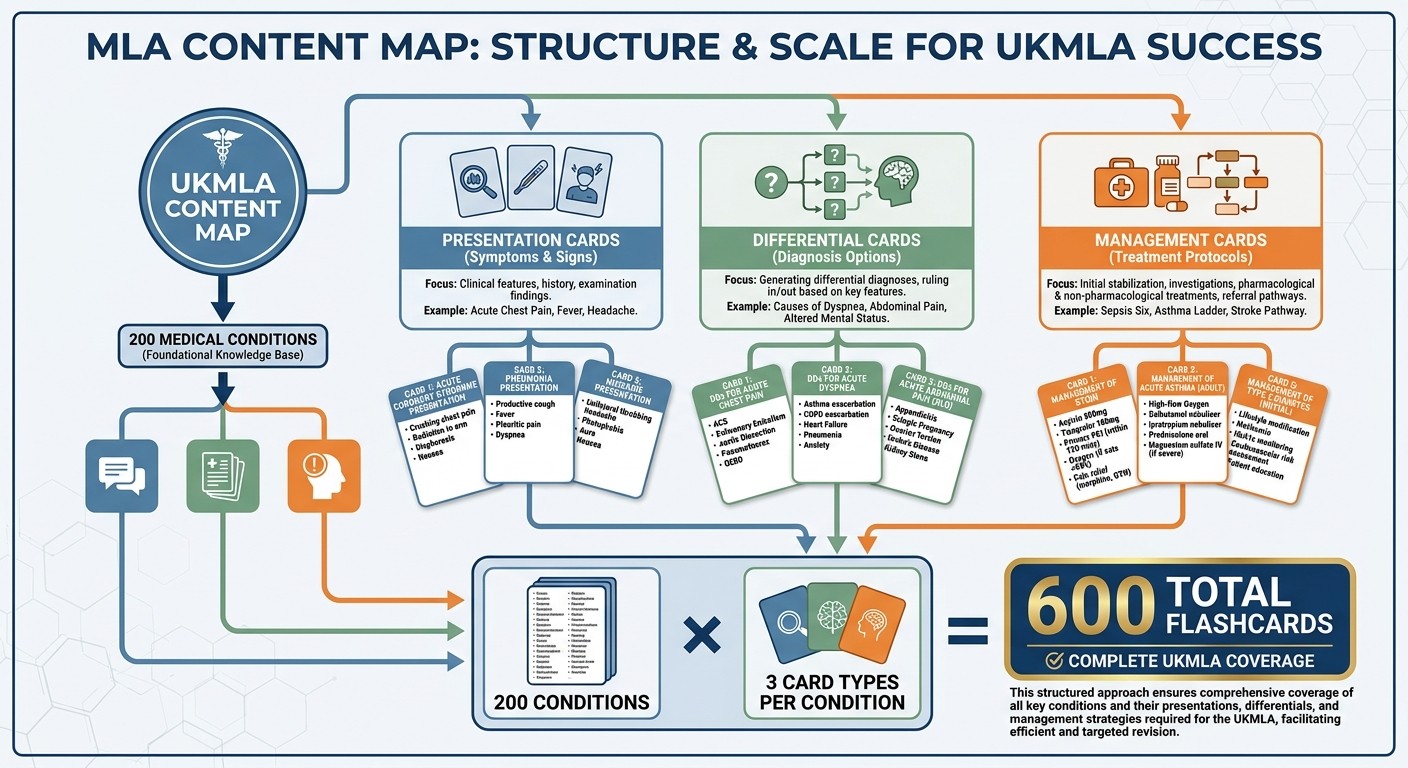
Take atrial fibrillation as an example:
Presentation card: "65-year-old with palpitations, irregularly irregular pulse, absent P waves on ECG"
Differential card: "What arrhythmias cause irregularly irregular pulse?" (AF, atrial flutter with variable block, multifocal atrial tachycardia)
Management card: "Rate control vs rhythm control decision tree, anticoagulation criteria, when to refer"
This structure matches exactly how UKMLA questions test your knowledge — not as isolated facts, but as clinical reasoning chains.
Why Manual Scheduling Falls Apart for UKMLA
UKMLA preparation creates unique scheduling challenges that generic spaced repetition cant handle:
Uneven difficulty across systems: Cardiology conditions might click immediately while endocrine cases need frequent review. Fixed intervals dont adapt to these patterns. Performance data from MCQs: Your question bank tells you exactly which topics are weak, but traditional flashcard apps cant use that information to prioritize cards. Time pressure before the exam: As your UKMLA date approaches, you need to see your weakest cards more often, not follow the same spacing for everything. Clinical context matters: A missed heart failure question should trigger review of heart failure cards, but also related conditions like AF with rapid ventricular response or acute coronary syndromes that present similarly.
Manual deck management becomes a part-time job. You're spending study time managing cards instead of learning from them.
How Oncourse AI Synapses Solves the Scheduling Problem
Synapses removes the scheduling burden by making three key connections that traditional flashcard apps miss: MCQ performance drives card priority: Miss a question about heart failure management, and the heart failure management card surfaces earlier in your review queue. Nail pneumonia cases consistently, and those cards space out longer automatically. Pre-loaded UKMLA content map conditions: No deck building. No searching for high-quality cards. The 200 most important MLA conditions come ready with presentation, differential, and management cards that match current UKMLA patterns. AI adjusts to your learning patterns: If you consistently struggle with endocrine conditions but excel at cardiology, the system adjusts spacing algorithms per topic area. Your strong areas get longer intervals, weak areas get more frequent review.
This creates a feedback loop that traditional spaced repetition lacks. Your practice questions inform your flashcard priority, and your flashcard performance guides which question areas to focus on next. The two study methods reinforce each other instead of competing for time.
The Three-Card System for UKMLA Conditions
Each high-yield condition in Synapses follows the same three-card structure, optimized for how UKMLA questions test clinical reasoning:
Presentation Cards
These capture the "front door" — how patients actually present with this condition. Instead of textbook symptom lists, you get clinical vignettes that match UKMLA question stems.
Example: Instead of "Type 1 diabetes symptoms include polyuria, polydipsia, weight loss," you get "22-year-old presents with 3-week history of increased thirst, frequent urination, 8kg weight loss despite normal appetite. Random glucose 18 mmol/L."
Differential Cards
These build diagnostic reasoning by forcing you to consider what else could cause similar presentations. Critical for the "most likely diagnosis" questions that dominate UKMLA.
Example: "Causes of acute breathlessness in a 70-year-old with known COPD" — testing whether you can distinguish between COPD exacerbation, pneumonia, heart failure, and PE when the presentations overlap.
Management Cards
These focus on decision trees and first-line treatments. Not comprehensive management plans, but the key decisions that UKMLA questions test.
Example: "45-year-old with new AF and CHADS2-VASc score of 3" — testing anticoagulation decisions, rate vs rhythm control, and when immediate cardioversion is indicated.
The beauty of this system is that each card type prepares you for specific question formats while building comprehensive understanding of each condition.
From Question Banks to Flashcard Priority
The breakthrough insight is connecting your MCQ performance directly to flashcard scheduling. When you practice UKMLA questions, your correct and incorrect answers automatically adjust which cards appear in your next review session.
Miss questions about diabetes management? Those management cards surface earlier. Consistently nail respiratory conditions? Those cards space out to focus your limited study time on areas that need work.
This connection works both ways. As your flashcard performance improves for specific conditions, the system can recommend focused question practice in those areas to reinforce learning and identify remaining gaps.
Traditional study methods treat questions and flashcards as separate activities. You do questions, then separately do flashcard reviews. But weak areas need integrated reinforcement — the conditions you miss in questions need immediate flashcard attention, and the cards you struggle with need targeted question practice.
Building Long-Term Retention Without the Overdue Pile
The real test of any spaced repetition system is what happens when you miss a few days. Life happens. Clinical rotations get intense. You come back to study and wonder if your review schedule is still useful.
Synapses adapts to irregular study patterns without penalizing you for breaks. Skip three days, and you dont get 200 overdue cards creating psychological pressure. Instead, the AI adjusts intervals based on your actual availability and prioritizes the most important reviews for your available study time.
During busy clinical rotations, you might only have 15 minutes for flashcard review. The system ensures those 15 minutes target your weakest areas rather than following a rigid schedule that doesnt match your current needs.
As your UKMLA date approaches, this flexibility becomes crucial. Instead of fighting an overdue pile, you can focus entirely on the conditions that need work, with confidence that the spacing algorithm is optimizing your long-term retention automatically.
UKMLA Synapses vs Traditional Flashcard Methods
Traditional Anki | Oncourse AI Synapses |
|---|---|
Manual deck creation and maintenance | Pre-loaded UKMLA content map conditions |
Fixed spacing intervals for all cards | Adaptive algorithms per topic area |
No connection to MCQ performance | Question misses drive card priority |
Overdue cards pile up during breaks | AI adjusts to irregular study patterns |
Generic medical content | UKMLA-specific presentations and management |
Self-managed review sessions | Automatic prioritization of weak areas |
The difference isn't just convenience — it's effectiveness. When your flashcard system adapts to your actual learning patterns and connects directly to your question practice, you spend more time learning and less time managing study tools.
Getting Started with UKMLA Flashcard Scheduling
Your first session with Synapses establishes baseline performance across the major UKMLA content areas. Instead of starting with random cards, you get an initial assessment that identifies your current strengths and knowledge gaps.
From there, the system builds a personalized review schedule that targets your weak areas while maintaining long-term retention in stronger topics. As you continue practicing questions and reviewing flashcards, the AI refines its understanding of your learning patterns.
The key is consistency in both activities — regular question practice and regular flashcard review. Even 10-15 minutes of focused flashcard review daily, combined with your normal question practice, creates the feedback loop that makes adaptive spacing effective.
Most students see improvements in MCQ accuracy within 2-3 weeks as the system identifies their consistent weak areas and prioritizes relevant cards. The scheduling burden disappears immediately — no more manual deck management or overdue card anxiety.
Common UKMLA Flashcard Mistakes to Avoid
Mistake 1: Trying to memorize the entire MLA content map
The content map has 315 conditions, but UKMLA questions focus on the most common presentations. Start with high-yield conditions that appear frequently in question banks.
Mistake 2: Creating cards that test passive recognition
"What is diabetes?" cards dont help with UKMLA questions. Focus on clinical scenarios that match question formats: presentation, differential diagnosis, management decisions.
Mistake 3: Ignoring your question bank performance
If you consistently miss endocrine questions but spend equal time reviewing all systems, you're not optimizing your study time. Let your weak areas guide your review priority.
Mistake 4: Treating flashcards as separate from MCQ practice
The most effective UKMLA preparation connects these activities. Use flashcards to strengthen areas where you miss questions, and use questions to identify which flashcard topics need work.
Mistake 5: Getting overwhelmed by overdue reviews
When traditional spaced repetition creates scheduling pressure, many students abandon flashcards entirely. AI-powered scheduling prevents this problem by adapting to your actual study patterns.
Advanced Tips for UKMLA Flashcard Success
Connect related conditions: When reviewing heart failure cards, you'll notice connections to AF, coronary artery disease, and hypertension. These connections build the clinical reasoning skills that UKMLA tests. Use the three-card structure for new topics: If you encounter an unfamiliar condition in your question practice, create presentation, differential, and management cards to build comprehensive understanding. Track your accuracy trends: Both your flashcard performance and your question bank accuracy should improve over time. If one is improving but not the other, adjust your study balance. Focus on high-yield presentations: The MLA content map includes 217 presentations, but UKMLA questions focus on the most common ones. Prioritize presentations that appear frequently in your question practice. Integrate with your clinical experience: When you see patients with conditions from your flashcard deck, use those encounters to reinforce and refine your card content.
Frequently Asked Questions
How many UKMLA flashcards do I need?
The MLA content map covers 315 conditions, but focusing on 200 high-yield conditions with 3 cards each gives you 600 total cards. This covers the vast majority of UKMLA question content without overwhelming your review schedule.
Can AI scheduling really replace manual flashcard management?
Yes, but only when the AI has enough data about your learning patterns. This comes from consistent question practice and flashcard review. After 2-3 weeks of regular use, adaptive algorithms become more effective than manual scheduling.
How does spaced repetition work with irregular study schedules?
Traditional spaced repetition struggles with irregular schedules because it assumes consistent daily reviews. AI-powered systems adapt intervals based on your actual availability and prioritize the most important reviews for your current study time.
Should I abandon my existing Anki decks for UKMLA?
If your current Anki deck is working well and you're comfortable with manual scheduling, there's no need to switch. But if you're struggling with overdue cards or want better integration with your question practice, AI-powered flashcards offer significant advantages.
How do I know if my flashcard system is working?
Your MCQ accuracy should improve over time, especially in areas where you're doing focused flashcard review. If you're consistently missing the same types of questions despite regular flashcard review, your card content or scheduling may need adjustment.
What's the difference between UKMLA flashcards and general medical flashcards?
UKMLA flashcards focus specifically on the clinical presentations and conditions listed in the MLA content map. They emphasize diagnostic reasoning and management decisions rather than comprehensive medical knowledge, matching the format and content of actual UKMLA questions.
Prepare smarter with Oncourse AI — adaptive MCQs, spaced repetition, and AI explanations built for UKMLA. Download free on Android and iOS.