Back
NBME Step 1: Practice Questions That Expose Weak Areas with Oncourse AI
Master NBME Step 1 practice questions to identify weak areas systematically. Learn diagnostic review techniques, timed vs untimed blocks, and targeted remediation strategies for 2026.

NBME Step 1: Practice Questions That Expose Weak Areas with Oncourse AI
You are probably staring at your NBME Step 1 practice results wondering why you missed that cardiology question when you just reviewed arrhythmias yesterday. Here's what every Step 1 candidate discovers: knowing facts and answering NBME-style questions are completely different skills.
NBME Step 1 has 280 questions across seven 60-minute blocks. You get 90 seconds per question to apply basic science concepts to clinical vignettes under pressure. The difference between passing and failing often comes down to systematically identifying your weak areas and fixing them before test day.
This guide shows you exactly how to use NBME Step 1 practice questions diagnostically – not just as test prep, but as surgical instruments that expose the gaps in your knowledge so you can fix them efficiently.
What NBME Step 1 Practice Questions Actually Reveal
NBME questions dont just test what you know. They test how you think under pressure, how you prioritize information in lengthy vignettes, and whether you can connect basic science mechanisms to clinical presentations.
When you miss an NBME question, you're usually failing in one of these areas:
Pattern Recognition Failures: You know atrial fibrillation causes irregular rhythm, but you miss the question because the vignette focuses on the patient's shortness of breath and you dont immediately connect it to the underlying arrhythmia. Mechanism Gaps: You memorized that ACE inhibitors cause hyperkalemia, but you cant explain why, so when they ask about the mechanism in a different context, you're lost. Clinical Application Weakness: You know the biochemistry of diabetes, but when they present a diabetic ketoacidosis case, you dont recognize the clinical pattern fast enough. Reading Comprehension Under Pressure: You miss key details in the vignette because you're rushing or you fixate on irrelevant information.
The diagnostic power of NBME practice lies in identifying which type of failure is happening consistently across your missed questions.
Why Students Miss Questions Despite Knowing the Facts
Here's the brutal truth about Step 1: most students who fail know 80% of the tested material. They fail because they cant access that knowledge reliably under exam conditions.
Common Reasoning Traps in NBME Questions
The "Too Complete" Answer Trap: NBME often includes answer choices that are technically correct but not the best answer for what they're specifically asking. Students who overthink often choose the more comprehensive option when a simpler, more direct answer is correct. The "Premature Closure" Trap: You see the first few symptoms, jump to a diagnosis, and pick an answer without reading the complete vignette. NBME vignettes often include red herrings or additional information that changes the most likely diagnosis. The "Mechanism vs Management" Confusion: The question asks about pathophysiology, but you're thinking about treatment, or vice versa. This happens when you dont pause to identify exactly what the question is asking. The "Classic vs Atypical Presentation" Trap: You memorized textbook presentations, but NBME often tests atypical or early presentations of common conditions.
When I was preparing for Step 1, I kept missing questions about heart failure – not because I didn't know the pathophysiology, but because I was looking for classic symptoms when NBME often presents it with subtle findings like mild exertional dyspnea in a younger patient. The AI-powered question bank on Oncourse helped me recognize these patterns by showing why each distractor was tempting and walking me through the reasoning trap I was falling into.
How to Review Wrong Answers by Mechanism and Reasoning
Most students review wrong answers by reading the explanation once and moving on. That's not diagnostic enough for Step 1 success. Here's how to make every wrong answer teach you something transferable:
The Four-Step Diagnostic Review
Step 1: Categorize the Miss
Content gap: Did you not know the fact?
Application gap: Did you know the fact but couldn't apply it?
Reading error: Did you misread the question or vignette?
Reasoning trap: Did you fall for a distractor?
Step 2: Identify the Mechanism
Don't just memorize the correct answer. Understand why it's correct at the mechanism level. If the answer is "ACE inhibitor," make sure you can explain the renin-angiotensin pathway and why blocking ACE specifically helps in heart failure.
Step 3: Analyze Each Distractor
This is where most students skip steps. For each wrong answer choice, understand why it's wrong and when it would be correct. This teaches you the boundaries of each concept.
Step 4: Create a Transferable Rule
Turn each question into a rule you can apply to similar questions. Instead of "Patient with chest pain and EKG changes has MI," create a rule like "Acute chest pain + ST elevation in contiguous leads = STEMI, regardless of age or risk factors."
For complex explanations, I found that asking follow-up questions through Oncourse's explanation chat helped clarify the exact mechanism and reasoning traps. Instead of leaving gaps unresolved, you can dig deeper into why specific distractors were included and how to avoid similar traps.
Timed vs Untimed Practice Blocks: When to Use Each
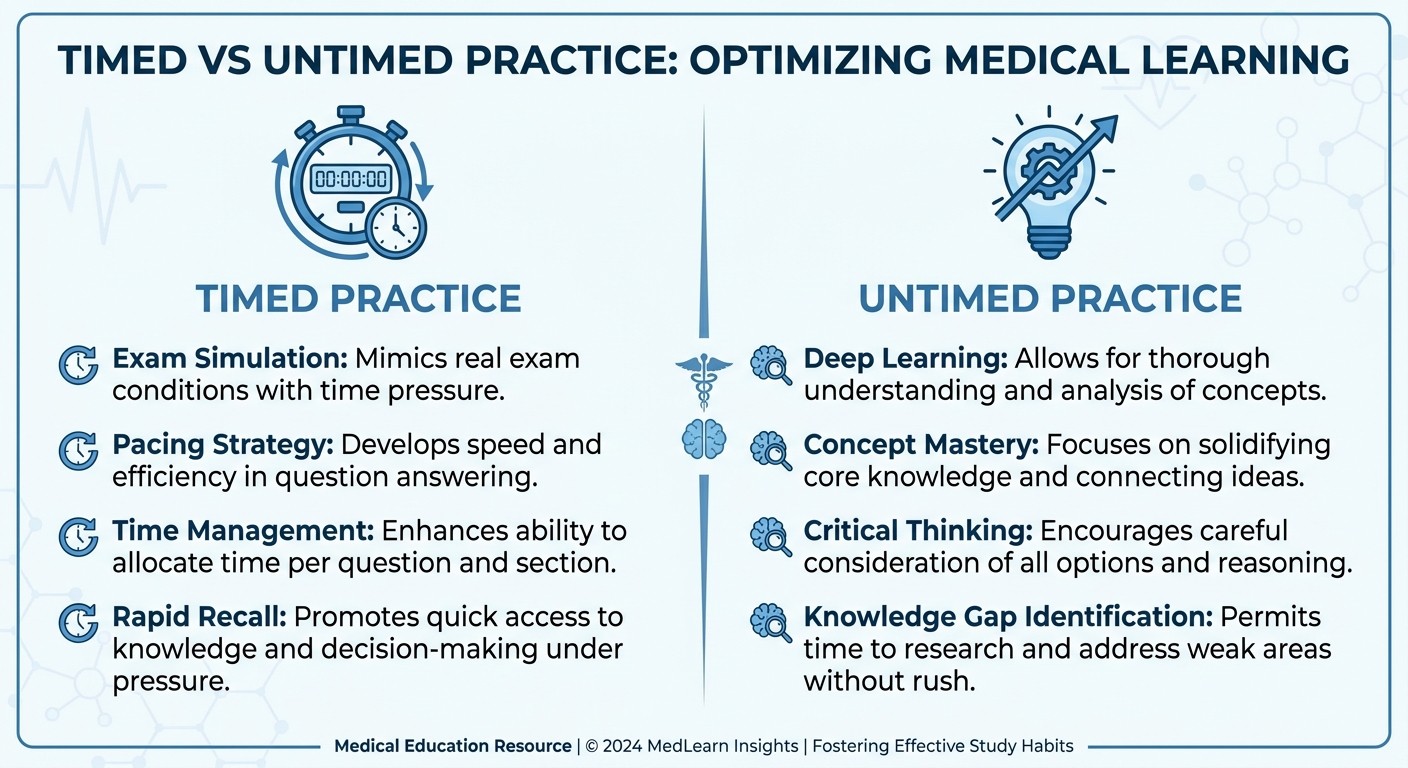
The timing of your NBME practice blocks matters more than most students realize. Each mode serves a different diagnostic purpose.
Untimed Practice (First 60% of Prep)
Use untimed blocks when you're building diagnostic skills and learning to read NBME-style vignettes. Untimed practice lets you:
Analyze complex vignettes without time pressure
Develop systematic approaches to different question types
Deep-dive into explanations and mechanisms
Build confidence with unfamiliar question formats
When to use untimed: First 6-8 weeks of dedicated study, when learning new topics, or when your accuracy is below 65% in a subject area.
Timed Practice (Final 40% of Prep)
Timed blocks simulate test day conditions and expose different types of weaknesses:
Time management failures
Reading comprehension under pressure
Decision-making when uncertain
Stamina and focus maintenance
When to use timed: Final 4-5 weeks before your exam, when accuracy is consistently above 70%, or when practicing full-length assessments.
The Hybrid Approach
In the middle phase of prep, alternate between timed and untimed blocks:
Monday/Wednesday/Friday: Timed 40-question blocks
Tuesday/Thursday: Untimed 20-question blocks focusing on weak areas
Weekends: Full-length timed NBME practice tests
Converting Weak Area Tags Into Targeted Study
After each practice session, you need a systematic way to convert your mistakes into actionable study priorities. Most students tag "cardiology" as a weak area, which is too broad to be useful.
Granular Weak Area Tagging
Instead of broad categories, tag specific mechanisms or clinical patterns:
Too Broad: "Cardiology weak" Better: "Arrhythmia interpretation weak" Best: "Atrial fibrillation with RVR vs multifocal atrial tachycardia differentiation" Too Broad: "Immunology weak" Better: "Hypersensitivity reactions weak" Best: "Type II vs Type III hypersensitivity mechanism and clinical examples"
The Performance Analytics Approach
Oncourse's performance analytics dashboard turns your practice results into a visual map of exactly what needs fixing. Instead of guessing where you're weak, you can see patterns like "consistently missing questions about enzyme deficiencies in metabolic pathways" or "time management issues in long vignettes with multiple lab values."
Track these specific patterns:
Question types you consistently miss
Topics where you're slow (>2 minutes per question)
Areas where you're guessing frequently
Mechanisms you can't explain to someone else
From Tags to Study Plans
Once you have specific weak areas identified, create targeted study blocks:
Week 1 Focus: Cardiovascular pharmacology mechanisms (ACE inhibitors, beta blockers, calcium channel blockers)
20 targeted questions daily on CV pharm
Review mechanism pathways for each missed question
Create comparison tables for drug classes
Week 2 Focus: Renal pathophysiology (GFR, clearance, electrolyte disorders)
15 questions daily on nephrology
Focus on calculation-based questions
Practice lab value interpretation under time pressure
Your Weekly Step 1 Practice Loop
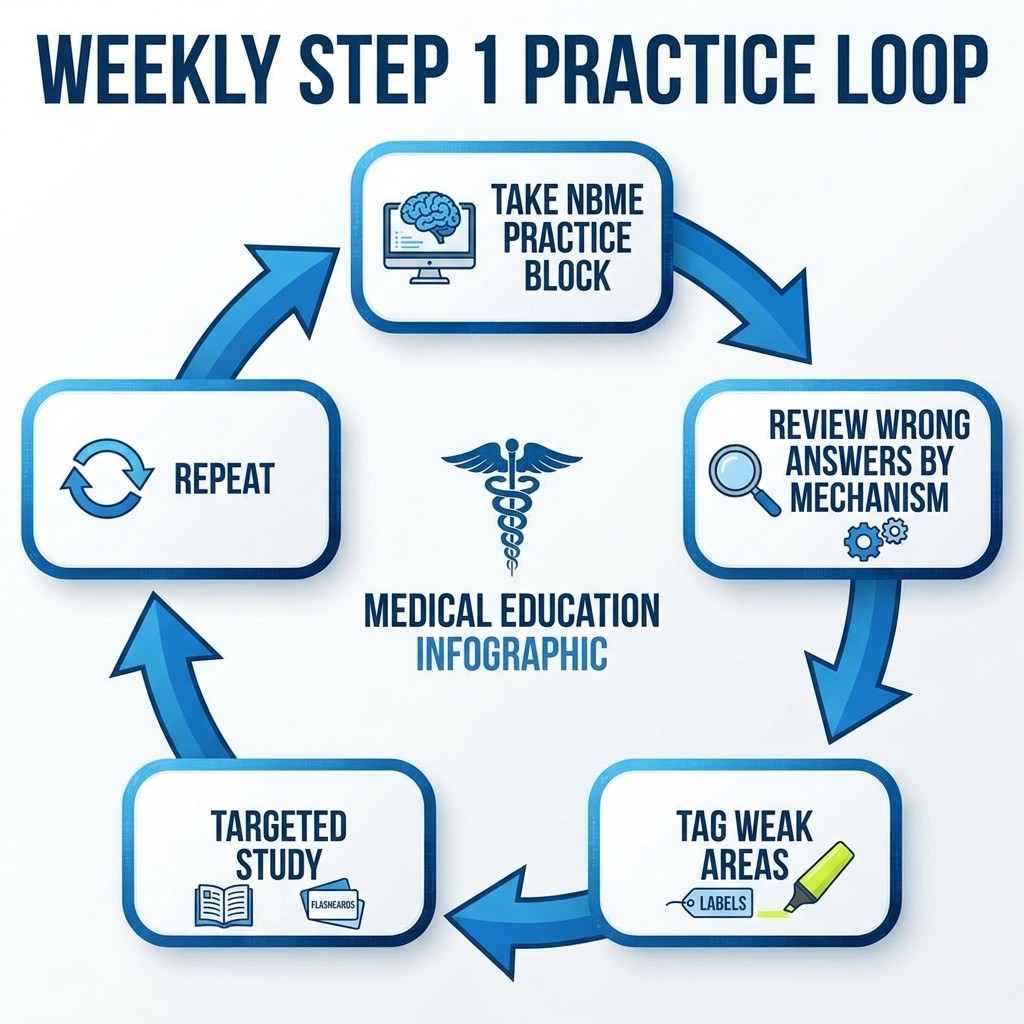
Consistency beats intensity for Step 1 success. Here's the weekly practice rhythm that exposes weak areas systematically:
Monday: Fresh Start Assessment
Take a 40-question timed block covering mixed topics
Review immediately for 60-90 minutes
Tag specific weak areas, not broad categories
Plan the week's targeted study based on results
Tuesday-Thursday: Targeted Remediation
Focus on the 2-3 weakest areas from Monday's assessment
20-30 questions daily in these specific topics
Untimed practice to build accuracy before speed
Deep-dive into mechanisms and pathways
Friday: Integration Test
40-question timed block mixing your previous weak areas with new topics
Goal: confirm improvement in targeted areas
Identify any new patterns of weakness
Weekend: Full Assessment
Take a complete NBME practice test or UWSA
Comprehensive review session (2-3 hours)
Update your weak area tags and priorities for next week
This cycle ensures you're not just doing random practice but systematically addressing your specific knowledge gaps.
Final 30-Day Practice Cadence
Your final month of Step 1 prep should shift from learning new material to polishing weak areas and building exam stamina. Here's the optimal practice frequency:
Weeks 4-3 Before Exam
NBME Practice Tests: Take 1 every 5-7 days (total of 2)
Daily Practice: 40 questions, 50% timed/50% untimed
Focus: Major weak areas identified in previous practice
Review Time: 90 minutes per practice block
Weeks 2-1 Before Exam
NBME Practice Tests: Take 1 every 3-4 days (total of 2-3)
Daily Practice: 60 questions, 80% timed/20% untimed
Focus: Fine-tuning and confidence building
Review Time: 60 minutes per practice block (focus on patterns)
Final Week
NBME Practice: 1 assessment, 2-3 days before exam
Daily Practice: 20-30 questions, review only missed ones
Focus: Maintaining sharpness, not learning new material
No new NBMEs: 48 hours before your exam
Common Final Month Mistakes
Over-practicing: Taking an NBME every day creates burnout and doesn't allow time for targeted remediation between assessments. Under-reviewing: Rushing through explanations to get to more questions. In the final month, quality of review matters more than quantity of practice. Chasing perfect scores: Aiming for 90%+ on practice questions instead of focusing on consistent performance in your weak areas. Ignoring patterns: Not tracking what types of questions you miss consistently, leading to repeated mistakes on test day.
Frequently Asked Questions
How many NBME practice tests should I take?
Take 4-6 NBME Comprehensive Basic Science Self-Assessments (CBSSA) spread throughout your prep. Start with 1 baseline early in dedicated study, take 2-3 during your preparation weeks (spaced 1-2 weeks apart), and finish with 1-2 in your final two weeks. More than 8 NBMEs usually indicates you need more targeted studying, not more assessments.
Should I retake NBME forms I've already completed?
No, retaking the same NBME form inflates your score and gives false confidence. NBME releases new forms regularly – use fresh assessments to get accurate readiness estimates. If you need more practice, supplement with UWorld Self-Assessments or other question banks.
What NBME score predicts Step 1 passing in 2026?
NBME provides an estimated probability of passing based on your performance, typically shown as a percentage. While specific score cutoffs aren't published, most students with 75%+ estimated probability of passing succeed on their first attempt. Focus on the probability percentage, not raw scores.
How long should I spend reviewing each NBME question?
Spend 2-3 times as long reviewing as you did taking the assessment. For a 200-question NBME (5 hours), plan 10-15 hours of thorough review spread over 2-3 days. Quality review matters more than rushing through explanations.
Can I use NBME practice questions to predict my weak areas?
Yes, this is exactly what NBME assessments are designed for. The INSIGHTS dashboard in your MyNBME portal breaks down performance by content area, question difficulty, and time spent per item. Use this data to guide your study priorities, not just overall scores.
What if I'm consistently failing NBME practice tests?
If you're scoring below 60% probability of passing on multiple NBMEs, extend your study timeline. Focus on building foundational knowledge through content review before returning to intensive question practice. Consider working with a tutor or using adaptive learning tools to address fundamental gaps.
Prepare smarter with Oncourse AI – adaptive MCQs, spaced repetition, and AI explanations built for USMLE Step 1. Download free on Android and iOS.