Back
USMLE Preparation: Build an Adaptive Plan with Oncourse AI
Learn how to build an adaptive USMLE study plan that adjusts to your weak systems, question performance, and timeline. Stop following rigid schedules that ignore your data.

USMLE Preparation: Build an Adaptive Plan with Oncourse AI
You are probably staring at another "12-week USMLE schedule" that treats every medical student like theyre identical. Same daily question count. Same content timeline. Same weekly milestones that assume your weak areas perfectly match whoever wrote the plan.
Heres the problem: USMLE Step 1 and Step 2 CK dont test your ability to follow someone elses calendar — they test your mastery of 15+ medical systems under time pressure. When your diagnostic shows youre crushing cardiology but struggling with renal physiology, a static plan that dedicates equal time to both is actively working against your score potential.
The students who jump 40+ points between practice exams aren't following generic schedules. Theyre using adaptive study plans that rebuild around their actual performance data, not projected timelines.
This article shows you how to build a USMLE prep plan that changes with you — targeting weak systems, adjusting question mix based on your error patterns, and recalibrating timelines when life hits. No more fighting against a rigid schedule that ignores what the data is telling you.
Why Static USMLE Plans Break Down
Most USMLE prep failures don't happen because students lack intelligence or motivation. They happen because static plans create a fundamental mismatch between how you actually learn and what the plan demands.
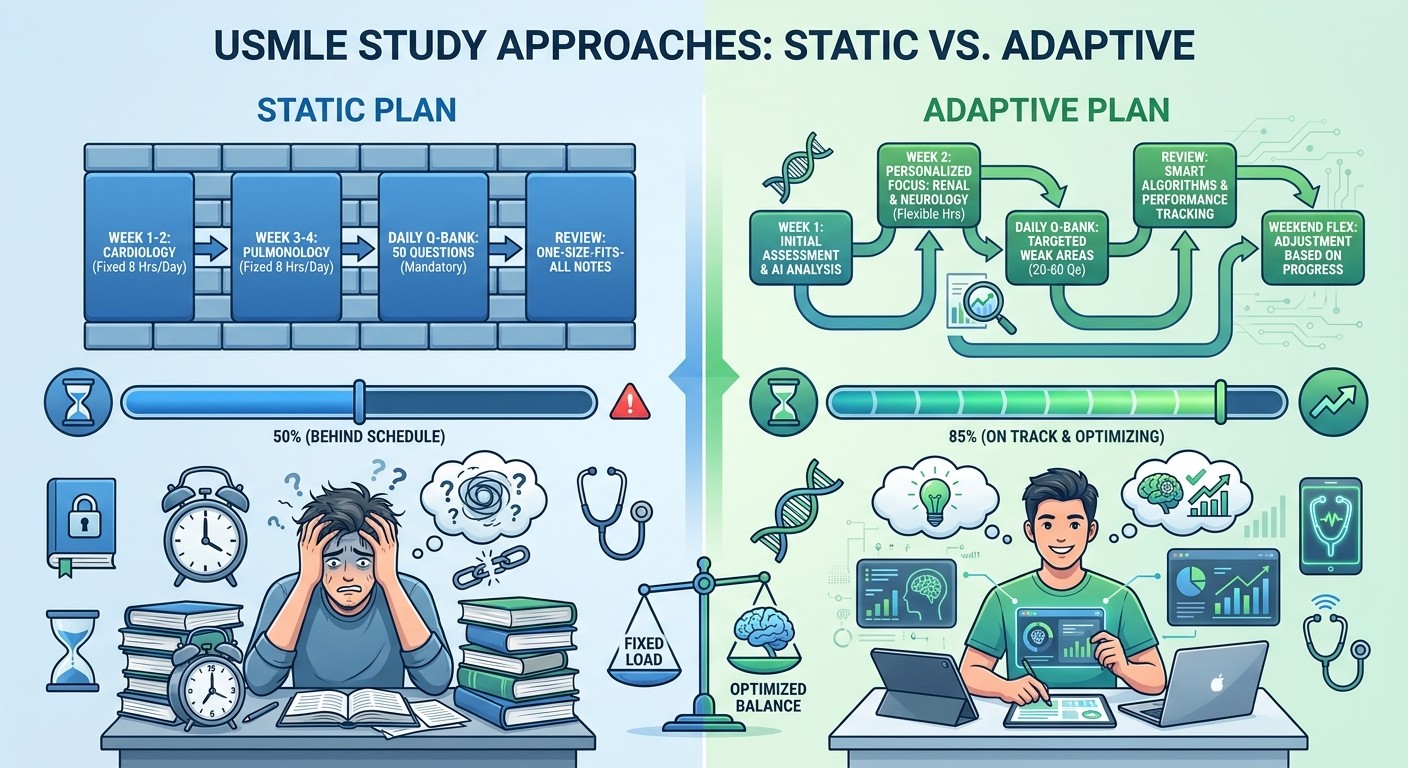
The False Promise of "Proven" Schedules
Every pre-made USMLE schedule comes with the same promise: "Follow this exactly and you'll score 250+." The reality is more complex. That "proven" 8-week plan worked for someone with a specific knowledge baseline, specific weak areas, and a specific life situation that probably doesn't match yours.
When you hit week 4 of that plan and realize youre still missing basic cardiology concepts while the schedule has moved on to nephrology, you face an impossible choice: stick to the timeline and leave gaps unfilled, or fall behind and never catch up.
System-Specific Learning Curves Vary Wildly
Your brain doesn't absorb endocrinology and infectious diseases at the same rate. Some students grasp pharmacology mechanisms instantly but struggle with anatomical pathways. Others excel at pattern recognition in radiology but need extra time with biochemical pathways.
Static plans ignore these individual learning curves entirely. They allocate the same 5 days to each system regardless of whether you need 2 days for cardiology and 10 days for neurology.
Question Performance Patterns Arent Universal
Here's what happens in week 6 of most static plans: You've completed 2,000+ practice questions, but youre still missing the same question types you struggled with in week 2. The plan says "move to pathology questions," but your analytics show you haven't actually mastered the physiology concepts those pathology questions assume you know.
An adaptive approach would catch this pattern and adjust. A static plan marches forward, building weakness on top of weakness.
The Adaptive Advantage: How AI Changes USMLE Prep
Adaptive USMLE preparation means your study plan evolves based on three key data points: your diagnostic baseline, your ongoing question performance, and your real-world constraints (exam date, daily study time, life circumstances).
Instead of fighting against a predetermined schedule, you work with a system that identifies exactly where youre struggling and rebuilds your daily study priorities around closing those specific gaps.
Real-Time Weak Area Detection
Traditional question banks tell you what you got wrong. Adaptive systems tell you why youre getting it wrong and what to study next. When you miss a cardiology question about heart failure, the system doesn't just mark it incorrect — it identifies whether the gap is in basic physiology, pharmacology, clinical presentation, or diagnostic workup.
Oncourse AI's adaptive study paths use this diagnostic approach to rebuild your plan around weak topics rather than predetermined content blocks. If your performance data shows consistent struggles with renal physiology across multiple question stems, the system automatically increases your exposure to targeted renal content and adjusts your daily question mix to reinforce those concepts.
Question Mix That Responds to Your Performance
Static plans typically prescribe the same question distribution for everyone: "40 questions daily, mixed systems." Adaptive planning goes deeper. If youre consistently missing questions that require you to differentiate between similar drugs, your daily mix shifts to include more comparative pharmacology questions. If youre strong on basic concepts but struggle with multi-step clinical reasoning, you get more complex vignettes.
This isn't random adjustment — its precision targeting based on your actual error patterns. Oncourse AI's QBank and clinical-vignette practice identifies weak systems instead of only counting questions completed, so your daily practice focuses on the exact areas where additional exposure will drive the biggest score improvements.
Progress Tracking That Predicts Performance Gaps
Most students track progress by counting hours studied or questions completed. Adaptive systems track progress by measuring how reliably you can answer questions in each content area under timed conditions.
When Oncourse's performance analytics show that your internal medicine scores have plateaued for 2 weeks while your surgery scores are still climbing, that's actionable intelligence. The system turns mock results and missed-question patterns into next-step study priorities, automatically adjusting your upcoming study sessions to address the stagnation.
Building Your Adaptive USMLE Plan: The Framework
Creating an adaptive plan means establishing the right diagnostic baseline, then building flexible systems that respond to what the data shows you.
Step 1: Establish Your True Baseline
Before you can adapt, you need to know where youre starting. This means taking a full-length diagnostic assessment within your first week of serious prep — not when you "feel ready."
For Step 1: Start with the Free 120 or NBME CBSSA Form 25. These aren't practice sessions — theyre diagnostic tools that reveal your content gaps and test-taking patterns under realistic conditions. For Step 2 CK: Take an NBME CCSSA form or a full-length practice exam from your primary question bank. The key is using the same format and timing youll face on test day.
The baseline results tell you three critical things:
Content gaps by system (which medical specialties need immediate attention)
Question-type patterns (whether you struggle more with basic recall, clinical application, or multi-step reasoning)
Timing and stamina issues (whether you fade in later blocks or rush through questions)
Step 2: Set Dynamic Study Priorities
Unlike static plans that lock you into predetermined content blocks, adaptive planning uses your baseline results to establish flexible priorities that shift based on performance.
High-Priority Systems: The 3-4 medical areas where your baseline scores were lowest. These get 40% of your daily study time and question allocation. Medium-Priority Systems: Areas where youre competent but not strong. These get 35% of your time and serve as your "maintenance" content. Low-Priority Systems: Your strongest areas get 25% of time. This prevents knowledge decay while maximizing time spent on areas with the highest improvement potential.
These percentages shift weekly based on your practice exam results. When a high-priority system moves into your competency range, it shifts to maintenance mode and a new weak area gets intensive focus.
Step 3: Design Question Practice That Adapts
Your daily question practice should change based on what last weeks performance data revealed. This means moving beyond fixed daily question counts to adaptive question selection.
Week 1-2: Focus on mixed-system blocks that mirror your diagnostic baseline. This establishes consistent performance patterns across content areas. Week 3-6: Shift to system-focused blocks for your high-priority areas, with mixed blocks 2-3 times per week to maintain broad exposure. Week 7+: Return to full mixed blocks that simulate test-day conditions, but with continued emphasis on question types that historically trip you up.
The key is tracking not just percentage correct, but question-type patterns within each system. If youre getting cardiology physiology questions right but missing cardiology pharmacology consistently, your adaptive plan increases pharmacology exposure specifically.
Daily Implementation: Making Adaptive Planning Practical
Theory is useless without practical daily implementation. Heres how to structure your daily study sessions so they actually adapt to your performance data.
Morning: Targeted Weak Area Review (60-90 minutes)
Start each day by reviewing content from your current highest-priority system. This isn't passive reading — use active recall methods like practice questions, concept mapping, or teaching the material out loud.
The content you review should come directly from your recent missed questions. If yesterday's practice revealed gaps in renal physiology, this mornings session focuses specifically on the physiological concepts those questions assumed you knew.
When working through weak areas, Oncourse AI's mnemonics system can help cement these challenging concepts through memorable memory devices tailored to medical content.
Mid-Day: Adaptive Question Practice (90-120 minutes)
Your question practice sessions should be timed blocks that mirror test conditions, but with content distribution that reflects your current priorities.
Sample Daily Question Mix (based on weak areas):
60% questions from high-priority systems
25% questions from medium-priority systems
15% questions from low-priority systems (maintenance)
Track not just your percentage correct, but your confidence level on each question. Questions where you guessed correctly still represent knowledge gaps that need attention.
For real-time feedback during practice, Oncourse AI's Rezzy tutor can provide instant explanations when you encounter unfamiliar concepts, helping you understand not just what the right answer is, but why the other options are wrong.
Evening: Spaced Review and Plan Adjustment (45-60 minutes)
End each day by reviewing your performance data and making small adjustments to tomorrows focus. This isn't a major plan overhaul — its fine-tuning based on what today revealed.
Questions to ask yourself:
Which content areas showed improvement today?
Which question types are still consistently problematic?
Is my current system-priority ranking still accurate based on this weeks performance?
Use spaced repetition tools like flashcards for concepts you've recently struggled with. The goal isn't to memorize facts, but to strengthen recall of information youve already learned but aren't retrieving reliably under time pressure.
Progress Checkpoints: When and How to Adjust
Adaptive planning requires regular checkpoints where you assess whether your current approach is working and make data-driven adjustments.
Weekly Performance Reviews
Every 7 days, analyze your practice question performance across all systems. Look for three key patterns:
Improvement Trends: Which systems are showing consistent score increases? These might be ready to move from high-priority to maintenance mode. Plateau Patterns: Which systems have flatlined for 2+ weeks despite focused attention? These may need a different study approach or deeper content review. Regression Patterns: Which previously strong systems are starting to decline? These need to shift back into active review rotation.
Monthly Practice Exam Recalibration
Take a full-length practice exam monthly to recalibrate your system priorities and overall timeline. These exams serve as major checkpoints for plan adjustment.
After each practice exam:
1. Compare your system-by-system performance to your previous exam
2. Identify new weak areas that may have emerged
3. Adjust your daily question mix percentages based on current gaps
4. Reassess your target test date based on improvement trajectory
If your practice scores aren't trending toward your target within the expected timeline, this is when you make bigger adjustments — extending your study period, changing your daily study time allocation, or shifting to more intensive weak-area focus.
Real-Time Daily Adjustments
The most important adaptations happen in real-time during your daily study sessions. When you encounter concepts that clearly represent knowledge gaps, adjust your immediate study priorities.
Example: If morning practice questions reveal that you don't understand basic cardiac electrophysiology, shift your afternoon content review to focus on EKG interpretation and cardiac cycle physiology, even if your planned schedule said to study something else.
This kind of responsive adjustment is what separates adaptive planning from rigid schedules that ignore what the data is telling you.
Common Adaptive Planning Mistakes to Avoid
Even with good intentions, students make predictable mistakes when implementing adaptive study plans. Here are the most common pitfalls and how to avoid them.
Over-Adjusting Based on Single Bad Days
One poor practice session doesn't indicate a fundamental knowledge gap. Adaptive planning responds to patterns, not isolated performances.
Rule: Only make priority adjustments based on 3+ days of consistent performance in a given direction. A single bad day might reflect fatigue, distraction, or random question difficulty rather than a true knowledge gap.
Ignoring Strong Areas Too Long
Adaptive planning focuses heavily on weak areas, but completely neglecting your strong systems leads to knowledge decay. Even your best subjects need maintenance review.
Rule: Never let a strong system go more than 7 days without some exposure through mixed practice questions or brief content review. Your goal is maintaining strength while building weakness, not sacrificing one for the other.
Changing Study Methods Too Frequently
When a system isnt improving quickly, students often blame their study method and constantly switch approaches. This prevents any single method from having time to work.
Rule: Give each study approach 2-3 weeks to show results before switching methods. Consistency in approach often matters more than the specific method you choose.
Focusing Only on Content Gaps, Ignoring Test-Taking Skills
Adaptive plans can become so focused on content review that they neglect test-taking strategy development. USMLE success requires both content mastery and efficient question analysis skills.
Rule: 20% of your study time should focus on test-taking technique — timing management, answer elimination strategies, and question stem analysis — regardless of your content gaps.
Technology That Enables True Adaptation
Effective adaptive planning requires tools that can track performance patterns, identify knowledge gaps, and adjust study recommendations in real-time. Generic question banks and static flashcard decks cant provide this level of responsiveness.
AI-Driven Performance Analytics
Modern adaptive platforms use AI to identify not just what you got wrong, but why you got it wrong and what to study next. This goes beyond simple percentage tracking to pattern recognition across question types, content areas, and reasoning processes.
Look for platforms that provide system-by-system performance tracking, identify recurring error patterns, and automatically adjust question selection based on your weak areas. The goal is spending your limited study time on content that will drive the biggest score improvements.
Integrated Learning Tools
The most effective adaptive systems integrate multiple learning modalities — questions, flashcards, content review, and active recall games — so your plan can adjust the mix of activities based on what your performance data suggests you need.
For example, if you're consistently missing questions due to factual recall gaps, the system should increase flashcard exposure. If youre missing questions due to clinical reasoning problems, it should emphasize complex vignette practice and case-based learning games like Oncourse's Probe Game, which challenges you to diagnose cases under time pressure.
Responsive Content Delivery
Static platforms deliver the same content to everyone in the same order. Adaptive platforms adjust both the content you see and the sequence in which you see it based on your individual learning patterns.
This means getting additional exposure to concepts you're struggling with, while spending less time on material youve already mastered. The result is a study experience that feels personalized because it actually is personalized to your specific knowledge gaps and learning patterns.
Frequently Asked Questions
How long does it take to see results from an adaptive study plan?
Most students see measurable improvement in their weak systems within 2-3 weeks of implementing adaptive planning. However, significant score improvements typically take 6-8 weeks because youre not just learning new information — youre building reliable recall under time pressure. The key advantage of adaptive planning is that improvements happen more efficiently because youre focusing on areas with the highest improvement potential.
Can I use an adaptive approach if my USMLE exam is only 6 weeks away?
Yes, but the approach needs to be more aggressive. With a short timeline, adaptive planning becomes even more critical because you cant afford to waste time on content you already know well. Focus 70% of your study time on your 2-3 weakest systems, and use daily performance data to make rapid adjustments. The shorter timeline makes precise targeting essential.
What if my weak areas keep changing from week to week?
This usually indicates that your study approach isnt building durable knowledge. Instead of constantly chasing new weak areas, pick your bottom 3 systems and commit to intensive review for 3-4 weeks straight. Use spaced repetition and active recall methods to ensure information moves from short-term to long-term memory. Stable weak areas are easier to address than constantly shifting gaps.
How do I balance adaptive planning with comprehensive content coverage?
Adaptive planning doesn't mean ignoring entire systems — it means adjusting time allocation based on your individual needs. Ensure every system gets some exposure through mixed practice questions, but dedicate intensive study time to areas where focused attention will drive score improvements. Use maintenance review for strong areas and intensive review for weak areas.
Should I abandon my adaptive plan if Im not improving fast enough?
Before abandoning the approach, check whether youre actually implementing adaptive principles. Many students think theyre being adaptive but are actually following modified static plans. True adaptive planning requires daily adjustments based on performance data, not weekly tweaks to a predetermined schedule. If youre genuinely adapting but not improving, consider whether you need more total study time rather than a different study approach.
Prepare smarter with Oncourse AI — adaptive MCQs, spaced repetition, and AI explanations built for USMLE Step 1 and Step 2 CK. Download free on Android and iOS.