Back
USMLE Step 1 Microbiology: Build Faster Recall with Oncourse Mnemonics and Probe Game
Transform USMLE Step 1 microbiology from passive reading to rapid recall. Learn clinical clue recognition, mnemonic strategies, and active recall training for faster organism identification.
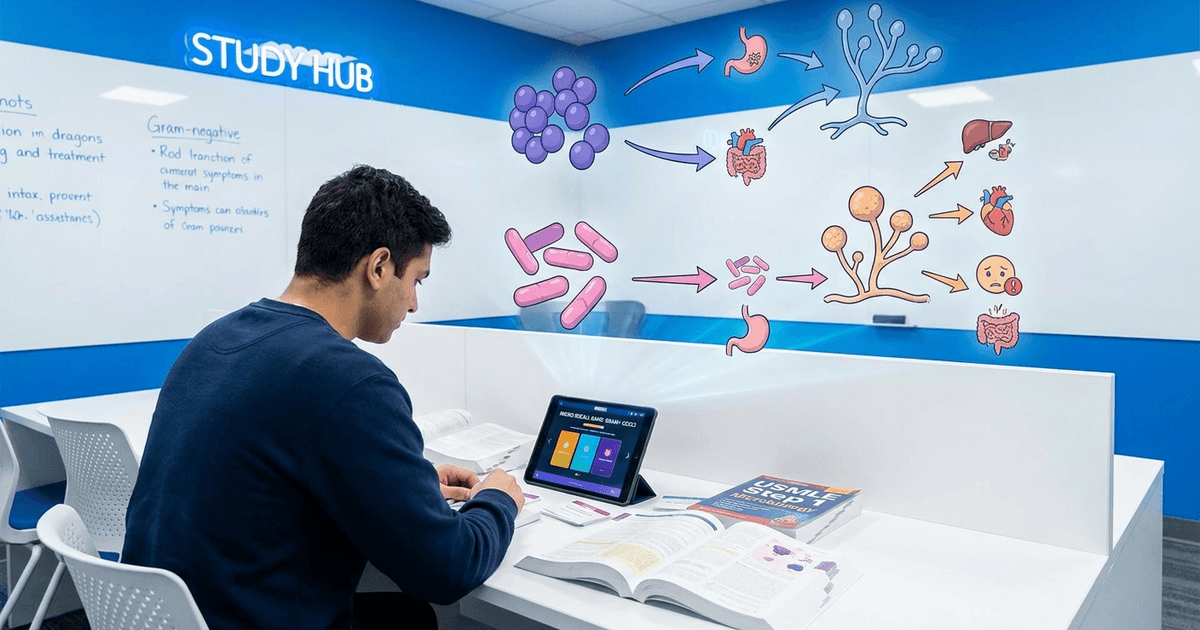
USMLE Step 1 Microbiology: Build Faster Recall with Oncourse Mnemonics and Probe Game
You probably know the feeling. You open First Aid to that 80-page microbiology chapter and your brain immediately starts negotiating. "Maybe I'll just focus on the high-yield stuff today." But here's the problem: microbiology doesnt let you get away with passive reading. Step 1 vignettes give you partial clues—a gram-positive coccus in chains with β-hemolysis, a patient with "rice-water" stool, or an obligate intracellular organism causing atypical pneumonia—and expect instant organism recognition.
The students who crush microbiology questions dont memorize organism lists. They build rapid recall systems that connect clinical clues to organisms in seconds. When you see "gram-negative diplococci in neutrophils," you need _Neisseria gonorrhoeae_ to pop into your head before you finish reading the sentence.
Here's how to transform microbiology from a memory nightmare into your fastest recall subject using proven active recall techniques.
Why Microbiology Feels Impossible on Step 1
Microbiology hits differently than other Step 1 subjects. Anatomy has visual landmarks. Physiology follows logical pathways. But microbiology dumps 200+ organisms, each with unique morphology, virulence factors, clinical presentations, and antimicrobial sensitivities into your brain and expects perfect recall under time pressure.
The problem isnt the volume—its how students approach it. Most read through organism lists repeatedly, hoping repetition creates retention. But passive reading builds recognition, not recall. When Step 1 gives you a clinical vignette with scattered clues, you need active recall that connects dots instantly.
Traditional approach: Read "Streptococcus pyogenes causes pharyngitis, cellulitis, impetigo" five times Recall-based approach: See "β-hemolytic gram-positive cocci" → instantly think Group A Strep → recall M protein virulence → connect to pharyngitis/cellulitis/necrotizing fasciitis
The difference? Speed and clinical context. Step 1 microbiology questions test pattern recognition from partial clinical information, not textbook definitions.
Breaking Down Microbiology for Faster Recall
Instead of studying organisms as isolated entities, build recall around clinical recognition patterns. Here's how to organize microbiology content for active recall:
1. Organisms by Morphology and Gram Stain
Start with the basics that appear in every vignette:
Gram-positive cocci: Clusters (Staph) vs. chains (Strep)
Gram-negative cocci: Diplococci (Neisseria) vs. coccobacilli (Haemophilus)
Gram-positive rods: Spore-forming (Bacillus, Clostridium) vs. non-spore-forming (Listeria, Corynebacterium)
Gram-negative rods: Lactose fermenters vs. non-fermenters, oxidase-positive vs. negative
2. Virulence Factors and Toxins
Connect specific virulence factors to clinical presentations:
Capsules: Anti-phagocytic (pneumococcus, meningococcus)
Exotoxins: Specific mechanisms (diphtheria toxin inhibits protein synthesis, cholera toxin activates adenylyl cyclase)
Cell wall components: Protein A (Staph aureus), M protein (Group A Strep)
3. Clinical Clue Recognition
Build rapid associations between symptoms and organisms:
"Rice-water stool" → Vibrio cholerae
"Currant jelly sputum" → Klebsiella pneumoniae
"Rose spots on trunk" → Salmonella typhi
The key is creating instant mental links between clinical descriptions and organisms, not memorizing every detail about each bug.
Using Mnemonics Without Losing Understanding
Mnemonics get a bad rap because students use them as substitutes for understanding. But when used correctly, they accelerate recall while preserving mechanistic knowledge. The trick is building mnemonics that encode both the fact and its clinical context.
Bad mnemonic: "CAMPS" for Campylobacter causing diarrhea Good mnemonic: "CAMP's Bloody GI tract" → Campylobacter → bloody diarrhea → Guillain-Barré syndrome connection
The second version connects the organism to its key clinical presentations and complications, not just its name.
When you need to memorize complex virulence factors or antibiotic mechanisms, Oncourse Mnemonics helps turn dense lists into memorable recall cues tied to exactly what you keep missing. Instead of generic memory aids, you get personalized mnemonics based on your weak areas—so if you consistently miss mycobacterial cord factor questions, you get targeted memory devices for that specific concept.
High-Yield Mnemonic Categories
Focus your mnemonic energy on these high-impact areas:
Encapsulated organisms (vulnerable to asplenic patients):
"SHiN" → Strep pneumoniae, Haemophilus influenzae, Neisseria
Catalase-positive organisms:
"SPACES" → Staph, Pseudomonas, Aspergillus, Candida, E. coli, Serratia
Obligate intracellular organisms:
"CCRLM" → Chlamydia, Coxiella, Rickettsia, Legionella, Mycobacteria
Spore-forming gram-positive rods:
"BC" → Bacillus, Clostridium
The goal isnt to memorize every mnemonic—its to build targeted memory aids for your personal weak spots.
Rapid Clue-Based Recall Training
Step 1 microbiology questions rarely give you complete clinical pictures. They drop clues throughout vignettes and expect you to synthesize partial information into organism identification. This requires trained pattern recognition, not memorized lists.
Here's how to build clue-based recall:
1. Practice with Partial Information
Instead of studying complete organism profiles, practice with incomplete clues:
Clue: "Gram-negative diplococci in neutrophils"
Response: _Neisseria gonorrhoeae_
Extension: Urethritis, PID, disseminated gonococcal infection
Start with morphology, add one clinical clue, then build toward full syndrome recognition.
2. Speed Recognition Drills
Set strict time limits for organism identification. When you see "oxidase-positive gram-negative curved rod from shellfish," you should hit Vibrio within 3-5 seconds. This mirrors actual test conditions where hesitation costs points.
This is where Probe Game transforms microbiology recall. Instead of passively reviewing notes, you get fast clue-based practice that mimics Step 1 question stems. The game presents partial organism clues—gram stain, morphology, clinical context—and trains you to identify patterns from incomplete information rather than complete textbook descriptions.
3. Wrong Answer Analysis
Every missed microbiology question contains recall training opportunities. When you select the wrong organism, dont just check the right answer—analyze why the distractors seemed plausible. Often, youll find gaps in clinical clue recognition or morphology differentiation.
Converting Missed Questions into Recall Prompts
The most efficient microbiology study happens after you miss questions. Each wrong answer reveals specific gaps in your recall system. Here's how to convert missed questions into targeted practice:
Step 1: Identify the recognition failure
Did you miss the gram stain?
Confused similar organisms?
Failed to connect clinical clues?
Step 2: Create recall prompts
Transform the missed question into active recall practice:
Original miss: Confused Enterobacter with E. coli
Recall prompt: "Gram-negative rod, lactose-positive, but ESBL-producing"
Answer: Enterobacter (vs. E. coli which is usually ESBL-negative)
Step 3: Schedule repeated exposure
Don't just review once—schedule the weak organism for repeated practice until recognition becomes automatic.
When you miss microbiology questions, you can use Rezzy AI to dig deeper into why you chose the wrong answer, explore the clinical clues you missed, and understand how similar organisms differ. Then route those specific weak areas back into focused recall practice rather than re-reading entire chapters.
Your Daily Microbiology Recall Loop
Effective microbiology recall requires consistent, focused practice. Here's a proven daily workflow that builds speed and accuracy:
Morning (15-20 minutes): Mechanism Focus
Pick 5-10 organisms from your weak list
Review key virulence factors and clinical presentations
Create or review mnemonics for complex mechanisms
Focus on understanding, not just memorization
Afternoon (20-30 minutes): Active Recall Practice
Use clue-based recall drills (morphology → organism)
Practice with partial clinical vignettes
Time yourself—aim for 5-second organism recognition
Mix familiar organisms with ones you frequently miss
Evening (10-15 minutes): Review and Schedule
Analyze any missed questions from the day
Update your weak organism list
Schedule tomorrow's focus areas
Quick review of the day's new mnemonics
The key is consistency over marathon sessions. Daily recall practice builds automatic recognition patterns that persist under test pressure.
High-Yield Organism Categories for Step 1
Focus your recall training on these high-impact categories that appear most frequently on Step 1:
Gram-Positive Cocci
Staphylococcus aureus: Catalase +, coagulase +, β-hemolytic
Clinical: Skin infections, endocarditis, toxic shock syndrome
Key virulence: Protein A, enterotoxins, TSST-1
Streptococcus pyogenes (Group A): Catalase -, β-hemolytic
Clinical: Pharyngitis, cellulitis, necrotizing fasciitis
Key virulence: M protein, streptolysins
Streptococcus pneumoniae: Catalase -, α-hemolytic, lancet diplococci
Clinical: Pneumonia, meningitis, otitis media ("MOPS")
Key virulence: Polysaccharide capsule, pneumolysin
Gram-Negative Rods
Escherichia coli: Lactose +, indole +
Clinical: UTIs, neonatal meningitis, traveler's diarrhea
Key virulence: Various toxins (LT, ST, Shiga-like)
Pseudomonas aeruginosa: Oxidase +, non-lactose fermenting
Clinical: Burn infections, CF lung disease, hospital-acquired pneumonia
Key virulence: Exotoxin A, biofilm formation
Salmonella: Non-lactose fermenting, H2S +
Clinical: Gastroenteritis, typhoid fever
Key virulence: Vi antigen (typhi), invasion proteins
Atypicals and Intracellulars
Mycoplasma pneumoniae: No cell wall, cold agglutinins
Clinical: Atypical pneumonia, walking pneumonia
Key feature: Resistance to β-lactams
Chlamydia pneumoniae: Obligate intracellular
Clinical: Atypical pneumonia, COPD exacerbations
Key feature: Elementary vs. reticulate bodies
Legionella pneumophila: Gram-negative, oxidase +
Clinical: Legionnaires' disease, Pontiac fever
Key feature: BCYE agar, silver stain
Common Microbiology Recall Mistakes
Avoid these patterns that slow down recall development:
Mistake 1: Memorizing Lists Without Clinical Context
Problem: Learning "Strep pneumoniae causes pneumonia, meningitis, otitis media" Solution: Connect morphology → clinical clues → organism → complications in one recall chain
Mistake 2: Ignoring Wrong Answer Explanations
Problem: Checking the right answer and moving on Solution: Analyze why each distractor was tempting and what clues differentiate similar organisms
Mistake 3: Never Testing Recall Under Time Pressure
Problem: Slow, methodical organism identification Solution: Regular speed drills with 5-second recognition targets
Mistake 4: Cramming Before Exams
Problem: Passive re-reading of microbiology notes Solution: Daily active recall practice with spaced repetition of weak areas
Your 7-Day Microbiology Recall Sprint
Ready to transform your microbiology recall? Here's an intensive 7-day protocol:
Days 1-2: Foundation Building
Map all gram-positive and gram-negative organisms by morphology
Create recall chains: gram stain → shape → key organism → major diseases
Focus on the most common 20-30 organisms first
Days 3-4: Virulence Factor Integration
Add virulence factors to your recall chains
Practice mechanism-based questions (toxin MOA, resistance patterns)
Build mnemonics for complex pathways (complement evasion, intracellular survival)
Days 5-6: Clinical Recognition Training
Practice with partial vignette clues
Speed recognition drills: 5 seconds per organism identification
Focus on your personal weak organisms from practice questions
Day 7: Synthesis and Testing
Mixed organism recall from random clinical clues
Timed practice sessions mimicking exam conditions
Analyze remaining gaps and plan ongoing practice
Remember: this sprint builds the foundation. Maintain daily recall practice to preserve and strengthen these patterns.
Frequently Asked Questions
How long does it take to build reliable microbiology recall?
With daily active recall practice, most students see significant improvement in 2-3 weeks. Complete organism recognition for Step 1 typically takes 4-6 weeks of consistent practice. The key is regularity—15-20 minutes daily beats 3-hour weekend sessions.
Should I memorize every organism detail or focus on high-yield ones?
Focus on rapid recall for high-yield organisms first. Master gram-positive and gram-negative cocci, common rods, and atypicals before diving into rare organisms. Step 1 tests pattern recognition more than encyclopedic knowledge.
How do I remember antibiotic mechanisms and resistance patterns?
Build recall chains that connect organism → resistance mechanism → clinical impact. For example: MRSA → PBP alteration → β-lactam resistance → vancomycin/linezolid therapy. Link mechanisms to actual patient care decisions.
What should I do when I keep confusing similar organisms?
Create direct comparison recall prompts. If you confuse E. coli and Enterobacter, practice side-by-side: "Lactose + gram-negative rods: E. coli (usually ESBL-) vs. Enterobacter (often ESBL+)." Focus on the one differentiating feature.
How important are rare organisms and tropical diseases?
Learn them after mastering common organisms. Step 1 includes some low-yield organisms, but most questions focus on bacteria you'd encounter in US clinical practice. Prioritize accordingly.
Can mnemonics replace understanding mechanisms?
Never. Use mnemonics to accelerate recall of facts you already understand. If you dont know why diphtheria toxin inhibits protein synthesis, a mnemonic wont help with mechanism-based questions. Build understanding first, then add memory aids.
Prepare smarter with Oncourse AI—adaptive MCQs, spaced repetition, and AI explanations built for USMLE Step 1. Download free on Android and iOS.