Back
UKMLA AKT Study Strategy 2026: Is Case-Based Learning the Right Approach?
Evidence-based analysis of case-based vs traditional study methods for UKMLA AKT 2026. Compare learning science, pass rates, and strategic implementation for UK graduates and IMGs.

UKMLA AKT Study Strategy 2026: Is Case-Based Learning the Right Approach?
You are probably staring at a stack of textbooks wondering if reading them cover-to-cover will actually help you pass the UKMLA AKT. Here is the uncomfortable truth: the AKT has 180 questions. Each one presents a clinical scenario requiring applied reasoning, not memorized facts. If you have been planning to study the way you did for medical school finals, you are setting yourself up for a shock.
The UKMLA AKT tests clinical application through case vignettes - patient presentations where you diagnose, investigate, and manage based on limited information. This isnt a recall exam. Its pattern recognition under pressure. The question becomes: should you build that pattern recognition through case-based learning or stick with traditional textbook study?
The data from 2025 pass rates tells us something important. UK graduates had an 89% first-attempt pass rate, while international medical graduates (IMGs) sat at 71%. The difference wasnt knowledge gaps - both groups knew their medicine. The difference was exposure to UK clinical reasoning patterns and case-based decision making.
What Makes the UKMLA AKT Different from Other Medical Exams
The Applied Knowledge Test lives up to its name. Every question starts with a clinical vignette: "A 67-year-old man presents with chest pain and shortness of breath..." Your job is to work through the case like a practicing doctor, not recite textbook definitions.
The exam blueprint divides into clinical domains weighted by real-world frequency. Emergency presentations get 15% of questions because they are high-stakes, high-frequency scenarios. Mental health gets 12% because psychiatric presentations are common in UK practice. Surgery gets 10%, reflecting the reality that most doctors refer surgical cases rather than manage them directly.
This weighting system means your study strategy needs to match real clinical exposure, not academic course structures. Traditional textbook chapters treat all topics equally - the AKT doesnt.
The Case for Case-Based Learning
Active clinical reasoning builds the exact skill the AKT tests: taking incomplete information and working toward the most likely diagnosis and management plan. When you work through patient scenarios repeatedly, you develop pattern recognition that passive reading cannot replicate.
Learning science backs this up. Spaced repetition of cases - seeing similar presentations with slight variations over time - builds stronger neural pathways than massed practice with isolated facts. Your brain learns to recognize the subtle differences between myocardial infarction and pericarditis because you have worked through dozens of chest pain cases, not because you memorized their textbook definitions.
Case-based learning also mirrors how practicing doctors actually think. Clinical reasoning is not linear - you form differential diagnoses early, then gather information to confirm or rule out possibilities. Oncourse's Clinical Rounds mimics this exactly, presenting scenarios where you work through the diagnostic process step by step, building the same thought patterns you will need on exam day.
Interleaving different case types within study sessions improves transfer learning. Instead of studying all cardiology cases in one block, mixing cardiac, respiratory, and gastrointestinal presentations forces your brain to discriminate between similar symptoms across systems. This builds the flexibility the AKT demands.
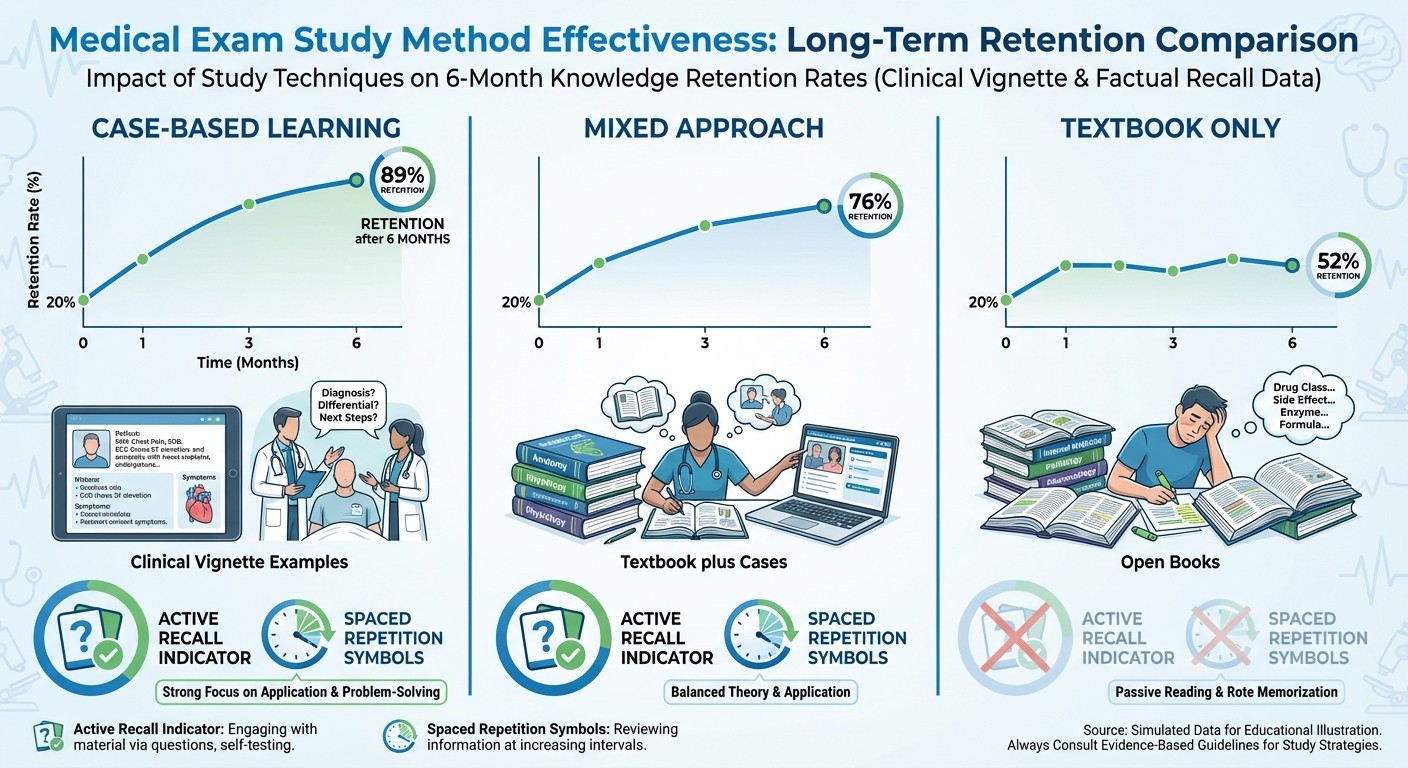
The retention benefits compound over time. Case-based learners show superior performance 6 months after initial learning compared to fact-based learners, according to cognitive science research. For a 12-week UKMLA prep window, this means case-based methods maintain knowledge strength right through to exam day.
The Traditional Textbook Approach
Systematic textbook study provides comprehensive coverage and builds strong foundational knowledge. Many successful candidates have used this method, particularly those with strong baseline clinical exposure. If you are a UK graduate with recent clinical attachments, textbook review might efficiently reinforce what you already know.
Textbooks excel at explaining mechanisms and providing complete topic coverage. When you need to understand why certain treatments work or how pathophysiology connects to clinical presentation, well-written medical texts provide depth that question banks cannot match. UKMLA preparation resources often recommend textbooks as foundational reading for this reason.
The linear structure appeals to organized learners who prefer systematic progression through topics. Some candidates find comfort in checking off completed chapters and knowing they have covered everything in a methodical way.
However, textbook learning has significant limitations for AKT preparation. Reading about diseases creates familiarity but not necessarily recognition speed. The AKT gives you 90 seconds per question. You need to spot patterns quickly, not work through diagnostic algorithms from first principles every time.
Passive reading also fails to build the uncertainty tolerance required for clinical practice. Real patients dont present with textbook symptoms. The AKT reflects this reality by including atypical presentations and requiring judgment calls with incomplete information.
Learning Science Behind Effective UKMLA Preparation
Active recall consistently outperforms passive review in medical education research. Testing yourself on information - whether through practice questions or flashcard-style review - creates stronger memory traces than rereading the same content. This is why question-based preparation shows higher pass rates than reading-only approaches.
Spaced repetition algorithms optimize this further. Instead of reviewing topics at fixed intervals, adaptive systems like Oncourse's Probe surface your weak areas more frequently while reducing time spent on mastered content. This performance-led revision approach ensures you spend prep time where it will have maximum impact.
The testing effect - improved retention from retrieval practice - is particularly strong for applied knowledge. When you practice recalling diagnostic criteria under timed conditions, you build both content knowledge and test-taking efficiency. This dual benefit explains why heavy question bank users consistently show higher pass rates.
Contextual learning - studying information in the same format you will be tested - improves transfer to exam conditions. Case vignettes during prep sessions reduce the cognitive load of processing clinical scenarios on test day, leaving more mental resources for actual clinical reasoning.
Which Study Method Fits Your Background?
UK Medical Graduates
If you completed clinical years in the UK, you already have exposure to local presentation patterns and management guidelines. Your advantage is familiarity with NHS protocols and UK-specific treatment pathways. Case-based learning builds on this foundation efficiently.
Focus your case practice on areas with high AKT weighting but limited clinical exposure during medical school. Emergency presentations, mental health scenarios, and primary care consultations often get less hands-on time during training but represent 35% of exam content combined.
Use micro-revision between case sessions to reinforce high-yield facts. Synapses auto-generates flashcards from your case practice, creating targeted review materials that focus on concepts you actually encountered during study sessions rather than random fact collections.
International Medical Graduates
Without UK clinical experience, you face a knowledge gap in local protocols and presentation patterns. Pure case-based learning might initially feel overwhelming if you lack baseline familiarity with UK clinical guidelines.
A hybrid approach works better: start with focused reading on UK-specific management protocols (UKMLA cardiology preparation provides system-specific guidance), then transition to heavy case practice once you have foundational knowledge.
Spend extra time on primary care scenarios, which represent 40% of AKT content but might be unfamiliar if your medical education emphasized hospital-based care. UK general practice has specific approaches to common presentations that differ from hospital protocols.
Recent Graduates vs Experienced Doctors
Fresh graduates have recent clinical knowledge but limited pattern recognition from repeated patient encounters. Case-based learning accelerates pattern development that would normally take years of clinical practice.
Experienced doctors have strong clinical intuition but might be rusty on detailed knowledge. A mixed approach - case practice for pattern recognition plus targeted reading for knowledge gaps - often works best.
The key difference is confidence with uncertainty. Experienced clinicians are comfortable making decisions with incomplete information, while recent graduates often seek more data than the AKT provides. Case practice builds this clinical judgment skill regardless of experience level.
Building Your 12-Week UKMLA AKT Study Plan
Weeks 1-4: Foundation Phase
Start with systematic coverage of high-yield domains. Emergency presentations, internal medicine, and primary care represent 55% of exam content - prioritize these areas first. Mix case practice with focused reading to build both knowledge base and application skills.
Aim for 30-40 cases per day across different systems. Interleaving prevents you from getting stuck in pattern ruts where you start predicting questions based on the current topic rather than clinical presentation. Real patients dont announce their system involvement.
Use adaptive questioning to identify weak areas early. Rather than working through question banks linearly, let performance data guide your focus areas. If cardiology cases consistently trip you up, spend extra sessions there before moving on.
Track your reasoning patterns, not just correct answers. Note when you made the right diagnosis for the wrong reasons - this identifies knowledge gaps that correct guessing can mask. The AKT punishes lucky guesses with follow-up questions that expose incomplete understanding.
Weeks 5-8: Pattern Recognition Phase
Increase case volume to 50-60 daily scenarios with emphasis on rapid pattern recognition. The goal is reducing time-to-decision on straightforward presentations so you have more time for complex multi-step questions.
Focus on atypical presentations during this phase. Textbook cases are important for building baseline recognition, but the AKT includes unusual presentations deliberately. Practice with cases where the obvious diagnosis is wrong or where multiple conditions coexist.
Add timed sessions to build exam-day pressure tolerance. Work through 30-question blocks in 45 minutes to simulate actual test conditions. Note which question types slow you down most and target those areas for additional practice.
Incorporate spaced repetition of previous mistakes. Return to cases you got wrong 3-7 days after initial exposure. This reinforces correct reasoning patterns and prevents repeated errors on similar presentations.
Weeks 9-12: Performance Phase
Simulate full exam conditions with 180-question practice tests. Focus on stamina building - maintaining accuracy across 3+ hours of sustained concentration. Mental fatigue causes more exam failures than knowledge gaps at this stage.
Use micro-review sessions between practice blocks. Ten-minute flashcard reviews of high-yield concepts maintain retention without causing cognitive overload. This is where AI-generated review materials like those from case-based practice sessions prove most valuable.
Refine your exam strategy based on performance patterns. If you consistently struggle with mental health scenarios, dedicate extra sessions to psychiatry cases. If time management is your weakness, practice question triage - identifying which complex cases to skip and return to if time allows.
Strategic Implementation for Maximum Results
The most effective UKMLA preparation combines multiple evidence-based techniques rather than relying on a single approach. Pure case-based learning works for candidates with strong foundational knowledge, but most successful test-takers benefit from strategic mixing.
Start each study session with 10-15 minutes of active recall using spaced repetition flashcards. This primes your memory for new learning and reinforces previous concepts without significant time investment. Follow with 45-60 minutes of case-based practice, focusing on your current weak areas. End with 10-15 minutes of targeted reading to fill knowledge gaps identified during case work.
This micro-cycle approach - recall, apply, learn - maximizes both retention and transfer. You are constantly moving between different types of cognitive processing, which builds more robust knowledge networks than single-mode study.
Use performance data to guide study decisions rather than arbitrary topic rotations. If your psychiatry scores are consistently 20% below your medicine scores, spend proportionally more time on mental health cases until the gap closes. This performance-led revision ensures effort goes toward maximum point gains.
Track leading indicators, not just practice scores. Monitor your time-to-first-impression on cases, your confidence in diagnoses, and your ability to generate appropriate differential diagnoses. These process measures predict exam performance better than raw accuracy rates during early preparation phases.
Frequently Asked Questions
How many practice cases should I complete before the UKMLA AKT?
Most successful candidates complete 3,000-4,000 practice cases during their preparation period. This includes initial learning cases, spaced repetition reviews, and full practice tests. Quality matters more than quantity - focus on understanding reasoning patterns rather than rushing through large volumes.
Can I pass the UKMLA AKT using only textbooks without case practice?
While possible, textbook-only preparation shows significantly lower first-attempt pass rates. The AKT format heavily favors candidates with case-based practice experience. If you prefer reading, supplement with at least 1,000 practice cases to build pattern recognition skills.
How long should I spend on each practice case during preparation?
During learning phases, spend 3-5 minutes per case including review of explanations. During timed practice, aim for 90 seconds per question to match exam conditions. Use longer review sessions for cases you get wrong to understand reasoning gaps.
Should international medical graduates study differently than UK graduates?
IMGs benefit from extra focus on UK-specific guidelines and primary care scenarios. Start with more textbook foundation work before transitioning to heavy case practice. Spend additional time on mental health and emergency presentations, which often differ significantly from international training patterns.
How important is spaced repetition for UKMLA AKT preparation?
Spaced repetition is crucial for long-term retention during 12-week preparation cycles. Candidates using adaptive spaced repetition systems show 25-30% better retention rates compared to those using fixed review schedules. This translates to 3-5% higher exam scores on average.
What percentage of study time should be case-based vs reading?
For most candidates, an optimal split is 70% case-based practice and 30% targeted reading. UK graduates can push this to 80/20, while IMGs might benefit from 60/40 during early preparation phases. Adjust based on your performance patterns rather than rigid ratios.
Prepare smarter with Oncourse AI — adaptive MCQs, spaced repetition, and AI explanations built for UKMLA AKT success. Download free on Android and iOS.