Back
USMLE Step 1 Pass Rate 2026: What the NBME Data Actually Shows
Complete breakdown of USMLE Step 1 pass rates in 2026 - first attempt vs repeat, US MD vs DO vs international schools, trends since pass/fail switch. Real data, actionable insights.
USMLE Step 1 Pass Rate 2026: What the NBME Data Actually Shows
You are probably staring at pass rate statistics right now, heart racing, wondering if that 87% first-attempt pass rate means 13% of people just like you are going to fail. I get it. When I was prepping for Step 1, I refreshed the NBME data page more times than I care to admit, trying to decode what those numbers meant for my chances.
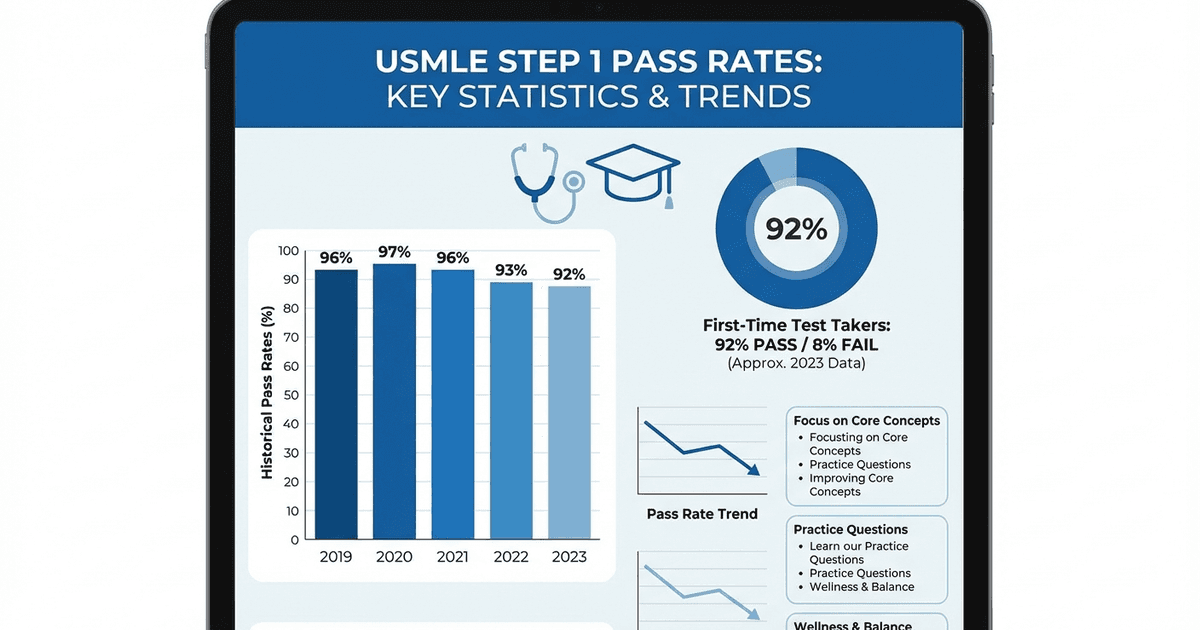
Here's what the 2026 USMLE Step 1 pass rate data actually shows — and more importantly, what it means for you. The overall first-attempt pass rate sits at 87%, but that number hides massive variations by school type, preparation time, and repeat attempts. US MD students pass at 96% on first attempt, while international medical graduates see 75% first-attempt success rates. The gap isnt about intelligence — it's about preparation strategy and resource access.
Since the pass/fail transition in 2022, one thing has become crystal clear: Step 1 rewards depth over breadth. The students who pass consistently are the ones who can explain mechanisms, not just memorize facts. And contrary to what anxiety-inducing forums suggest, these pass rates have remained remarkably stable year over year.
Let me break down exactly what the NBME data reveals about your realistic chances — and how to position yourself in that passing 87%.
Overall USMLE Step 1 Pass Rates in 2026
The headline number everyone obsesses over: 87% overall pass rate for first-time test takers in 2026. That means 13 out of every 100 students taking Step 1 for the first time will need to retake it.
But here's the nuance most people miss. This 87% includes every type of medical school, every level of preparation, every student who walked into Prometric thinking "I'll wing it" and every student who spent 6 months with a detailed study plan. When you dig into the school-specific data, your actual odds shift dramatically.
School Type | First-Attempt Pass Rate | Sample Size |
|---|---|---|
US MD Schools | 96% | ~22,000 |
US DO Schools | 91% | ~7,500 |
International Schools | 75% | ~15,000 |
Caribbean Schools | 68% | ~3,200 |
The 4% failure rate for US MD students tells a different story than the 25% failure rate for international students. It's not about capability — it's about preparation infrastructure. US MD students have built-in USMLE prep, standardized curricula aligned with Step 1 content, and peer networks sharing effective strategies. International students often piece together their own study plans without institutional support.
For repeat attempts, the numbers improve across all groups. Second-attempt pass rates jump to 89% overall, with US MD students reaching 98% and international students climbing to 82%. The exam itself doesnt get easier — students just know exactly where they fell short the first time.
What does this mean practically? If you are spending 4+ months with a structured plan, consistently scoring 65%+ on practice questions, your pass probability is much higher than that headline 87%. If you are cramming for 6 weeks hoping for the best, you are swimming upstream against those statistics. When students use tools like Synapses to identify their actual weak areas through spaced repetition, they stop wasting time on topics they already know and drill what they are actually forgetting — the difference between passing and failing often comes down to this efficiency.
Pass Rates by School Type: The Real Breakdown
The 21-point gap between US MD and international school pass rates isnt random. It reflects systematic differences in how students access high-yield content and practice questions.
US MD Schools: 96% First-Attempt Pass Rate
US MD students benefit from curricula designed around USMLE objectives. Their schools integrate Step 1 content throughout the first two years, offer dedicated prep periods, and provide institutional access to major question banks. More importantly, they have peer networks where study strategies spread organically.
The 4% who dont pass on first attempt typically fall into predictable categories: insufficient dedicated study time (less than 8 weeks), overconfidence leading to inadequate practice question volume, or major life disruptions during prep. Almost none fail due to content gaps — they know the material but struggle with question interpretation under time pressure.
US DO Schools: 91% First-Attempt Pass Rate
DO students face a unique challenge: preparing for both COMLEX and USMLE simultaneously. The 5-point gap from MD students reflects this split focus, not differences in academic preparation. DO students who commit early to USMLE-focused resources and treat Step 1 as their primary board exam perform nearly as well as their MD counterparts.
The key differentiator? DO students who pass consistently treat USMLE and COMLEX as distinct exams requiring different preparation strategies. They dont assume knowledge transfers seamlessly between the two.
International Medical Graduates: 75% First-Attempt Pass Rate
The 25% failure rate for international students reflects structural disadvantages, not intellectual ones. International students often lack access to high-quality question banks during medical school, receive less exposure to USMLE-style questions, and have limited peer networks sharing effective strategies.
However, international students who pass demonstrate remarkable consistency in their approach. They typically spend longer in dedicated study (12+ weeks vs 8-10 weeks for US students), use multiple question banks to ensure comprehensive coverage, and invest heavily in understanding US medical culture and terminology differences.
The repeat-attempt data is revealing here. International students who retake Step 1 pass at 82% — much closer to US student rates. They know the content; they just needed to learn the exam format and question style. Many use Rezzy to ask follow-up questions on complex topics like biochemistry mechanisms, ensuring they understand not just the fact but why it matters for diagnosis — the kind of active recall Step 1 actually tests.
Caribbean Medical Schools: 68% First-Attempt Pass Rate
Caribbean students face the steepest odds, with a 32% first-attempt failure rate. This largely reflects the wide variation in curriculum quality across Caribbean institutions and limited institutional support for USMLE preparation.
Caribbean students who pass tend to supplement their school's curriculum heavily with external resources from day one of medical school. They dont wait until dedicated study period to start USMLE-focused preparation.
First-Attempt vs Repeat Pass Rates
The jump from 87% first-attempt to 89% second-attempt pass rates might seem small, but it represents a fundamental shift in approach for students who retake.
What Changes on Repeat Attempts
Students who pass on their second attempt make three consistent adjustments:
1. Question volume increases dramatically. First-time takers average 2,500-3,000 practice questions. Repeat takers do 4,000-5,000 questions, ensuring they've seen every question type multiple times.
2. Active recall replaces passive reading. Instead of re-reading First Aid cover to cover, repeat takers focus on explaining mechanisms out loud and teaching concepts to others.
3. Weak area identification becomes precise. Failed students usually know their general weak subjects (biochemistry, anatomy) but cant pinpoint specific subtopics. Successful repeaters drill down to specific pathways, specific anatomical relations, specific drug mechanisms.
The Psychology of Repeat Attempts
Repeat takers approach the exam differently psychologically. They've already experienced the worst-case scenario — failing — and survived it. This removes much of the performance anxiety that derails first-time takers.
They also have concrete data about their performance. They know exactly which subjects hurt them, which question styles they struggled with, and which time management issues they faced. This specificity allows for targeted improvement rather than general studying.
Many repeat takers describe their second attempt as "easier" not because the content changed, but because they knew what to expect and had addressed their specific weak areas systematically.
Trends Since the Pass/Fail Switch in 2022
The 2022 transition from three-digit scoring to pass/fail fundamentally changed Step 1 preparation strategies, but the actual pass rates have remained remarkably stable.
What Changed After Pass/Fail
Pre-2022, students aimed for specific score targets (240+, 250+) and could predict their performance based on practice exam scores. Post-2022, the anxiety shifted to the binary pass/fail outcome, but the preparation didnt need to change as dramatically as students feared.
The biggest shift was psychological. Without score targets, students struggled to know when they were "ready." This led to both over-preparation (students studying for months longer than necessary) and under-preparation (students assuming pass/fail was "easier").
Pass Rates: 2022 vs 2026 Comparison
Year | Overall Pass Rate | US MD | US DO | International |
|---|---|---|---|---|
2022 | 86% | 95% | 90% | 74% |
2026 | 87% | 96% | 91% | 75% |
The 1-point improvement across all categories suggests the exam difficulty hasnt changed substantially. Students and institutions have adapted to the pass/fail format without major disruption to outcomes.
How Preparation Strategies Evolved
Post-2022, successful students shifted focus from score optimization to competency assurance. Instead of aiming for 270+ equivalent performance, they focus on consistent 70%+ practice question accuracy across all subjects.
This has led to more efficient study plans. Students spend less time on ultra-high-yield minutiae that might add 5 points to a score and more time ensuring they dont have glaring weak areas that could cause failure. Study schedules became more balanced across subjects rather than hyper-focused on high-yield topics.
Many students now use adaptive scheduling tools that adjust daily priorities based on performance data, ensuring no subject gets neglected while they chase marginal improvements in their strongest areas.
What These Numbers Really Mean for Your Preparation
Looking at pass rate data can either motivate you or paralyze you, depending on how you interpret it. Here's how to use these statistics constructively.
Your Personal Pass Probability
Your individual pass probability depends more on your preparation approach than your school type. A well-prepared international student with 4+ months of dedicated study and 4,000+ practice questions has higher pass odds than a US MD student cramming for 6 weeks.
Key predictive factors for passing:
Dedicated study time: 8+ weeks correlates with 95%+ pass rates
Practice question volume: 3,000+ questions with 70%+ accuracy
Assessment consistency: Scoring above passing threshold on multiple practice exams
Weak area remediation: Specific plans for subject areas scoring below 60%
How to Position Yourself in the Passing 87%
The students who consistently pass share common preparation habits:
1. They treat practice questions as learning tools, not just assessments. After every wrong answer, they understand not just why their choice was wrong but why the correct answer was right and what knowledge gap led to the error.
2. They maintain detailed weak area logs. Instead of vague "I'm bad at biochemistry," they track specific pathways, reactions, and disease mechanisms they consistently miss.
3. They simulate exam conditions regularly. They take full-length practice exams under timed conditions, not just random question sets during study breaks.
4. They prioritize understanding over memorization. They can explain why hypertrophic cardiomyopathy causes a systolic murmur that decreases with increased preload, not just memorize the association.
Red Flags That Predict Failure
Students who end up in the failing 13% typically show these warning signs during preparation:
Inconsistent practice exam scores that vary by more than 10 percentage points
Subject avoidance where they consistently skip or postpone difficult topics
Passive study habits like repeatedly reading notes without active recall
Unrealistic timelines trying to cover all of Step 1 content in less than 6 weeks
If you recognize these patterns, extend your study timeline and shift to active learning methods before your test date.
Breaking Down the Anxiety Around Pass Rates
The pass rate data triggers anxiety because students imagine themselves in the failing percentage without considering how those failures happen. Let me give you the realistic picture.
Who Actually Fails Step 1
The 13% who dont pass first attempt generally fall into these categories:
Underprepared students who significantly underestimated the required study time
Students with major life disruptions during their dedicated period (family emergencies, health issues, financial crises)
Chronic procrastinators who spent weeks "planning to study" instead of actually studying
Students with test-taking anxiety severe enough to impair performance despite adequate content knowledge
Very few well-prepared students with adequate study time and consistent practice scores fail Step 1. The exam is challenging but fair — it tests exactly what it says it tests.
Why Pass/Fail Anxiety Is Often Misplaced
Students worry about the binary nature of pass/fail, but this actually reduces pressure compared to the old scoring system. You dont need to be perfect; you need to be competent. You dont need to know every rare disease mechanism; you need to understand common pathways thoroughly.
The pass/fail format rewards consistent preparation across all subjects rather than exceptional performance in a few areas. A student who scores 65% across all subjects will pass, while a student who scores 85% in their strong subjects but 45% in weak areas will struggle.
This means your preparation should focus on identifying and addressing gaps rather than optimizing your strongest areas. Tools that surface your actual weak areas through spaced repetition become much more valuable than resources that promise to teach you "high-yield secrets."
Using Pass Rate Data Constructively
Instead of letting pass rates create anxiety, use them to calibrate your preparation intensity:
If you are US MD/DO: The high pass rates should give you confidence, but dont breed complacency. Stick to proven study methods and timelines.
If you are international: The lower pass rates reflect preparation challenges, not intellectual limitations. Plan for longer study periods and invest in high-quality question banks early.
If you are retaking: The improved second-attempt rates show that targeted preparation works. Focus on your specific weak areas rather than general review.
Remember, these are population statistics. Your individual outcome depends on your specific preparation, not your demographic category.
Strategic Insights for Different Student Types
Your optimal preparation strategy should account for both the general pass rate data and your specific circumstances.
US MD Students: Avoiding Overconfidence
With 96% pass rates, the biggest risk for US MD students is complacency. The 4% who fail typically underestimate the exam or shorten their dedicated period too aggressively.
Key strategies:
Maintain standard study timelines even though your school suggests shorter periods
Take practice exams seriously — dont dismiss low scores as "just practice"
Address weak subjects early rather than assuming they'll improve naturally
US MD students often have access to institutional resources but may not use them strategically. They might have UWorld through their school but not supplement it with additional question banks for comprehensive coverage.
US DO Students: Managing Split Focus
DO students need to decide early whether they're pursuing USMLE, COMLEX, or both. Those pursuing both should allocate 70% of effort to their primary board exam rather than trying to split evenly.
Key strategies:
Choose your primary exam early in second year, not during dedicated study
Use USMLE-specific resources if Step 1 is your priority — dont rely solely on COMLEX materials
Network with successful DO students who've passed both exams for strategy insights
International Students: Systematic Preparation
With 75% pass rates, international students need systematic approaches that address both content gaps and cultural/language barriers.
Key strategies:
Start USMLE prep during medical school, not just during dedicated period
Invest in high-quality question banks early to understand US-style question formats
Join online study groups with US students to learn cultural context for questions
International students often excel at memorizing content but struggle with the clinical reasoning style of US questions. Practice questions should focus on understanding why answers are right/wrong, not just getting the answer correct.
Repeat Test-Takers: Precision Targeting
Students retaking Step 1 have one major advantage: specific data about their weaknesses. Use this precisely.
Key strategies:
Analyze your score report meticulously to identify not just weak subjects but weak subtopics
Increase question volume significantly — aim for 5,000+ questions if you did 3,000 previously
Change your study methods — if you failed with passive reading, switch to active recall
Many repeat takers make the mistake of studying everything again instead of focusing on their specific gaps. Your second attempt should be laser-focused on your documented weak areas.
Frequently Asked Questions
What is the current USMLE Step 1 first attempt pass rate?
The 2026 USMLE Step 1 first attempt pass rate is 87% overall, with significant variation by school type: US MD students pass at 96%, US DO students at 91%, and international medical graduates at 75%.
How have Step 1 pass rates changed since pass/fail in 2022?
Pass rates have remained remarkably stable since the 2022 pass/fail transition. The overall pass rate has improved slightly from 86% in 2022 to 87% in 2026, with similar small improvements across all school types.
What are the repeat attempt pass rates for Step 1?
Second attempt pass rates are 89% overall, representing a 2-point improvement from first attempts. US MD students reach 98% on second attempts, while international students improve to 82%.
Why do international students have lower Step 1 pass rates?
The lower pass rates for international students (75% vs 96% for US MD) reflect structural challenges including limited access to US-style question banks during medical school, less exposure to American medical culture and terminology, and lack of institutional USMLE preparation support.
How long should I study for Step 1 to have the best pass odds?
Students with 8+ weeks of dedicated study time show 95%+ pass rates across all school types. Shorter study periods (6 weeks or less) correlate with higher failure rates, while longer periods (12+ weeks) show diminishing returns for most students.
What practice question accuracy predicts Step 1 success?
Consistent accuracy of 70%+ across multiple question banks and practice exams strongly predicts passing. Students scoring below 60% on practice questions should extend their study period and focus on weak area remediation before their test date.
---
The USMLE Step 1 pass rate data shows that well-prepared students consistently succeed, regardless of their background. Your school type influences your starting point, but your preparation approach determines your outcome. Focus on systematic weak area identification, adequate practice question volume, and active learning methods.
Prepare smarter with Oncourse AI — adaptive MCQs, spaced repetition, and AI explanations built for USMLE Step 1. Download free on Android and iOS.