Back
UKMLA 2026: Build an Adaptive AKT and CPSA Prep Plan with Oncourse AI
Build a data-driven UKMLA 2026 study plan that adapts to your weak areas. Learn how to connect AKT knowledge with CPSA performance, turn missed questions into targeted revision, and create a 12-week adaptive preparation strategy.

UKMLA 2026: Build an Adaptive AKT and CPSA Prep Plan with Oncourse AI
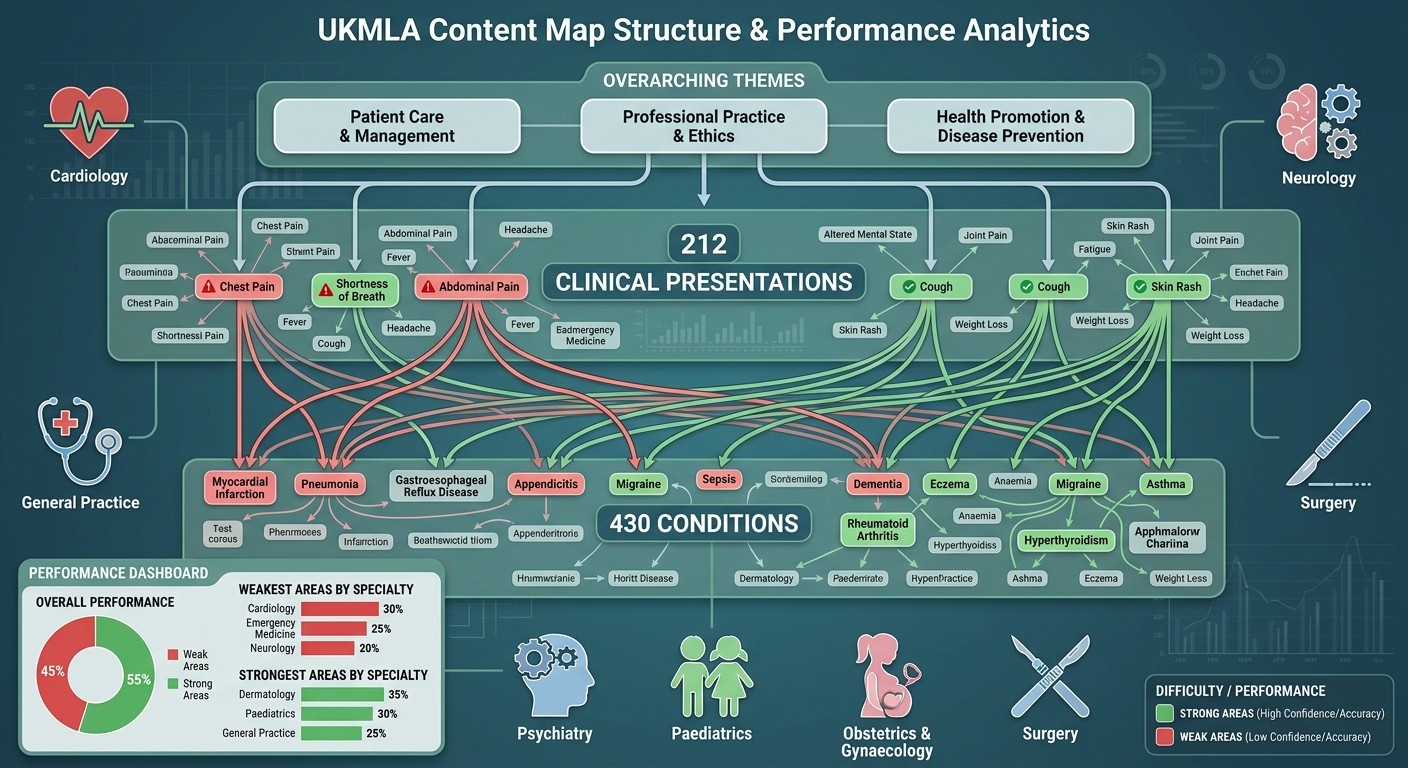
You are staring at 430 conditions and 212 clinical presentations. The UKMLA content map for 2026 sits open on your laptop, and the sheer volume feels overwhelming. Where do you even start?
Traditional study plans treat every topic equally, but your brain doesnt work that way. You might nail acute coronary syndromes but struggle with endocrine emergencies. A static 12-week schedule cant adapt when you discover these gaps. That is where adaptive planning changes everything.
This guide walks you through building a dynamic UKMLA 2026 prep plan that adjusts based on your actual performance data, not generic timelines. We will cover how AKT knowledge connects to CPSA performance, how to turn missed questions into targeted study sessions, and how to balance timed practice with clinical reasoning skills.
What UKMLA 2026 Candidates Need to Plan For
The 2026 UKMLA represents the most significant shift in UK medical licensing since finals were introduced. Both UK graduates and international medical graduates now face the same content map, the same question bank, and the same pass thresholds.
AKT Structure for 2026
180 single-best-answer questions across two papers (90 each)
3 hours total (roughly 60 seconds per question)
430 core conditions can appear in any specialty context
212 clinical presentations form the backbone of every case vignette
Pass threshold: typically 53-60% depending on the sitting
CPSA Evolution for 2026
OSCE-style stations testing history-taking, examination, and communication
Professional capabilities: ethics, uncertainty management, escalation
UK-specific guidelines: NICE, BNF, and GMC Good Medical Practice integration
Standardized marking: same rubrics whether you are UK-trained or IMG
The content expansion from 311 to 430 conditions means more ground to cover, but it also means more predictable patterns. Every question now maps clearly to the GMC content blueprint.
How AKT and CPSA Demands Differ (And Why It Matters)
Most candidates prep for AKT and CPSA separately, but this misses a crucial point: they test the same clinical reasoning from different angles.
AKT Tests Recognition Speed
You read a 4-line vignette about chest pain, shortness of breath, and a raised D-dimer. Your brain needs to instantly pattern-match to pulmonary embolism and select the best next investigation. Speed matters more than depth.
CPSA Tests Applied Performance
You face a standardized patient with the same presentation. Now you need to take a structured history, perform focused examination, explain your reasoning, and communicate next steps clearly. Depth matters more than speed.
The connection: if you cant recognize pulmonary embolism quickly in AKT format, you definitely cant manage it smoothly in a CPSA station. AKT knowledge forms the foundation that CPSA skills build upon.
This is why adaptive planning works better than sequential preparation. When Oncourse AI Daily Plan identifies weak areas in your AKT practice, it should immediately influence your CPSA station priorities for that week.
Building Your Baseline Diagnostic Week
Before any adaptive system can help you, it needs data about your current knowledge gaps. Week 1 is entirely diagnostic.
Day 1-2: Content Map Audit
Download the official GMC UKMLA content map and spend 90 minutes reading it cover to cover. Focus on:
How presentations link to multiple conditions
Which conditions appear across multiple specialties
The three overarching themes that underpin everything
Day 3-4: Mixed Practice Baseline
Take a 90-question mixed practice test covering all domains. Dont review explanations yet. Just note:
Overall accuracy percentage
Time per question average
Which specialties felt most uncomfortable
Day 5-7: Domain-Specific Confidence Scoring
Rate yourself 0-5 in each clinical domain:
Medicine (cardiology, respiratory, gastroenterology, etc.)
Surgery (general surgery, orthopaedics, urology, etc.)
Paediatrics (general paediatrics, neonatology)
Obstetrics & Gynaecology
Psychiatry (adult, child, substance misuse)
Primary Care (prevention, chronic disease management)
Professional Knowledge (ethics, law, patient safety)
Your three lowest-scoring domains become priority subjects. Your two highest-scoring domains get maintenance-level attention.
How to Split Study Across Clinical Domains
Once you have identified your weak areas, the temptation is to spend all your time there. This backfires because memory decay hits your strong subjects while you are away from them.
The 70/30 Rule
70% of daily study time on your three weakest domains
30% of daily study time rotating through maintenance topics
Domain-Specific Study Approaches
Clinical Presentations (Start Here)
Every AKT question begins with a presentation. Master the differential diagnosis for chest pain, breathlessness, abdominal pain, headache, and altered consciousness. These five presentations appear in 40% of all questions.
Investigations (High-Yield ROI)
Learn the investigative pathway for each presentation, not just the final diagnosis. When do you order troponin vs D-dimer vs CT pulmonary angiogram? The AKT tests decision-making, not just knowledge.
Management (CPSA Connection)
Management questions bridge AKT knowledge to CPSA performance. If you know that acute heart failure requires IV furosemide, you can confidently prescribe it in a CPSA station and explain the mechanism to a patient.
Prescribing & Safety (Never Skip)
Drug interactions, contraindications, and monitoring requirements are heavily weighted in 2026. The BNF integration means specific dosing questions are fair game.
Ethics & Communication (CPSA-Heavy)
These domains appear more in CPSA than AKT, but when they do appear in AKT, they are often high-scoring questions. Capacity, consent, confidentiality, and safeguarding are non-negotiable.
UK Guideline Awareness (New Emphasis)
NICE Clinical Knowledge Summaries, GMC guidance, and updated sepsis protocols are explicitly tested in 2026. Bookmark and cross-reference during question practice.
Turning Missed Questions Into Weak-Area Priorities
This is where most traditional study plans fail. You miss a question about diabetic ketoacidosis, read the explanation, and move on. But that missed question contains multiple learning opportunities.
The 3-Layer Analysis System
Layer 1: What Went Wrong?
Did you misread the clinical presentation?
Did you miss a key investigation result?
Did you forget the management pathway?
Was it a knowledge gap or a silly mistake?
Layer 2: What Else Could This Be?
What other conditions present similarly?
What investigations would rule them out?
How would management differ for each differential?
Layer 3: Where Else Does This Appear?
What other clinical presentations could this condition cause?
Which other specialties might test this knowledge?
How would this appear in a CPSA station?
The Performance Analytics dashboard tracks these patterns automatically. Instead of just marking questions right or wrong, it identifies recurring weak spots across presentations and conditions.
Using Daily Plans That Actually Adapt
Static study schedules assume linear progress, but learning doesnt work that way. Some days you will nail cardiology questions and struggle with psychiatry. Some weeks you will improve rapidly in surgery and plateau in medicine.
How Adaptive Daily Planning Works
Morning Assessment (10 minutes)
Start each day with 10 mixed questions spanning your current weak areas. This diagnostic mini-session determines what you actually need to work on today, not what the calendar says.
Targeted Study Blocks (2-3 hours)
Based on the morning assessment, focus your main study time on the domains where you struggled most. If you missed questions about heart failure, spend the morning on cardiovascular medicine.
Evening Reinforcement (30 minutes)
End with 10 more questions targeting the same weak areas you studied during the day. This spaced repetition on the same day helps consolidate new learning.
Weekly Adaptation
Every Sunday, the system recalibrates based on the week's performance data. Domains that improved get less attention. Domains that remained weak get more focus.
This is exactly how Oncourse AI Daily Plan adjusts your study schedule automatically, turning performance data into actionable daily tasks.
Balancing Timed MCQ Blocks with CPSA Practice
The biggest mistake UKMLA candidates make is treating AKT prep and CPSA prep as completely separate activities. In reality, they are complementary and should be practiced together.
The Integrated Practice Method
Monday/Wednesday/Friday: AKT-Heavy Days
90 minutes of timed SBA practice
60 minutes reviewing explanations and making notes
30 minutes of CPSA station practice on the same clinical domains
Tuesday/Thursday: CPSA-Heavy Days
60 minutes of history-taking and examination practice
45 minutes of communication and ethics scenarios
30 minutes of related AKT questions for the same presentations
Weekend: Mixed Mock Sessions
Saturday: Full 90-question AKT mock with detailed review
Sunday: 6-station CPSA circuit covering the week's weak areas
Why This Integration Works
When you practice diabetic ketoacidosis questions in AKT format, you are priming your brain for pattern recognition. When you immediately practice taking a DKA history in CPSA format, you are applying that knowledge in a clinical context.
The cognitive load of switching between formats actually strengthens your understanding. You cant coast on memorized facts when you need to explain the same condition to a standardized patient.
Your 12-Week Adaptive Study Framework
Here is how to structure 12 weeks of adaptive preparation that adjusts based on your actual performance, not arbitrary timelines.
Weeks 1-4: Foundation and Gap Identification
Week 1: Diagnostic baseline across all domains Week 2-4: Systematic domain coverage with weak-area emphasis Daily Structure:
Morning: 15 mixed questions (diagnostic)
Main study: 2 hours on weakest domain from morning assessment
Evening: 15 questions targeting the same domain
Weekly Targets:
400 practice questions total
6 hours of CPSA station practice
Complete review of 2 major clinical domains
Weeks 5-8: Application and Pattern Recognition
Focus: Timed practice and clinical reasoning development Daily Structure:
Morning: 20 mixed questions (timed)
Main study: 90 minutes targeted revision + 90 minutes new content
Evening: 10 questions from the day's weak areas
Weekly Targets:
500 practice questions total
8 hours of CPSA practice with mock scenarios
Master 50 highest-yield clinical presentations
The Oncourse AI Question Bank uses spaced repetition to surface missed concepts at optimal intervals during this phase, ensuring weak areas get repeated exposure without overwhelming your schedule.
Weeks 9-12: Performance and Exam Technique
Focus: Full mocks and final consolidation Daily Structure:
Morning: Full-length mock every 3 days
Main study: Targeted review of mock mistakes
Evening: CPSA station practice related to mock weak spots
Weekly Targets:
2 full AKT mocks with detailed analysis
1 complete CPSA circuit (8 stations)
Eliminate remaining knowledge gaps in priority domains
Week 12: Taper and Final Review
The final week should be lighter, not heavier. Review your highest-yield weak areas and practice exam technique, but avoid learning new content.
Final 30-Day Review Strategy
The last month isnt about cramming new information. It is about consolidating what you have learned and sharpening exam technique.
Days 30-21: Consolidation Phase
Daily 45-question mixed mocks
Target review of persistent weak areas
2 CPSA stations daily focusing on communication skills
Days 20-11: Performance Phase
Full-length AKT mocks every other day
Complete CPSA circuits twice weekly
Stress-test your knowledge under timed conditions
Days 10-1: Maintenance Phase
Light review of highest-yield topics
1 final mock to confirm readiness
Focus on sleep, nutrition, and exam logistics
Exam Week
No new content
Light review of your personalized weak-area summaries
Practice relaxation techniques for exam anxiety
Common Planning Mistakes to Avoid
Mistake 1: Treating All Topics Equally
The content map includes 430 conditions, but they are not equally likely to appear. Acute presentations (chest pain, shortness of breath, altered consciousness) are heavily weighted. Rare genetic conditions appear much less frequently.
Mistake 2: Sequential Subject Study
Spending two weeks only on cardiology, then two weeks only on respiratory medicine leads to massive forgetting. Mixed daily practice with weak-area emphasis works better.
Mistake 3: Ignoring Performance Data
Many candidates know they struggle with psychiatry but keep spending equal time on all subjects. Use your practice question analytics to guide time allocation, not arbitrary balance.
Mistake 4: AKT/CPSA Segregation
Preparing for these components in isolation misses the synergy between knowledge application and clinical performance. Integrate your practice.
Mistake 5: Static Planning
A 12-week schedule that doesnt adjust based on your actual learning progress will waste time on concepts you have mastered while neglecting persistent weaknesses.
Practical Guidance for Different Pathways
For PLAB-Route Candidates
You have additional challenges around UK healthcare system familiarity and communication style adaptation. Spend extra time on:
NHS referral pathways
UK-specific drug names and protocols
Communication scenarios with British patients
GMC ethical frameworks vs home country approaches
For UK Medical School Candidates
Your advantage is healthcare system familiarity, but dont underestimate the breadth of the content map. Focus on:
Presentations outside your recent placement experience
Conditions you havent seen clinically yet
Professional scenarios beyond student-level encounters
Converting academic knowledge to applied decision-making
Frequently Asked Questions
How long should I study each day for UKMLA 2026?
For most candidates, 4-5 hours of focused study daily is optimal. This breaks down to 3 hours of AKT preparation and 1-2 hours of CPSA practice. Quality matters more than quantity - focused, adaptive study is more effective than grinding through random questions.
When should I start CPSA preparation?
Start CPSA practice from Week 1, not after passing the AKT. Even basic history-taking and examination practice reinforces your AKT knowledge by applying it in clinical contexts. Aim for 30 minutes of CPSA practice daily throughout your preparation.
How many practice questions should I complete?
Target 2,500-3,000 practice questions over 12 weeks, with 70% focused on your identified weak areas. This breaks down to roughly 30-40 questions daily, with detailed review of explanations and pattern analysis.
What if I am consistently weak in multiple domains?
This is common and why adaptive planning matters. Focus on your bottom 3 domains first, spending 70% of your time there. As these improve, gradually shift attention to the next weakest areas. Dont try to fix everything simultaneously.
How do I know if my study plan is working?
Track four metrics weekly: overall accuracy percentage, time per question average, consistency across domains, and confidence in weak areas. If these metrics improve steadily over 2-3 weeks, your plan is effective. If not, increase focus on your weakest areas.
Should I use multiple question banks or focus on one?
Use one primary question bank that offers detailed analytics and adaptive features, supplemented by official GMC practice materials. Multiple databases can dilute your progress tracking and make weak-area identification less reliable.
---
Prepare smarter with Oncourse AI — adaptive MCQs, spaced repetition, and AI explanations built for UKMLA. Download free on Android and iOS.