Back
FMGE High Yield Topics 2026: Turn High-Yield Subjects Into Daily Adaptive Practice
Master FMGE 2026 with subject-wise high-yield topics, adaptive practice strategies, and daily workflows. Learn which topics carry maximum weightage and how to turn weak areas into strengths.

FMGE High Yield Topics 2026: Turn High-Yield Subjects Into Daily Adaptive Practice
You are probably staring at a 300-question FMGE syllabus thinking "where do I even start?" Here's the reality: FMGE has 300 questions. You have roughly 60 seconds per question. Half the students who attempt this exam dont make the 150-mark passing threshold.
The difference between passing and failing isnt studying more hours. Its studying the right topics with the right intensity. FMGE follows clear patterns — some subjects carry 33 questions while others carry just 5. Some topics repeat every single exam cycle while others havent appeared in years.
This guide breaks down exactly which FMGE topics deserve your time in 2026, how to identify your personal weak areas through question practice, and most importantly — how to convert this knowledge into a daily adaptive practice system that fixes your gaps instead of reinforcing what you already know.
Always verify the latest FMGE syllabus, eligibility criteria, and exam dates from the official NBE/NMC bulletin before finalizing your preparation strategy.
What Makes a Topic "High-Yield" for FMGE 2026
High-yield doesnt mean "important for medicine." It means "frequently tested on FMGE with predictable question patterns."
FMGE follows NBE's clear subject weightage. General Medicine carries approximately 33 questions. Psychiatry carries 5. That's not a value judgment — thats math. If you spend equal time on both subjects, you are mathematically disadvantaging yourself.
High-yield topics share three characteristics:
Repeatability: They appear consistently across exam cycles with minor variations in presentation Clinical relevance: They connect basic science concepts to real patient scenarios NBE preference: They fit NBE's question-writing style and difficulty level
For example, diabetes management in General Medicine appears in multiple forms — diagnosis, complications, drug mechanisms, and patient counseling scenarios. Meanwhile, rare genetic syndromes might be medically fascinating but rarely make it past NBE's question selection process.
Subject-Wise FMGE Priority for 2026
Here's how to allocate your study time based on actual question distribution:
Tier 1: Maximum Impact Subjects (30+ Questions Each)
General Medicine (33 questions)
Diabetes mellitus: diagnosis, complications, management protocols
Hypertension: classification, target organ damage, drug selection
Myocardial infarction: ECG interpretation, acute management
Tuberculosis: diagnosis, treatment protocols, drug resistance
Stroke: types, acute management, rehabilitation
COPD: staging, pharmacological management
Thyroid disorders: hypo/hyperthyroidism, thyroid function tests
General Surgery (32 questions)
Hernias: types, surgical indications, complications
Appendicitis: clinical presentation, imaging, management
Thyroid surgery: indications, complications, post-op care
Gallbladder disease: cholelithiasis, cholangitis, surgical timing
Burns: classification, fluid resuscitation, wound management
Trauma: ATLS protocols, hemorrhage control
Wound healing: phases, factors affecting healing
Obstetrics & Gynecology (30 questions)
Antenatal care: routine investigations, high-risk identification
Eclampsia and pre-eclampsia: diagnosis, management protocols
Contraception: methods, contraindications, counseling
Menstrual disorders: causes, investigations, management
Cervical cancer: screening, staging, treatment approaches
Labor management: normal and complicated deliveries
Postpartum hemorrhage: causes, management algorithms
Tier 2: Moderate Weight Subjects (15-17 Questions Each)
Anatomy (17 questions)
Brachial plexus: formation, branches, clinical correlations
Cranial nerves: pathways, functions, clinical testing
Embryology: cardiac, CNS, GIT development milestones
Histology: liver, kidney, respiratory system microanatomy
Brain blood supply: arterial territories, stroke correlations
Physiology (17 questions)
Cardiac cycle: pressure-volume loops, murmurs, ECG correlation
Acid-base balance: compensation mechanisms, clinical interpretation
Renal physiology: GFR, tubular functions, clinical correlations
GIT hormones: secretion, actions, clinical significance
Reflexes: types, pathways, clinical examination
Biochemistry (17 questions)
Vitamins: deficiency syndromes, biochemical functions
Enzymes: clinical significance, diagnostic applications
Metabolism: carbohydrate, protein, lipid pathways
DNA replication: mechanisms, clinical correlations
Liver function tests: interpretation, clinical significance
When practicing with FMGE biochemistry questions, pay attention to enzyme-disease correlations that frequently appear in clinical vignettes.
Tier 3: Focused High-Yield Subjects (13-15 Questions Each)
Pathology (13 questions)
Inflammation: acute vs chronic, mediators, resolution
Neoplasia: benign vs malignant characteristics, staging
Blood disorders: anemia classification, leukemias, coagulation
Glomerulonephritis: types, presentation, prognosis
Cellular injury: mechanisms, morphological changes
Microbiology (13 questions)
Immunology: hypersensitivity reactions, vaccines, immunity types
Tuberculosis: diagnosis, drug resistance, contact management
HIV: stages, opportunistic infections, antiretroviral therapy
Malaria: species, diagnosis, treatment protocols
Laboratory diagnosis: culture methods, antimicrobial sensitivity
Pharmacology (13 questions)
Autonomic drugs: receptor selectivity, clinical applications
Antimicrobials: mechanisms, resistance, clinical selection
Anti-tuberculosis drugs: mechanisms, side effects, monitoring
Chemotherapy: mechanisms, toxicity profiles, monitoring
Antihypertensives: classes, mechanisms, contraindications
The FMGE pharmacology lessons cover drug mechanisms with clinical correlation — essential for understanding why specific drugs are chosen in different scenarios.
Tier 4: Selective Focus Subjects (5-15 Questions Each)
Community Medicine (30 questions) — Despite lower individual question weight, this subject has high collective impact
National Immunization Schedule: vaccines, timing, contraindications
Epidemiology: study designs, measures of association, screening
Health indicators: calculation, interpretation, international comparisons
National health programs: objectives, implementation, evaluation
Biomedical waste management: categories, disposal methods
Pediatrics (15 questions)
Growth and development: milestones, assessment, deviations
Immunization: schedule, contraindications, adverse effects
Neonatal care: resuscitation, feeding, common problems
Malnutrition: assessment, management, prevention
Common pediatric infections: diagnosis, treatment, prevention
Smaller subjects like Dermatology, Psychiatry, Anesthesia, and Orthopedics carry 5 questions each. Focus on the most commonly tested conditions rather than trying to master entire subjects.
Converting High-Yield Lists Into Personal Weak Areas
Having a topic list isnt the same as having a study plan. Your weak areas arent the same as your friends weak areas. The only way to identify genuine gaps is through systematic question practice.
Here's how to map your actual weaknesses:
Phase 1: Initial Assessment (Week 1)
Take 3-4 mixed subject tests of 50 questions each across different sessions. Dont review answers immediately — complete all tests first to avoid pattern recognition bias.
Phase 2: Gap Analysis (Week 1-2)
Review your performance by subject and topic. Look for patterns:
Which subjects consistently score below 60%?
Which clinical scenarios do you repeatedly miss?
What types of questions trip you up? (mechanism-based, diagnostic, management)
When using Oncourse's adaptive practice system, your missed questions automatically generate targeted explanations that show you exactly why each option is right or wrong — turning every mistake into a learning opportunity rather than just a score reduction.
Phase 3: Weakness Mapping (Week 2)
Create three priority categories:
Red zones: Subjects scoring below 50% (immediate intervention needed)
Yellow zones: Subjects scoring 50-70% (systematic improvement required)
Green zones: Subjects scoring above 70% (maintenance level practice)
Phase 4: Pattern Recognition (Ongoing)
Track which specific sub-topics within subjects cause problems. For example, you might score well in Cardiology overall but consistently miss ECG interpretation questions or drug mechanism queries.
Daily Adaptive Practice Workflow
Static timetables dont account for your changing strengths and weaknesses. An adaptive approach adjusts your daily practice based on real performance data.
Morning Session: Weak Area Focus (45-60 minutes)
Start each day with 25-30 questions targeting your current red and yellow zones. The key is intelligent question selection — not random practice.
Week 1-2: Focus 70% of questions on red zone subjects, 30% on yellow zones Week 3-4: Shift to 50% red zones, 40% yellow zones, 10% green zone maintenance Week 5+: Balance based on improvement patterns
Use performance analytics to track which topics are genuinely improving versus which ones remain stuck. Oncourse's weak-area dashboard converts your practice history into a visual map showing exactly which subjects and systems need attention, so you spend time fixing gaps instead of practicing topics you already know.
Evening Session: Mixed Practice + Review (45-60 minutes)
Questions (20-25 minutes): Take a 20-question mixed test covering all subjects in proportion to FMGE weightage Review (25-35 minutes): Deep-dive into explanations, especially for questions you got right but werent confident about
This combination prevents tunnel vision while maintaining focused improvement on weak areas.
Weekly Recalibration
Every Sunday, analyze the week's performance:
Which red zones moved to yellow?
Which yellow zones are ready for green status?
What new weak spots emerged from mixed practice?
Adjust next week's focus accordingly. This prevents you from over-practicing topics that have already improved while neglecting persistent weak areas.
Final 30-Day High-Yield Workflow
Your last month should shift from learning to consolidation and pattern mastery:
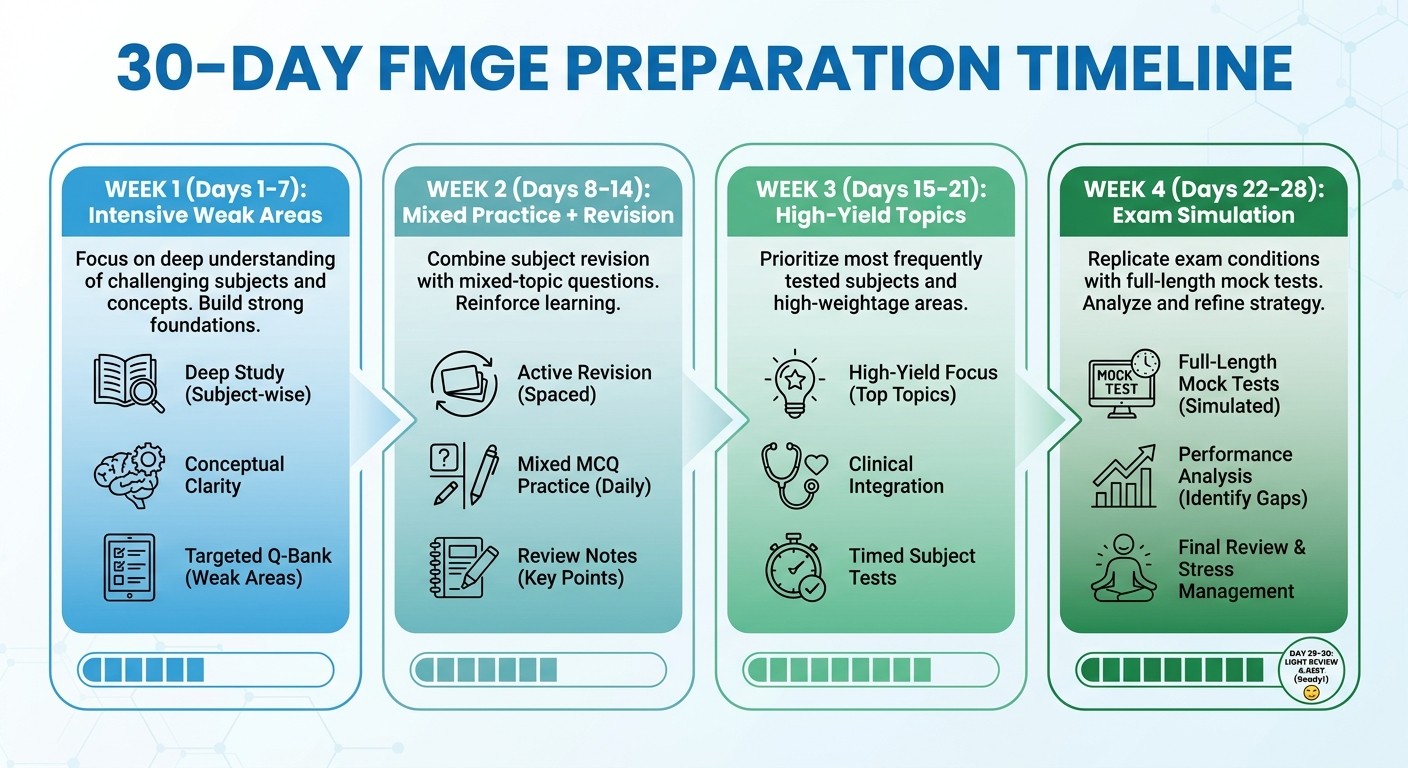
Days 1-7: Intensive Weak Area Correction
80% practice time on remaining red zones
Deep explanatory review for every missed question
Create quick reference notes for persistent confusion areas
Days 8-14: High-Yield Topic Mastery
Focus exclusively on Tier 1 and Tier 2 subjects
Practice clinical correlation questions
Memorize high-frequency facts and formulas
Days 15-21: Integration and Mixed Practice
Full-length 300-question practice tests
Timed sections to build exam endurance
Review answer patterns and time management
Days 22-30: Exam Simulation and Maintenance
Daily 150-question practice sessions matching actual exam timing
Light revision of formulaic facts
Avoid learning new topics — focus on recall speed
Throughout this period, Oncourse's adaptive daily plans automatically adjust your study queue based on performance data, ensuring you practice the topics that need the most work rather than following a rigid schedule that might not match your actual progress.
Frequently Asked Questions
How many hours should I study FMGE high-yield topics daily?
Quality beats quantity. 4-5 focused hours with systematic weak area targeting often outperforms 8+ hours of unfocused studying. Allocate 2-3 hours for active practice and 2 hours for review and consolidation.
Should I study all subjects equally for FMGE?
No. Allocate study time proportional to question weightage. General Medicine (33 questions) deserves more time than Psychiatry (5 questions). However, dont completely ignore low-weight subjects — even 3-4 correct answers can make the difference between passing and failing.
How long before FMGE should I start high-yield topic practice?
Start identifying high-yield topics immediately, but shift to intensive high-yield focus 8-12 weeks before your exam. Earlier preparation should build foundational knowledge across all subjects.
Can I pass FMGE by studying only high-yield topics?
High-yield topics increase your probability of reaching 150/300, but they dont guarantee it. You need adequate coverage of medium-yield topics and basic competency across all subjects tested.
How do I know if my weak area improvement is real or temporary?
Test weak areas in different contexts. If you improve at Cardiology questions when practicing Cardiology in isolation but still miss cardiac questions in mixed tests, your improvement might not be durable. Mixed practice reveals genuine competency.
What if I dont have time to cover all high-yield topics?
Prioritize Tier 1 subjects first, then selectively cover Tier 2 topics based on your baseline performance. Its better to master fewer topics completely than to poorly understand everything.
Prepare smarter with Oncourse AI — adaptive MCQs, spaced repetition, and AI explanations built for FMGE success. Download free on Android and iOS.