Back
INICET High-Yield Topics 2026: Let Oncourse AI Turn Weak Areas Into Daily Practice
Master INICET 2026 with adaptive daily practice that converts weak areas into strengths. Complete subject-wise high-yield topics, practice strategies, and analytics-driven improvement plans.

INICET High-Yield Topics 2026: Let Oncourse AI Turn Weak Areas Into Daily Practice
You're staring at your INICET 2026 prep plan. You have high-yield topic lists from 5 different sources. Medicine, Surgery, OBG — all mapped out perfectly. Yet your mock scores aren't budging.
Here's what no one tells you: static high-yield lists are useless. The real game-changer? Converting your weak areas into targeted daily practice that adapts as you improve.
INICET 2026 has 200 questions in 180 minutes. That's 54 seconds per question across 19 subjects. With 815 seats at stake, every mark counts. The students who crack INICET dont just study high-yield topics — they turn their weakest areas into their strongest through systematic daily practice.
Always verify the latest official INICET bulletin for eligibility, dates, pattern, and syllabus changes.
What High-Yield Topics Actually Mean for INICET 2026
High-yield doesnt mean "most important topics." It means topics with the highest question density per hour studied.
For INICET, high-yield breaks into three buckets:
Clinical Heavyweights (60% of paper): Medicine, Surgery, OBG, Pediatrics. These subjects dominate question count. Missing basics here costs you ranks directly. Para-Clinical Foundations (25% of paper): Pathology, Pharmacology, Microbiology, PSM. These integrate with clinical subjects. Weak foundations here make clinical questions unsolvable. Pre-Clinical Essentials (15% of paper): Anatomy, Physiology, Biochemistry. Lower question count but often decide between two close options.
But here's the catch: your high-yield topics are different from your friend's. If you're weak in Pharmacology MOA but strong in Surgery, your high-yield priority becomes drug mechanisms, not fracture classifications.
Why Static Topic Lists Fail (And What Works Instead)
Traditional high-yield lists assume everyone has the same knowledge gaps. They dont.
Student A struggles with ECG interpretation but aces Anatomy. Student B knows every nerve pathway but cant differentiate heart failure drugs. Both need completely different daily practice routines.
The Dynamic Approach That Actually Works:
1. Diagnostic Phase: Identify your specific weak areas through structured practice
2. Adaptive Practice: Convert weak areas into daily question sessions
3. Progressive Tracking: Monitor improvement and shift focus as areas strengthen
4. Strategic Review: Prioritize repeated mistakes over comfortable subjects
This approach ensures you're not practicing what you already know while ignoring what's costing you marks.
The Three Types of Topics You Need to Track
Not all weak areas are created equal. INICET preparation requires tracking three distinct categories:
High-Yield Topics
Subjects that appear frequently across multiple INICET papers. These include ACS protocols in Medicine, trauma management in Surgery, and drug MOAs in Pharmacology. High question density makes them worth intensive focus.
Weak Areas
Your personal knowledge gaps identified through mock tests and practice sessions. These might be low-yield globally but high-impact for your score. A single student might struggle with Anatomy embryology while excelling at Pathology.
Recently-Forgotten Topics
Subjects you studied months ago but haven't revised. These create false confidence in mocks — you remember the concept but cant recall specifics under time pressure.
The key insight: your daily practice must balance all three, not just chase generic high-yield lists.
Subject-Wise High-Yield Buckets Across All INICET Topics
Based on question analysis from recent INICET papers, here's the strategic breakdown:
Clinical Subjects (Prioritize These First)
Medicine (30-35 questions):
Cardiology: ACS, heart failure, arrhythmias, ECG interpretation
Pulmonology: COPD, asthma, pneumonia protocols
Gastroenterology: IBD, hepatitis, GI bleeding management
Endocrinology: DM complications, thyroid disorders
Nephrology: AKI/CKD staging, electrolyte disorders
Surgery (25-30 questions):
General Surgery: Acute abdomen, appendicitis, hernias
Trauma: ATLS protocols, head injury management
GI Surgery: Bowel obstruction, perforation management
Orthopedics: Fracture classifications, joint disorders
Urology: Stone disease, BPH, UTI management
Obstetrics & Gynecology (20-25 questions):
Obstetrics: APH, PPH, preeclampsia management
Gynecology: Menstrual disorders, contraception
Reproductive endocrinology: PCOS, infertility basics
Pediatrics (15-20 questions):
Neonatology: Birth asphyxia, neonatal jaundice
Growth & development: Milestones, nutrition
Pediatric emergencies: Seizures, dehydration
Para-Clinical Foundations
Pathology (15-20 questions):
Cell injury and adaptation mechanisms
Inflammation and healing processes
Neoplasia: classification and staging
Hematopathology: anemia types, bleeding disorders
Pharmacology (15-20 questions):
Drug mechanisms by system
Side effects and contraindications
Drug interactions and toxicology
Clinical pharmacology applications
Microbiology (10-15 questions):
Common bacterial pathogens
Viral infections and vaccines
Antifungal and antiviral agents
Hospital-acquired infections
Pre-Clinical Essentials
Anatomy (10-15 questions):
Neuroanatomy: cranial nerves, brain stem
MSK anatomy: joint mechanics, nerve supplies
Embryology: congenital malformations
Physiology (8-12 questions):
Cardiovascular physiology
Respiratory mechanics
Renal function and regulation
Biochemistry (6-10 questions):
Metabolic pathways integration
Clinical correlations of enzyme defects
Protein structure and function
Lower-Yield But Scoring Subjects
PSM (8-12 questions): Epidemiology, biostatistics, national health programs Forensic Medicine (6-8 questions): IPC sections, autopsy findings Ophthalmology (6-8 questions): Common eye conditions, refractive errors ENT (6-8 questions): CSOM, hearing loss, vertigo Dermatology (6-8 questions): Common skin conditions, dermatoses Psychiatry (4-6 questions): Major psychiatric disorders Anesthesia (4-6 questions): Basic anesthesia principles Radiology (4-6 questions): Basic imaging interpretation
How to Diagnose Your Weak Areas From MCQ Sessions
Weak area identification requires systematic analysis, not gut feeling. Here's the step-by-step process:
Step 1: Baseline Assessment
Take a comprehensive mock test covering all INICET subjects. Don't aim for high scores — aim for accurate diagnosis.
Track these metrics:
Subject-wise accuracy: Which subjects consistently score below 60%?
Question type patterns: Struggling with image-based questions? Clinical vignettes? Direct factual recall?
Time analysis: Which subjects take longer than allocated time per question?
Step 2: Pattern Recognition
After 3-4 mock tests, patterns emerge:
Consistent weak subjects: Always score low regardless of question difficulty
Variable performance subjects: Sometimes high, sometimes low (indicates incomplete understanding)
Time pressure subjects: Know the answer but consistently run out of time
Step 3: Root Cause Analysis
For each weak area, identify the underlying cause:
Knowledge Gap: Don't know the concept at all Application Gap: Know the theory but cant apply to clinical scenarios Recall Gap: Learned it before but forgot details Speed Gap: Know it but take too long to recall
Each gap type requires different practice strategies.
This is where Oncourse's adaptive question bank becomes invaluable — it automatically identifies these patterns and converts missed questions into guided explanations, helping you understand not just what went wrong, but why each option was right or wrong.
The Daily Practice Loop That Actually Builds Strength
Static study schedules fail because they dont adapt to your changing weak areas. The daily practice loop creates a self-correcting system:
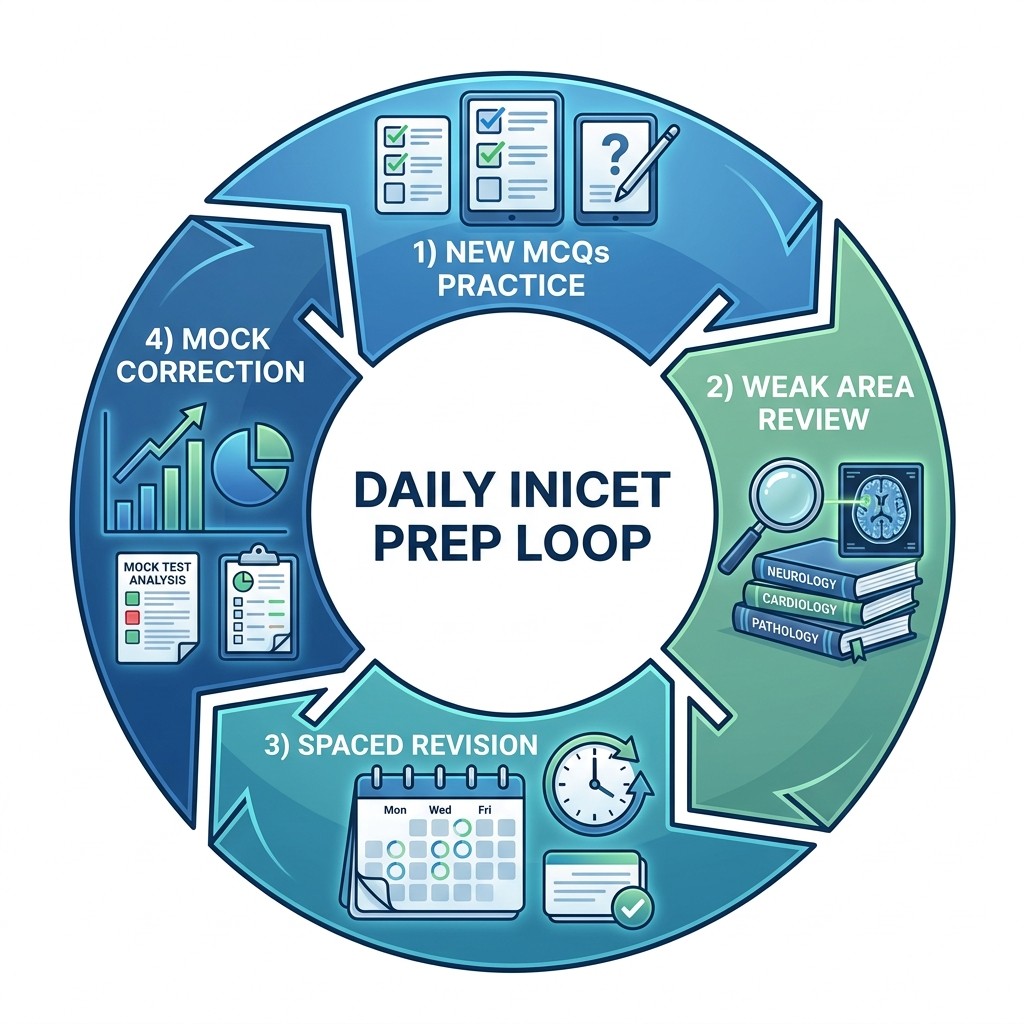
Phase 1: New Questions (30-40 minutes)
Start each session with 25-30 fresh questions from your weakest subject. Not random questions — targeted practice in specific weak topics identified from previous sessions.
Key principles:
Focus on one weak subject per session
Mix question types (MCQs, image-based, clinical vignettes)
Time yourself: 1 minute per question maximum
Don't look up answers during the session
Phase 2: Weak Area Review (20-25 minutes)
Immediately review incorrect answers with detailed analysis:
Why was your choice wrong?
What concept were you missing?
How does the correct answer connect to broader clinical knowledge?
What pattern should you recognize next time?
Create quick notes for repeated mistake patterns. If you're consistently missing Pharmacology MOA questions, note the specific drug classes causing problems.
Phase 3: Spaced Revision (15-20 minutes)
Review weak topics identified 3 days ago. This isn't fresh learning — it's reinforcing concepts that were weak but are now partially understood.
Use active recall:
Can you explain the concept without looking?
Can you solve a similar question within time limits?
Do you remember why you got it wrong before?
Phase 4: Mock Correction (15-20 minutes)
Weekly mock test analysis becomes your roadmap for the next week's practice:
Which new weak areas emerged?
Which previous weak areas have improved?
What time management issues need addressing?
The beauty of this loop: it automatically adjusts your focus as you improve. As Pharmacology strengthens, more time shifts to Surgery. As Surgery improves, more time goes to image-based Anatomy questions.
Oncourse's adaptive daily plan turns this manual process into an automated workflow, adjusting your daily question mix as weak areas change and ensuring you're always practicing what needs the most attention.
How to Prioritize Repeated Misses Over Comfortable Subjects
The biggest trap in INICET preparation: spending time on subjects you're already good at because it feels productive.
The 60-30-10 Rule:
60% time on subjects consistently below 70% accuracy
30% time on subjects with variable performance (60-80% accuracy)
10% time on subjects consistently above 80% accuracy
Identify Your Repeat Offenders
Track questions you've gotten wrong multiple times. These aren't random mistakes — they represent fundamental gaps that will cost you marks in the actual exam.
Common repeat patterns:
Drug MOA confusion: Keep mixing up similar-acting drugs
Clinical criteria mixing: Confuse diagnostic criteria between similar conditions
Image interpretation: Consistently miss radiological findings
Time pressure errors: Know the answer but consistently pick wrong options under stress
The Mistake Journal Strategy
For each repeated mistake, create a focused entry:
Question stem: Brief version of the clinical scenario Your wrong answer: What you picked and why Correct answer: Right choice with clear reasoning Pattern note: What broader concept this represents Review trigger: When to review this mistake again
Example entry:
Heart failure drug - picked ACE inhibitor for acute setting - correct answer: diuretics first-line for volume overload - Pattern: acute vs chronic heart failure management - Review: every 3 days until no mistakes
Break the Comfort Zone Cycle
Strong subjects feel productive but don't improve your score. If you're consistently scoring 85% in Anatomy, those extra hours won't boost your rank significantly.
Force allocation discipline:
Set maximum daily time for strong subjects (45 minutes max)
Track weak subject improvement weekly
Celebrate closing knowledge gaps, not perfect scores in comfortable areas
This approach ensures every study hour directly translates to mark improvement rather than ego boosting.
Final 30-Day Practice Strategy: Converting Weak Areas to Strength
The last month requires a different approach. You're not learning new concepts — you're converting existing knowledge into exam-ready recall.
Week 1: Diagnostic Deep Dive
Daily routine:
Morning: One major weak subject (2 hours focused practice)
Afternoon: 100 targeted MCQs from that subject
Evening: Quick review of 2 comfortable subjects (maintain sharpness)
Primary goal: Create an accurate map of exactly what's costing you marks.
Take detailed notes on:
Which specific subtopics within Medicine are weak?
What type of Surgery questions are you missing?
Are Pharmacology mistakes about MOA, side effects, or indications?
Week 2: Targeted Blitz
Daily routine:
Morning: Deep dive into one high-yield weak topic per day
Afternoon: Practice questions specific to morning's topic (minimum 50)
Evening: Spaced review of topics covered 3 days ago
Primary goal: Systematically strengthen identified weak areas.
Oncourse's INICET-specific lessons become crucial here — they're designed to address exactly these knowledge gaps with clinical correlations that stick.
Week 3: Integration and Speed
Daily routine:
Morning: Mixed practice combining multiple weak subjects
Afternoon: Timed mock sections (50 questions in 45 minutes)
Evening: Immediate error analysis and pattern identification
Primary goal: Build speed without losing accuracy in weak areas.
Focus on:
Can you solve weak-area questions within time limits?
Are you maintaining accuracy under pressure?
Which subjects still need more time allocation?
Week 4: Final Polish
Daily routine:
Morning: Full-length mock tests (alternate days)
Afternoon: Rapid review of highest-yield weak areas
Evening: INICET flashcards for quick recall
Primary goal: Maintain all improvements while fine-tuning exam strategy.
The key insight: by the final week, your weak areas should be stronger than your original comfortable subjects.
Common Mistakes That Sabotage High-Yield Preparation
Even with perfect topic lists and daily practice routines, these mistakes derail INICET preparation:
Mistake 1: Passive Reading Instead of Active Practice
What it looks like: Reading Medicine textbooks for hours without solving questions. Why it fails: Reading creates familiarity, not recall. Under exam pressure, familiarity doesn't translate to correct answers. The fix: Every study session must include questions. Aim for 2:1 ratio of practice time to reading time.
Mistake 2: Chasing Lists Without Personal Analysis
What it looks like: Studying every "high-yield" topic from online lists without considering your specific weak areas. Why it fails: You end up strengthening areas you're already good at while ignoring personal knowledge gaps. The fix: Use high-yield lists as starting points, but adapt based on your mock test performance.
Mistake 3: Ignoring Incorrect Option Logic
What it looks like: When reviewing wrong answers, only reading why the correct option is right. Why it fails: INICET often tests your ability to eliminate wrong choices. If you don't understand why incorrect options are wrong, you'll fall for similar distractors. The fix: For every wrong answer, analyze why each incorrect option is wrong and what makes the correct option better.
Mistake 4: Copying Another Student's Schedule
What it looks like: Following your friend's study plan because they scored well in a mock. Why it fails: Their weak areas aren't your weak areas. Their time allocation won't optimize your score. The fix: Create your own schedule based on your diagnostic results. Take inspiration from successful strategies but customize for your gaps.
Mistake 5: Mock Test Overload Without Analysis
What it looks like: Taking 2-3 mocks daily in the final month without proper review. Why it fails: More tests don't improve performance — better analysis does. Taking tests without learning from mistakes wastes valuable time. The fix: One quality mock with 2-3 hours of analysis beats three rushed mocks without review.
How Oncourse AI Turns Weak Areas Into Daily Practice Gold
Here's what makes systematic weak area improvement possible:
INICET-Style Adaptive Practice: Instead of generic medical MCQs, get questions that match exactly what INICET tests. When you miss a Pharmacology question, Rezzy AI tutor doesn't just explain the answer — it shows you why each incorrect option was designed to mislead and what pattern to recognize next time. Performance Analytics Dashboard: Your practice history converts into a visual map of exactly where marks are being lost. See which subjects, systems, and specific topics are costing you ranks. No guesswork, no generic advice — just precise data on what needs work. Adaptive Daily Workflow: Instead of static study schedules, get a realistic daily plan that adjusts as your weak areas change. As Surgery improves, more questions automatically shift to Medicine. As clinical subjects strengthen, more time goes to Para-clinical integration.
This isn't about using more study tools — it's about making your existing study time infinitely more precise and effective.
Frequently Asked Questions
How many hours daily should I practice MCQs for INICET 2026?
Aim for 3-4 hours of structured question practice daily, split into 60% weak subjects and 40% maintenance of strong subjects. Quality trumps quantity — 100 well-analyzed questions beat 300 rushed attempts.
What's the minimum mock test frequency for weak area identification?
Take one comprehensive mock weekly during preparation phase, then increase to 3 mocks per week in the final month. Focus on thorough analysis rather than mock quantity.
Should I study new topics 30 days before INICET 2026?
No. The final 30 days should focus only on strengthening existing knowledge and converting weak areas to competent ones. New topics create confusion under exam pressure.
How do I balance high-yield topics with INICET syllabus completion?
Use the 80-20 rule: 80% time on high-yield topics that appear frequently, 20% time on comprehensive coverage for unexpected questions. Your weak areas within high-yield topics get highest priority.
What if my weak areas are in low-yield subjects like Forensic Medicine?
Still address them if they're costing you easy marks. A few hours fixing simple Forensic Medicine concepts might give you 4-5 additional correct answers — often enough to improve ranks significantly.
How many questions should I practice daily from weak subjects?
Practice 50-75 questions daily from your weakest subject, plus 25-50 questions from moderately weak areas. Maintain strong subjects with 20-30 questions to prevent knowledge decay.
Transform Your INICET 2026 Preparation Today
Static high-yield lists wont crack INICET 2026. Converting your specific weak areas into targeted daily practice will.
The students who clear INICET dont study more hours — they study the right things. They identify exactly what's costing them marks and systematically convert those weaknesses into strengths.
Your rank depends on precision, not perfection. Start diagnosing your weak areas today, build a systematic daily practice routine, and watch your mock scores climb consistently.
Prepare smarter with Oncourse AI — adaptive MCQs, performance analytics, and AI explanations built for INICET 2026. Download free on Android and iOS.