Back
Medical mnemonics: when Oncourse AI helps facts stick faster
Learn when medical mnemonics work, when they fail, and how Oncourse AI creates exam-relevant memory cues that stick. Transform missed questions into memorable facts.
Medical mnemonics: when Oncourse AI helps facts stick faster
You are staring at a pharmacology question. Beta-blocker side effects. You know you've seen this before — maybe five times — but your brain serves up a blank page when it matters. Sound familiar?
Here's the thing: 73% of medical students use mnemonics, but most are doing it wrong. They memorize random acronyms without connecting them to actual understanding. They create memory cues for easy stuff while missing the facts they actually forget. They build mnemonics in isolation, then wonder why recall fails under exam pressure.
Medical mnemonics work when they're targeted, tested, and tied to reasoning. When they're created for the exact concept you keep missing, then reinforced through retrieval practice until recall becomes automatic. That's where smart mnemonic systems — like the ones built into Oncourse AI — make the difference between memorizing noise and remembering what counts.
What medical mnemonics actually do (and dont)
A medical mnemonic is a memory device that links hard-to-remember medical facts to something more memorable. Think "VINDICATE" for differential diagnosis categories or "MUDPILES" for metabolic acidosis causes.
When mnemonics work best:
Complex lists that don't follow logical patterns
High-yield facts you encounter repeatedly on exams
Information with multiple discrete components
Facts that connect to visual or story-based cues
When they fail spectacularly:
Covering concepts you already understand well
Replacing actual comprehension of mechanisms
Built around random, meaningless associations
Never tested under retrieval conditions
Research from the Bangladesh Journal of Medical Education found that acrostic mnemonics (where each letter starts a related word) outperform simple acronyms for anatomical recall. But here's the key: both only worked when students actively retrieved the information multiple times, not just reread the mnemonic.
The mnemonic trap most students fall into
Medical education is drowning in mnemonics. Walk into any anatomy lab, and you'll hear students chanting "NAVEL" for femoral sheath contents or "Some Lovers Try Positions That They Can't Handle" for carpal bones.
The problem isn't the mnemonics themselves. It's how students use them.
Trap #1: Random noise memorization
Students create mnemonics for everything, including stuff that makes perfect sense without memory tricks. You dont need a mnemonic for "inspiration involves the diaphragm moving down" — that's logical. Save mnemonics for truly arbitrary lists.
Trap #2: Disconnected from understanding
The mnemonic "DEATH" helps remember activities of daily living (dressing, eating, ambulation, toileting, hygiene), but as one medical education critique noted, it also subconsciously associates patients who need assistance with being terminal. Effective mnemonics should connect to, not replace, clinical reasoning.
When I work with students who struggle with pharmacology, they often have dozens of drug mnemonics memorized but cant explain why a beta-blocker causes the side effects they're listing. The mnemonic becomes a crutch that actually prevents deeper learning.
Building mnemonics that actually stick
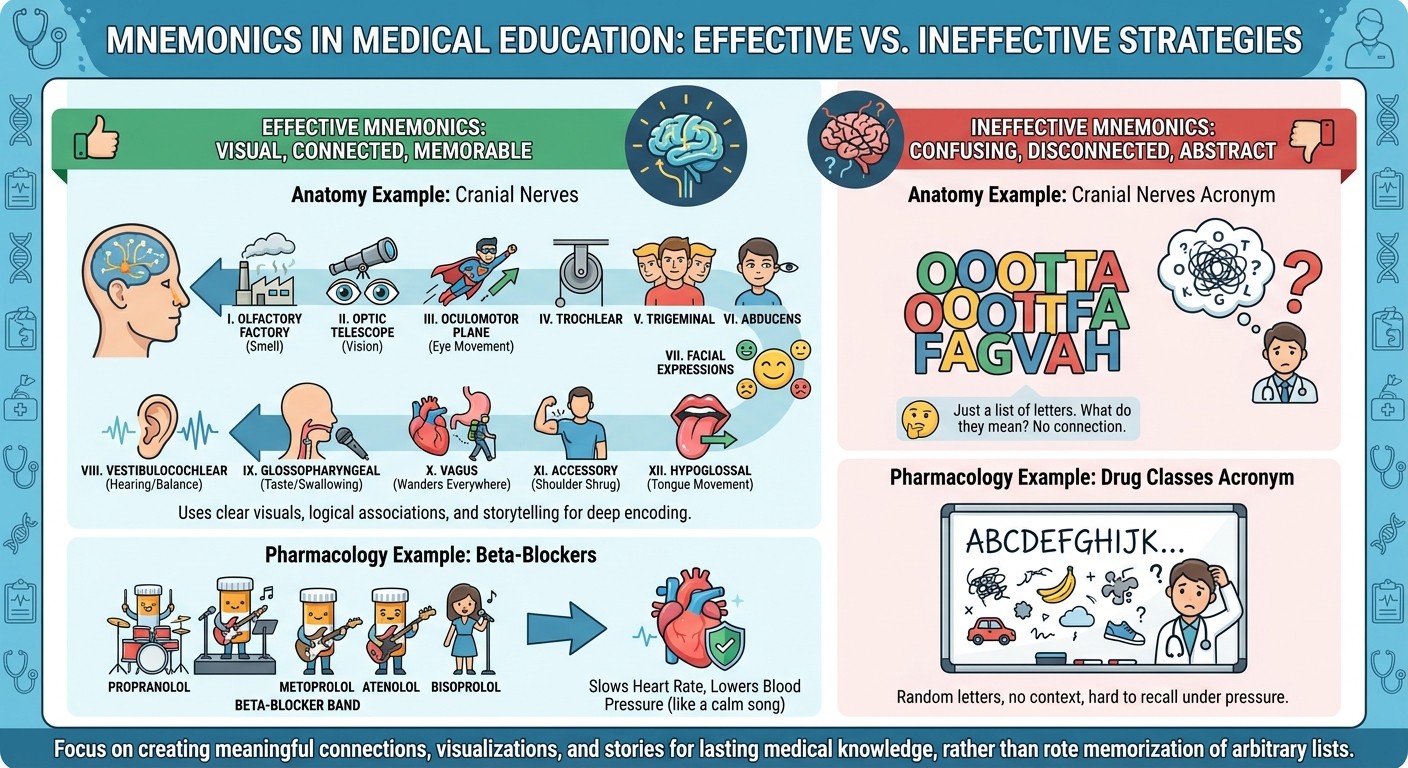
The best medical mnemonics aren't random — they're designed around three principles:
1. Target your actual weak spots
Don't create mnemonics for concepts you already know. Instead, track which facts you consistently miss on practice questions, then build memory cues specifically for those gaps.
For instance, if you keep confusing the branches of the facial nerve, that's mnemonic-worthy. If you understand cardiac output physiology but keep forgetting the normal values, create a mnemonic for the numbers, not the concept.
2. Connect to meaning, don't replace it
Strong mnemonics help you recall information that you understand but struggle to remember quickly. The mnemonic "SOAP BRAIN MD" works for lupus symptoms because lupus pathophysiology is genuinely complex — you cant reason through all manifestations from first principles in 90 seconds.
But don't use mnemonics to avoid learning mechanisms. Oncourse's pharmacology lessons teach drug mechanisms first, then provide mnemonics for the details that are purely memorization-based.
3. Test under pressure immediately
This is where most students fail. They create a mnemonic, use it a few times while studying, then expect it to work during exams. Memory cues need pressure-testing through active recall, not passive review.
The most effective approach: create your mnemonic, then immediately quiz yourself on related practice questions without looking back at your notes. Can you use the mnemonic to answer actual exam-style questions, or does it only work when you're casually studying?
Oncourse's Probe Game turns this into active retrieval by presenting time-pressured questions where you have to use your memory cues under exam-like conditions, not just during comfortable study sessions.
Medical mnemonics across the core subjects
Different medical subjects need different mnemonic approaches. Here's what works:
Anatomy mnemonics: location and relationships
Anatomy benefits from mnemonics that preserve spatial relationships. "NAVEL" (nerve, artery, vein, empty space, lymphatic) works for the femoral triangle because it maintains the lateral-to-medial order.
Effective anatomy mnemonics often use:
Sequential patterns that match anatomical order
Visual associations that connect to actual structures
Story-based cues that link related regions
Pharmacology mnemonics: mechanisms and side effects
Pharmacology mnemonics work best for drug classifications and side effect profiles. "ABCD" for hypertension treatment (ACE inhibitors, Beta-blockers, Calcium channel blockers, Diuretics) groups by mechanism.
The key is connecting the mnemonic back to why these drugs work. When you recall "ABCD," you should also remember that each category targets a different aspect of blood pressure control — not just four random drug types.
Pathology mnemonics: differential diagnosis lists
Pathology mnemonics shine for differential diagnosis frameworks. "VINDICATE" (vascular, inflammatory, neoplastic, degenerative, intoxication, congenital, autoimmune, traumatic, endocrine) provides systematic disease categories.
But these only work when paired with actual clinical reasoning. The mnemonic gets you to consider vascular causes, but you still need to know which vascular conditions fit the presentation.
Microbiology mnemonics: organism characteristics
Microbiology mnemonics help with organism features and antibiotic coverage patterns. The challenge is avoiding oversimplification — many organisms have exceptions to the general rules your mnemonic captures.
Oncourse's Synapses feature addresses this by connecting mnemonic-based memory cues to the full clinical context where each organism appears, so you learn both the memory trick and its limitations.
Converting missed questions into memory cues
Here's a practical system for building mnemonics that target your actual knowledge gaps:
Step 1: Track your misses
Every time you get a practice question wrong, note whether you missed it due to:
Not knowing a fact (mnemonic-worthy)
Not understanding a concept (need to study mechanism)
Misreading the question (test-taking issue)
Knowing the fact but forgetting under pressure (mnemonic + retrieval practice)
Step 2: Build targeted mnemonics
For facts you consistently forget, create specific memory cues. If you keep missing which cranial nerves control eye movement, build a mnemonic specifically for CN III, IV, VI — not for all twelve cranial nerves.
Step 3: Test immediately
Don't just memorize your new mnemonic. Find related practice questions and see if the memory cue actually helps you get the right answer. If not, revise the mnemonic or approach the topic differently.
Step 4: Space out retrieval
Use your mnemonic in practice questions across multiple study sessions. The goal isn't just to remember the mnemonic — it's to automatically recall the underlying information when you see related questions.
This is where Rezzy AI becomes particularly useful: you can ask it to explain how your mnemonic connects to the underlying mechanism, helping you build understanding alongside memorization. Rather than just accepting "MUDPILES" for metabolic acidosis, you can explore why methanol causes acidosis and how that fits the broader pattern.
When mnemonics become dangerous
Medical mnemonics can backfire in predictable ways. Here's how to avoid the most common traps:
Oversimplification trap
Some students use mnemonics to avoid learning complex topics entirely. The mnemonic "ToRCHES" covers some infections that cross the placenta, but focusing only on this list means missing other important perinatal infections.
The fix: use mnemonics as starting points for systematic thinking, not endpoints. "ToRCHES" should prompt you to consider infectious causes, then think through the full differential based on clinical context.
Dehumanization risk
Mnemonics like "DEATH" for activities of daily living or "DIAPERS" for incontinence causes can subtly shape how you think about patients. While memorable, they risk reducing complex human experiences to acronyms.
Consider whether your mnemonics respect patient dignity. Would you be comfortable if patients knew how you remembered their conditions?
Rote memorization replacement
The biggest danger is using mnemonics instead of understanding. If you can recite "MUDPILES" but can't explain why salicylates cause metabolic acidosis, the mnemonic is hurting more than helping.
Strong mnemonics should make it easier to apply knowledge you already understand, not replace the need to understand it.
Testing mnemonics with practice questions
A mnemonic is only as good as its performance under exam conditions. Here's how to pressure-test your memory cues:
Immediate application: Right after creating a mnemonic, find 3-5 practice questions on that topic. Can you use the mnemonic to get the right answers, or do you need to look up additional information? Delayed recall: Wait 24-48 hours, then test the mnemonic again with different practice questions. If recall fails, the mnemonic needs revision or more practice. Mixed practice: Use the mnemonic while working through questions that mix different topics. Can you still recall and apply it when your brain is switching between subjects? Time pressure: Test your mnemonics under timed conditions. Practice with Oncourse's question banks simulates real exam pressure where memory cues need to work quickly and reliably.
The goal isn't just to remember the mnemonic — it's to use the mnemonic to answer questions correctly and quickly.
Common mnemonic mistakes to avoid
After working with thousands of medical students, certain mnemonic errors appear repeatedly:
Creating mnemonics for easy content: Don't build memory devices for information you already remember well. Focus on genuinely difficult-to-recall facts. Never updating failed mnemonics: If a mnemonic consistently fails to help with practice questions, abandon or revise it. Don't persist with memory cues that don't work. Memorizing other people's mnemonics blindly: The best mnemonics are often personal. Someone else's "clever" acronym might not resonate with how your brain works. Adapt existing mnemonics or create your own. Skipping retrieval practice: Creating a mnemonic is 10% of the work. Testing and reinforcing it through repeated retrieval is the other 90%. Forgetting to connect back to clinical reasoning: Always link your mnemonics to the underlying pathophysiology or mechanism. The memory cue should enhance understanding, not replace it.
Making medical mnemonics work within Oncourse AI
Effective medical mnemonics aren't just about memorization — they're about creating retrieval pathways that connect memory cues to clinical reasoning and exam performance. That's why the mnemonic tools built into Oncourse AI focus on making facts stick through targeted practice rather than random memorization.
When you're working through Oncourse flashcards, the platform helps you identify which specific facts you keep missing, then suggests memory techniques for those exact knowledge gaps. Rather than generic mnemonics for entire topics, you get targeted memory cues for the details that actually trip you up.
The integration between memory techniques and active retrieval means your mnemonics get tested immediately through practice questions, ensuring they work under exam pressure, not just during comfortable review sessions.
Frequently Asked Questions
How do I know if a mnemonic is actually helping me?
Test it with practice questions immediately after creating it. If you can use the mnemonic to correctly answer related questions without looking up additional information, it's working. If you still need to check your notes, the mnemonic needs work.
Should I create mnemonics for every difficult topic?
No. Only create mnemonics for facts that are arbitrary or genuinely hard to remember through logic alone. If you can reason through a concept, focus on understanding the mechanism rather than memorizing an acronym.
How long should I spend making a mnemonic memorable?
No more than 5-10 minutes per mnemonic. If it takes longer to create a memory device than to just drill the facts through spaced repetition, skip the mnemonic and use direct retrieval practice instead.
What's the difference between good and bad medical mnemonics?
Good mnemonics target specific knowledge gaps, connect to underlying understanding, and consistently help with practice questions. Bad mnemonics cover concepts you already know well, replace actual learning, or fail to work under exam pressure.
Can mnemonics replace understanding pathophysiology?
Never. Mnemonics should make it easier to recall information you understand, not substitute for learning mechanisms. If you can recite a drug mnemonic but can't explain how the drugs work, you're using mnemonics incorrectly.
How many mnemonics is too many?
If you can't consistently recall and apply all your mnemonics during practice questions, you have too many. Focus on memory cues for truly high-yield facts that you encounter repeatedly on exams.
---
Prepare smarter with Oncourse AI — adaptive MCQs, spaced repetition, and AI explanations built for medical exams. Download free on Android and iOS.