Back
UKMLA Question Bank: Use Oncourse AI to Practice the Questions That Expose Weak Areas
Master UKMLA AKT prep by using question banks strategically to identify weak clinical reasoning areas. Learn timed vs untimed practice, error tracking, and targeted review techniques that work.

UKMLA Question Bank: Use Oncourse AI to Practice the Questions That Expose Weak Areas
You're three months out from your UKMLA AKT. You've been through medical school, absorbed clinical knowledge, and now you're staring at a question bank with thousands of practice questions. But here's the problem: most candidates treat question banks like a test rather than the diagnostic powerhouse they should be.
I've watched too many students complete 4,000+ questions only to find their scores plateau. They're answering randomly, hoping volume equals success. That's not strategy – that's wishful thinking. The UKMLA AKT tests clinical reasoning across 212 presentations and 6 domains, and random practice won't expose the specific gaps in your diagnostic thinking.
Here's what actually works: using your question bank as a surgical tool to identify, isolate, and eliminate your weak clinical reasoning areas before exam day. Not every wrong answer signals the same type of problem, and not every right answer means you're ready.
What a UKMLA Question Bank Should Actually Diagnose
A proper UKMLA question bank doesnt just test your knowledge – it reveals the specific patterns in how you think clinically. When you get a question wrong, the issue could be:
Diagnostic reasoning gaps: You missed key clinical features that point to acute coronary syndrome vs stable angina. You confused the presentation of heart failure with COPD exacerbation. Management protocol errors: You know the diagnosis but selected first-line treatment for the wrong clinical context. You chose appropriate medication but missed contraindications from the patient history. Guideline application failures: You're applying outdated protocols or missing NICE pathway updates for common presentations like hypertension or diabetes. Clinical prioritization mistakes: In emergency scenarios, you're not identifying which intervention comes first – ABC assessment vs specific treatments. Risk stratification confusion: You're not properly using tools like CURB-65 for pneumonia, GRACE score for ACS, or CHA2DS2-VASc for atrial fibrillation.
Each error type needs a different revision approach. Random question-answering cant distinguish between them.
Why Passive Question Completion Fails
Most candidates approach question banks passively. They read a vignette, select an answer, check if they're right, maybe read the explanation, then move to the next question. This approach fails because:
No pattern recognition: You're not tracking why you got questions wrong or identifying recurring themes in your mistakes. Shallow explanation engagement: Reading explanations once doesnt cement the clinical reasoning. You need to actively work through why each distractor was incorrect. No weak area prioritization: All topics feel equally important, so you spread your time evenly instead of targeting your actual gaps. Lack of deliberate practice: You're not intentionally practicing your weakest clinical presentations until they become strengths.
For UKMLA success, your question bank practice needs to be diagnostic first, educational second.
How to Attempt Questions Cold for Maximum Learning
Start every question session "cold" – without reviewing notes or guidelines first. This mirrors exam conditions and reveals your true baseline knowledge gaps.
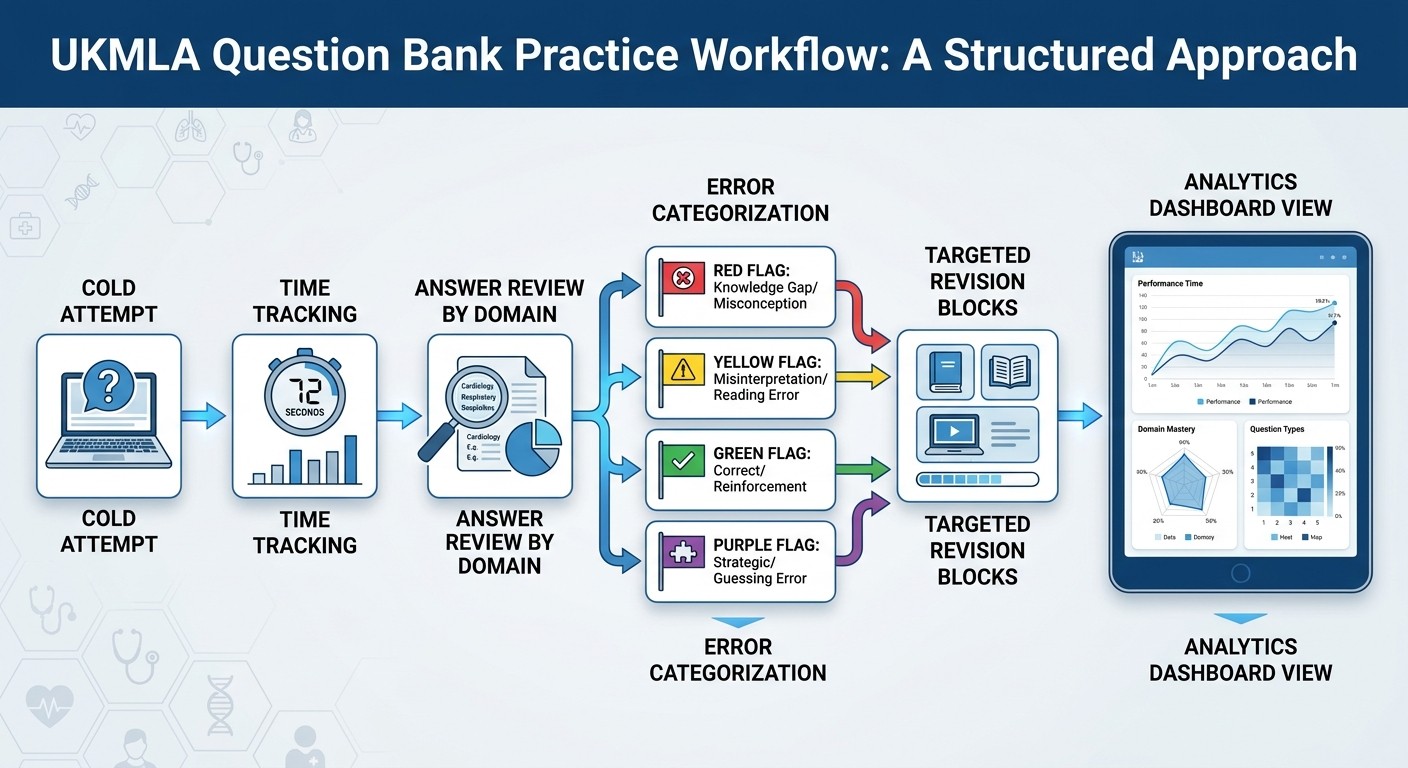
Read the clinical vignette completely before looking at answer options. Extract the key patient demographics, presenting complaint, examination findings, and investigation results. What diagnosis are you considering based on this information alone? Formulate your answer mentally before reading the options. What's the most likely diagnosis? What would be your next investigation? What management step comes first? Having a clear answer in your head prevents you from being swayed by plausible-sounding distractors. Time yourself consistently. The UKMLA AKT gives you 72 seconds per question. Practice at this pace from early in your preparation. If you cant answer confidently within 60 seconds, that signals a knowledge gap worth flagging.
When reviewing your performance with Oncourse AI's adaptive question bank, you get immediate feedback on your reasoning process. The platform tracks whether your mistakes stem from knowledge gaps, time pressure, or clinical reasoning errors – helping you understand not just what you got wrong, but why.
Mark your confidence level for each answer, even when you're correct. A lucky guess on a question you weren't confident about should be treated as a learning opportunity, not a success.
How to Review Wrong Answers by Clinical Domain
Wrong answers are your most valuable learning tool, but only if you review them systematically. Organize your review sessions around clinical domains rather than random question order.
By Symptom Complex
Group your incorrect answers by presenting symptoms. If you're missing questions about chest pain presentations, dedicate a review session to working through acute coronary syndrome, pulmonary embolism, aortic dissection, and pneumothorax presentations.
By Body System
Create targeted review blocks for your weakest systems. If cardiology questions consistently trip you up, spend a focused session reviewing all your cardiology errors together. Look for patterns – are you missing heart failure management questions specifically, or struggling with arrhythmia interpretation?
By Management Phase
Some candidates consistently get the diagnosis right but struggle with management decisions. Review all your treatment-related errors together. Are you missing first-line vs second-line therapy distinctions? Struggling with medication dosing?
Oncourse AI's performance analytics dashboard automatically categorizes your errors this way, showing you exactly which clinical domains and reasoning phases need the most attention. Instead of guessing where your weaknesses lie, you get a clear roadmap of what to review.
How to Tag and Track Your Weak Areas
Effective question bank practice requires systematic tracking of your weak areas. Create a simple tagging system for your errors:
Red flags: Questions you got completely wrong and weren't confident about. These represent genuine knowledge gaps that need immediate attention. Yellow flags: Questions you got wrong but were confident about. These suggest reasoning errors or guideline misapplications that could be dangerous in clinical practice. Green flags: Questions you got right but weren't confident about. Review these to ensure you understand the reasoning, not just the answer. Purple flags: Repeated mistakes on similar clinical presentations. If you've missed atrial fibrillation management questions three times, this becomes a high-priority revision target.
Track these patterns in a simple spreadsheet or use Oncourse AI's built-in error tracking, which automatically flags recurring weak areas and schedules them for review based on spaced repetition principles.
Using Timed vs Untimed Question Blocks Strategically
Your question bank practice should evolve as your exam approaches. Early in preparation, use untimed blocks to focus on understanding clinical reasoning. As exam day nears, shift to timed practice to build speed and confidence.
Untimed Practice (8+ weeks before exam)
In the foundation phase, take unlimited time to work through questions thoroughly. Your goal is understanding, not speed. After each question:
Read all explanations, even for options you eliminated correctly
Look up any medication, condition, or guideline reference you dont recognize
Cross-reference management recommendations with current NICE guidelines
Note any reasoning shortcuts or pattern recognition tips from explanations
This is where Oncourse AI's smart revision system excels – it identifies concepts you struggle with and schedules them for repeated review, ensuring weak topics dont get forgotten while you're learning new material.
Mixed Timed Blocks (4-8 weeks before exam)
Start incorporating timed 20-question blocks that mix high-yield topics with your identified weak areas. This builds exam stamina while maintaining focus on improvement areas.
Set a timer for 24 minutes (72 seconds per question) and stick to it. If you dont know an answer within 45 seconds, flag it and move on.
Full Timed Mocks (2-4 weeks before exam)
Complete 100-question mock exams under strict time conditions. These sessions should feel like exam day – no interruptions, no note-checking, pure clinical reasoning under pressure.
A Weekly Practice Cadence That Works
Consistent, structured practice beats sporadic intensive sessions. Here's a weekly cadence that builds knowledge systematically:
Monday: Complete 40 questions across mixed domains, untimed. This gives you a baseline for the week. Tuesday-Thursday: Focus each day on your 2-3 weakest domains from the previous week's practice. Complete 30-40 questions per session in these specific areas. Friday: Mixed 50-question timed block combining all domains. This tests whether your targeted work is translating to improved performance under time pressure. Weekend: Alternate between full 100-question mocks (every other weekend) and comprehensive review of the week's mistakes.
With Oncourse AI's adaptive scheduling, this cadence becomes even more effective. The platform automatically adjusts your daily question mix based on your performance data, ensuring you spend more time on persistent weak areas.
What to Do in the Final 30 Days
The last month before your UKMLA AKT requires a different approach. You're no longer building knowledge – you're cementing clinical reasoning patterns and eliminating final gaps.
Days 30-21: Complete one full 100-question mock every other day. On non-mock days, review your mistakes and complete targeted 20-question blocks on your persistently weak areas. Focus your review on high-yield presentations that appear frequently. Days 20-11: Shift focus to questions you've gotten wrong repeatedly. If atrial fibrillation management still trips you up, complete every available AF question in your bank. The goal is pattern recognition. Days 10-3: Complete shorter, mixed-topic blocks (20-30 questions) focusing on your strongest areas mixed with your final weak spots. The goal is maintaining confidence while polishing rough edges. Days 2-0: Complete one final 20-question practice block to stay sharp, then rest. Review your summary notes of common mistake patterns, but avoid intensive studying that could create anxiety.
Common Question Bank Mistakes That Kill Scores
Even with good intentions, candidates make predictable mistakes that limit their question bank effectiveness:
Mistake 1: Reading explanations only for questions you got wrong. Correct answer explanations often contain crucial clinical reasoning steps and guideline updates you might have missed. Mistake 2: Reading explanations once and never returning. Clinical reasoning requires repeated exposure. Use spaced repetition to review missed concepts multiple times over weeks. Mistake 3: Focusing on overall percentage scores rather than domain-specific performance. A 75% overall score could hide dangerous gaps in emergency medicine or prescribing safety. Mistake 4: Answering questions in random order without targeting weak areas. Your practice should be majority weak areas, minority strong areas. Mistake 5: Practicing exclusively untimed to avoid anxiety. While untimed practice has its place early on, exam-day time pressure affects clinical reasoning. Mistake 6: Using multiple question banks simultaneously, diluting your progress tracking. Stick with one comprehensive bank that provides detailed analytics.
Strengthen Your Weak Areas with Targeted Resources
While question bank practice forms the core of your UKMLA preparation, supplement your learning with targeted resources for your weakest domains:
For medicine core systems, focus on high-yield presentations like heart failure, COPD, and diabetes management.
Master prescribing and patient safety principles that appear across multiple domains.
Use targeted practice questions to drill weak presentations until they become strengths.
Reinforce learning with spaced repetition flashcards that ensure concepts stick long-term.
When you need instant clarification on clinical reasoning steps, Oncourse AI's Rezzy tutor provides immediate, contextual explanations tailored to UKMLA requirements.
Frequently Asked Questions
How many questions should I complete before the UKMLA AKT?
Target 2,500-4,000 questions total, but focus on quality over quantity. Its better to deeply understand 2,500 questions with thorough explanation review than to rush through 6,000 questions passively. The key is systematic coverage of your weak areas rather than hitting arbitrary question counts.
Should I repeat questions I've already answered correctly?
Yes, but strategically. Repeat questions you got right but weren't confident about, and questions you initially got wrong after a spaced interval (2-4 weeks later). This builds pattern recognition and ensures concepts stick long-term.
How do I balance question bank practice with textbook study?
Use question banks as your primary learning tool, supplemented by targeted reading. When you miss questions on heart failure management, spend 30 minutes reviewing relevant NICE guidelines rather than reading entire cardiology chapters. Question-driven study is more efficient for exam preparation.
What percentage accuracy should I aim for in practice?
Aim for 75-85% accuracy on mixed-topic blocks by 4 weeks before your exam. However, percentage is less important than the pattern – you should see consistent improvement in your weakest domains over time. Track domain-specific performance rather than overall scores.
How should I handle questions about unfamiliar conditions?
For rare conditions that appear in question banks but aren't in the UKMLA Content Map, read the explanation but dont spend extensive time memorizing details. Focus your energy on the 212 presentations and 430 conditions explicitly listed in the official curriculum.
Is it worth practicing questions from other medical exams?
Stick to UKMLA-specific questions that align with UK guidelines and the official Content Map. PLAB questions may use different guidelines, and USMLE questions often reference US management protocols that dont apply in UK practice. Quality UKMLA questions are more valuable than quantity from other exams.
Prepare smarter with Oncourse AI – adaptive MCQs, spaced repetition, and AI explanations built for UKMLA success. Download free on Android and iOS.