Back
Step 3 Day 2 Format: How to Practice Clinical Decision-Making with Oncourse AI
Master USMLE Step 3 Day 2 clinical decision-making with CCS cases, next-best-step reasoning, and AI-powered practice strategies. Learn what Day 2 demands differently from Day 1.
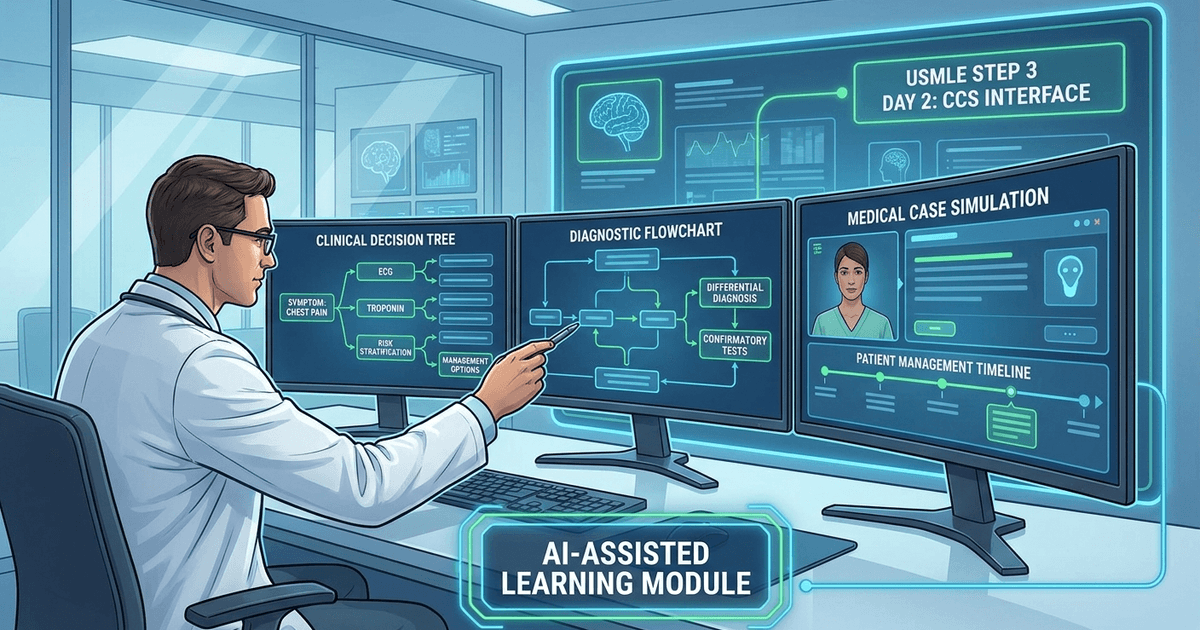
You are staring at the USMLE Step 3 Day 2 interface. The computer-based case simulation (CCS) has started, and you have 20 minutes to manage a 45-year-old diabetic presenting with chest pain. Unlike Day 1's rapid-fire MCQs, Day 2 wants something different: sustained clinical reasoning over time, prognosis planning, and real-world management decisions that mirror independent practice.
Day 2 isnt about recognizing buzzwords anymore. Its about building decision pathways, sequencing interventions, and thinking like the attending you'll become. If youve been drilling MCQs the same way you did for Step 2 CK, youre missing the point.
Here's how to actually prepare for the step 3 day 2 format — not with passive review, but with tactical practice that builds clinical decision-making muscle.
What Makes Day 2 Different From Day 1
Day 1 (Foundations of Independent Practice) tests whether you know what to do. Day 2 (Advanced Clinical Medicine) tests whether you know how to do it — and in what order, over what timeframe, with what follow-up.
The USMLE Step 3 content outline breaks it down clearly:
Day 1 focuses on: Basic medical knowledge, biostatistics, ethics, diagnosis, and initial management decisions. Think single-encounter medicine. Day 2 focuses on: Applied clinical management over time, prognosis and outcomes, health maintenance, screening, therapeutics, and clinical decision-making in evolving scenarios.
The difference shows up immediately in question style. Day 1 asks: "What's the most likely diagnosis?" Day 2 asks: "The patient returns to clinic 3 months later with new symptoms. What's your next step?"
Day 2's CCS cases amplify this further. You're not selecting from 5 choices — you're typing orders into a simulated EMR, watching lab results come back over simulated hours or days, and adjusting your approach as the patient's condition changes.
The CCS Reality Check
The computer-based case simulations make up 25-30% of your Day 2 score. Youll manage 12-13 cases, each lasting 10-25 minutes of real time while simulating minutes to months of clinical care.
Each case starts with a brief patient description. From there, you're ordering tests, prescribing treatments, moving patients between care settings (ED to floor to ICU to discharge), and making ongoing management decisions. The software tracks everything: what you order, when you order it, how long you take, and whether your sequencing makes clinical sense.
Most students underestimate the interface learning curve. The order entry system contains thousands of possible orders. Finding "CBC with differential" takes practice. Knowing when to advance simulated time — and by how much — requires clinical judgment that goes beyond textbook knowledge.
How Day 2 Tests Clinical Decision-Making
Traditional question banks train pattern recognition. You see "crushing chest pain radiating to the jaw" and think acute MI. Day 2 goes deeper: the patient has chest pain, you've confirmed STEMI, started dual antiplatelet therapy and heparin, but now they're hypotensive. What's your next diagnostic step? Do you add pressors first or get an echo? In what order? How do you monitor response?
This is why passive review fails for Day 2. Reading about acute MI management isn't the same as working through the decision tree in real time with evolving patient data. The format demands active clinical reasoning — the same thinking you'd use during overnight call.
When I see students struggle with Day 2, it's usually because they're still studying like medical students instead of thinking like residents. They know the facts but cant sequence the workflow.
Consider this common Day 2 scenario type:
> A 67-year-old man with diabetes and hypertension presents to the ED with altered mental status. Initial vitals show BP 180/100, HR 95, RR 18, O2 sat 92% on room air, glucose 380 mg/dL. What's your immediate next step?
Day 1 thinking: "Hyperglycemia and altered mental status — probably DKA or HHS."
Day 2 thinking: "This patient needs immediate stabilization. Check ABG and basic metabolic panel stat, start IV access, give supplemental oxygen for hypoxemia, and prepare for insulin protocol. But first, rule out stroke given the hypertension and altered mental status. Need head CT and neuro exam before assuming this is purely metabolic."
See the difference? Day 2 rewards systematic, prioritized thinking that addresses immediate threats while gathering data for definitive management.
Building Decision Pathways: The Core Strategy
The most effective Day 2 preparation focuses on building clinical decision pathways — mental flowcharts that guide you from presentation to disposition. Heres how to do it systematically:
1. Map Common Presentations to Decision Trees
Start with high-yield presentations that appear frequently in CCS:
Chest pain → Rule out ACS → Risk stratify → Disposition
Shortness of breath → Oxygen needs → Imaging → Treatment → Monitoring
Altered mental status → Airway/breathing → Glucose → Neuro assessment → Cause
For each pathway, identify the decision points where management changes based on new data. This mirrors what the CCS software tests: how you respond when lab results change your differential or when a patient's condition deteriorates.
2. Practice Sequential Decision-Making
Unlike MCQs where you pick the best answer once, CCS requires multiple sequential decisions. After you order that chest X-ray, what's next while you wait for results? After starting antibiotics for pneumonia, how do you monitor response?
The key insight: every action should set up your next decision point. Order a BNP not just because the patient has dyspnea, but because the result will guide whether you start diuretics or pursue alternative causes.
When you practice with Clinical Rounds on Oncourse, you're working through exactly this type of sequential reasoning: history → investigation → diagnosis → management, with each step informing the next. This builds the clinical decision-making workflow that CCS cases demand.
3. Time-Based Thinking
Day 2 loves scenarios that unfold over time. The patient presents with chest pain, you start treatment, but 6 hours later the troponin comes back elevated. Now what? Or the patient improves with initial management but returns to clinic 2 weeks later with new symptoms.
This temporal aspect separates Day 2 from other USMLE steps. You need to think beyond the immediate presentation to ongoing monitoring, follow-up intervals, and what could go wrong next.
The Three Pillars of Day 2 Clinical Reasoning
Based on the Day 2 format, successful preparation builds three core competencies:
1. Applied Clinical Management
Day 2 assumes you know the diagnosis. The question is: now what? This shift from diagnostic reasoning to management planning changes how you should practice.
Instead of drilling "What's the most likely diagnosis?" questions, focus on "Given this diagnosis, what's your management approach?" scenarios. Practice with cases that present a known condition and ask you to build a treatment plan, monitor response, and adjust therapy.
After reviewing a topic like heart failure, immediately ask: How do I initiate ACE inhibitor therapy? What labs do I monitor? When do I uptitrate? What are the contraindications? When do I add other agents? This management-focused review builds Day 2 reasoning skills.
2. Prognosis and Risk Assessment
Day 2 heavily emphasizes prognosis, risk stratification, and long-term outcomes. Questions often present a patient with multiple comorbidities and ask you to prioritize interventions based on life expectancy, functional status, or disease trajectory.
This appears in both MCQ and CCS formats. The 80-year-old with advanced dementia who develops pneumonia — do you pursue aggressive care or focus on comfort? The diabetic with CKD stage 4 — how does their kidney function affect your medication choices?
Practice with scenarios that require balancing disease-specific management with patient-specific factors. Use your daily review sessions to ask prognostic questions: What's this patient's 5-year survival? How does their comorbidity burden affect treatment decisions?
3. Next-Best-Step Reasoning Under Uncertainty
Day 2 questions often present incomplete information and ask for your next diagnostic or therapeutic step. This mirrors real clinical practice where you're constantly making decisions with partial data.
The classic format: "The patient has been receiving treatment X for condition Y. Despite therapy, symptom Z persists. What's your next step?"
This requires systematic thinking about why treatments fail and how to adjust course. When initial management doesn't work, you need frameworks for reassessing diagnosis, checking compliance, adjusting doses, or switching agents.
When you miss a next-best-step question, don't just review the correct answer. Use Rezzy's explanation chat to dig deeper: Why was the incorrect choice wrong? What clinical clue should have pointed toward the right answer? How do you distinguish between similar management options in this scenario?
Tactical Practice Approaches That Work
Effective Day 2 preparation requires active practice methods that simulate the exam's decision-making demands:
1. Case-Based Learning Loops
Traditional study: Read about pneumonia management, then move to the next topic.
Day 2 approach: Start with a pneumonia case, work through the management decisions, then immediately practice another pneumonia case with different complications. Build pattern recognition for how management changes based on patient factors, severity, response to treatment, and complications.
After studying a topic, practice applying it in Clinical Rounds case scenarios. The Hx→Ix→Dx→Rx format mirrors the sequential decision-making that Day 2 tests. You're not just selecting a diagnosis — you're building the entire clinical reasoning chain that leads to effective patient management.
2. Timed Decision Drills
Day 2 tests your ability to make good decisions efficiently. Practice with time constraints that mirror the exam:
Give yourself 2 minutes to outline initial management for an acute presentation
Set 90-second timers for next-best-step decisions
Practice full CCS-style cases with realistic time limits
The goal isn't speed for its own sake, but developing clinical reasoning that works under time pressure. When you're comfortable with the decision-making process, you can execute it efficiently during the exam.
3. Post-Question Review Protocol
When you miss a Day 2-style question, follow this review sequence:
1. Identify the decision point: What specific clinical decision was being tested?
2. Map the reasoning: What information should have led to the correct choice?
3. Find the knowledge gap: Was this a knowledge issue or a reasoning issue?
4. Practice the pattern: Find 2-3 similar questions that test the same decision-making pattern
This type of targeted review builds clinical reasoning skills more effectively than reading explanations passively.
Use your practice results to identify whether you're missing questions due to diagnostic uncertainty, management knowledge gaps, or timing/sequencing issues. Day 2 preparation should target the specific decision-making skills you're still developing.
Leveraging AI for Clinical Decision Training
The most effective Day 2 preparation combines systematic content review with active clinical decision practice. Here's where AI-powered tools add unique value:
Converting Explanations into Clinical Reasoning
When you miss a clinical management question, traditional explanations tell you the correct answer. AI tutoring can help you understand the decision-making process. After reviewing a missed question about heart failure management, ask Rezzy: "Why would adding a beta-blocker be contraindicated here? What clinical signs would change this decision? How do I distinguish between cases where beta-blockers help versus harm?"
This turns a single missed question into a comprehensive review of clinical decision-making for that condition.
Targeted Weak Area Practice
Day 2 preparation becomes more efficient when you can identify specific gaps in clinical reasoning. Use adaptive practice results to focus your next study session. If you're consistently missing questions about antibiotic selection, spend your next session drilling infectious disease management scenarios rather than reviewing everything broadly.
Your daily practice plan should reflect your actual clinical reasoning gaps, not a generic study schedule.
Real-Time Case Management Practice
The biggest challenge in Day 2 preparation is finding enough high-quality case scenarios that mirror the exam's decision-making demands. Clinical Rounds provides structured case practice that follows the history → investigation → diagnosis → management sequence that Day 2 emphasizes.
After reviewing a topic theoretically, immediately practice it in a case-based format. This bridges the gap between knowing facts and applying them in clinical scenarios — exactly what Day 2 tests.
Common Day 2 Preparation Mistakes
Most students prepare for Day 2 using Day 1 methods, then wonder why their scores dont improve. Here are the key mistakes to avoid:
Mistake 1: Over-Emphasizing Diagnostic Knowledge
Day 2 assumes you can make the diagnosis. The challenge is knowing what to do next. If you're spending most of your prep time drilling diagnostic criteria, youre missing the point.
Focus your review on management protocols, treatment algorithms, and monitoring strategies. Know when to start medications, how to adjust doses, what side effects to monitor, and when to switch therapies.
Mistake 2: Passive Question Review
Reading through question explanations doesn't build clinical decision-making skills. You need active practice that requires you to work through the reasoning process.
Instead of reading 100 explanations, actively work through 30 cases where you have to make sequential management decisions and adapt based on evolving patient data.
Mistake 3: Ignoring the CCS Interface
Many students focus entirely on MCQ practice and ignore CCS preparation. This is dangerous — CCS represents 25-30% of your score and requires specific skills that MCQs dont develop.
Spend at least 20% of your Day 2 prep time working with CCS-style interfaces and practicing the sequential decision-making that these cases demand.
Mistake 4: Generic Study Plans
Day 2 preparation should reflect your specific gaps in clinical reasoning. Using the same study plan as everyone else ignores your individual learning needs.
Use practice performance to guide your review priorities. If youre missing questions about chronic disease management, focus there. If your weakness is acute care decision-making, prioritize that content.
Building Your Day 2 Practice Schedule
Effective Day 2 preparation requires consistent practice with clinical decision-making scenarios. Here's a framework that works:
Daily Practice Structure (90 minutes)
Morning (45 minutes): Targeted Content Review
Review 1-2 high-yield topics with management focus
Create decision trees for common presentations
Practice dosing, monitoring, and adjustment protocols
Evening (45 minutes): Active Case Practice
Work through 3-4 CCS-style cases or Clinical Rounds scenarios
Focus on sequential decision-making and time management
Review missed decisions and build improvement plan for next day
Weekly Practice Blocks
Monday/Wednesday/Friday: High-Yield Management Topics
Acute coronary syndromes → risk stratification → monitoring → discharge planning
Sepsis → fluid resuscitation → antibiotic selection → source control → supportive care
Heart failure → medication initiation → monitoring → optimization
Tuesday/Thursday: Mixed Practice
Random case scenarios testing multiple specialties
Focus on transitions of care and disposition decisions
Practice with time constraints that mirror the exam
Weekend: Comprehensive Review
Full-length CCS practice sessions
Review weekly performance and identify patterns
Plan next week's focus areas based on identified gaps
Monthly Assessment
Track your progress with metrics that matter for Day 2:
Average time per CCS case completion
Accuracy on next-best-step questions
Performance trends in different clinical scenarios (acute vs chronic, inpatient vs outpatient)
Use these data points to adjust your preparation strategy. If youre consistently slow on CCS cases, spend more time with interface practice. If youre missing questions in specific specialties, target those content areas.
Frequently Asked Questions
How long should I spend preparing specifically for Day 2?
Most students need 4-6 weeks of targeted Day 2 preparation after completing their general Step 3 content review. This assumes 2-3 hours daily focused on clinical decision-making practice and CCS preparation.
What's the biggest difference between Day 2 and Step 2 CK questions?
Day 2 questions assume you know the diagnosis and focus on management over time. Step 2 CK emphasizes diagnostic accuracy and initial management. Day 2 also includes temporal elements — what happens next week, next month, or if the patient returns with new symptoms.
How important is CCS performance for my overall Step 3 score?
CCS represents 25-30% of your Day 2 score, which makes it roughly 15-20% of your overall Step 3 performance. You cant ignore it, but excellent MCQ performance can compensate for average CCS performance.
Should I use the same question bank for Day 2 as I used for Step 2 CK?
Not exactly. You need questions that emphasize management decisions, temporal reasoning, and next-best-step logic rather than pure diagnostic accuracy. Look for question sources that provide CCS-style scenarios and management-focused vignettes.
How do I know if I'm ready for Day 2?
You're ready when you can work through complex cases with sequential decision-making, adapt management plans based on evolving data, and complete CCS scenarios efficiently. Your practice scores should consistently reflect competent clinical decision-making, not just knowledge recall.
What should I do if I'm running out of time during CCS cases?
This usually indicates you need more interface practice and better clinical decision-making frameworks. Focus on developing systematic approaches to common presentations so you can move through cases more efficiently. Practice with time constraints until your decision-making becomes automatic.
---
Day 2 isn't just another test — it's your first real assessment of independent clinical reasoning. The format demands thinking like a resident, not a medical student. Master the decision pathways, practice with realistic scenarios, and build the clinical reasoning skills that'll serve you long after Step 3.
Prepare smarter with Oncourse AI — adaptive MCQs, clinical case simulations, and AI explanations built for USMLE Step 3. Download free on Android and iOS.