What Step 2 Score Do You Need for General Surgery Residency in 2026?
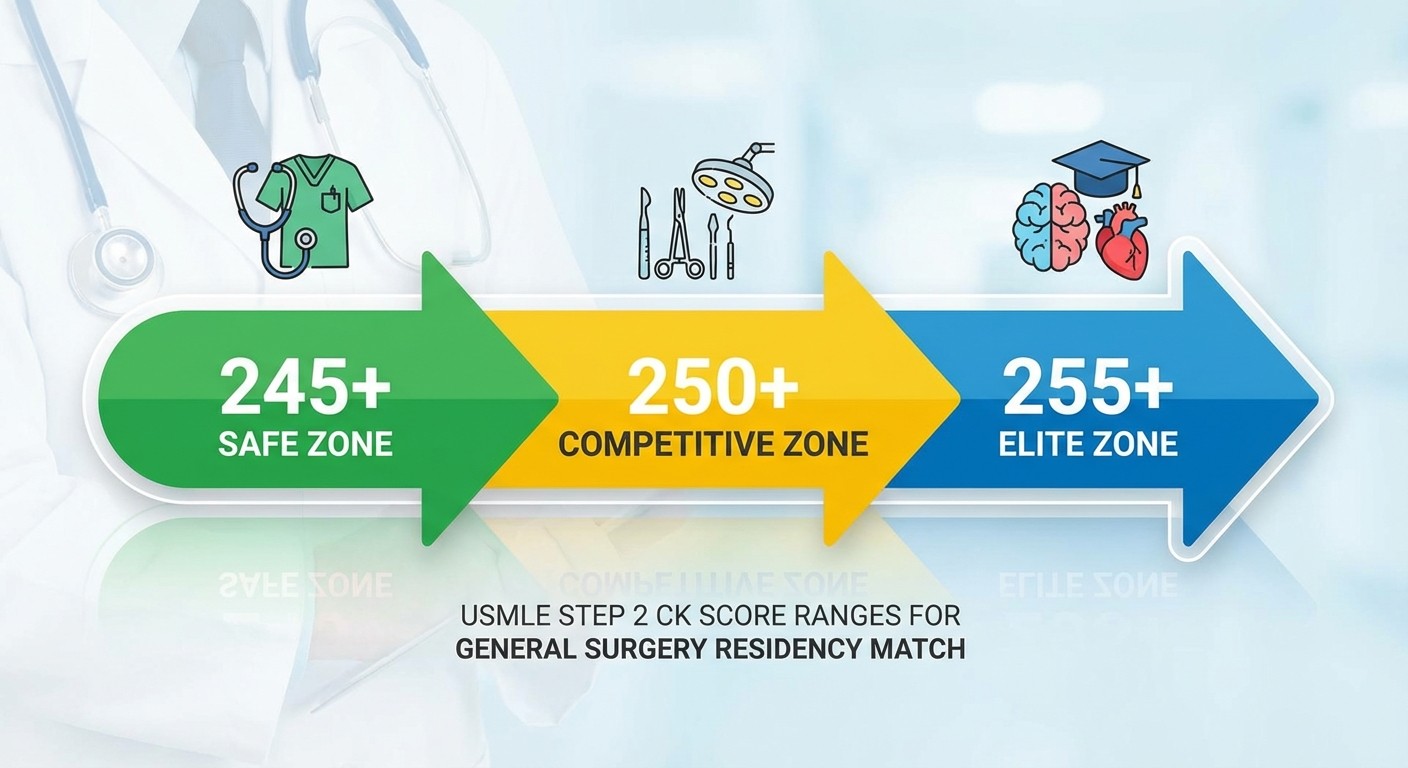
Learn the exact Step 2 CK score ranges for general surgery residency match in 2026. Safe (245+), competitive (250+), and elite (255+) score thresholds with program tiers and match strategies.

What Step 2 Score Do You Need for General Surgery Residency in 2026?
You just got your Step 2 CK score back. 247. Your hands are shaking as you wonder: is this enough for general surgery?
Here's the truth no one wants to say directly: general surgery is brutally competitive, and your Step 2 score carries more weight than ever in 2026. With Step 1 being pass/fail, programs lean heavily on Step 2 CK to separate candidates.
This article breaks down exactly what scores put you in safe, competitive, and elite territory for general surgery match. No fluff, just the numbers that matter.
The Bottom Line: General Surgery Step 2 Score Ranges for 2026
Let's cut straight to what you came here for. Based on 2026 match data and program feedback, here are the Step 2 CK score ranges for general surgery:
Score Tier | Range | Match Probability | Program Access |
|---|---|---|---|
Safe | 245+ | 85-90% | Community + some academic |
Competitive | 250+ | 92-95% | Most academic programs |
Elite | 255+ | 97%+ | Top-tier + research powerhouses |
The harsh reality: Scores below 240 make general surgery extremely difficult unless you have exceptional research, connections, or are applying to specific programs that know your work.
Why These Numbers Matter More Than Ever
General surgery received 2,847 applications for 1,484 positions in the 2026 match cycle. That's a 52% match rate before you factor in couples matching and specific geographic preferences.
With Step 1 pass/fail since 2022, Step 2 CK became the primary numerical filter. Programs can't afford to interview everyone, so they use Step 2 scores as an initial screen.
Most surgery program directors report setting their ERAS filters between 240-245. This means if you score below this range, your application might not even be reviewed by human eyes.
When studying surgery-heavy clinical scenarios, Oncourse's surgery-focused QBank helps you tackle the exact question types that appear on Step 2 CK. These clinical vignettes emphasize pre-op workup, post-op complications, and surgical emergencies — the areas where surgery applicants need to excel.
Program Tiers and Score Expectations
Community Surgery Programs (245+ Safe Zone)
Community programs typically have Step 2 cutoffs around 240-245. These programs value:
Clinical performance during surgery rotations
Local connections and geographic ties
Demonstrated commitment to the region
Strong letters from surgery faculty
If you have a 245-248 with excellent clinical grades and local connections, you're competitive at community programs.
Academic Surgery Programs (250+ Competitive Zone)
University-affiliated programs expect higher scores because they're training future academic surgeons and dealing with complex cases. They typically screen at 245+ but prefer 250+.
These programs also heavily weight:
Research publications in surgery journals
Surgery shelf exam scores
Leadership in medical school
Away rotations at their institution
Elite Surgery Programs (255+ Territory)
Top 20 programs (Johns Hopkins, Mass General, UCSF, etc.) see average Step 2 scores of 255-260. These programs can be extremely selective because they receive applications from the strongest candidates nationwide.
At this level, a 255+ Step 2 score is table stakes. You still need:
Multiple first-author publications
Prestigious research fellowships
AOA membership
Glowing letters from department chairs
Oncourse's Step 2 Surgery Module targets the high-yield overlap between surgery shelf content and Step 2 CK, helping you nail both simultaneously during your surgery rotation.
How General Surgery Compares to Other Surgical Specialties
Here's where general surgery sits relative to other surgical fields:
Specialty | Average Step 2 Score | Competitiveness Rank |
|---|---|---|
Dermatology | 262 | Most competitive |
Orthopedic Surgery | 258 | Extremely competitive |
Neurosurgery | 256 | Extremely competitive |
General Surgery | 252 | Highly competitive |
Anesthesiology | 245 | Competitive |
Emergency Medicine | 242 | Competitive |
General surgery falls in the middle of surgical specialties — more competitive than anesthesia or EM, but not as brutal as ortho or derm.
What If Your Score Is Below 245?
Don't panic yet. Lower Step 2 scores can still match into surgery, but you need a strategic approach:
Boost Other Application Components
Research: Aim for 3-5 first-author papers in surgery journals
Clinical performance: Honor your surgery rotation (aim for top 10% of students)
Networking: Do away rotations at programs where you want to match
Geographic targeting: Apply broadly to community programs in less competitive regions
Consider These Timing Strategies
Gap year: Take a research year to strengthen your application
Preliminary surgery: Apply to preliminary positions to prove yourself
Backup specialties: Have a realistic backup plan (anesthesia, family medicine with surgery focus)
Regional Opportunities
Some regions consistently have lower Step 2 requirements:
Rural programs in the Midwest and South
Military programs (if you're eligible)
International medical graduate-friendly programs
If you're using Oncourse's Score Gap Analyzer, it shows exactly how many points you need to gain and in which domains to hit your surgery target score if you decide to retake.
How Surgery Programs Actually Use Step 2 Scores
Understanding how programs filter applications helps you strategize:
Initial ERAS Screening (October)
Programs set automatic cutoffs (usually 240-245)
Geographic preferences may override score cutoffs
Research connections can sometimes bypass score filters
Interview Selection (November-December)
Step 2 score combined with clinical grades
Heavy weight on surgery rotation performance
Research quality and quantity matter significantly
Rank List Creation (January-February)
Step 2 scores matter less at this stage
Interview performance becomes primary factor
Program fit and personality match dominate
Score Reporting Strategy: When to Take Step 2
Timing Options
Option 1: End of M3 Year
Pros: Fresh surgery knowledge, earlier application submission
Cons: Less time to study, may need to retake if score is low
Option 2: Spring of M4 Year
Pros: More dedicated study time, can retake if needed
Cons: Late score reporting may hurt interview invitations
Option 3: Summer Before M4
Pros: Balanced timeline, allows for retake, fresh clinical knowledge
Cons: Tight timeline if you need to retake
For general surgery applicants, I recommend the summer before M4 approach. This gives you enough time to retake if needed while getting your score to programs before interview invitations.
Retaking Strategy for Surgery Applicants
If your first attempt is below 245, retaking usually makes sense for surgery. Programs care more about your highest score than number of attempts.
When to Retake
First score below 240: Almost always retake
Score 240-244: Retake if you have time and can realistically improve 10+ points
Score 245-249: Consider retaking only if targeting top academic programs
How Much Improvement to Expect
Typical retake improvements:
15-20 points with 2 months of dedicated study
10-15 points with 6 weeks of focused review
5-10 points with minimal additional preparation
Remember: you can only retake Step 2 CK once (except in specific circumstances), so make it count.
Building a Surgery-Focused Study Plan
Focus Areas for Surgery Applicants
Step 2 CK heavily tests these surgery-relevant domains:
Emergency medicine: Trauma, acute abdomen, surgical emergencies
Internal medicine: Pre-op risk assessment, post-op complications
Surgery rotations: General surgery, orthopedics, urology
Anesthesiology: Perioperative management
High-Yield Surgery Topics for Step 2
1. Acute Abdomen Workup (appears in 8-10% of questions)
2. Post-operative Complications (fever, wound infections, anastomotic leaks)
3. Trauma Management (ATLS protocols, damage control surgery)
4. Perioperative Risk Assessment (cardiac risk, pulmonary complications)
5. Surgical Emergencies (compartment syndrome, necrotizing fasciitis)
When reviewing surgical emergencies and post-op complications, many students find that using targeted surgery question banks helps them think through the clinical decision-making that Step 2 tests.
Study Timeline for Surgery Applicants
8 weeks before exam:
Complete UWorld surgery and emergency medicine blocks
Review surgery shelf notes
Focus on perioperative management
4 weeks before exam:
High-yield surgery review (First Aid Step 2)
Practice surgery-heavy question sets
Review common post-op complications
1 week before exam:
Quick review of surgical emergencies
Practice timing on surgery cases
Rest and prepare mentally
Red Flags That Hurt Surgery Applications
Even with a great Step 2 score, these factors can sink your surgery application:
Academic Red Flags
Failed any clinical rotation
Below average grades in surgery or medicine rotations
Multiple Step exam attempts
Gaps in medical education without explanation
Professional Red Flags
Professionalism issues documented anywhere
Poor letters of recommendation
No surgery research or clinical exposure
Late application submission
Geographic Red Flags
Applying only to highly competitive regions (NYC, California, Boston)
No geographic ties to where you're applying
Not applying broadly enough
International Medical Graduate (IMG) Considerations
IMGs face additional challenges in surgery matching:
Higher Score Requirements
IMG surgery applicants typically need 250+ to be competitive
US-IMGs have slightly lower requirements than non-US IMGs
Research connections become even more critical
Pathway Strategies for IMGs
1. Research years at target institutions 2. Preliminary surgery positions to prove clinical skills 3. Regional programs more open to IMG candidates 4. Military programs (if eligible)
Frequently Asked Questions
Is a 245 Step 2 score enough for general surgery?
A 245 puts you in the safe zone for community surgery programs but may be low for competitive academic programs. With strong clinical performance and research, 245 can definitely match into surgery.
Should I retake Step 2 with a 248 for surgery?
Not necessarily. A 248 is competitive for most surgery programs. Focus your energy on research, clinical performance, and away rotations rather than retaking.
How much does Step 2 score matter compared to research for surgery?
Step 2 score gets you through initial screening filters, but research quality determines interview invitations at academic programs. You need both — minimum score thresholds plus meaningful research.
Can I match surgery with a low Step 2 if I have great research?
Research rarely compensates for very low Step 2 scores (below 235) because programs use automated filters. However, above 240, strong research can definitely overcome a mediocre Step 2 score.
Do surgery programs look at Step 2 score breakdowns by domain?
Most programs focus on your total score rather than domain-specific performance. However, consistently low performance in surgery-related domains (emergency medicine, anesthesiology) might raise questions.
When should I take Step 2 CK if applying to surgery?
Take it by June before your application year. This gives you time to retake if needed while getting scores to programs before they start reviewing applications in October.
The general surgery match is competitive, but with the right Step 2 score and strategic application approach, you can secure your spot in a surgery residency. Focus on reaching that 245+ threshold, then pour energy into the clinical and research experiences that set you apart.
Prepare smarter with Oncourse AI — adaptive MCQs, spaced repetition, and AI explanations built for USMLE Step 2 CK. Download free on Android and iOS.