Back
How Oncourse Probe's AI Viva Simulation Prepares You for NEET PG, INICET and FMGE Clinical Spotters (2026)
Master clinical viva rounds with Oncourse Probe's AI simulation. Practice conversational diagnosis, defend differentials, and build articulation skills for NEET PG, INICET, and FMGE exam success in 2026.
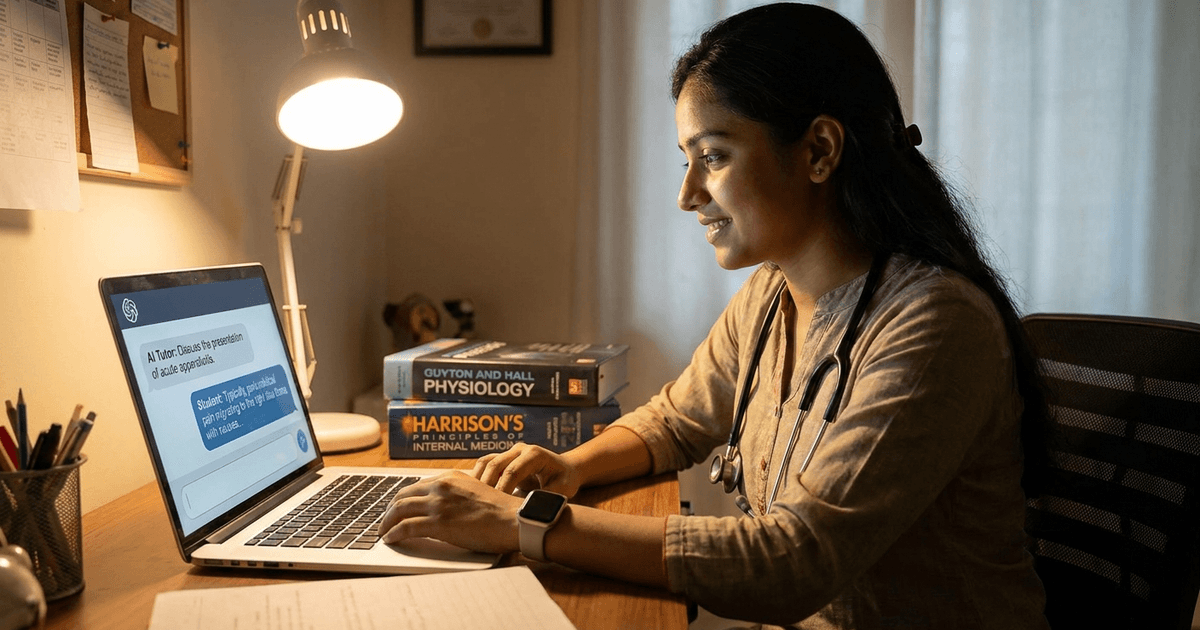
How Oncourse Probe's AI Viva Simulation Prepares You for NEET PG, INICET and FMGE Clinical Spotters (2026)
You are probably staring at that cardiology murmur spotter question right now, knowing exactly what aortic stenosis sounds like, but dreading the thought of explaining it out loud to an examiner.
The terror is real. NEET PG has 200 questions in 210 minutes—that's 63 seconds per question. INICET gives you 3 hours for the same 200 questions. FMGE throws 300 questions at you in 150 minutes. But none of these numbers capture the real fear: what happens when you can recognize the answer but cant articulate why.
Traditional MCQ practice trains pattern recognition. You see "harsh systolic murmur radiating to carotids" and tick aortic stenosis. Done. But clinical spotters in postgrad interviews, ward rounds, and even the conversational elements of these exams demand something different—you need to describe findings, justify differentials, and defend your diagnosis out loud.
Thats where Oncourse Probe's AI viva simulation changes everything.
The Viva Gap That MCQ Banks Miss
Most NEET PG, INICET, and FMGE aspirants can solve clinical vignettes on paper. Show them an ECG with ST elevation in leads II, III, aVF, and they'll correctly identify inferior MI. Ask them to list the complications of acute MI, and they'll rattle off cardiogenic shock, arrhythmias, mechanical complications.
But put them in front of an examiner and ask, "Tell me about this ECG finding and walk me through your management approach"—suddenly, the same student stumbles.
The issue isn't knowledge. It's articulation under pressure.
Traditional question banks train your brain to recognize patterns and select answers from options. But clinical practice—and increasingly, the conversational elements of postgrad interviews—requires you to verbalize your clinical reasoning, explain your thought process, and defend your decisions when challenged.
How Probe's AI Viva Simulation Works
Oncourse Probe flips the script. Instead of showing you options to choose from, it makes you the teacher. The AI picks a clinical concept—say, acute pancreatitis—and you have to describe it based on progressive clues.
Here's what a typical Probe session looks like:
Clue 1: "This condition presents with severe epigastric pain radiating to the back" You think: Could be pancreatitis, posterior MI, aortic dissection... You guess: "Acute pancreatitis" AI responds: "Correct! Now explain why the pain radiates to the back and what other findings would support this diagnosis."
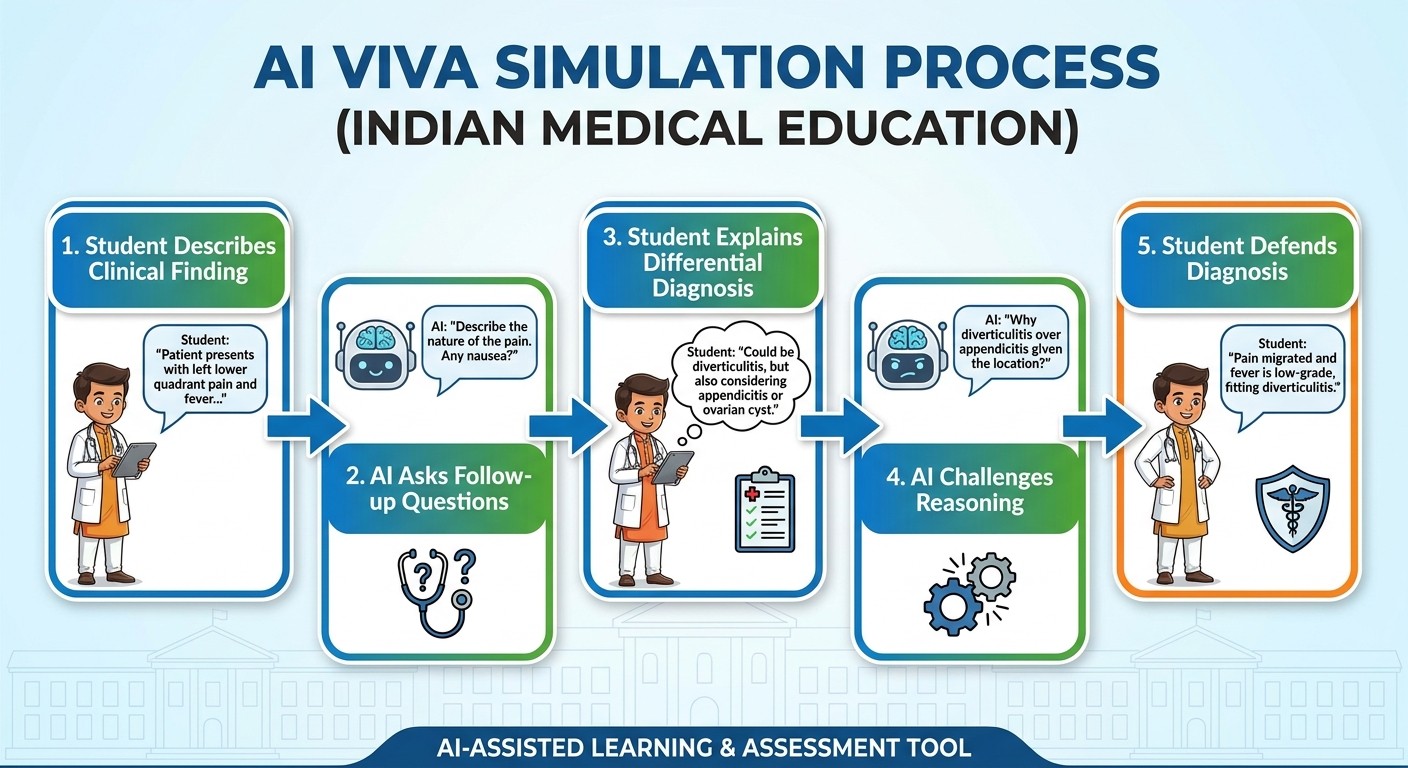
This back-and-forth mirrors exactly what happens in clinical spotters. The examiner gives you a finding, you provide your interpretation, they challenge your reasoning, and you defend your diagnosis.
Why This Matters for NEET PG Clinical Reasoning
NEET PG 2026 has shifted toward more clinical vignette-based questions. According to recent pattern analysis, 60-70% of questions now present clinical scenarios rather than straight factual recall.
But here's what most students miss: the questions that separate top rankers from average scores aren't just about knowing the facts—they're about applying clinical reasoning under time pressure.
When Probe asks you to describe why a patient with chest pain, diaphoresis, and ST elevations in V2-V4 has an anterior STEMI, you're not just recalling a fact. You're practicing the same clinical reasoning pathway you'll use in those 63-second question intervals.
During one Probe session on cardiology, I had to explain why a patient with exertional chest pain and a harsh systolic murmur would need an echocardiogram before being cleared for surgery. The AI didn't just accept "rule out AS"—it made me explain the pathophysiology, the risk stratification, and the management implications. That's exactly the depth of clinical reasoning NEET PG tests.
INICET's Application-Based Focus
INICET has become notoriously application-heavy. Question trends from 2021-2026 show increasing emphasis on patient scenarios, image-based diagnosis, and treatment decisions based on comorbidities.
The AI viva simulation in Probe prepares you for this shift. When the AI presents a case and asks you to walk through your differential diagnosis, you're practicing the same multi-step reasoning INICET now demands.
I remember practicing a Probe session on a patient with fever, headache, and neck stiffness. The AI didn't just want "meningitis"—it made me explain why I'd order a CT before LP, what CSF findings I'd expect in bacterial vs viral meningitis, and how I'd adjust empirical therapy based on age and immune status.
This conversational diagnostic process directly translates to INICET's case-based questions. Instead of passively reading a vignette and selecting an answer, Probe trains you to actively build differential diagnoses and defend your clinical reasoning.
FMGE Module 2 and Clinical Application
FMGE has 300 questions across two modules, with clinical subjects carrying 200 of those marks. Module 2 heavily tests clinical application—not just knowledge of diseases, but ability to apply that knowledge to patient care scenarios.
For foreign medical graduates, this can be particularly challenging. Different medical systems emphasize different diagnostic approaches and treatment protocols. Probe's AI simulation helps bridge this gap by focusing on core clinical reasoning principles that apply across systems.
During practice sessions, the AI might present a case of acute shortness of breath and guide you through the systematic approach: history for risk factors, examination for signs of heart failure vs respiratory pathology, appropriate initial investigations, and interpretation of results to reach a diagnosis.
This systematic approach—describe findings, form differentials, justify investigations, interpret results—is exactly what FMGE Module 2 tests through its clinical vignettes.
The Clinical Rounds Connection
Beyond Probe, Clinical Rounds takes the viva simulation further. While Probe focuses on rapid-fire concept identification, Clinical Rounds lets you work through full patient cases from presentation to management.
The synergy is powerful. You can run a Clinical Rounds case on acute coronary syndromes—taking history, ordering tests, interpreting results—then jump into Probe to drill the rapid identification of specific ECG patterns and cardiac enzymes.
This creates a complete viva preparation loop: comprehensive case analysis in Clinical Rounds, then rapid-fire articulation practice in Probe.
Building the Articulation Muscle
The biggest benefit of AI viva simulation isn't the clinical knowledge—you probably already know most of the facts. It's building what I call the "articulation muscle."
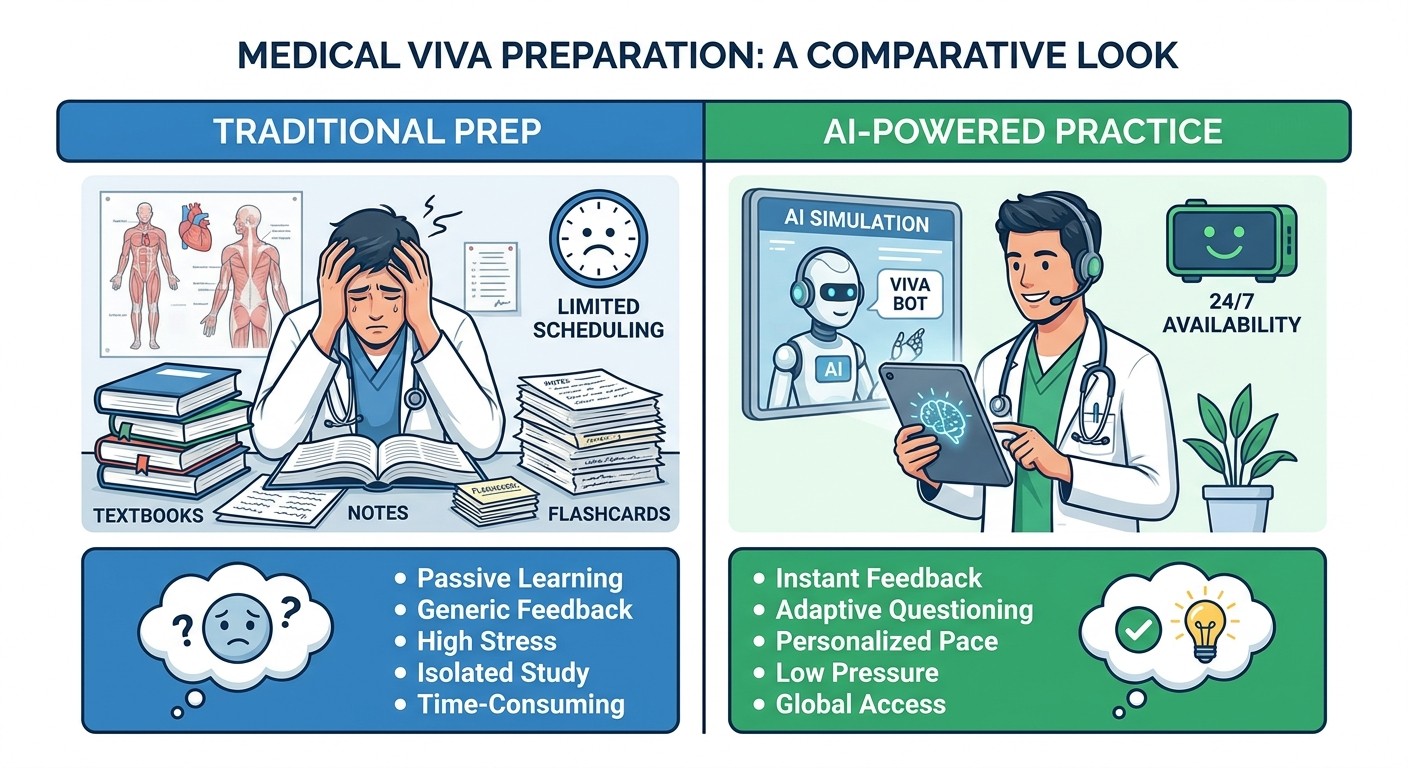
Traditional study methods are passive. You read about aortic stenosis, watch videos about murmurs, solve MCQs about valvular heart disease. But when you need to explain aortic stenosis to an examiner—or answer a complex clinical vignette under time pressure—you're using a completely different cognitive process.
Probe forces active recall under conversational pressure. When the AI asks you to describe a finding and explain your reasoning, you can't just recognize the right answer—you have to construct it from memory and articulate it clearly.
This is the same cognitive process you use during actual clinical spotters, ward presentations, and the conversational elements of postgrad interviews.
Weak Topic Analysis for Targeted Practice
After every Probe session, Oncourse's AI surfaces your weak areas through a visual dashboard. This creates a closed-loop improvement system specifically designed for viva preparation.
Say you consistently struggle with endocrinology cases in Probe—missing diabetes complications or thyroid function interpretation. The weak topic analysis flags this pattern, and you can immediately focus your next study sessions on clinical manifestations in internal medicine or drill targeted endocrinology practice questions.
For NEET PG, where clinical topics like medicine, surgery, and OB-GYN form the bulk of high-yield questions, this targeted approach ensures you're not just practicing randomly—you're systematically strengthening your weakest clinical reasoning areas.
The Confidence Factor
There's something psychological that happens when you can articulate medical concepts clearly. It builds genuine confidence that goes beyond just knowing the right answer.
During my NEET PG preparation, I noticed the difference immediately. Students who could only solve MCQs would hesitate during group discussions or clinical case presentations. But those who had practiced explaining their reasoning—even to themselves—spoke with authority about clinical scenarios.
Probe creates that same confidence through repetition. When you've explained aortic stenosis pathophysiology to the AI twenty times, describing it during an exam becomes automatic.
Real Exam Applications
This articulation training translates directly to exam performance, even in MCQ formats:
For NEET PG: When you read a clinical vignette, your brain automatically walks through the same diagnostic reasoning you've practiced in Probe. Instead of struggling to identify the right answer among options, you arrive at the diagnosis through systematic clinical thinking. For INICET: The application-based questions become easier because you've practiced not just recognizing patterns, but explaining why those patterns matter clinically. For FMGE: The clinical scenarios feel familiar because you've worked through similar cases in a conversational format, building the clinical reasoning pathways that these questions test.
Integration with Traditional Prep Methods
AI viva simulation doesn't replace traditional study methods—it supercharges them. Your routine might look like:
1. Morning: Review high-yield topics from standard textbooks or video lectures
2. Afternoon: Solve MCQs from traditional question banks
3. Evening: Run Probe sessions to practice articulating the concepts you studied
4. Weekly: Complete Clinical Rounds cases to integrate everything into comprehensive patient management
This creates a complete learning loop: passive acquisition → pattern recognition → active articulation → clinical integration.
Addressing Common Concerns
"Isn't this just glorified flashcards?"
No. Flashcards test simple recall. Probe tests your ability to construct explanations and defend reasoning under pressure. The AI challenges your answers, asks follow-up questions, and adapts based on your responses.
"Will this help with pure MCQ exams?"
Absolutely. Clinical reasoning skills transfer directly to MCQ performance. When you can explain why aortic stenosis causes syncope, you'll recognize it faster in MCQ vignettes.
"Is AI viva simulation as good as practicing with real people?"
It's different, but complementary. Real people can provide nuanced feedback and catch communication errors. But AI simulation offers 24/7 availability, unlimited practice, and systematic weak area targeting that human practice partners can't match.
Getting Started with AI Viva Practice
The best approach is gradual integration. Start with 15-minute Probe sessions focusing on your strongest subjects. This builds confidence and familiarity with the format. Then gradually expand to weaker areas and longer sessions.
For anatomy-heavy topics, practice with clinical examination principles first, then use Probe to drill rapid identification of anatomical findings. For pathology, review disease mechanisms, then practice explaining pathophysiology through Probe's conversational format.
The key is consistency. Ten minutes of daily articulation practice builds stronger clinical reasoning than hours of passive reading.
Frequently Asked Questions
How does AI viva simulation differ from traditional MCQ practice?
MCQ practice trains pattern recognition and option elimination. AI viva simulation trains active recall and verbal articulation. Instead of choosing the right answer from a list, you construct explanations from memory and defend your reasoning when challenged. This builds deeper understanding and clinical confidence.
Can Probe help with subjects beyond clinical medicine?
Yes. Probe covers pathology, microbiology, pharmacology, physiology, anatomy, and community medicine. The conversational format works particularly well for subjects that require understanding mechanisms and relationships rather than just memorizing facts.
How much time should I spend on viva simulation vs traditional study?
Start with 80% traditional study, 20% viva simulation. As you build confidence, shift toward 60% traditional study, 40% active practice. The goal is integrating articulation practice throughout your prep, not replacing other methods entirely.
Does this work for students who are shy or uncomfortable speaking?
Actually, yes. AI viva simulation provides a low-pressure environment to build speaking confidence. The AI doesn't judge, doesn't get impatient, and provides consistent feedback. Many shy students find it easier to practice with AI first, then transition to human practice partners.
How do I track progress with viva simulation?
Oncourse's analytics track your response accuracy, speed, and weak areas across all Probe sessions. You can see which clinical domains need more work and how your articulation skills improve over time. This data helps focus your traditional study sessions on areas where you struggle to explain concepts clearly.
Will AI viva practice help with postgrad interviews?
Definitely. The conversational diagnostic reasoning you practice in Probe transfers directly to clinical case discussions in interviews. You'll be more comfortable explaining your thought process, defending differentials, and answering follow-up questions from interview panels.
Building Clinical Confidence for 2026
The medical education landscape is shifting toward application and reasoning skills. NEET PG emphasizes clinical vignettes, INICET tests real-world application, and FMGE demands comprehensive clinical thinking.
AI viva simulation prepares you for this reality. It builds the articulation skills that separate confident clinicians from anxious test-takers. When you can explain your clinical reasoning clearly under pressure, you perform better on exams and feel more prepared for actual clinical practice.
The technology is here, refined, and ready. The question isn't whether AI viva simulation works—it's whether you'll use it to build the clinical confidence that defines successful physicians.
Prepare smarter with Oncourse AI — adaptive MCQs, spaced repetition, and AI explanations built for NEET PG, INICET, and FMGE success. Download free on Android and iOS.