Back
NEET PG Subject-Wise Weightage 2026: Complete Marks Distribution, High-Yield Subjects and Topper Strategy
Complete NEET PG 2026 subject-wise weightage breakdown across all 19 subjects. Discover which 4 subjects carry 60% marks, high-yield topics, and data-driven study time allocation strategy toppers use to maximize NEET PG scores.
NEET PG Subject-Wise Weightage 2026: Complete Marks Distribution, High-Yield Subjects and Topper Strategy
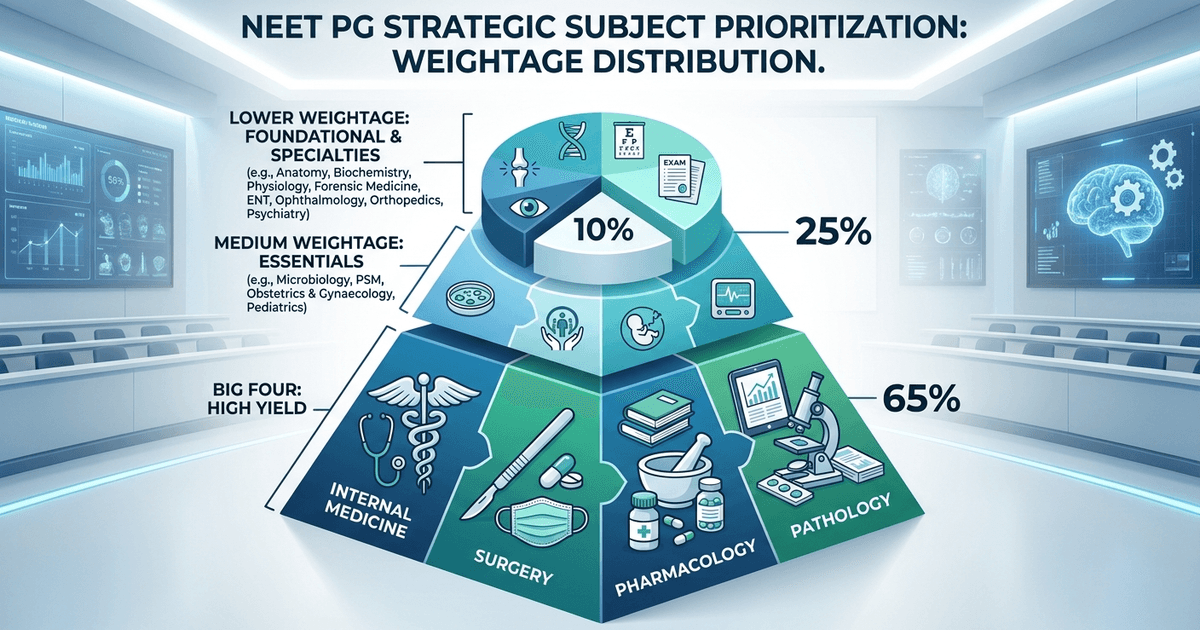
You are probably staring at all 19 NEET PG subjects right now, wondering how to split your remaining months without wasting time on low-yield content. Here is what every topper figured out: NEET PG isnt an equal-weightage exam. Four subjects carry 60% of your marks, while 8 subjects barely touch 25% combined.
This breakdown gives you the exact weightage distribution across all 19 subjects for 2026, the highest-yield topics within each, and how to allocate study time intelligently. No guesswork — just the data-driven prioritization strategy that gets you maximum marks per study hour.
Complete NEET PG Subject-Wise Marks Distribution 2026
NEET PG has 200 questions worth 800 marks total. But the distribution is nowhere close to equal across subjects. Here is the brutal reality based on analysis of the past 5 years:
Tier 1 Subjects: The Big Four (60% of exam)
Subject | Questions | Marks | Weightage |
|---|---|---|---|
Internal Medicine | 40-45 | 160-180 | 17-18% |
Surgery (including subspecialties) | 35-40 | 140-160 | 14-16% |
Pharmacology | 20-25 | 80-100 | 8-10% |
Pathology | 18-22 | 72-88 | 7-9% |
Tier 2 Subjects: Moderate Weightage (25% of exam)
Subject | Questions | Marks | Weightage |
|---|---|---|---|
Anatomy | 12-15 | 48-60 | 6-7% |
Physiology | 10-12 | 40-48 | 5-6% |
Obstetrics & Gynecology | 8-10 | 32-40 | 4-5% |
Pediatrics | 8-10 | 32-40 | 4-5% |
Forensic Medicine | 8-12 | 32-48 | 4-6% |
Tier 3 Subjects: Lower Weightage (15% of exam)
Subject | Questions | Marks | Weightage |
|---|---|---|---|
Microbiology | 8-10 | 32-40 | 4-5% |
Community Medicine | 8-10 | 32-40 | 4-5% |
Biochemistry | 6-8 | 24-32 | 3-4% |
Dermatology | 5-7 | 20-28 | 2-3% |
Radiology | 4-6 | 16-24 | 2-3% |
Ophthalmology | 4-6 | 16-24 | 2-3% |
ENT | 4-6 | 16-24 | 2-3% |
Orthopedics | 4-6 | 16-24 | 2-3% |
Anesthesia | 3-5 | 12-20 | 1-2% |
Psychiatry | 3-5 | 12-20 | 1-2% |
The math is simple: Master the Big Four and you have secured 480+ marks. That alone puts you in the top percentile range for most branches.
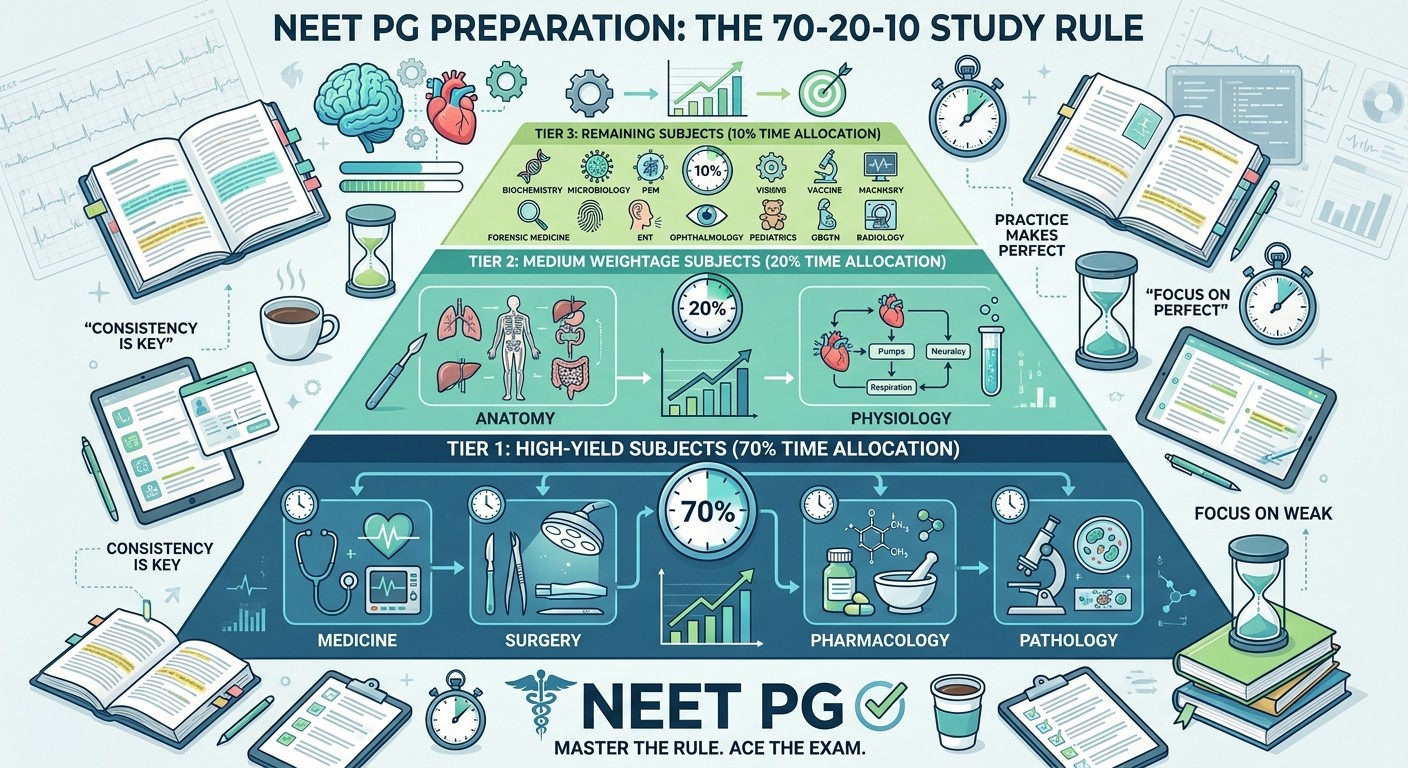
Strategic Time Allocation: The 70-20-10 Rule
Based on this weightage data, here is how toppers actually split their study time:
70% time on Big Four subjects:
Internal Medicine: 25%
Surgery: 20%
Pharmacology: 15%
Pathology: 10%
20% time on Moderate-Weightage subjects:
Focus on Anatomy, Physiology first
Then OB-GYN, Pediatrics, Forensic Medicine
10% time on Lower-Weightage subjects:
Quick revision only
Focus on high-yield topics within each
When you are using Oncourse AI's Daily Plan feature, this weightage distribution automatically adjusts to surface Medicine, Surgery, Pharmacology, and Pathology more frequently in your study schedule, while ensuring you dont skip the moderate-weightage subjects completely.
High-Yield Topics by Subject: What Actually Gets Asked
Internal Medicine (40-45 Questions)
Cardiology (8-12 questions):
ECG interpretation (ST changes, arrhythmias)
Acute coronary syndrome management
Heart failure classification and drugs
Hypertension guidelines and target BP
Endocrinology (6-10 questions):
Diabetes management and complications
Thyroid disorders (hypo/hyperthyroidism)
PCOS and metabolic syndrome
Adrenal disorders
Gastroenterology (6-8 questions):
Chronic liver disease and cirrhosis
IBD (Crohns vs UC features)
GI bleeding approach
Peptic ulcer disease
The DM-HTN-CAD combination covers roughly 40% of Internal Medicine questions — about 16-18 questions annually. For complex classification schemes in endocrinology, the AI Mnemonic engine can instantly generate memory hooks like "STRIDE" for metabolic syndrome criteria, turning passive reading into active recall.
Surgery (35-40 Questions)
General Surgery (12-15 questions):
Acute abdomen management
GI surgeries (appendectomy, cholecystectomy)
Hernias and their complications
Trauma protocols
Orthopedics (8-10 questions):
Fracture management
Joint diseases and arthritis
Spine disorders
Sports injuries
Surgical Subspecialties (15+ questions):
Urology: kidney stones, BPH, prostate cancer
Neurosurgery: head injuries, brain tumors
CVT Surgery: valve diseases, bypass procedures
Surgery questions are increasingly case-based. Practice with surgery lessons that focus on clinical decision-making rather than just textbook facts.
Pharmacology (20-25 Questions)
High-Yield Drug Classes:
Cardiovascular drugs (ACE inhibitors, beta blockers, diuretics)
Antimicrobials (antibiotics, antifungals, antivirals)
CNS drugs (antidepressants, antiepileptics, antipsychotics)
Endocrine drugs (insulin, thyroid hormones, steroids)
Mechanism of Action Questions:
Drug interactions and contraindications
Side effects and adverse reactions
Clinical pharmacology applications
Pharmacology is memory-heavy with classifications and mechanisms. For drug class mnemonics like "ABCD" for antihypertensives (ACE inhibitors, Beta blockers, Calcium channel blockers, Diuretics), instant AI-generated memory hooks save hours of manual mnemonic creation.
Pathology (18-22 Questions)
General Pathology (8-10 questions):
Inflammation and healing
Neoplasia classification
Cell injury and death
Hemodynamic disorders
Systemic Pathology (10-12 questions):
Cardiovascular pathology
Respiratory pathology
GI tract pathology
Renal pathology
Use pathology flashcards for spaced repetition of classification schemes and diagnostic criteria.
Topper Strategy: How to Allocate Study Hours
6-Month Preparation Plan
Months 1-2: Foundation Building (70% Big Four)
Medicine: 3 hours/day
Surgery: 2 hours/day
Pharmacology: 2 hours/day
Pathology: 1 hour/day
Others: 2 hours total
Months 3-4: Intensive Coverage (Balanced approach)
Maintain 4 hours daily on Big Four
Add 2 hours on Anatomy/Physiology
Add 2 hours on clinical subjects (OB-GYN, Pediatrics)
Months 5-6: Revision + Mock Tests
50% revision of Big Four
30% moderate-weightage subjects
20% quick review of low-weightage subjects
12-Month Preparation Plan
Months 1-4: Complete first reading
Cover all subjects equally
Build strong conceptual foundation
Start MCQ practice after each topic
Months 5-8: Weighted second reading
Apply 70-20-10 rule strictly
Focus on internal medicine lessons and high-yield topics
Months 9-12: Revision and practice
Subject-wise mock tests
Weak area identification and targeted study
Final month: only revision and full-length mocks
Using Synapses spaced repetition flashcards during this phase helps retain the massive volume of facts across 19 subjects — cards from high-weightage subjects like Medicine surface more frequently, while low-yield content gets deprioritized as your exam approaches.
Common Mistakes That Cost Marks
Over-investing in Low-Yield Subjects
Many students spend equal time on all subjects. This is a disaster. Spending 2 hours daily on Psychiatry (3-5 questions) while giving Medicine the same time is like preparing equally for a 5-mark question and a 180-mark question.
Ignoring Clinical Application
NEET PG 2026 has increased clinical vignettes and image-based questions. Rote memorization wont cut it anymore. Focus on clinical reasoning and case-based learning, especially in high-weightage subjects.
Not Using Weightage for Mock Analysis
After each mock test, analyze your performance by weightage, not just percentage. Missing 5 questions in Medicine hurts more than missing 5 in Psychiatry. Prioritize improving accuracy in Big Four subjects first.
Skipping Spaced Repetition
With 19 subjects worth of facts, forgetting is inevitable without systematic revision. Tag your Synapses flashcards by subject priority — let the algorithm surface Medicine and Surgery cards more frequently while automatically spacing out low-yield content you already know.
How to Build Your Study Plan Using This Data
Step 1: Calculate Your Available Study Hours
6 months = ~720 hours
12 months = ~1440 hours
Step 2: Apply the 70-20-10 Rule
Big Four: 70% of total hours
Moderate: 20% of total hours
Low-yield: 10% of total hours
Step 3: Subject-Specific Allocation Within Each Tier
Big Four breakdown:
Medicine: 35% of the 70% (largest chunk)
Surgery: 30% of the 70%
Pharmacology: 20% of the 70%
Pathology: 15% of the 70%
Step 4: Track and Adjust Weekly
Use your mock test performance to fine-tune. If your Medicine accuracy drops, temporarily increase its percentage. If you are consistently scoring well in Surgery, shift some hours to weaker Big Four subjects.
Frequently Asked Questions
How accurate is this weightage data for NEET PG 2026?
This distribution is based on analysis of NEET PG patterns from 2019-2024. While exact numbers may vary by ±2-3 questions per subject, the relative weightage hierarchy remains consistent year after year.
Should I completely skip low-weightage subjects?
No. Allocate 10% of your time to them. Even 3-5 questions can make the difference between your target branch and backup option. Quick revision and high-yield topics in these subjects can secure easy marks.
What if I am strong in low-weightage subjects but weak in high-weightage ones?
Resist the temptation to over-focus on your strengths. The opportunity cost is too high. Use your strong subjects for confidence-building during breaks, but dedicate prime study hours to Big Four improvement.
How do I handle burnout while focusing heavily on Big Four subjects?
Rotate within the Big Four daily. Monday: Medicine focus, Tuesday: Surgery focus, etc. Also, use your 10% low-yield time as "brain breaks" — subjects like Forensic Medicine can feel lighter after intense Medicine study.
Is this strategy applicable for different NEET PG rank goals?
Yes, but intensity varies. For top 1000 rank: follow this religiously with 75%+ accuracy in Big Four. For top 5000 rank: 70% Big Four accuracy with decent moderate subject performance. The weightage principle remains the same.
How should I adjust this plan if I have limited time (3-4 months)?
Intensify the 70-20-10 rule. Go to 80-15-5 if needed. Focus almost exclusively on Big Four with just basic coverage of moderate subjects. Skip detailed study of low-weightage subjects entirely — just do previous year questions.
The key insight is this: NEET PG rewards strategic preparation over comprehensive coverage. Master the Big Four, maintain competency in moderate subjects, and grab quick wins from low-yield areas. This data-driven approach has consistently produced top ranks because it aligns study effort with actual exam weightage.
Prepare smarter with Oncourse AI — adaptive MCQs, spaced repetition, and AI explanations built for NEET PG. Download free on Android and iOS.