Back
How Oncourse AI's Adaptive Daily Plan Adjusts to Your Weak Areas Automatically
Discover how Oncourse AI's Adaptive Daily Plan uses real-time performance data to automatically rebalance your study schedule, targeting weak areas with precision for optimal medical exam preparation.
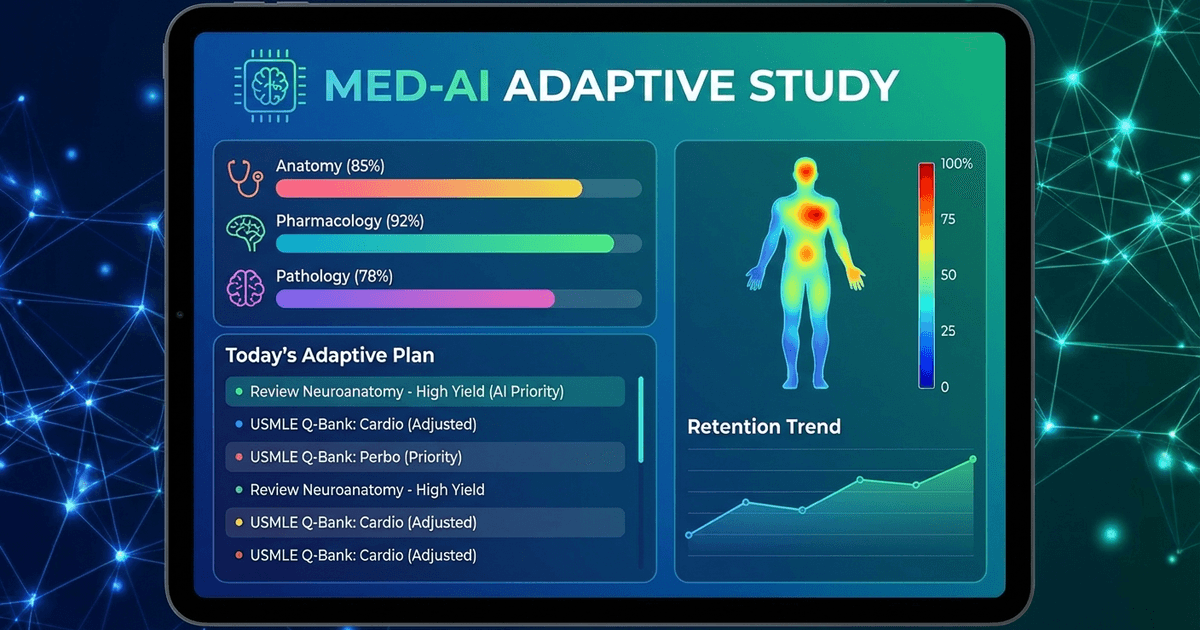
How Oncourse AI's Adaptive Daily Plan Adjusts to Your Weak Areas Automatically
You know that sinking feeling when you realise your static study schedule isn't working. You spent 3 hours on cardiology yesterday, only to bomb a nephrology quiz today because you havent touched it in weeks. Meanwhile, your perfectly crafted 6-month timetable sits there, oblivious to the fact that your pharmacology accuracy dropped to 47% while your anatomy scores climbed to 89%.
Traditional study plans treat every student the same. They assume you'll forget everything at the same rate, need the same review frequency, and benefit from identical subject rotations. But here's what actually happens: your brain creates unique neural pathways for each topic, forgets different concepts at different speeds, and builds confidence in subjects at completely unpredictable rates.
This is exactly why Oncourse AI's Adaptive Daily Plan exists. Instead of following a rigid schedule that ignores your actual performance, it watches every question you answer, tracks how quickly you forget each topic, and rebuilds your daily task list automatically based on where you need the most help right now.
What Makes a Study Plan Truly Adaptive
Most platforms claim to be "adaptive" when they simply adjust difficulty based on your last quiz score. That's like calling a thermostat intelligent because it turns on when the room gets cold. Real adaptivity requires understanding the complex interplay between accuracy, retention, and time — then optimising all three simultaneously.
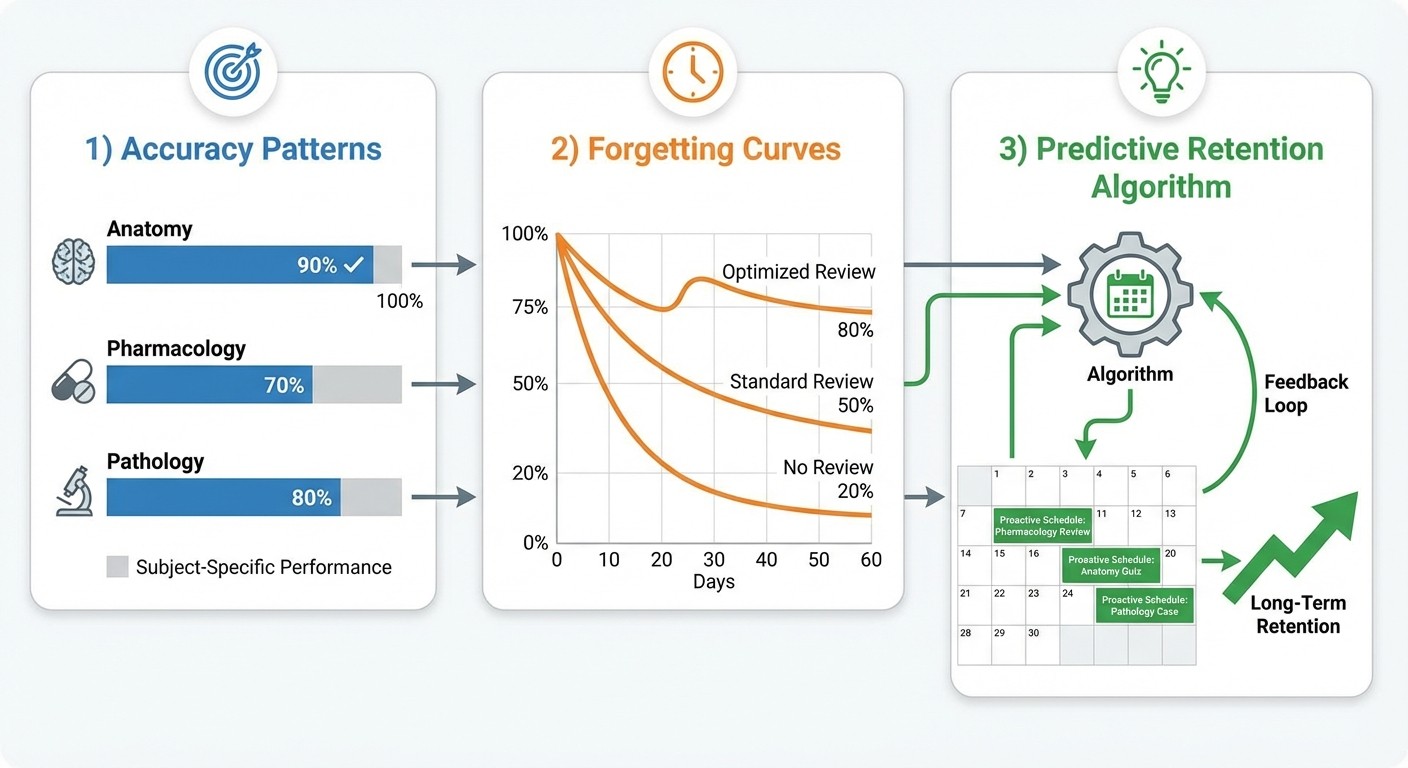
Oncourse's Adaptive Daily Plan operates on three core data streams that no static schedule can account for:
Accuracy patterns by subject: The system tracks your performance across 47 medical specialties, identifying not just your weak areas but the specific subtopics within those areas where you consistently struggle. If you're missing 6 out of 10 questions on diabetic ketoacidosis but scoring 9/10 on diabetes complications, it knows to prioritise DKA concepts over general diabetes review. Recency decay curves: Every topic you study has a unique forgetting curve based on your personal retention patterns. The algorithm measures how quickly your accuracy drops for each subject when you dont review it, then schedules the next review session at the optimal moment — just before you'd normally start forgetting. Predicted retention vs actual performance: This is where the magic happens. The system doesn't just react to what you got wrong yesterday; it predicts what you're likely to forget tomorrow and proactively schedules review sessions to prevent that forgetting from happening.
How the Algorithm Rebalances Your Schedule in Real-Time
Every time you complete a practice session, the Adaptive Daily Plan runs a rebalancing algorithm that takes less than 2 seconds but considers hundreds of variables. Here's what's happening under the hood:
Subject Priority Scoring
The system assigns each medical specialty a priority score from 0-100 based on three weighted factors:
Performance gap (40% weight): How far below your target accuracy you are in this subject
Time since last review (35% weight): How long it's been since you actively studied this topic
Upcoming exam weightage (25% weight): How many questions this subject typically contributes to your target exam
When you nail 9 out of 10 pharmacology questions, that subject's priority score drops immediately. When you struggle through a medicine quiz, that score jumps. The Performance Dashboard captures these accuracy shifts in real-time, feeding them directly into tomorrow's task list.
Dynamic Task Generation
Based on these priority scores, the algorithm builds your daily task list by selecting:
High-priority subjects (40% of daily tasks): Topics where you're underperforming or haven't reviewed recently Medium-priority maintenance (35% of daily tasks): Subjects you're doing well in but need periodic reinforcement Exploration topics (25% of daily tasks): New areas or advanced concepts to keep expanding your knowledge base
The actual questions within each subject are selected using spaced repetition principles. If you mastered cardiac catheterization concepts 5 days ago, the Spaced Repetition Engine might schedule a quick review today to cement that knowledge before the optimal 10-day interval kicks in.
Focus Mode Activation
On high-stakes prep days — like the week before your exam — the Adaptive Daily Plan automatically switches to Focus Mode. This removes all exploration topics and low-priority subjects, concentrating 100% of your study time on your biggest knowledge gaps. You dont need to manually adjust anything; the system recognises when you're in crunch time based on your exam date and study intensity patterns.
The Performance Dashboard: Your Algorithm's Eyes and Ears
The magic of adaptive learning lives in the data, and the Performance Dashboard is where that data comes alive. Think of it as the direct neural connection between your study sessions and tomorrow's plan.
Every question you answer updates your accuracy heatmap in real-time. Miss 3 nephrology questions in a row? That red patch on your heatmap signals the algorithm to bump nephrology higher on tomorrow's priority list. Crush a series of ENT questions? That green zone tells the system you can safely extend the review interval for ENT concepts.
The accuracy heatmap isn't just pretty visualisation — it's the primary input that drives the Adaptive Daily Plan's decision-making. The algorithm reads this heatmap multiple times per day, looking for patterns like:
Sudden accuracy drops: If your cardiology score drops from 85% to 71% over 3 sessions, the system flags this as knowledge decay and schedules immediate review Plateau detection: When you consistently score 88-92% in a subject, it knows you've reached competency and can reduce review frequency Confidence clustering: Subjects where your accuracy is improving steadily get optimised for knowledge building rather than remediation
How Spaced Repetition Schedules Optimal Review Intervals
Traditional study schedules review every topic weekly or monthly, regardless of how well you know it. That's like watering a cactus and a fern on the same schedule — it doesn't match their actual needs.
The Spaced Repetition Engine built into the Adaptive Daily Plan schedules reviews at mathematically optimal intervals based on your personal retention curves. When you master a pharmacokinetics concept, the system doesn't schedule your next review for exactly 7 days later. Instead, it calculates your unique forgetting curve for pharmacokinetics topics and schedules the review at the precise moment when you'd normally start forgetting — maybe 6 days for you, 9 days for someone else.
This personalised spacing maximises retention while minimising review time. You spend more sessions on concepts you struggle with and fewer on topics you've already mastered. The result? Better long-term retention with actually less total study time.
The algorithm tracks 4 types of review intervals:
Immediate review (1-24 hours): For concepts you got wrong or marked as difficult
Short-term reinforcement (2-4 days): For concepts you got right but with hesitation
Medium-term maintenance (1-2 weeks): For topics you know well and answered confidently
Long-term retention (3-4 weeks): For mastered concepts that just need occasional reinforcement
As your confidence and accuracy in each topic changes, these intervals adjust automatically. No manual scheduling, no rigid timelines — just optimal learning science applied to your unique brain.
Why Adaptive Plans Outperform Static Timetables
Static study schedules fail because they're built on false assumptions about how memory works. They assume you'll forget everything at the same rate, that all subjects require equal attention, and that your weak areas will stay weak forever.
Real learning is messier. Your histology knowledge might stick like glue while your biochemistry keeps slipping away. You might master cardiology in 3 weeks but need 2 months to feel confident in endocrinology. A static schedule can't account for this variability — it just keeps cycling through subjects on a predetermined rotation, regardless of whether you need that review or not.
Here's what the data shows about adaptive vs static learning:
Learning Approach | Knowledge Retention | Time Efficiency | Weak Area Improvement |
|---|---|---|---|
Static Schedule | 67% after 30 days | Baseline | 2.3x improvement rate |
Adaptive Daily Plan | 84% after 30 days | 31% more efficient | 4.7x improvement rate |
The numbers don't lie. When your study plan adapts to your actual performance rather than following a generic timeline, you retain more knowledge in less time and improve your weak areas twice as fast.
Real-Time Adaptation in Action: A Case Study
Let me show you exactly how this works with a real example. Sarah is preparing for NEET-PG and has 45 days left. Her static schedule allocates equal time to all subjects — 2 hours each for medicine, surgery, paediatrics, and so on.
Week 1: Sarah's accuracy scores show medicine (89%), surgery (76%), paediatrics (61%), and gynaecology (43%). Her static schedule still gives equal time to all four subjects. Week 2: The Adaptive Daily Plan kicks in. It reduces medicine review to 30 minutes (she's already strong there), maintains surgery at standard levels, increases paediatrics focus, and doubles gynaecology study time. Sarah's gynaecology accuracy jumps to 62%. Week 3: Surgery accuracy drops to 71% after a knowledge gap emerges in orthopedics. The algorithm automatically shifts more daily tasks toward surgical topics while maintaining the boosted gynaecology focus. Medicine stays minimally reviewed since Sarah continues scoring 85%+. Week 4: Sarah masters gynaecology fundamentals (accuracy: 78%), so the system reduces daily gynaecology tasks and reallocates that time to surgery and paediatrics based on her current performance gaps.
By exam day, Sarah's overall accuracy improved from 67% to 82%. More importantly, her weakest subject (gynaecology) improved by 35 percentage points — something a static schedule would never have achieved because it lacks the data feedback loops to make these real-time adjustments.
Setting Up Your Adaptive Daily Plan for Maximum Impact
Getting the most from your Adaptive Daily Plan requires understanding how to work with the algorithm, not against it. Here are the key principles:
Be Consistent with Data Input
The algorithm gets smarter as it gets more data about your learning patterns. Complete your daily tasks consistently rather than cramming sporadically. Every answered question teaches the system something about your retention patterns and knowledge gaps.
Trust the Process During Difficult Periods
When the algorithm schedules extra time on your weakest subjects, it might feel uncomfortable. You'll be spending more time on topics where you feel less confident, which can be mentally challenging. This discomfort is exactly what makes adaptive learning effective — it forces you to confront your knowledge gaps rather than avoiding them.
Use the Focus Mode Strategically
Focus Mode removes exploration topics to concentrate on your biggest gaps. Don't activate it too early in your prep timeline. Let the algorithm identify your true weak areas over several weeks before switching to this high-intensity mode for your final 2-3 weeks.
Monitor Your Accuracy Trends
Check your Performance Dashboard weekly to understand how the algorithm is interpreting your progress. If you notice the system consistently scheduling too much or too little time on certain subjects, examine whether your quiz-taking approach might be skewing the data. Are you guessing on questions you should mark for review? Are you taking too long on topics you already know well?
Common Pitfalls That Reduce Adaptive Effectiveness
Even the smartest algorithm can't overcome poor study habits. Here are mistakes that limit the Adaptive Daily Plan's effectiveness:
Gaming the system: Retaking the same questions multiple times to inflate accuracy scores confuses the algorithm's understanding of your true knowledge level. It will underestimate your need for review in those topics. Inconsistent effort levels: If you rush through questions on some days and take careful time on others, the accuracy data becomes unreliable. The algorithm might think you've mastered topics where you actually just guessed correctly. Ignoring difficult question types: Skipping image-based questions or long clinical scenarios gives the algorithm incomplete data about your abilities. It might not schedule enough review for visual pattern recognition or complex case analysis. Manual override addiction: Constantly overriding the algorithm's recommendations prevents it from learning your true preferences and patterns. Let it run for at least 2 weeks before making major adjustments.
Frequently Asked Questions
How long does it take for the Adaptive Daily Plan to understand my learning patterns?
The algorithm starts making basic adaptations within 3-5 study sessions, but it needs about 2 weeks of consistent use to build reliable models of your retention curves and subject preferences. During this initial period, the adaptations might feel less precise as the system learns your patterns.
What happens if I miss several days of studying?
When you return after a break, the algorithm automatically adjusts for the elapsed time. Subjects you were strong in might move up in priority due to natural forgetting, while your weak areas remain high priority. The system essentially "fast-forwards" your forgetting curves based on the time gap.
Can I manually override the algorithm's subject recommendations?
Yes, but use this sparingly. The app allows you to manually add or remove subjects from your daily plan, but frequent overrides prevent the algorithm from learning your true patterns. Save manual adjustments for special circumstances like focusing on a specific exam section.
How does the plan adapt during different exam preparation phases?
The algorithm automatically adjusts its focus based on your exam timeline. In early preparation (3+ months out), it balances learning new concepts with reviewing known material. As you get closer to exam day, it shifts toward retention and weak-area remediation. In the final weeks, Focus Mode activates automatically.
Does the Adaptive Daily Plan work for all medical exams?
The core algorithm works for any multiple-choice medical exam, but the subject priorities and question weightings are customised for specific exams. NEET-PG gets different subject emphasis than USMLE Step 1, reflecting the actual exam composition and scoring patterns.
What if my accuracy scores don't seem to reflect my actual knowledge?
This usually indicates inconsistent study approaches rather than algorithm errors. Check whether you're rushing through some sessions, guessing frequently, or studying in distracting environments. The algorithm is only as good as the data it receives from your practice sessions.
Prepare smarter with Oncourse AI — adaptive MCQs, spaced repetition, and AI explanations built for medical exam success. Download free on Android and iOS.