NEET PG 2026 Syllabus: Complete Subject-Wise Breakdown, Weightage and What to Study First
Complete NEET PG 2026 syllabus breakdown with subject-wise question weightage, tier-based study strategy, and optimal preparation sequence. Master the 19 subjects strategically.
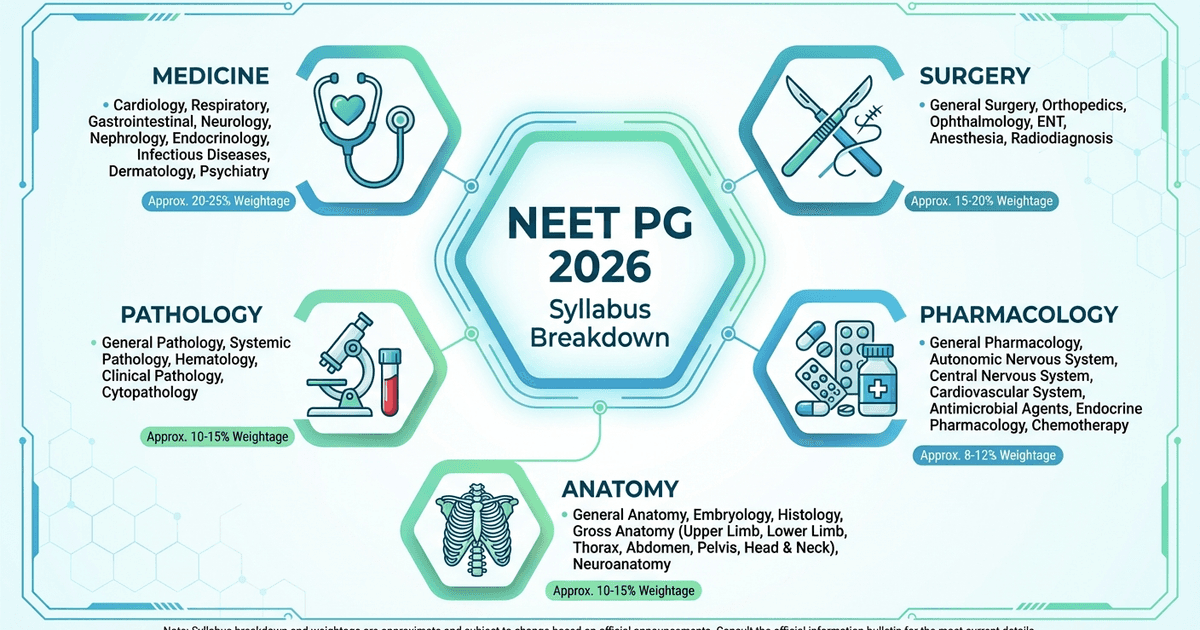
NEET PG 2026 Syllabus: Complete Subject-Wise Breakdown, Weightage and What to Study First
You are probably staring at the official NBE syllabus PDF thinking "19 subjects, 200 questions, where do I even start?" The truth is, most NEET PG aspirants approach the syllabus wrong. They study everything equally when some subjects carry 25+ questions while others barely hit 5.
NEET PG has 200 questions across 19 subjects. That gives you exactly 3 minutes per question. But here's what the toppers know: Pathology alone carries 24-26 questions. Medicine carries 20-22. Surgery carries 18-20. Those three subjects? Thats 33% of your total score right there.
This isnt about studying everything. Its about studying smart. Lets break down exactly which subjects matter, what weightage they carry, and the precise order to tackle them for maximum score ROI.
Official NEET PG 2026 Subject Distribution
The National Board of Examinations has standardized NEET PG into these 19 subjects. No surprises here - this hasnt changed since 2019:
Clinical Subjects (High Weightage):
General Medicine
General Surgery
Obstetrics & Gynaecology
Paediatrics
Orthopedics
ENT
Ophthalmology
Psychiatry
Dermatology
Radiodiagnosis
Anaesthesiology
Basic Sciences (Foundation Heavy):
Anatomy
Physiology
Pathology
Pharmacology
Microbiology
Biochemistry
Forensic Medicine & Toxicology
Community Medicine/PSM
The total: 200 questions, 800 marks, 3.5 hours. No negative marking since 2021.
Subject-Wise Question Weightage Analysis
Based on the last 5 years of NEET PG patterns, here's the real question distribution you need to plan around:
Subject | Questions | Percentage | Study Priority |
|---|---|---|---|
Pathology | 24-26 | 12-13% | Tier 1 |
General Medicine | 20-22 | 10-11% | Tier 1 |
General Surgery | 18-20 | 9-10% | Tier 1 |
Pharmacology | 16-18 | 8-9% | Tier 1 |
Anatomy | 14-16 | 7-8% | Tier 1 |
Physiology | 12-14 | 6-7% | Tier 2 |
Microbiology | 12-14 | 6-7% | Tier 2 |
Biochemistry | 10-12 | 5-6% | Tier 2 |
OBG | 10-12 | 5-6% | Tier 2 |
Paediatrics | 10-12 | 5-6% | Tier 2 |
ENT | 8-10 | 4-5% | Tier 3 |
Ophthalmology | 8-10 | 4-5% | Tier 3 |
Orthopedics | 8-10 | 4-5% | Tier 3 |
PSM | 6-8 | 3-4% | Tier 3 |
Radiodiagnosis | 6-8 | 3-4% | Tier 3 |
Anaesthesia | 4-6 | 2-3% | Tier 3 |
Dermatology | 4-6 | 2-3% | Tier 3 |
Psychiatry | 4-6 | 2-3% | Tier 3 |
Forensic Medicine | 4-6 | 2-3% | Tier 3 |
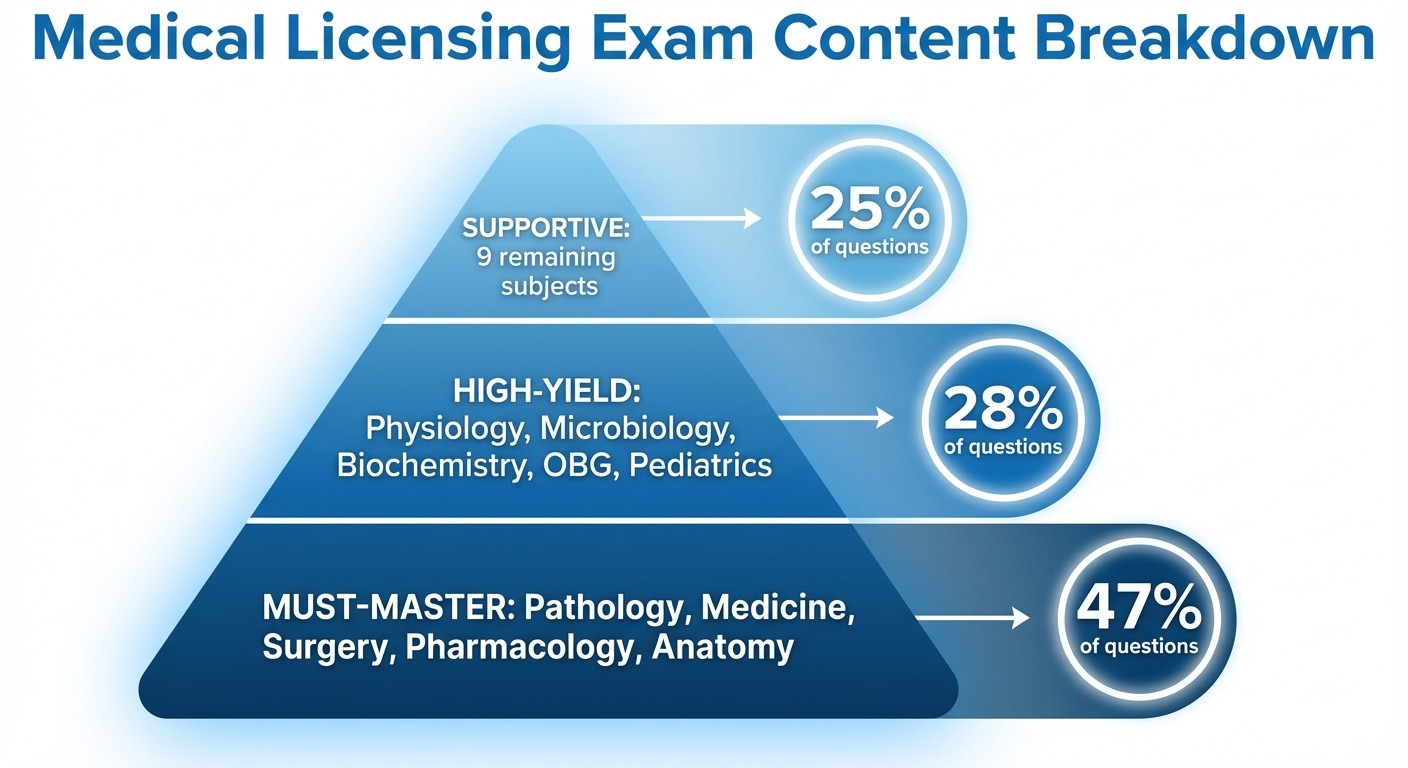
Key insight: Tier 1 subjects (top 5) account for 47-52% of total questions. Master these five, and you are already halfway to your target score.
The Three-Tier Study Strategy: What to Study First
Tier 1: Must-Master Subjects (Study First)
Timeline: Months 1-4 of prep 1. Pathology (24-26 questions)
Start here. Pathology connects to every clinical subject. When you know the pathophysiology of myocardial infarction, cardiology questions become easier. When you understand inflammatory bowel disease pathology, gastroenterology clicks.
High-yield areas: Neoplasia, Inflammation, CVS pathology, GIT pathology, Kidney pathology, CNS pathology.
Oncourse AI tracks your pathology performance across 847 high-yield concepts, automatically scheduling difficult topics like amyloidosis and vasculitis for repeated review using spaced repetition.
2. General Medicine (20-22 questions)
The backbone of NEET PG. Medicine questions often test clinical decision-making, not just theoretical knowledge.
High-yield: Cardiology (8-10 questions alone), Gastroenterology, Nephrology, Endocrinology, Infectious diseases.
3. General Surgery (18-20 questions)
Surgery questions are often case-based with imaging. Pattern recognition matters more than memorizing surgical techniques.
High-yield: GI surgery, Trauma, Oncology principles, Fluid management, Surgical infections.
4. Pharmacology (16-18 questions)
The highest ROI subject per hour studied. Pharmacology has predictable patterns: mechanism, side effects, contraindications, drug interactions.
High-yield: CVS drugs, Antimicrobials, CNS drugs, Chemotherapy, Emergency drugs.
Practice pharmacology MCQs daily from month 1. Oncourse AI question bank organizes pharmacology by drug classes, letting you drill beta-blockers until you know every side effect and contraindication cold.
5. Anatomy (14-16 questions)
Anatomy questions are either straightforward (you know it or you dont) or clinically applied. Focus on clinical correlations over pure descriptive anatomy.
High-yield: Neuroanatomy, Heart anatomy, GIT anatomy, Applied anatomy for surgeons.
Tier 2: High-Yield Subjects (Study Months 3-6)
Timeline: Start after Tier 1 foundation is solid
These subjects carry 5-7 questions each but are often easier to score in:
Physiology: CVS, Respiratory, Renal physiology dominate
Microbiology: Bacteriology, Virology, Parasitology - very factual
Biochemistry: Clinical biochemistry, Enzymology, Metabolism
OBG: High-yield but vast - focus on common conditions
Paediatrics: Growth milestones, vaccines, genetic disorders
For these subjects, the Oncourse AI adaptive daily plan automatically increases your question targets when you are performing above average, and provides extra mnemonics for complex topics like metabolic pathways in biochemistry.
Tier 3: Supportive Subjects (Study Months 5-8)
Timeline: After Tier 1+2 foundation
These carry 2-5 questions each. Dont skip them, but dont start here:
ENT, Ophthalmology, Orthopedics, PSM, Radiology, Anaesthesia, Dermatology, Psychiatry, Forensic Medicine.
Strategy for Tier 3: Focus on high-yield topics only. One afternoon per subject covering the most commonly asked 20-30 topics will get you 70% of available marks.
Common NEET PG Syllabus Mistakes (Avoid These)
1. Starting with Tier 3 subjects because they seem "easier"
ENT might feel less intimidating than pathology, but ENT carries 8 questions while pathology carries 25. Do the math.
2. Reading textbooks before doing MCQs
NEET PG tests application, not recall. Start with MCQ practice from day 1, then read to fill gaps.
3. Studying all subjects equally
Equal time for every subject means you are undershooting in high-weightage areas and overshooting in low-weightage areas.
4. Ignoring cross-connections
Pathology connects to medicine. Pharmacology connects to everything. Study these foundations first and watch other subjects become easier.
5. Not tracking weak areas systematically
Without data on your subject-wise accuracy, you are flying blind. You might think you are good at cardiology when you are actually struggling with heart failure pharmacology specifically.
Week-by-Week Study Sequence for Maximum ROI
Months 1-2: Foundation Phase
Week 1-2: Pathology - Neoplasia, Inflammation
Week 3-4: Pathology - System-wise pathology starts
Week 5-6: Pharmacology - CVS drugs, CNS drugs
Week 7-8: Medicine - Cardiology basics
Months 3-4: Core Phase
Week 9-10: Surgery - GI surgery, Trauma
Week 11-12: Anatomy - Neuroanatomy, Applied anatomy
Week 13-14: Physiology - CVS, Respiratory
Week 15-16: First full-subject revision cycle
Months 5-6: Expansion Phase
Week 17-20: Add Microbiology, Biochemistry, OBG, Paediatrics
Week 21-24: Continue MCQ practice, add Tier 3 subjects
Months 7-8: Consolidation Phase
Week 25-28: Full-syllabus practice tests
Week 29-32: Weak area targeting and final review
The Oncourse AI spaced repetition engine ensures that pathology questions you got wrong in month 1 resurface at scientifically optimal intervals - typically 3 days after first attempt, then 1 week, then 3 weeks, then 2 months, so you never forget foundational concepts while building new ones.
How Oncourse AI Maps to the NEET PG Syllabus
The Oncourse AI platform is built around the official NEET PG syllabus structure. When you set your target as NEET PG 2026, the system automatically:
Subject-Filtered Learning: Every lesson, MCQ, and flashcard is tagged to the 19 NEET PG subjects. Want to drill only pathology? Filter to pathology. Want a mixed session of Tier 1 subjects? Select your preference. Adaptive Question Targets: Based on your target exam date and current performance, Oncourse AI calculates how many questions you need to solve per subject daily. If you are weak in pharmacology but strong in anatomy, the system automatically increases your pharmacology targets. Performance Analytics: The platform tracks your accuracy across all 19 subjects and identifies weak sub-topics. Instead of guessing where you need work, you get data: "You are 67% accurate in cardiology overall, but only 45% in heart failure pharmacology." Cross-Subject Connections: When studying pathology of myocardial infarction, the system suggests related pharmacology questions about thrombolytics and cardiology questions about ECG changes, because NEET PG loves questions that test multiple subjects together.
You can access detailed NEET PG pathology lessons, practice with subject-filtered MCQs, and review using high-yield flashcards - all aligned to the official NBE syllabus structure.
Subject-Specific High-Yield Topics to Prioritize
Pathology High-Yield Areas:
Neoplasia: Oncogenes, tumor suppressor genes, metastasis
Inflammation: Acute vs chronic, types, mediators
CVS: Atherosclerosis, MI, heart failure pathology
Kidney: Glomerulonephritis, acute tubular necrosis
CNS: Stroke, infections, degenerative diseases
Medicine High-Yield Areas:
Cardiology: ACS, heart failure, arrhythmias, valvular diseases
Gastroenterology: IBD, liver diseases, GI bleeding
Nephrology: AKI, CKD, electrolyte disorders
Endocrinology: DM, thyroid disorders, adrenal diseases
Infectious diseases: Sepsis, antimicrobial resistance
Surgery High-Yield Areas:
GI surgery: Appendicitis, bowel obstruction, GI bleeding
Trauma: ATLS principles, shock management
Oncology: Staging, surgical principles
Urology: Kidney stones, BPH, prostate cancer
Pharmacology High-Yield Areas:
CVS: ACE inhibitors, beta-blockers, diuretics, anti-arrhythmics
Antimicrobials: Beta-lactams, quinolones, antifungals, antivirals
CNS: Antiepileptics, antidepressants, antipsychotics
Chemotherapy: MOA, resistance, toxicity
Emergency drugs: Vasopressors, antidotes
Creating Your Personal Study Timeline
If you have 12 months:
Months 1-6: Complete Tier 1 + Tier 2 subjects with deep MCQ practice
Months 7-10: Add Tier 3 subjects, continue revision cycles
Months 11-12: Full-syllabus practice and weak area targeting
If you have 8 months:
Months 1-4: Rush through Tier 1 subjects with focused MCQ practice
Months 5-6: Add Tier 2 subjects, light coverage of Tier 3
Months 7-8: Practice tests and revision
If you have 6 months:
Months 1-3: Tier 1 subjects only, aggressive MCQ practice
Months 4-5: Add selected Tier 2 subjects (Physiology, Microbiology)
Month 6: Practice tests, Tier 3 high-yield topics only
The key is starting with subjects that give maximum return per hour invested. A week spent mastering cardiovascular pharmacology will improve your scores in cardiology, surgery, anaesthesia, and emergency medicine questions.
For efficient revision planning, check out our comprehensive NEET PG preparation strategy guide and subject-wise preparation approach.
Frequently Asked Questions
What are the most important subjects in NEET PG 2026 syllabus?
The top 5 subjects by question count are Pathology (24-26 questions), Medicine (20-22), Surgery (18-20), Pharmacology (16-18), and Anatomy (14-16). These five subjects account for nearly 50% of the total questions, making them your highest priority for preparation.
How many questions come from each subject in NEET PG?
NEET PG has 200 questions distributed across 19 subjects. High-weightage subjects like Pathology carry 24-26 questions, while lower-weightage subjects like Forensic Medicine carry only 4-6 questions. The exact distribution varies slightly each year but follows predictable patterns.
Should I study all subjects equally for NEET PG?
No, studying all subjects equally is a common mistake. Focus 60-70% of your time on Tier 1 subjects (Pathology, Medicine, Surgery, Pharmacology, Anatomy) since they carry the most questions. Spend proportionally less time on subjects that carry fewer questions.
Which subject should I start with for NEET PG preparation?
Start with Pathology. It connects to every clinical subject and carries the highest number of questions (24-26). When you understand pathophysiology, questions in medicine, surgery, and other clinical subjects become much easier to tackle.
How long does it take to cover the complete NEET PG syllabus?
With focused preparation, covering the complete NEET PG syllabus takes 6-12 months depending on your daily study hours and previous knowledge. Most successful candidates spend 8-10 months with 8-10 hours of daily study, prioritizing high-yield subjects first.
What is the best way to study NEET PG syllabus?
Start with MCQ practice from day 1 rather than reading textbooks. Focus on Tier 1 subjects first, use spaced repetition for retention, and track your performance across subjects to identify weak areas. Practice questions daily and use active recall techniques rather than passive reading.
---
The NEET PG syllabus is vast, but it isnt random. The NBE follows predictable patterns in question distribution. Focus on the subjects that matter most, start with the foundations that connect to everything else, and track your progress systematically.
Prepare smarter with Oncourse AI — adaptive MCQs, spaced repetition, and AI explanations built for NEET PG 2026. Download free on Android and iOS.