INICET Preparation 2026: Complete Subject-Wise Strategy, High-Yield Topics and Study Plan for First Attempt
Master INICET 2026 with this comprehensive preparation guide. Subject-wise strategies, high-yield topics, realistic study plans, and first-attempt success tips for medical graduates.
INICET Preparation 2026: Complete Subject-Wise Strategy, High-Yield Topics and Study Plan for First Attempt
You are probably wondering if 6 months is enough for INICET preparation. The answer depends on whether you know what youre up against. INICET 2026 has 200 questions in 3 hours — thats 54 seconds per question. But heres the reality: 60% of these questions arent simple recall anymore. Theyre clinical scenarios testing your decision-making ability.
This isnt the INICET your seniors faced. The exam shifted dramatically in January 2024 when AIIMS introduced sectional timing — 50 questions in 45 minutes per section. You cant skip around freely anymore. Every minute counts, and every weak subject becomes a potential disaster.
If youre planning your first attempt at INICET 2026, this guide covers everything: exam pattern changes, subject-wise weightage, high-yield topics from the last 5 years of papers, and realistic study plans for 6 months, 3 months, and the final month.
Understanding INICET 2026: Pattern and Weightage
Exam Structure and Changes
INICET 2026 follows the sectional format introduced in 2024:
200 multiple choice questions
3 hours total duration
4 sections of 50 questions each
45 minutes per section
+1 for correct, -1/3 for incorrect answers
The sectional timing is non-negotiable. You cant spend 30 minutes on Medicine questions and then rush through Surgery. Each section demands balanced preparation across all subjects.
Subject-Wise Weightage Distribution
Subject Category | Questions | Weightage | Key Focus Areas |
|---|---|---|---|
High-Yield Subjects | |||
General Medicine | 20-25 | 10-12.5% | CNS, CVS, Infectious diseases |
General Surgery | 20-25 | 10-12.5% | Breast, thyroid, trauma, GI |
Pathology | 15-20 | 7.5-10% | Neoplasia, hematology, cell injury |
Pharmacology | 15-20 | 7.5-10% | CNS drugs, autonomic drugs, DOCs |
Medium-Yield Subjects | |||
Community Medicine | 15-20 | 7.5-10% | Epidemiology, biostatistics, NHPs |
Microbiology | 15-20 | 7.5-10% | Virology, bacteriology, immunology |
Anatomy | 10-15 | 5-7.5% | Neuroanatomy, embryology |
Physiology | 10-15 | 5-7.5% | CVS, renal, nervous system |
Biochemistry | 10-15 | 5-7.5% | Metabolism, enzymes, vitamins |
Clinical Subjects | |||
OBGYN | 15-20 | 7.5-10% | Obstetric emergencies, contraception |
Pediatrics | 5-10 | 2.5-5% | Growth milestones, IMNCI |
Orthopedics | 5-10 | 2.5-5% | Fractures, bone tumors |
ENT | 5-10 | 2.5-5% | CSOM, vertigo, audiometry |
Ophthalmology | 5-10 | 2.5-5% | Cataract, glaucoma |
Others (Anesthesia, Psychiatry, Dermatology, Radiology) | 5-10 each | 2.5-5% each | DOCs, emergency management |
Subject-Wise INICET Preparation Strategy
Medicine (20-25 Questions) - Your Highest Scorer
Medicine carries maximum weightage, but the questions have evolved. Instead of "Name the drug for hypertension," expect scenarios like "A 65-year-old diabetic with heart failure presents with..."
High-Yield Topics:
CNS disorders: Stroke protocols, seizure management, movement disorders
Cardiovascular: ACS management, heart failure guidelines, arrhythmias
Infectious diseases: Sepsis protocols, antimicrobial resistance, tropical diseases
Rheumatology: Autoimmune markers, treatment protocols
Endocrinology: Diabetes complications, thyroid emergencies
Strategy: Focus on recent guidelines and protocols. Practice questions that combine multiple conditions. Use internal medicine questions to build pattern recognition for complex scenarios.
Surgery (20-25 Questions) - Clinical Decision Making
Surgery questions test surgical principles and emergency management rather than operative techniques.
High-Yield Topics:
Trauma: ATLS protocols, polytrauma management
GI Surgery: Acute abdomen, bowel obstruction, GI bleeding
Breast: BIRADS classification, treatment algorithms
Thyroid: Thyroid cancer staging, surgical indications
Hernia: Types, complications, mesh repair principles
Strategy: Learn algorithms for common surgical conditions. Focus on when to operate, not how to operate. The questions often test initial management and investigations.
Pathology (15-20 Questions) - Microscopy Meets Medicine
Pathology shifted from pure histology to clinico-pathological correlation. Expect images with clinical context.
High-Yield Topics:
Neoplasia: TNM staging, tumor markers, paraneoplastic syndromes
Hematology: Leukemia classification, bleeding disorders, blood banking
Cell injury: Apoptosis vs necrosis, ischemia-reperfusion injury
Inflammation: Acute vs chronic, wound healing
Immunopathology: Autoimmune diseases, transplant rejection
Strategy: Connect pathology findings to clinical presentations. Practice image-based questions. Understanding pathophysiology helps more than memorizing morphology. When reviewing pathology concepts, Oncourse's adaptive question bank can identify which pathological processes you struggle with most and adjust difficulty accordingly.
Pharmacology (15-20 Questions) - Clinical Applications
Pharmacology questions focus on real prescribing scenarios, drug interactions, and adverse effects in clinical context.
High-Yield Topics:
CNS drugs: Antiepileptics, antipsychotics, antidepressants with side effects
CVS drugs: Antihypertensives, anticoagulants, drug interactions
Autonomic drugs: Cholinergic and adrenergic systems in clinical context
Antimicrobials: Resistance patterns, DOCs for specific infections
DOCs: Disease-specific first-line therapies
Strategy: Learn drugs by therapeutic class, not alphabetically. Focus on contraindications and drug-drug interactions. Questions often test what NOT to prescribe.
Community Medicine (15-20 Questions) - Public Health Principles
Community Medicine requires understanding of health programs and biostatistics applications.
High-Yield Topics:
Epidemiology: Study designs, bias types, screening principles
Biostatistics: Sensitivity, specificity, predictive values, study analysis
National Health Programs: Recent updates in RMNCH+A, NCD programs
Environmental health: Water, air pollution, occupational health
Health planning: Health indicators, demographic transition
Strategy: Stay updated with recent government health initiatives. Practice calculation problems in biostatistics. Understanding concepts is more important than memorizing program details.
Microbiology (15-20 Questions) - Infectious Disease Focus
Microbiology integrates with clinical medicine, focusing on diagnostic methods and treatment protocols.
High-Yield Topics:
Virology: COVID-19, influenza, hepatitis viruses, diagnostic methods
Bacteriology: Gram-positive and negative bacteria, antibiotic sensitivity
Immunology: Vaccine schedules, immunodeficiency disorders
Mycology: Systemic mycoses, antifungal therapy
Parasitology: Tropical diseases, life cycles with clinical correlation
Strategy: Link microorganisms to diseases they cause. Focus on diagnostic tests and first-line treatments. Recent developments in antimicrobial resistance are frequently tested.
Pre-Clinical Subjects Strategy
Anatomy (10-15 Questions)
Neuroanatomy: 40% of anatomy questions come from nervous system
Embryology: Focus on developmental anomalies with clinical correlation
Gross anatomy: High-yield areas include brachial plexus, diaphragm, and pelvis
Physiology (10-15 Questions)
CVS: Cardiac cycle, ECG, blood pressure regulation
Renal: GFR, acid-base balance, diuretics mechanism
Nervous system: Sensory pathways, motor control, autonomic functions
Biochemistry (10-15 Questions)
Metabolism: Glycolysis, TCA cycle, gluconeogenesis with clinical correlation
Enzymes: Enzyme kinetics, diagnostic enzymes
Vitamins: Deficiency diseases, fat-soluble vs water-soluble
INICET Study Plans: 6-Month to Last Month
6-Month Study Plan (Detailed Preparation)
Months 1-2: Foundation Building
Complete theory from standard textbooks for all subjects
Focus 40% time on high-yield subjects (Medicine, Surgery, Pathology, Pharmacology)
Start with subject-wise question practice from Day 1
Target: 50 questions daily across subjects
Months 3-4: Integration and Pattern Recognition
Mixed subject practice sessions
Focus on clinical correlation between subjects
Increase question solving to 75 questions daily
Start short notes for high-yield topics
Weekly mock tests to identify weak areas
Months 5-6: Intensive Practice and Revision
Daily mock tests in sectional format
Focus revision on consistently weak topics using subject-wise performance analytics
Target: 100+ questions daily
Fine-tune timing for each section
Practice previous year questions in exam conditions
3-Month Intensive Study Plan
Month 1: Rapid Theory Coverage
High-yield subjects: 60% of study time
Theory + Questions simultaneously
Target: 75 questions daily
Complete one mock test per week
Month 2: Mixed Practice and Weak Area Focus
Subject-wise analysis to identify gaps
Increase to 100 questions daily
Two mock tests per week
Focus on speed and accuracy balance
Month 3: Final Sprint
Daily mock tests
Sectional practice with timing
Quick revision of high-yield notes
Previous year paper analysis
Last Month Strategy
Week 4: High-Yield Topic Revision
Medicine: Guidelines and protocols
Surgery: Emergency management algorithms
Pathology: Image-based diagnosis
Pharmacology: DOCs and contraindications
Daily mock test with analysis
Week 3: Sectional Practice
Practice 4 sections daily in exam timing
Focus on weaker sections identified through analytics
Review incorrect answers immediately
Light theory revision
Week 2: Mock Tests and Analysis
Two full-length tests daily
Detailed analysis of mistakes
Quick revision of frequently asked topics
Mental preparation and stress management
Week 1: Maintenance Mode
One mock test daily
Light revision of formula and high-yield facts
Avoid new topics
Focus on exam logistics and mental preparation
High-Yield Topics from Recent INICET Papers
Medicine High-Yield Areas
Cardiology: ACS management protocols, heart failure classification, ECG interpretation
Neurology: Stroke thrombolysis criteria, seizure classification, movement disorder drugs
Gastroenterology: IBD management, liver function tests interpretation, GI bleeding protocols
Respiratory: COPD GOLD classification, pneumonia management, pleural effusion analysis
Surgery High-Yield Areas
Emergency Surgery: Acute abdomen differential, trauma ATLS protocols
Breast Surgery: BIRADS classification, breast cancer staging and treatment
GI Surgery: Bowel obstruction management, appendicitis variants, hernia complications
Thyroid Surgery: Thyroid cancer types, surgical indications, complications
Pathology High-Yield Areas
Hematopathology: Leukemia classification, lymphoma staging, coagulation disorders
Oncopathology: Tumor staging systems, immunohistochemistry markers, metastasis patterns
Cardiovascular pathology: MI types, atherosclerosis, cardiomyopathies
Revision Strategy and Test-Taking Tips
Smart Revision Techniques
Active Recall Method:
Instead of re-reading notes, test yourself. Write down everything you remember about a topic, then check for gaps. This works particularly well for high-yield topics that appear frequently.
Spaced Repetition: Use flashcards for facts that need memorization — drug dosages, normal values, classifications. Oncourse's spaced repetition system automatically schedules reviews based on your retention patterns. Clinical Correlation:
Always connect basic science to clinical applications. When studying renal physiology, immediately connect to diuretic mechanisms and kidney disease management.
Test-Taking Strategy for INICET
Section Management:
First 15 minutes: Skim all 50 questions, mark the easy ones
Next 25 minutes: Solve marked questions and moderately difficult ones
Last 5 minutes: Attempt remaining questions or make educated guesses
Question Analysis:
INICET questions follow patterns. Long clinical scenarios usually test practical management, not rare diseases. Focus on the action required rather than getting lost in details.
Negative Marking Strategy:
Attempt questions where you can eliminate at least 2 options confidently. If you are completely clueless about a topic, skip it. The -1/3 penalty means you need 25% accuracy to break even on guesses.
Common First-Attempt Mistakes to Avoid
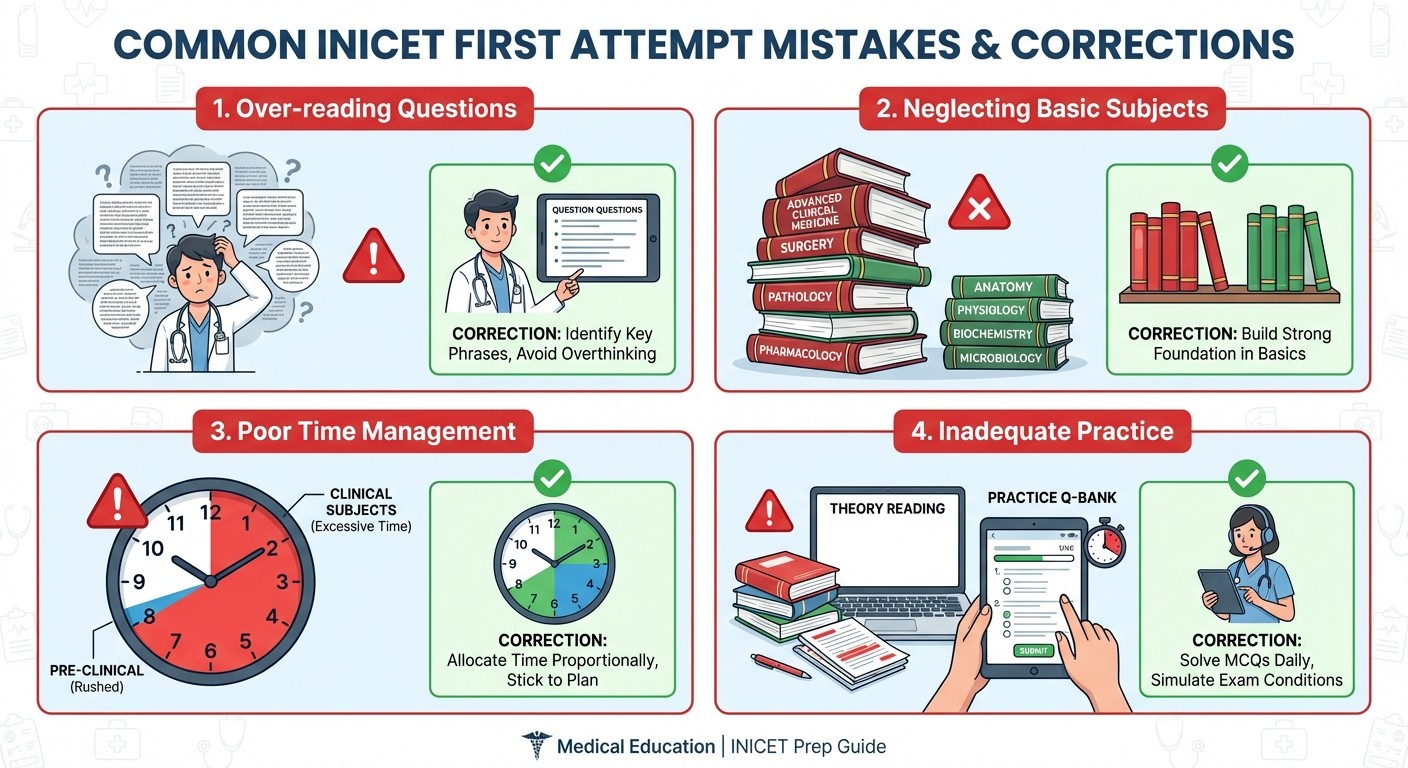
Mistake 1: Over-Emphasizing Rare Topics
First-time candidates often waste months studying rare syndromes and zebra diagnoses. INICET tests common conditions presented in complex ways, not rare diseases. Focus 80% of your time on conditions you will see in your residency.
Mistake 2: Neglecting Basic Subjects
Many candidates spend all their time on Medicine and Surgery, treating Anatomy and Physiology as "easy marks." This backfires when basic science questions become application-based. Allocate adequate time to pre-clinical subjects.
Mistake 3: Question Bank Shopping
Jumping between multiple question banks dilutes your preparation. Choose one comprehensive platform and stick with it. The pattern recognition comes from repeatedly seeing how the same concepts are tested differently.
Using analytics features helps identify which specific subtopics within each subject consistently trip you up — like autoimmune diseases in Pathology or drug mechanisms in Pharmacology — allowing targeted practice instead of blanket revision.
Mistake 4: Ignoring Sectional Timing Practice
Many students practice 200 questions continuously but never practice 50 questions in 45 minutes. The sectional format creates different pressure. Practice each section type separately before attempting full papers.
Mistake 5: Passive Revision in Final Weeks
Reading notes passively in the last month is ineffective. Your revision should be active: solving questions, explaining concepts aloud, and connecting topics. If you cant explain a concept simply, you dont understand it well enough.
Building Mental Resilience for INICET
Stress Management During Preparation
INICET preparation is mentally demanding. Unlike undergraduate exams, the competition is intense and the stakes feel higher. Build resilience early:
Study Load Management: Study 8-10 hours daily consistently rather than 14 hours sporadically. Consistency beats intensity for long-term retention. Mock Test Psychology: Treat every mock test as the real exam. This builds familiarity with the pressure and reduces exam-day anxiety. Peer Support: Connect with other INICET candidates for motivation, but avoid comparing your preparation timeline with theirs. Everyone has different backgrounds and learning speeds.
Exam Day Strategy
Night Before: Review high-yield formulas and classification tables only. Avoid attempting new questions or topics. Morning Routine: Eat a familiar breakfast. Reach the center 45 minutes early. Carry glucose tablets for energy during the exam. During Exam: Start each section with questions you are confident about. This builds momentum and confidence. If stuck on a question for more than 90 seconds, move on.
Technology-Enhanced INICET Preparation
Modern INICET preparation benefits significantly from adaptive learning technologies that adjust to your performance patterns.
PYQ Pattern Analysis
Previous year question analysis reveals that certain concepts repeat with variations every 2-3 years. INICET PYQ practice in simulated conditions helps identify these patterns and builds exam-specific thinking approaches.
Performance Tracking
Subject-wise accuracy tracking helps identify consistent weak spots that need focused attention. For instance, if you consistently struggle with autoimmune diseases in Pathology or specific drug classes in Pharmacology, targeted practice becomes essential.
The key is not just solving more questions, but solving the right questions that address your specific knowledge gaps and timing issues.
Frequently Asked Questions
Is 6 months enough for INICET preparation from scratch?
Six months is adequate for INICET preparation if you study efficiently. Focus 60% of your time on high-yield subjects (Medicine, Surgery, Pathology, Pharmacology) and maintain consistent daily practice. The key is active learning with immediate application through questions rather than passive reading.
What's the minimum score needed for INICET qualification?
INICET doesnt have a fixed cutoff. The qualifying score varies based on the difficulty level and candidate performance. Historically, scores around 110-120 out of 200 have been safe for AIIMS Delhi in general category, but this fluctuates annually.
Should I focus more on theory or questions for INICET?
INICET requires a balanced approach with 40% theory and 60% question practice. The exam tests application of knowledge rather than recall, so questions are crucial for understanding the exam pattern. Start questions from Day 1 of preparation.
How important are coaching materials for INICET preparation?
While coaching materials can be helpful for compiled notes, they arent essential. Standard textbooks combined with comprehensive question practice and previous year analysis are sufficient. Focus on understanding concepts rather than memorizing coaching shortcuts.
What if I fail INICET on my first attempt?
INICET can be attempted multiple times without restrictions. First-attempt failure provides valuable insights into your preparation gaps and exam strategy. Use the experience to refine your approach for the next attempt rather than viewing it as a setback.
How do I balance INICET preparation with internship duties?
Prioritize high-yield subjects and utilize clinical exposure during internship to reinforce theoretical knowledge. Study early morning or late evening when youre fresh. Use clinical cases to understand practical applications of concepts you study.
---
INICET 2026 rewards strategic preparation over extensive reading. Focus on high-yield topics, practice in exam conditions, and build consistent daily habits. The exam tests your ability to think clinically under pressure, not your ability to memorize textbooks.
Prepare smarter with Oncourse AI — adaptive MCQs, spaced repetition, and AI explanations built for INICET success. Download free on Android and iOS.