Back
How IMGs Can Match Into Internal Medicine Residency in 2026: Step 2 Score, Timeline & Strategy
Complete 2026 guide for IMGs matching internal medicine: Step 2 CK score requirements (240+), ERAS timeline, program signaling strategy, and visa considerations for successful residency match.
How IMGs Can Match Into Internal Medicine Residency in 2026: Step 2 Score, Timeline & Strategy
You are probably staring at FREIDA or Doximity, scrolling through hundreds of internal medicine programs, wondering if your Step 2 CK score will be enough. The 2026 NRMP cycle is more competitive than ever, but here's what most IMGs dont realize: internal medicine remains the single highest-volume specialty for successful IMG matches.
Last year, 3,847 IMG positions were filled in internal medicine across all NRMP categories. That's 47% of all IMG matches. But the numbers tell only half the story — the real question is how you position yourself to be one of them.
This isnt about generic application advice. This is your roadmap for the 2026 cycle: the Step 2 CK scores that actually matter, the ERAS timeline that determines your interview invites, and the strategic moves that separate matched IMGs from those heading into SOAP.
Current IMG Internal Medicine Match Statistics for 2026
The 2025 NRMP data shows internal medicine filled 8,732 categorical positions, with IMGs securing 44% of those spots. For non-US IMGs specifically, the match rate was 58.3% — higher than most specialties but lower than previous years.
Here's what the numbers mean for your 2026 application:
IMG Match Rates by Category (Internal Medicine 2025):
Non-US IMGs: 58.3% match rate
US IMGs: 78.1% match rate
Categorical positions filled by IMGs: 3,847
Preliminary positions filled by IMGs: 892
The data reveals two critical insights: first, volume works in your favor — internal medicine has more IMG-friendly positions than any other specialty. Second, competition has intensified, with average Step 2 CK scores creeping upward across all IMG categories.
Regional Distribution Matters:
Northeast and Midwest programs filled 61% of IMG spots, while Southern programs showed increased IMG acceptance rates. West Coast programs remain highly competitive, with many requiring research connections or geographic ties.
Programs increasingly prefer IMGs with US clinical experience, making observerships and externships essential rather than optional. The visa sponsorship landscape also shifted, with 73% of IMG-filled positions offering J1 sponsorship and 27% providing H1B pathways.
Step 2 CK Score Requirements: The Real Numbers
Forget the "minimum passing score" conversation. Here are the Step 2 CK benchmarks that actually determine your interview invites in 2026:
Competitive Step 2 CK Scores for IMGs:
Safety threshold: 240+
Competitive range: 245-255
Top-tier programs: 250+ (with strong clinical experience)
DO NOT apply with: Below 230 without exceptional circumstances
The data shows a clear inflection point at 240. IMGs scoring 240+ received an average of 12 interview invites, while those scoring 235-239 averaged 6 invites. Below 230, the match rate drops to 31%.
Your Step 2 CK score directly impacts program signaling effectiveness. Programs receiving 3,000+ applications use score cutoffs as the first filter. Most community programs set internal thresholds at 235, while academic centers start reviewing at 245.
Score Timeline Strategy:
Take Step 2 CK by August if possible, giving yourself a September retake window if needed. Programs begin reviewing applications in October, and late scores (November+) significantly reduce interview opportunities.
When prepping for these score targets, Oncourse's adaptive question bank adjusts difficulty based on your performance, drilling weak areas like cardiology and pulmonology that commonly appear in both Step 2 CK and internal medicine interviews. The AI identifies knowledge gaps in real-time, so you're not wasting time on concepts you've already mastered.
ERAS Application Timeline: Month-by-Month Strategy
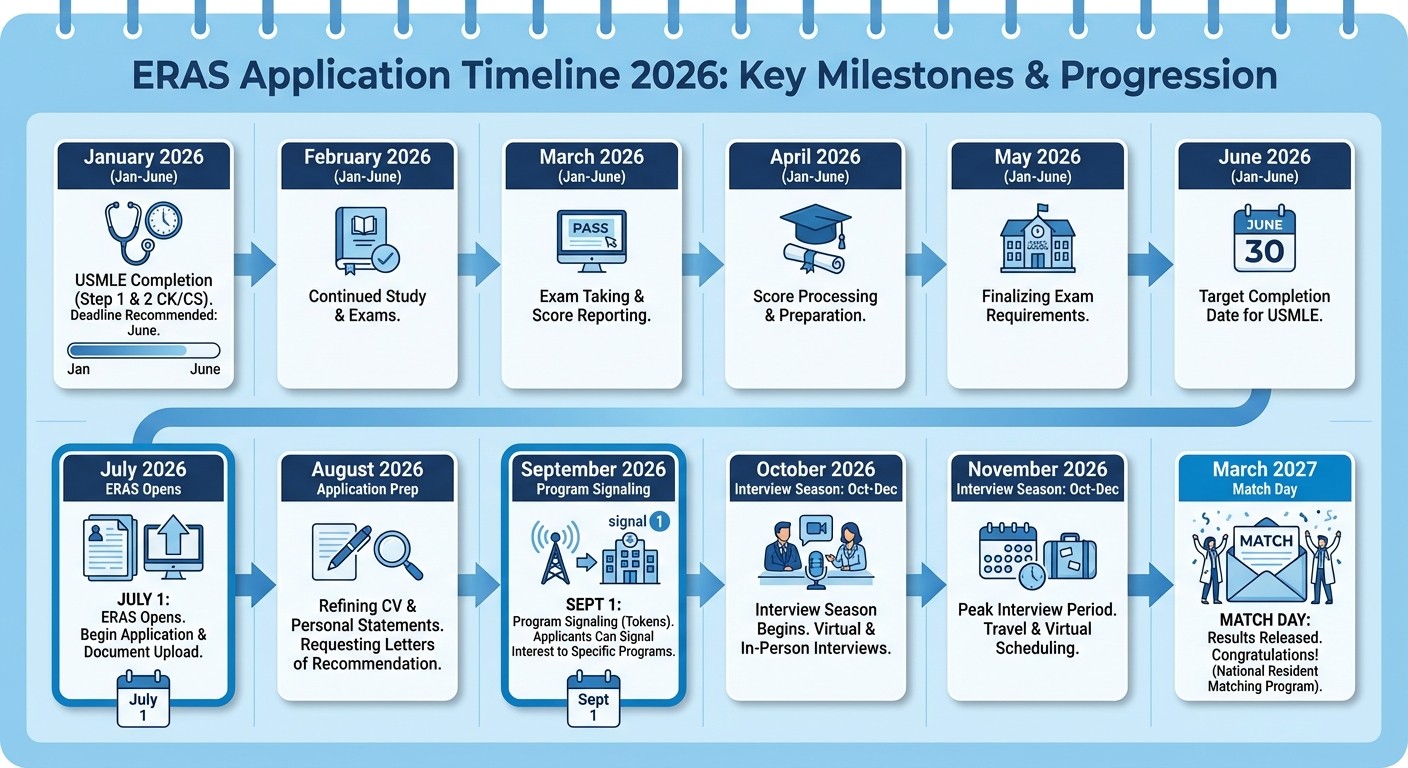
The 2026 NRMP timeline demands precise coordination between USMLE completion and application submission. Here's your monthly roadmap:
January - March 2026: Foundation Phase
Complete any remaining USMLE steps
Secure observership/externship opportunities
Begin reaching out to potential letter writers
Research program lists and visa sponsorship policies
April - June 2026: Preparation Phase
Finalize Step 2 CK (ideal completion: June)
Complete observerships with strong clinical performance
Draft personal statement (internal medicine-specific)
Request letters of recommendation (submit LOR requests)
July 2026: ERAS Opens
July 1: ERAS application portal opens
Submit application materials immediately
Upload Step 2 CK scores (if available)
Complete program list (apply broadly: 150+ programs recommended)
August - September 2026: Submission Phase
September 1: Program signaling opens (only 5 signals for internal medicine)
Applications transmitted to programs
Complete any missing documentation
Begin interview preparation
October - December 2026: Interview Season
Interview invites typically arrive October-November
Schedule interviews strategically (geographic clusters)
Continue Step 2 CK preparation if retaking
Submit rank order list preparation
The critical mistake most IMGs make is underestimating the July rush. Programs receive complete applications within hours of ERAS opening, and early submission correlates with interview invites. Prepare everything in advance.
Program Signaling Strategy: Your 5 Shots Count
Internal medicine limits program signals to 5 — fewer than most specialties. This forces strategic thinking about which programs receive your "gold star" designation.
Signal Allocation Strategy: 1. 2 signals: Reach programs (prestigious academic centers) 2. 2 signals: Target programs (solid fit based on your stats) 3. 1 signal: Safety program (community hospital, IMG-friendly) Programs Worth Signaling:
Academic centers in IMG-heavy regions (Northeast, Midwest)
Programs with established IMG tracks or international rotations
Community hospitals with consistently high IMG match rates
Programs offering H1B sponsorship (if that's your visa preference)
Research each program's recent match lists. Programs publishing IMG resident names and countries of origin are typically more IMG-friendly than those without diverse resident pages.
Geographic signaling also matters. Programs want residents likely to stay in their region. If you have connections to specific cities (family, previous rotations, research), signal programs in those areas.
The signaling deadline is firm — September 1, 2026. Unlike application materials, you cannot modify signals once submitted.
Research and Clinical Experience Requirements
Internal medicine programs expect clinical exposure, but the bar varies dramatically by program type. Here's what actually moves the needle:
Clinical Experience Hierarchy: 1. US clinical rotations: Observerships or sub-internships in internal medicine 2. Research with publications: Case reports or clinical studies 3. International clinical experience: Structured programs with US physician supervision 4. Quality improvement projects: Hospital-based initiatives with measurable outcomes Minimum Expectations:
4+ weeks US clinical experience (observership minimum)
1-2 research projects (publication preferred but not required)
Strong clinical letters of recommendation (at least 1 from internal medicine)
Community programs focus more on clinical readiness than research productivity. Academic programs want both, but they'll prioritize research potential if clinical scores are strong.
Letters of Recommendation Strategy:
Letter 1: Internal medicine attending (from US rotation preferred)
Letter 2: Medicine subspecialist or department chair
Letter 3: Research mentor (if significant research) OR second clinical letter
Avoid letters from medical school faculty unless they know your clinical abilities. Programs can distinguish between generic medical school recommendations and letters from physicians who've observed your patient care.
Visa Considerations: J1 vs H1B Programs
Visa sponsorship significantly impacts your program list strategy. Most internal medicine programs offer J1 sponsorship, but H1B availability varies by institution type.
J1 Sponsorship (Most Common):
Available at 87% of internal medicine programs
Requires 2-year home country return (with waiver options)
Faster processing, fewer bureaucratic hurdles
Allows fellowship applications during residency
H1B Sponsorship (Limited):
Available at 34% of internal medicine programs
No home country requirement
More complex application process
Higher program preference for applicants with research potential
Programs with Strong H1B Track Records:
Large academic medical centers
Hospitals in major metropolitan areas
Programs with established international partnerships
Private hospitals in competitive markets
Research visa sponsorship before applying. Programs listing "visa sponsorship available" without specifying type typically offer J1 only. H1B programs usually state this explicitly on their websites.
Contact program coordinators directly if visa information isnt clear. This shows serious interest and helps clarify your application timeline.
Building Your Program List: Numbers and Strategy
Most successful IMG applicants apply to 150+ internal medicine programs. This isnt desperation — it's mathematics. With 58.3% match rates, you need interview invites from multiple programs to secure your rank list.
Program Categories and Application Numbers:
Reach programs (20-25): Academic centers, prestigious hospitals
Target programs (80-100): Community hospitals, IMG-friendly academics
Safety programs (40-50): Programs with high IMG match rates
Geographic Distribution:
50% of applications: Northeast and Midwest (highest IMG volume)
30% of applications: South and Southeast (growing IMG acceptance)
20% of applications: West Coast and Southwest (highly competitive)
Program Research Checklist:
Recent match lists showing IMG residents
Visa sponsorship policies (J1/H1B)
Step score requirements (posted or inferred from resident profiles)
Research opportunities and fellowship match rates
Program size (larger programs = more positions)
Avoid programs with recent accreditation issues or significant faculty turnover. Check ACGME databases and program websites for stability indicators.
Apply broadly within internal medicine subspecialty tracks if offered. Programs with distinct hospitalist, primary care, or academic tracks often have separate consideration pools, effectively increasing your chances.
Interview Preparation: What Programs Actually Ask
Internal medicine interviews follow predictable patterns. Programs evaluate clinical knowledge, communication skills, and cultural fit within their specific hospital environment.
Standard Interview Questions:
"Why internal medicine?" (have specific subspecialty interests ready)
"Walk me through your clinical decision-making process" (prepare patient scenarios)
"How do you handle uncertainty in clinical care?"
"Where do you see yourself in 5 years?" (fellowship vs hospitalist vs primary care)
IMG-Specific Questions:
"Why pursue residency in the US rather than your home country?"
"How will you adapt to US healthcare systems?"
"What unique perspective do you bring from your international experience?"
Clinical Scenarios:
Programs commonly present case-based questions testing internal medicine knowledge. Review common presentations: chest pain, shortness of breath, abdominal pain, altered mental status, and fever workups.
When preparing for interviews, the clinical reasoning you develop through Oncourse's AI-powered explanations becomes invaluable. Each question breakdown teaches you to think through differential diagnoses systematically — exactly what interview panels want to hear when you're working through their clinical scenarios.
Virtual vs In-Person Interviews:
Most programs offer hybrid options for 2026. Virtual interviews allow geographic flexibility but reduce your ability to assess program culture. Schedule in-person interviews for your top choices when possible.
Interview Timeline Management:
November and December are peak interview months. Book travel early, especially for Midwest and Northeast clusters. Some programs offer weekend interviews specifically for out-of-state candidates.
Red Flags to Avoid in Your Application
Certain application elements immediately flag IMG candidates as risky matches. Avoid these common mistakes:
Application Red Flags:
Large gaps in medical education or clinical experience without explanation
Multiple USMLE attempts without score improvement
Generic personal statements mentioning "helping people" without specific internal medicine focus
Letters of recommendation from non-clinical faculty
Research experience that's clearly fabricated or exaggerated
ERAS Profile Issues:
Incomplete Step scores (missing Step 1 or Step 2 CK)
Late application submission (after October 1)
Typos or formatting errors in personal statement
Mismatched information across different application sections
Interview Red Flags:
Poor English communication skills during phone/video screening
Inability to discuss your research or clinical experience in detail
Lack of knowledge about the specific program you're interviewing with
Unrealistic career goals (claiming interest in competitive fellowships without research background)
Programs increasingly use phone or video pre-screening before extending interview invites. Practice communicating clearly about your background, motivation for internal medicine, and specific interest in their program.
Social Media and Professional Online Presence:
Clean up your online profiles. Programs google applicants, and unprofessional social media content can eliminate candidates from consideration.
Maximizing Your Chances: Advanced Strategies
Beyond meeting basic requirements, several advanced strategies can differentiate your application in the competitive 2026 cycle.
Research Strategy:
Partner with US physicians on case reports or retrospective studies. Internal medicine programs value practical research over basic science publications. Focus on topics relevant to your target programs' interests.
Networking Approach: Attend virtual medical conferences and IMG-specific events. The American College of Physicians (ACP) hosts regional meetings where you can connect with program directors and current residents. Step 3 Timing:
Some IMGs take Step 3 before Match to demonstrate commitment. This can help with borderline applications but isnt necessary for strong candidates. Time it carefully — failure creates more problems than benefit.
Geographic Ties:
Establish legitimate connections to your target regions. This might mean rotating at hospitals in specific cities, attending local medical conferences, or highlighting family/personal connections in your application.
Using Oncourse's daily study plans helps coordinate this complex timeline. The platform automatically adjusts your Step 2 prep schedule around ERAS deadlines and interview travel, ensuring you maintain consistent preparation without compromising application quality.
Post-Interview Communication:
Send brief, specific thank-you notes within 48 hours. Reference specific conversations from your interview day. Avoid generic templates — programs receive hundreds of identical thank-you emails.
Backup Planning:
Prepare for multiple scenarios. If you dont match on Match Day, have a SOAP strategy ready. Research unfilled positions, prepare quick application updates, and maintain relationships with programs that interviewed you.
Frequently Asked Questions
What Step 2 CK score do I need as an IMG for internal medicine in 2026?
Aim for 240+ to be competitive. While programs accept lower scores with exceptional clinical experience, 240 is the practical threshold for consistent interview invites. Scores above 250 open doors to academic programs and increase your signaling effectiveness.
How many internal medicine programs should IMGs apply to in 2026?
Apply to 150-200 programs. The 58.3% IMG match rate means you need maximum exposure. Focus 50% of applications on Northeast and Midwest programs where IMGs historically match at higher rates.
Is research required for IMG internal medicine applicants?
Research helps but clinical experience matters more. Prioritize US clinical rotations over research projects. If you have research background, highlight publications and present findings at conferences when possible.
Should I apply to both J1 and H1B internal medicine programs?
Apply to both unless you have strong visa preferences. J1 programs are more numerous and typically faster to process. H1B programs offer long-term residency advantages but are more competitive and limited in number.
When should I take Step 2 CK for the 2026 match cycle?
Complete Step 2 CK by August 2026 at the latest. This allows time for a September retake if needed and ensures scores are available when programs begin serious application review in October.
How important are US clinical rotations for IMG internal medicine applicants?
Extremely important. Programs want evidence of US healthcare system familiarity. Complete at least 4 weeks of internal medicine observerships or sub-internships. Strong clinical letters from these rotations significantly impact interview invites.
---
Prepare smarter with Oncourse AI — adaptive MCQs, spaced repetition, and AI explanations built for USMLE success. Download free on Android and iOS.