Back
How to Study Neurology for NEET PG 2026: Stroke, Seizures, Cranial Nerves and High-Yield Topics
Master NEET PG neurology with focused strategies for stroke, seizures, cranial nerves and high-yield topics. Complete study plan with memory techniques and practice methods for 2026.
How to Study Neurology for NEET PG 2026: Stroke, Seizures, Cranial Nerves and High-Yield Topics
You are probably staring at a 1,200-page Harrison's chapter wondering where to even start. NEET PG neurology carries 8-12 questions every year. Thats roughly 40-60 marks. Miss these, and you are chasing cutoffs instead of your dream college.
Heres the reality: neurology isnt about memorizing every rare syndrome. Its about pattern recognition. Stroke presentations. Seizure classifications. Cranial nerve testing. The examiners love clinical scenarios that test your ability to localize lesions and pick the right next step.
Most students treat neurology like anatomy – pure memorization. Wrong approach. The toppers treat it like internal medicine – understanding pathophysiology first, then drilling clinical scenarios until pattern recognition becomes automatic.
This guide breaks down exactly how to master NEET PG neurology in 2026. No fluff, no outdated strategies. Just what works.
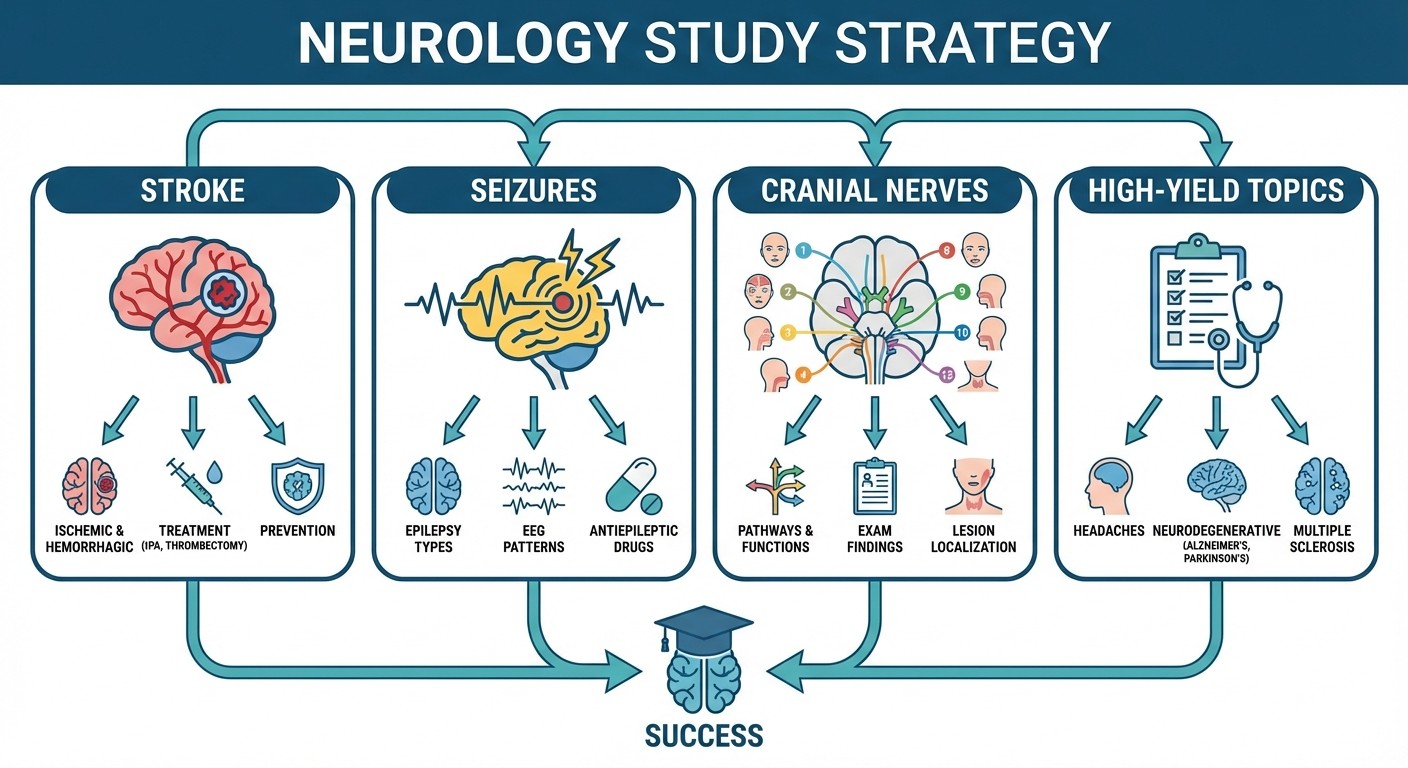
Understanding NEET PG 2026 Neurology Weightage
NEET PG dedicates 8-12 questions to neurology across general medicine, pediatrics, and surgery sections. Breakdown:
Stroke and cerebrovascular diseases: 3-4 questions
Seizures and epilepsy: 2-3 questions
Cranial nerves and localization: 2-3 questions
Movement disorders: 1-2 questions
Infections and inflammatory conditions: 1-2 questions
The pattern is consistent: clinical scenarios testing differential diagnosis, imaging interpretation, and management protocols. Pure theory questions are rare.
Recent trends show increased emphasis on:
Acute stroke protocols (thrombolysis criteria, time windows)
Status epilepticus management
Cranial nerve examination findings
Neuroimaging interpretation (especially CT and MRI stroke protocols)
Foundation Building: Core Concepts First
Neuroanatomy Made Simple
Skip the detailed textbook diagrams. Focus on clinical correlation:
Cerebral circulation patterns: Know the territories of anterior, middle, and posterior cerebral arteries. When you see "sudden onset right hemiparesis with aphasia," you should immediately think MCA territory stroke. Brainstem anatomy: Learn it by clinical syndromes, not isolated facts. Weber syndrome, Wallenberg syndrome, Benedikt syndrome – each tells you exactly where the lesion sits. Spinal cord tracts: Understand the clinical picture of each tract lesion. Dorsal column lesions cause loss of vibration and position sense. Corticospinal tract lesions cause weakness with hyperreflexia.
Start with neurology lessons that connect anatomy to clinical presentations. Pure anatomical memorization wont help in scenario-based questions.
Pathophysiology Over Memorization
Neurology becomes manageable when you understand why symptoms occur:
Stroke pathophysiology: Ischemic vs hemorrhagic mechanisms determine treatment choices. Thrombolysis works for ischemic strokes within 4.5 hours, but causes catastrophic bleeding in hemorrhagic strokes. Seizure mechanisms: Different seizure types have different underlying mechanisms. Generalized tonic-clonic seizures involve entire cortex synchronization. Focal seizures start in specific brain regions and may or may not generalize. Cranial nerve function: Instead of memorizing "CN III controls extraocular muscles," understand that CN III palsy causes ptosis, mydriasis, and eye deviation down and out. This pattern recognition helps in clinical scenarios.
Practice with targeted neurology MCQs that test pathophysiology understanding, not isolated facts.
Mastering Stroke: The Highest-Yield Topic
Stroke Classification and Recognition
NEET PG loves acute stroke scenarios. Master this framework:
Ischemic stroke subtypes:
Large vessel occlusion (LVO): Sudden severe deficits, NIHSS >6
Small vessel disease: Lacunar syndromes, pure motor or sensory deficits
Cardioembolic: Atrial fibrillation history, sudden onset, multiple territories
Hemorrhagic stroke patterns:
Intracerebral hemorrhage: Hypertensive, basal ganglia location most common
Subarachnoid hemorrhage: Thunderclap headache, nuchal rigidity
Subdural/epidural: Trauma history, characteristic CT findings
Clinical localization:
Anterior circulation: Hemiparesis, aphasia (if dominant hemisphere), neglect
Posterior circulation: Cranial nerve deficits, ataxia, vertigo, visual field cuts
Brainstem: Crossed signs (ipsilateral CN deficit + contralateral weakness)
Acute Stroke Management Protocols
This is where marks are won or lost:
Thrombolysis criteria (rtPA):
Time window: Within 4.5 hours of symptom onset
NIHSS score: Typically 4-25 (not too mild, not too severe)
No contraindications: Recent surgery, active bleeding, severe hypertension
CT shows no hemorrhage
Remember the mnemonic "TIME IS BRAIN" – every minute of delay costs 1.9 million neurons.
Mechanical thrombectomy:
Large vessel occlusion confirmed on imaging
Extended time window: Up to 24 hours in selected patients
Requires specialized stroke centers
Blood pressure management:
If thrombolysis candidate: Keep <185/110 mmHg
If no thrombolysis: Permissive hypertension initially (up to 220/120)
Gradual reduction over days, not hours
Use Rezzy AI to quiz yourself on stroke protocols. Ask specific scenario questions like "58-year-old with 3-hour onset aphasia, BP 190/100, what next?" The AI adapts to your weak areas.
Seizures and Epilepsy: Pattern Recognition
Seizure Classification Made Clear
Forget the complex ILAE classifications. Focus on NEET PG-relevant patterns:
Generalized seizures:
Tonic-clonic: Classical grand mal, post-ictal confusion
Absence: Brief staring spells, children, 3 Hz spike-wave on EEG
Myoclonic: Brief muscle jerks, often genetic epilepsy syndromes
Focal seizures:
Simple focal: Consciousness preserved, localized symptoms
Complex focal: Consciousness impaired, often temporal lobe origin
Focal with secondary generalization: Starts focal, then spreads
Status epilepticus: Seizure >5 minutes or recurrent seizures without recovery. Medical emergency requiring IV lorazepam then phenytoin/levetiracetam.
High-Yield Epilepsy Syndromes
Know these cold:
West syndrome: Infantile spasms + hypsarrhythmia + developmental delay. Treatment: ACTH or vigabatrin. Lennox-Gastaut syndrome: Multiple seizure types, slow spike-wave, cognitive decline. Poor prognosis. Temporal lobe epilepsy: Most common focal epilepsy. Aura (déjà vu, fear), automatisms, post-ictal aphasia if dominant side. Juvenile myoclonic epilepsy: Morning myoclonic jerks, photosensitivity, excellent response to valproate.
For pediatric seizures, focus on febrile seizures – simple vs complex criteria and when to worry.
Antiepileptic Drug Selection
NEET PG tests appropriate drug choices:
First-line for generalized epilepsy: Valproate (avoid in women of childbearing age), lamotrigine, levetiracetam First-line for focal epilepsy: Carbamazepine, phenytoin, lamotrigine, levetiracetam Status epilepticus protocol:
1. IV lorazepam (0.1 mg/kg)
2. If continues: Phenytoin 20 mg/kg IV or levetiracetam 60 mg/kg IV
3. If still continues: Anesthesia with propofol/midazolam
Drug interactions to remember:
Phenytoin induces hepatic enzymes (reduces OCP effectiveness)
Valproate inhibits metabolism (increases phenytoin levels)
Carbamazepine auto-induces its own metabolism
Cranial Nerves: Clinical Correlation
The NEET PG Approach to Cranial Nerves
Forget rote memorization. Learn through clinical syndromes:
CN III (Oculomotor) palsy:
Complete: Ptosis, mydriasis, eye "down and out"
Pupil-sparing: Suggests ischemic cause (diabetes)
Pupil-involving: Suggests compression (aneurysm, tumor)
CN VII (Facial) palsy:
Upper motor neuron: Forehead sparing (due to bilateral innervation)
Lower motor neuron: Complete facial weakness
Bells palsy: Idiopathic LMN palsy, treat with steroids
CN VIII (Vestibulocochlear):
Hearing loss: Conductive vs sensorineural (Weber and Rinne tests)
Vertigo: Central vs peripheral patterns
Brainstem Syndromes
These scenarios appear frequently:
Wallenberg syndrome (lateral medullary):
Ipsilateral: Facial pain/numbness, Horner syndrome, ataxia
Contralateral: Body pain/numbness
PICA territory stroke
Weber syndrome (ventral midbrain):
Ipsilateral: CN III palsy
Contralateral: Hemiparesis
PCA perforator stroke
Benedikt syndrome (dorsal midbrain):
Weber syndrome + contralateral tremor/ataxia
Red nucleus involvement
Use active recall with cranial nerve questions rather than passive reading.
High-Yield Topics That Appear Every Year
Movement Disorders
Parkinsons disease:
Clinical triad: Resting tremor, rigidity, bradykinesia
Asymmetric onset
Response to levodopa confirms diagnosis
DaTscan shows reduced dopamine uptake
Essential tremor:
Action tremor (not rest)
Symmetric
Improves with alcohol
Family history common
Huntington disease:
Chorea + personality changes + dementia
Autosomal dominant
CAG repeat expansion
Anticipation phenomenon
Infections and Inflammatory Conditions
Bacterial meningitis:
Acute onset, fever, neck stiffness, altered consciousness
CSF: High protein, low glucose, neutrophilia
Empirical treatment: Ceftriaxone + vancomycin
Viral encephalitis:
HSV encephalitis: Temporal lobe predilection, treat with acyclovir
Japanese encephalitis: Basal ganglia involvement
CSF: Lymphocytic pleocytosis
Multiple sclerosis:
Relapsing-remitting pattern most common
McDonald criteria for diagnosis
MRI shows periventricular white matter lesions
CSF oligoclonal bands
Neuromuscular Disorders
Myasthenia gravis:
Fatigable weakness
Ocular symptoms common
Positive acetylcholine receptor antibodies
Thymoma association
Guillain-Barré syndrome:
Ascending weakness post-infection
Areflexia
CSF: High protein, normal cell count (cytoalbuminous dissociation)
Treatment: IVIG or plasmapheresis
Memory Techniques for Neurology
Mnemonics That Actually Work
Cranial nerve functions: "Oh Oh Oh To Touch And Feel Very Good Velvet AH" (Olfactory, Optic, Oculomotor, Trochlear, Trigeminal, Abducens, Facial, Vestibulocochlear, Glossopharyngeal, Vagus, Accessory, Hypoglossal) Stroke risk factors: "CHADS2" (Congestive heart failure, Hypertension, Age >75, Diabetes, Stroke/TIA history) – each point increases thromboembolism risk Status epilepticus management: "LLP" – Lorazepam, then Levetiracetam/Phenytoin, then Propofol
Create personalized mnemonics using Oncourse's spaced repetition system. The AI identifies your weak areas and presents targeted memory aids when you need them most.
Visual Learning Strategies
Draw simple diagrams:
Stroke territories: Sketch brain from lateral view, mark ACA (leg), MCA (arm/face), PCA (vision) territories
Cranial nerve pathways: Simple line drawings showing nerve origins and targets
Seizure types: Flow chart from focal to generalized progression
Practice interpreting actual images with neurology flashcards that include CT, MRI, and clinical photos.
Practice Strategy for Maximum Retention
Question-Based Learning
Start with broad topics, then drill down:
1. Week 1-2: General neurology principles, basic anatomy
2. Week 3-4: Stroke and cerebrovascular disease
3. Week 5-6: Seizures and epilepsy
4. Week 7-8: Cranial nerves and localization
5. Week 9-10: Movement disorders and infections
6. Week 11-12: Mixed practice and weak area review
Active Recall Techniques
Instead of re-reading notes:
Cover the diagnosis, try to identify the syndrome from clinical features
Practice localizing lesions from examination findings
Time yourself on clinical scenarios (90 seconds per question)
Explain concepts aloud as if teaching someone else
Use spaced repetition for fact retention while focusing active practice time on clinical reasoning.
Error Analysis
Track your mistakes by category:
Knowledge gaps: Missing basic facts or concepts
Misreading: Rushing through question stems
Pattern recognition failures: Knowing facts but missing clinical connections
Elimination errors: Wrong answer choices discarded
Most neurology errors come from poor pattern recognition, not knowledge gaps. Focus practice time accordingly.
Revision Strategy for NEET PG 2026
One Month Before Exam
Week 1: Complete one final topic-wise review
Day 1-2: Stroke and cerebrovascular disease
Day 3-4: Seizures and epilepsy
Day 5-6: Cranial nerves and localization
Day 7: Movement disorders and others
Week 2-3: Mixed practice only
50 neurology questions daily
Focus on weak areas identified from error analysis
Review explanations thoroughly, don't just check answers
Week 4: Maintenance mode
20 questions daily to keep concepts fresh
Quick review of high-yield facts and mnemonics
No new learning – confidence building only
Last 48 Hours
Review only your personalized notes and error patterns. Avoid textbooks completely.
Quick revision checklist:
[ ] Stroke thrombolysis criteria (4.5-hour window, BP limits)
[ ] Status epilepticus management (Lorazepam → Phenytoin → Anesthesia)
[ ] CN III palsy patterns (pupil-involving vs sparing)
[ ] Brainstem syndrome triad (Weber, Wallenberg, Benedikt)
[ ] Parkinsons vs essential tremor features
[ ] Bacterial vs viral meningitis CSF patterns
Common Pitfalls to Avoid
Overemphasizing Rare Conditions
NEET PG tests common presentations of common diseases, not zebra diagnoses. Spend 80% of your time on stroke, seizures, cranial nerves, and movement disorders. Dont get lost in rare genetic syndromes.
Ignoring Clinical Context
Questions often include red herrings. A 70-year-old with sudden weakness, atrial fibrillation, and normal CT doesnt have a normal brain – they have an acute stroke that needs immediate intervention.
Memorizing Without Understanding
Knowing that "CN III controls extraocular muscles" is useless. Understanding that "CN III palsy causes ptosis, mydriasis, and down-and-out gaze because it innervates all extraocular muscles except lateral rectus and superior oblique" helps you answer scenario questions.
Neglecting Pediatric Neurology
Febrile seizures, developmental milestones, and pediatric epilepsy syndromes appear regularly. Dont skip these thinking "its mostly adult neurology."
Frequently Asked Questions
How many months should I dedicate to neurology preparation?
Plan 3-4 weeks for comprehensive neurology coverage. Week 1 for foundation building, weeks 2-3 for high-yield topics and practice, week 4 for revision and mixed questions. This assumes 2-3 hours daily dedicated to neurology.
Should I focus on Harrison's or review books for neurology?
Start with concise review books like Goljan or First Aid for pathophysiology understanding, then use targeted MCQ practice. Harrison's is too detailed for NEET PG time constraints. Focus on clinical scenarios over pure theory.
How important are EEG and neuroimaging interpretation questions?
Moderate importance. Know basic patterns: 3 Hz spike-wave for absence seizures, hypsarrhythmia for West syndrome. For imaging, focus on stroke CT findings and basic MRI patterns. Detailed interpretation is beyond NEET PG scope.
Is neuroanatomy tested separately or only through clinical correlation?
Primarily through clinical correlation. Pure anatomy questions are rare. Focus on clinically relevant anatomy – stroke territories, cranial nerve pathways, brainstem organization. Skip detailed histology and embryology.
What percentage of neurology questions involve drug therapy?
About 30-40%. Focus on first-line antiepileptic drugs, acute stroke medications (rtPA, aspirin), status epilepticus protocols, and Parkinsons treatment. Avoid memorizing every drug interaction and side effect.
How do I improve my speed in neurology MCQs?
Practice pattern recognition daily. Most neurology questions follow predictable formats – acute onset suggests stroke, gradual onset suggests neurodegenerative disease. Learn to quickly identify key clinical patterns and eliminate wrong answers systematically.
Prepare smarter with Oncourse AI — adaptive MCQs, spaced repetition, and AI explanations built for NEET PG. Download free on Android and iOS.