Back
7 High-Yield Cardiology Topics for INICET 2026 (With Must-Know ECG Patterns)
Master the 7 most-tested cardiology topics in INICET 2026. Essential ECG patterns, clinical vignettes, and exam-focused insights for MBBS graduates targeting AIIMS, PGIMER, JIPMER.
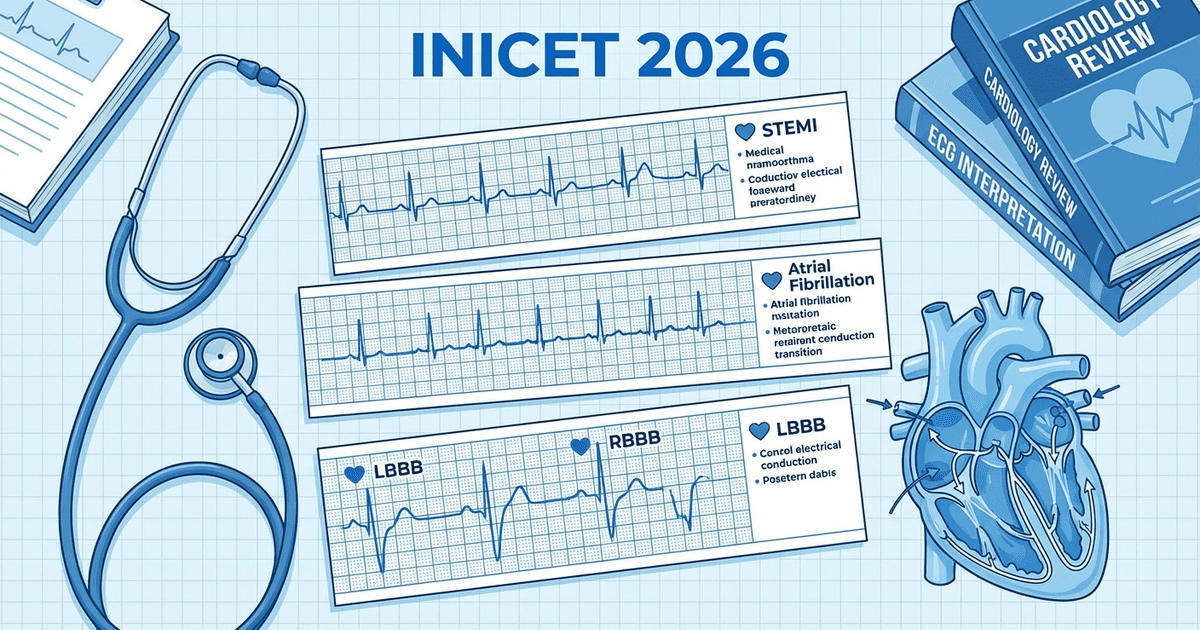
7 High-Yield Cardiology Topics for INICET 2026 (With Must-Know ECG Patterns)
You are probably staring at that INICET syllabus thinking: "200 MCQs, 3 hours, and cardiology makes up 15% of internal medicine." That means roughly 12-15 cardiology questions will decide whether you get into AIIMS, PGIMER, or JIPMER.
Here's the reality: INICET cardiology questions dont test obscure syndromes. They test pattern recognition. Can you spot a STEMI from lead changes? Can you differentiate atrial fibrillation from atrial flutter in 30 seconds? Can you recognize LVH criteria while the clock ticks?
This guide covers the 7 cardiology topics that appear in 80% of INICET cardiology questions. Each topic includes the must-know ECG pattern, clinical vignette clues, and why INICET examiners love testing it.
1. Acute Myocardial Infarction: STEMI vs NSTEMI ECG Changes
Why INICET loves this topic: Every year, 2-3 questions test MI recognition. The patterns are standardized, the management protocols are clear, and it separates students who memorize from those who understand.
Must-Know ECG Pattern: STEMI Localization
Anterior STEMI: ST elevation in V2-V6, reciprocal depression in II, III, aVF
Inferior STEMI: ST elevation in II, III, aVF, reciprocal depression in I, aVL
NSTEMI: ST depression or T-wave inversions, NO ST elevation
The key differentiator: STEMI shows ≥1mm ST elevation in ≥2 contiguous leads. NSTEMI shows ischemic changes without elevation.
Clinical Vignette Clue
"55-year-old male with crushing chest pain for 2 hours, sweating, ECG shows ST elevation in leads V2-V4."
Answer: Anterior STEMI. Management: Primary PCI within 90 minutes if available, thrombolysis if PCI unavailable.
Pro tip: When reviewing acute MI cases, use acute coronary syndrome lessons to reinforce territory-specific ECG changes. The adaptive question bank automatically identifies whether you struggle more with anterior vs inferior MI patterns and adjusts accordingly.
2. Atrial Fibrillation: Irregularly Irregular Rhythm Recognition
Why INICET loves this topic: AF affects 1-2% of the population. It's common, has clear ECG criteria, and tests both recognition and management decisions.
Must-Know ECG Pattern: The Irregularly Irregular Rhythm
No P waves: Replaced by fibrillatory waves (f-waves)
Irregularly irregular QRS: No pattern to RR intervals
Normal QRS width: Unless concurrent bundle branch block
Rate control vs rhythm control decision depends on symptom duration and patient factors.
Clinical Vignette Clue
"68-year-old female with palpitations for 6 months, irregular pulse, ECG shows absent P waves with irregularly spaced QRS complexes."
Answer: Atrial fibrillation. If >48 hours duration, anticoagulate before cardioversion.
During ECG interpretation practice with atrial fibrillation flashcards, focus on distinguishing AF from atrial flutter (which shows sawtooth pattern) and multifocal atrial tachycardia.
3. Heart Failure: LVF vs RVF ECG and Clinical Differentiation
Why INICET loves this topic: Heart failure questions test integrated thinking: ECG interpretation + clinical syndrome recognition + treatment priorities.
Must-Know ECG Patterns: Ventricular Strain
LVF: Left axis deviation, possible LVH criteria, poor R-wave progression V1-V3
RVF: Right axis deviation, RVH (tall R in V1, deep S in V6), P-pulmonale (tall P in II)
Biventricular failure: Features of both
Clinical Vignette Clue
"60-year-old diabetic with shortness of breath, bilateral pedal edema, JVP raised, ECG shows LVH. Echo: LVEF 35%."
Answer: Congestive heart failure with reduced ejection fraction (HFrEF). Treatment: ACE inhibitors, beta-blockers, diuretics.
Clinical insight: The heart failure question bank emphasizes differentiating systolic vs diastolic dysfunction based on ECG and echo findings, a frequent INICET pattern.
4. Valvular Heart Disease: Murmur Patterns and ECG Correlations
Why INICET loves this topic: Valvular disease combines auscultation skills with ECG interpretation. Perfect for clinical vignette questions.
Must-Know ECG-Murmur Correlations
Mitral Stenosis:
ECG: P-mitrale (broad, notched P waves in II), RVH, AF in severe cases
Murmur: Mid-diastolic rumble at apex, opening snap
Mitral Regurgitation:
ECG: LA enlargement, LVH, possible AF
Murmur: Pansystolic at apex radiating to axilla
Aortic Stenosis:
ECG: LVH with strain pattern, left axis deviation
Murmur: Crescendo-decrescendo systolic murmur at right upper sternal border
Aortic Regurgitation:
ECG: LVH, sometimes LA enlargement
Murmur: High-pitched diastolic murmur at left sternal border
Clinical Vignette Clue
"45-year-old with rheumatic heart disease, diastolic murmur at apex, ECG shows broad P waves in lead II."
Answer: Mitral stenosis with P-mitrale indicating left atrial enlargement.
5. Hypertensive Heart Disease: LVH Criteria (Sokolow-Lyon)
Why INICET loves this topic: LVH criteria are objective, measurable, and frequently tested. Plus, hypertension is the most common comorbidity in Indian patients.
Must-Know LVH Criteria: Sokolow-Lyon
Voltage Criteria:
S-wave in V1 + R-wave in V5 or V6 ≥35mm (3.5 mV)
OR R-wave in aVL ≥11mm
Additional LVH Features:
Left axis deviation
ST-T wave changes (strain pattern)
Increased QRS duration (>100ms)
Clinical Vignette Clue
"55-year-old hypertensive male, BP 160/100, ECG shows S in V1 = 20mm, R in V5 = 18mm."
Answer: LVH by Sokolow-Lyon criteria (20+18 = 38mm, >35mm threshold). Indicates target organ damage.
The synapses spaced-repetition tool helps lock in these exact voltage criteria — use the daily 10-minute Cardiology Synapse deck to reinforce LVH memory patterns before exam day.
6. Conduction Defects: LBBB vs RBBB Recognition
Why INICET loves this topic: Bundle branch blocks have clear morphology rules. They're pattern recognition questions that reward systematic ECG analysis.
Must-Know Morphology Patterns
Left Bundle Branch Block (LBBB):
QRS width ≥120ms
V1: Broad S wave (W pattern: rS or QS)
V6: Broad R wave (M pattern: no Q wave)
Mnemonic: WiLLiaM (W in V1, M in V6 for LBBB)
Right Bundle Branch Block (RBBB):
QRS width ≥120ms
V1: RSR' pattern (M pattern: rSR')
V6: Wide S wave (W pattern: qRS)
Mnemonic: MaRRoW (M in V1, W in V6 for RBBB)
AV Blocks:
1st degree: PR interval >200ms (0.2 seconds)
2nd degree Type I: Progressive PR prolongation until dropped QRS
2nd degree Type II: Fixed PR interval with intermittent dropped QRS
3rd degree: Complete dissociation of P waves and QRS
Clinical Vignette Clue
"70-year-old with chest pain, ECG shows QRS width 140ms, RSR' pattern in V1, wide S in V6."
Answer: Right bundle branch block. May indicate anterior MI if new-onset.
Practice systematic ECG analysis with bundle branch block questions to master the WiLLiaM-MaRRoW mnemonics.
7. Pericarditis and Myocarditis: Saddle-Shaped vs Localized ST Changes
Why INICET loves this topic: These inflammatory conditions test your ability to distinguish global vs territorial ECG changes — crucial for differential diagnosis of chest pain.
Must-Know ECG Patterns
Pericarditis:
Stage 1: Saddle-shaped ST elevation in multiple leads (global)
Stage 2: ST normalization, T-wave flattening
Stage 3: T-wave inversions
Stage 4: Normalization
Key feature: PR depression (opposite to ST elevation)
Myocarditis:
Similar to pericarditis but may show:
Localized ST changes (mimicking MI)
Ventricular arrhythmias
AV conduction blocks
Clinical Vignette Clue
"25-year-old with viral prodrome, sharp chest pain worse with inspiration, ECG shows widespread ST elevation with PR depression."
Answer: Acute pericarditis. Treatment: NSAIDs + colchicine.
Differentiating point: Pericarditis shows saddle-shaped ST elevation across multiple leads. MI shows convex ST elevation in territorial distribution.
When practicing ECG interpretation with clinical rounds, focus on timing yourself — INICET gives you roughly 54 seconds per question, including ECG analysis time.
Quick Reference: High-Yield ECG Criteria Table
Condition | Key ECG Finding | Time to Recognize |
|---|---|---|
STEMI | ≥1mm ST elevation in ≥2 contiguous leads | 15 seconds |
NSTEMI | ST depression or T inversions | 20 seconds |
Atrial Fibrillation | Irregularly irregular, no P waves | 10 seconds |
LVH (Sokolow-Lyon) | S(V1) + R(V5/V6) ≥35mm | 30 seconds |
LBBB | QRS ≥120ms, W in V1, M in V6 | 20 seconds |
RBBB | QRS ≥120ms, M in V1, W in V6 | 20 seconds |
Pericarditis | Global saddle-shaped ST elevation + PR depression | 25 seconds |
Frequently Asked Questions
How many ECG questions appear in INICET?
INICET typically includes 3-4 direct ECG interpretation questions plus 4-5 clinical vignettes that require ECG analysis. That's roughly 8-9 questions (4-5% of total marks) that depend on ECG skills.
Which ECG leads are most important for INICET?
Focus on leads II, V1, V5, and V6. These four leads help identify 90% of INICET-relevant patterns: rhythm (lead II), bundle branch blocks (V1 vs V6), and LVH (V5/V6).
Should I memorize all LVH criteria or just Sokolow-Lyon?
Stick to Sokolow-Lyon for INICET. It appears in 80% of LVH questions. Other criteria (Cornell, Romhilt-Estes) are rarely tested at the PG entrance level.
How do I differentiate STEMI from pericarditis on ECG?
STEMI shows territorial ST elevation (specific leads based on vessel) with reciprocal depression. Pericarditis shows global, saddle-shaped ST elevation without reciprocal changes, plus PR depression.
What's the most commonly missed ECG finding in INICET?
Right axis deviation in pulmonary embolism or RVH. Students focus on left-sided changes but miss subtle right heart strain patterns.
How much time should I spend on each ECG question?
Aim for 45-60 seconds total: 15 seconds for rhythm analysis, 15 seconds for axis and intervals, 15 seconds for ST-T changes, and 15 seconds to match with clinical vignette.
Prepare smarter with Oncourse AI — adaptive MCQs, spaced repetition, and AI explanations built for INICET. Download free on Android and iOS.