Back
FMGE Previous Year Questions: How to Use PYQs to Find Weak Areas and Build Daily Practice in 2026
Learn how to use FMGE previous year questions as a diagnostic tool to identify weak areas and build a targeted daily practice routine that improves your exam performance systematically.

FMGE Previous Year Questions: How to Use PYQs to Find Weak Areas and Build Daily Practice in 2026
You have 12 weeks. Medicine, Surgery, OBG, and 16 other subjects. 300 questions waiting in December 2026. You are probably thinking about how to cover everything without burning out or missing the high-yield topics that actually decide your score.
Here is what most FMGE aspirants get wrong: they treat all subjects equally. They spend the same hours on Anatomy (17 questions) as they do on Internal Medicine (38-40 questions). Then they wonder why they scored 146 when they needed 150.
Previous year questions aren't just practice material. They are your diagnostic tool, your weakness detector, and your daily study planner rolled into one. When used correctly, PYQs reveal exactly where your preparation gaps are and what deserves your limited study time.
In this guide, you'll learn how to turn FMGE previous year questions into a systematic weak-area identification system and build a daily practice routine that targets your specific gaps.
Why PYQs Matter More Than You Think for FMGE
FMGE isn't an exam you pass by memorizing everything. It's an exam you pass by understanding the pattern, knowing where the marks cluster, and being strategic about your preparation time.
Here's what 10 years of FMGE data reveals:
Medicine, Surgery, and OBG together contribute 130+ questions (43% of the paper)
15-20% of questions are image-based or clinical vignettes
Drug-of-choice and investigation-of-choice questions repeat consistently
Pass rates fluctuate between 12.8% and 35%, with 150/300 (50%) required to qualify
When you analyze previous year questions properly, you're not just practicing. You're getting a blueprint of what NBEMS actually tests, how they frame questions, and which topics show up repeatedly across sessions.
What PYQs Can and Cannot Predict
What PYQs tell you accurately:
Subject weightage patterns (Medicine 38-40 questions, Surgery 35-38 questions)
Question formats (one-liners vs clinical scenarios vs image-based)
High-yield topics that repeat across years
Your personal accuracy patterns by subject and topic type
What PYQs cannot predict:
Exact questions in your session (though similar concepts often repeat)
New emerging topics or recent guideline changes
The specific clinical scenarios or images you'll face
Individual question difficulty on your exam day
The key is using PYQs as pattern recognition training, not as a question bank you memorize.
How to Attempt Previous Year Questions Cold
Start every PYQ session with a "cold attempt" - no preparation, no subject revision. Just you and the questions. This gives you the most honest assessment of your current knowledge.
Cold attempt protocol: 1. Set exam conditions: 300 questions, 300 minutes (Part A: 150 questions in 150 minutes, Part B: 150 questions in 150 minutes) 2. No backtracking: Mirror the actual exam interface where you cant return to previous sections 3. Mark every question: Since there's no negative marking, attempt everything 4. Track time per question: Note if you're spending too long on specific types (target: 1 minute average per question)
During the cold attempt, pay attention to your thought process. Which questions made you pause? Where did you guess between two options? Which topics felt completely unfamiliar?
How to Review Explanations Actively
Most students read explanations passively. They glance at why the right answer is right, then move on. Active review means understanding why each wrong option is wrong and what knowledge gap led to your mistake.
Active explanation review steps: 1. Read the question again: Before looking at explanations, read the question one more time 2. Identify the knowledge gap: Was it factual recall, concept application, or question interpretation? 3. Analyze all options: Understand why each distractor was designed to mislead 4. Note the question pattern: One-liner fact, clinical vignette, investigation choice, drug choice, etc. 5. Connect to your studies: Link this concept to your textbook or lecture notes
For image-based questions, spend extra time understanding what you should have noticed in the image. Often, the diagnostic features are subtle but consistently tested.
Tagging Wrong Answers: The System That Works
Every wrong answer tells a story. But unless you categorize your mistakes systematically, you'll keep making the same errors. Here's how to tag your PYQ mistakes for maximum learning:
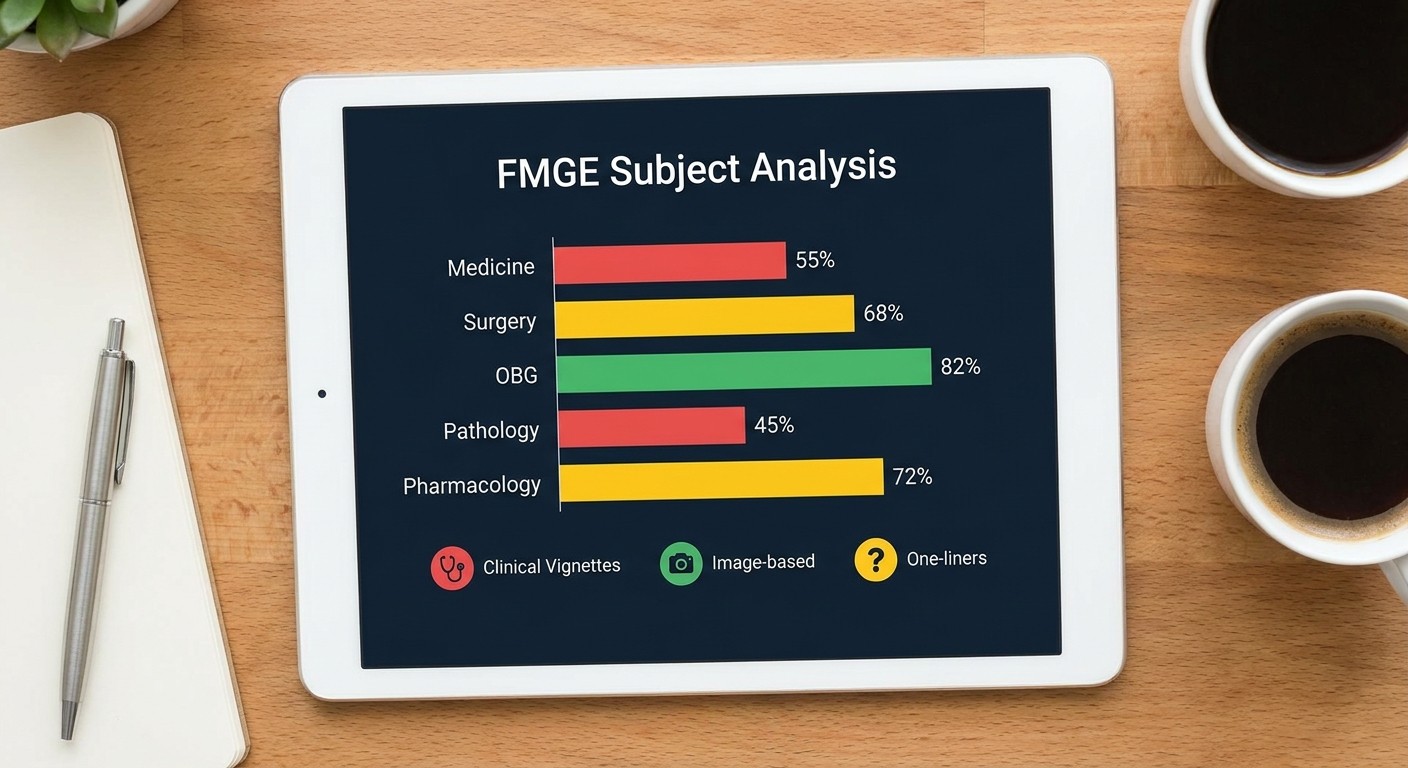
Three-layer tagging system: Layer 1 - Subject/Topic:
Medicine/Cardiology
Surgery/GI Surgery
OBG/High-risk pregnancy
Pathology/Hematology
Pharmacology/CNS drugs
Layer 2 - Question Type:
Clinical vignette
Image-based (X-ray, ECG, histopath, clinical photo)
Drug of choice
Investigation of choice
One-liner factual
Layer 3 - Error Type:
Knowledge gap (didn't know the concept)
Misapplication (knew concept, applied incorrectly)
Distractor trap (fell for designed wrong answer)
Time pressure (knew answer but made careless mistake)
Question misreading (misunderstood what was asked)
When you tag a wrong answer as "Medicine/Cardiology + Clinical vignette + Knowledge gap," you know exactly what to fix. When you see the pattern "OBG + Image-based + Distractor trap" repeatedly, you know you need to practice OBG image recognition more carefully.
The most effective students I work with maintain a simple spreadsheet with these three columns. After every PYQ session, they spend 15 minutes tagging their mistakes. By week 4, clear patterns emerge.
Converting PYQ Misses Into Focused Daily Practice
Your PYQ mistakes aren't failures - they're your personalized study plan. Here's how to convert your tagged errors into daily practice blocks.
Daily practice formula:
40% time: High-weight subjects where you're weak (Medicine, Surgery, OBG)
30% time: Medium-weight subjects where you're weak (Pathology, Pharmacology, Pediatrics)
20% time: Question types where you struggle (image-based, clinical vignettes)
10% time: Topics where you're strong (maintain accuracy)
Sample daily routine for someone weak in Medicine and Surgery:
Morning block (2 hours): 50 Medicine questions + active review
Afternoon block (1.5 hours): 30 Surgery questions + active review
Evening block (1 hour): 20 mixed image-based questions from all subjects
If your PYQ analysis shows you're consistently wrong on drug-of-choice questions in Pharmacology, dedicate one daily block specifically to drug selection MCQs until your accuracy improves.
The goal isn't to practice everything equally. Use your PYQ data to practice unequally - more time where you're weak, less time where you're strong.
Mixing PYQs with Fresh Question Bank Practice
PYQs show you the pattern, but you need fresh questions to test if you've actually learned the concepts. Oncourse's adaptive FMGE question bank adjusts question difficulty based on your performance, ensuring you're always practicing at the right challenge level.
Weekly mixing strategy:
Day 1-3: Pure PYQ practice with cold attempts and active review
Day 4-5: Fresh question bank practice on your weak areas identified from PYQs
Day 6: Mixed practice - PYQs and fresh questions together
Day 7: Full-length timed test using fresh questions
This prevents you from memorizing PYQ answers while ensuring you're applying concepts to new scenarios. When you get a fresh Pharmacology question right after struggling with similar PYQ topics, you know you've actually learned the concept.
Timed vs Untimed PYQ Practice: When to Use Each
Both approaches serve different purposes in your preparation strategy.
Use timed practice when:
You're 4+ weeks away from exam (building speed and stamina)
You want to simulate actual exam pressure
You're testing your overall performance across all subjects
You need to practice the sectional timing (150 questions in 150 minutes per part)
Use untimed practice when:
You're focusing on specific weak subjects or topics
You're in active learning mode (trying to understand concepts deeply)
You're analyzing question patterns and explanation quality
You're 1-2 weeks from exam and need to build confidence on challenging questions
Start with more untimed practice early in your preparation when you're identifying weak areas. Shift to more timed practice as you get closer to exam day.
For clinical vignette questions, I recommend students initially practice them untimed to develop a systematic approach to case analysis. Once you have a consistent method, switch to timed practice to build efficiency.
Image-Based and Clinical Vignette Review Strategy
FMGE has significantly increased its emphasis on image-based questions and clinical scenarios. These aren't just harder - they require different preparation strategies.
Image-based question mastery: 1. Build pattern recognition: Study the same image type across multiple questions (chest X-rays, ECGs, skin lesions) 2. Focus on pathognomonic signs: Learn the key diagnostic features that appear consistently 3. Practice without looking at options first: Look at the image, form your diagnosis, then check options 4. Study normal variants: Many wrong answers are normal findings presented as pathology Clinical vignette approach: 1. Extract key information: Age, sex, presenting complaint, key examination findings, relevant investigations 2. Form differential diagnosis: List 2-3 possibilities before looking at options 3. Apply clinical reasoning: Use history and examination to narrow down to most likely diagnosis 4. Watch for red herrings: Ignore irrelevant information designed to confuse
When reviewing FMGE clinical pharmacology lessons, pay attention to how drug choices connect to clinical presentations. This helps with both vignette questions and drug-of-choice MCQs.
Building Your Weekly Weak-Area Review Loop
Consistency beats intensity in FMGE preparation. Your weekly review loop should focus on converting identified weak areas into strengths systematically.
Sunday planning session (30 minutes):
Review previous week's PYQ performance
Identify top 3 weak areas needing focus
Plan daily practice blocks for the upcoming week
Set specific accuracy targets for each subject
Mid-week check (Wednesday, 15 minutes):
Quick accuracy assessment on your focus areas
Adjust remaining week's practice if needed
Note any new patterns of mistakes
Weekend analysis (Saturday, 45 minutes):
Complete performance analysis across all subjects
Update your weakness tracking system
Plan any strategy changes for next week
This loop ensures you're constantly adapting your preparation based on actual performance data, not just following a generic study plan.
Final 30-Day PYQ Strategy
The last month before FMGE requires a different approach to previous year questions. You should have identified your major weak areas by now - the final month is about fine-tuning and confidence building.
Week 1 (30 days out):
Complete 2 full PYQ papers under timed conditions
Focus morning practice on your top 2 weak subjects
60% PYQ practice, 40% fresh question bank
Week 2 (23 days out):
Daily mixed practice: 100 questions from various years
Heavy emphasis on image-based questions and clinical vignettes
70% PYQ practice, 30% fresh questions
Week 3 (16 days out):
Subject rotation: Monday Medicine, Tuesday Surgery, Wednesday OBG, etc.
Morning timed block, afternoon untimed review
80% PYQ practice, 20% fresh questions
Week 4 (9 days out):
Focus only on questions you've gotten wrong before
Practice high-yield topics that repeat consistently
90% previous mistakes review, 10% fresh practice
Final 3 days:
Only topics where you're already strong (confidence building)
Light practice, heavy revision of your summary notes
No new question types or topics
Common PYQ Analysis Mistakes to Avoid
After working with hundreds of FMGE aspirants, I've noticed these recurring mistakes that sabotage otherwise good preparation:
Mistake 1: Treating all PYQ years equally
Recent 3-4 years reflect current exam patterns better than older papers. Use 2023-2026 papers for primary practice, older papers for additional volume only.
Mistake 2: Memorizing specific question answers
Focus on understanding the concept behind each question. If you memorize "Furosemide is the answer to question 47 from Jan 2025," you'll miss similar questions asked differently.
Mistake 3: Skipping explanation review when you get questions right
Sometimes you get questions right for wrong reasons. Review explanations for correct answers too, especially if you guessed between two options.
Mistake 4: Not timing your practice sessions
FMGE has strict sectional timing. If you practice only untimed, you'll struggle with time pressure on exam day.
Mistake 5: Focusing only on your weak subjects
Don't neglect subjects where you're already strong. Maintaining accuracy in your strong areas is often easier than dramatically improving weak ones.
When using Oncourse's performance analytics, you can avoid these mistakes by getting automated insights into your practice patterns and accuracy trends across different question types.
Frequently Asked Questions
How many PYQ papers should I complete during my preparation?
Complete at least 8-10 full PYQ papers (2022-2026 sessions) under timed conditions, plus topic-wise practice from 5-6 additional years. Quality of review matters more than quantity of papers attempted.
What percentage accuracy on PYQs indicates I'm ready for the exam?
Target 60%+ accuracy on mixed PYQ practice. On your strong subjects, aim for 70%+. Remember, you need 150/300 (50%) to pass, but consistent 60%+ accuracy gives you a safety buffer.
Should I practice PYQs from other exams like NEET-PG?
Yes, but selectively. NEET-PG questions covering FMGE syllabus topics are useful, especially for additional volume in weak areas. Focus on clinical subjects and avoid NEET-PG-specific topics not relevant to FMGE.
How do I handle image-based PYQ questions when explanations are poor?
Use multiple question banks and reference sources. Poor explanations are common in image-based questions. Cross-reference with textbooks or online resources when PYQ explanations are inadequate.
What if my PYQ analysis shows I'm weak in high-weight subjects like Medicine?
Don't panic. Focus on high-yield topics within Medicine first - cardiology, infectious diseases, endocrinology. Get these subtopics to 65%+ accuracy before moving to lower-yield areas.
Should I attempt PYQs section-wise or as full papers?
Both. Use section-wise practice early in preparation for focused learning. Switch to full papers in the last 6-8 weeks to build stamina and simulate actual exam experience.
---
Previous year questions aren't just practice material for FMGE - they're your roadmap to understanding exactly what you need to study and how to allocate your limited preparation time. When you approach PYQs systematically, tag your mistakes properly, and convert your weak areas into focused daily practice, you transform from someone studying everything to someone studying the right things.
The difference between scoring 146 and 156 isn't studying harder. It's studying smarter by letting the exam's own data guide your preparation strategy.
Prepare smarter with Oncourse - adaptive MCQs, spaced repetition, and AI explanations built for FMGE. Download free on Android and iOS.