Back
FMGE Image-Based Questions: Train Visual Recall with Oncourse AI
Master FMGE image-based questions through systematic visual recall training. Learn active pattern recognition, systematic workflows, and spaced repetition strategies for anatomy, histology, radiology, and clinical images.
FMGE Image-Based Questions: Train Visual Recall with Oncourse AI
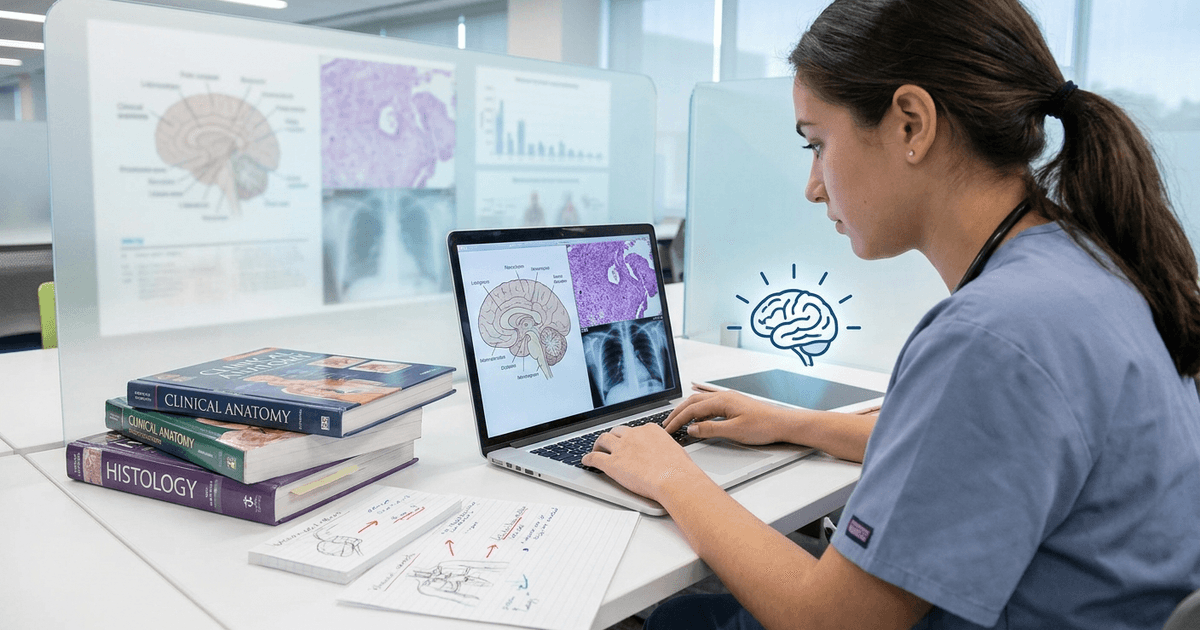
You are probably staring at an anatomy diagram right now, trying to memorize every label. Or maybe you just clicked through 50 histology slides, hoping something will stick. Here's the thing about FMGE image-based questions: they dont reward passive screenshot memorization. They test your ability to connect what you see to what you know.
FMGE 2026 includes 10-15% image-based questions across both papers. That's 30-45 questions worth 10-15% of your total score. These arent fill-in-the-blank anatomy labels. They're clinical scenarios wrapped around visuals that demand instant pattern recognition, differential reasoning, and mechanism linking.
The students who ace these questions have trained their visual recall differently. They dont just study images – they interrogate them.
Why Image-Based Questions Feel Different
Traditional FMGE questions test factual recall: "Which drug causes ototoxicity?" Image-based questions add a cognitive layer: "What does this audiogram show, and which drug most likely caused it?"
Your brain processes text and images through different pathways. Reading "consolidation in right lower lobe" activates language centers. Seeing consolidation on a chest X-ray activates visual processing, spatial reasoning, and pattern matching – simultaneously.
Most students study these separately. They read about pneumonia pathophysiology in Internal Medicine, then look at chest X-ray examples in Radiology. When exam day comes, they can't bridge the gap fast enough.
Visual recall training forces this integration from day one.
What FMGE Image-Based Questions Actually Test
FMGE image-based questions cluster around predictable domains:
Anatomy (25-30% of image questions):
Cross-sectional anatomy on CT/MRI
Gross anatomical specimens with clinical correlations
Embryological development stages
Surgical anatomy landmarks
Histology (20-25%):
Tissue architecture under different magnifications
Pathological changes in standard H&E sections
Special stains highlighting specific structures
Cellular morphology in disease states
Radiology (30-35%):
Plain radiographs with classic pathological signs
CT/MRI findings in common diseases
Ultrasound patterns and measurements
Nuclear medicine uptake patterns
Clinical Images (15-20%):
Dermatological lesions with characteristic appearances
Ophthalmoscopic findings in systemic diseases
Surgical instruments and procedures
Laboratory microscopy results
The common thread: each image connects to broader pathophysiological concepts. You're not identifying structures – you're using visual clues to diagnose, explain mechanisms, or predict outcomes.
The Visual Recall Workflow
Effective visual recall follows a systematic 5-step pattern. Practice this sequence until it becomes automatic:
Step 1: Identify the Image Type
Before reading the question stem, spend 5 seconds classifying what you're seeing. Is this histology, radiology, gross anatomy, or clinical photography? What magnification, imaging modality, or anatomical region?
Step 2: Name the Visual Clues
List 3-4 specific features you observe. "Homogeneous opacity in right lower lobe" beats "some white area." "Spindle-shaped cells in fascicles" beats "elongated structures." Specificity matters because FMGE distractors exploit vague thinking.
Step 3: Connect to Diagnosis/Mechanism
Bridge the visual finding to pathophysiology. That consolidation suggests infection, inflammation, or malignancy. Those spindle cells point toward mesenchymal origin. Don't jump to diagnosis – build the logical connection first.
For example, when reviewing FMGE histology lessons, practice connecting tissue architecture to functional implications. When studying radiological anatomy, link normal variants to clinical significance.
Step 4: Eliminate Distractors
FMGE distractors often represent related but incorrect diagnoses. Use your visual clues to systematically rule out options. If you see epithelial cells, eliminate mesenchymal tumors. If consolidation is bilateral, eliminate lobar pneumonia.
Step 5: Schedule Review
Mark challenging images for spaced repetition. Visual recall decays faster than text-based memory. Review missed images at 1 day, 3 days, 1 week, and 2 weeks.
Oncourse's Smart Lens feature helps with step 3 by revealing conceptual layers around image-heavy topics. Instead of memorizing isolated pictures, you see how visual findings connect to underlying anatomy, pathology, and mechanisms – building the reasoning bridge that FMGE tests.
Subject-Specific Visual Training Strategies
Anatomy: From Static to Dynamic
Anatomy images in FMGE aren't identification exercises. They test functional relationships and clinical correlations.
Cross-sectional mastery: Start with axial CT slices at key levels (C7, T5, T12, L3). Practice identifying organs, vessels, and spaces without labels. Then add pathology – where would you see pneumothorax, hematoma, or mass effect? Embryological sequences: FMGE loves developmental anatomy. Study neural tube closure, cardiac looping, and limb bud formation as video sequences, not static snapshots. Ask: "At which stage does this malformation occur?" Clinical correlations: Every anatomical structure has clinical significance. When studying brachial plexus anatomy, simultaneously learn Erb's palsy, Klumpke's palsy, and thoracic outlet syndrome presentations.
Practice with targeted anatomy questions to reinforce pattern recognition under exam conditions.
Histology: Pattern Over Memorization
FMGE histology questions test tissue recognition in pathological contexts, not normal textbook appearances.
Magnification training: Study the same tissue at 10x, 40x, and 100x magnification. Cells look different at each level. Practice identifying tissue type and pathology at all magnifications. Pathological changes: Normal histology is the baseline. Focus on inflammatory infiltrates, necrosis, fibrosis, and neoplastic changes. Learn how disease alters tissue architecture. Stain interpretation: H&E is standard, but FMGE may show special stains. Understand what PAS, trichrome, and immunohistochemistry highlight.
Build this pattern recognition through regular practice with histology questions that mirror FMGE's clinical emphasis.
Radiology: Signs Over Shadows
FMGE radiology images test pattern recognition of specific radiological signs, not general image interpretation.
Classic signs mastery: Learn 20-30 pathognomonic signs: air bronchogram, silhouette sign, Kerley B lines, coffee bean sign, apple core lesion. These appear repeatedly in different clinical contexts. Systematic approach: Develop a consistent reading sequence for each imaging modality. For chest X-rays: airways, bones, cardiac silhouette, diaphragm, edges, fields, gastric bubble, hila. Miss nothing systematically rather than catching some findings randomly. Normal variants: FMGE includes normal findings as distractors. Know age-related changes, anatomical variants, and technical artifacts that mimic pathology.
Strengthen these skills with dedicated practice using radiological anatomy lessons and related question banks.
Clinical Images: Context + Morphology
Clinical photographs in FMGE test diagnostic pattern recognition combined with clinical reasoning.
Dermatology patterns: Learn primary lesion types (macule, papule, vesicle, pustule) and secondary changes (scaling, crusting, ulceration). Distribution matters as much as morphology – flexural vs. extensor, symmetric vs. asymmetric. Ophthalmology findings: Fundoscopy images require systematic examination: disc, vessels, macula, periphery. Learn classic findings: papilledema, diabetic retinopathy stages, hypertensive changes. Systematic examination: For any clinical image, note: distribution, morphology, associated features, and patient demographics from the question stem.
Use Image Rush for quick pattern recognition drills across these clinical domains. This game builds speed and accuracy for visual diagnosis under time pressure – exactly what FMGE demands.
Active vs. Passive Image Study
Most students study images passively: looking at labeled diagrams, reading captions, highlighting text descriptions. This builds familiarity but not recall.
Passive approach (ineffective):
Reading image captions
Copying labeled diagrams
Highlighting textbook descriptions
Saving screenshots to folders
Active approach (effective):
Covering labels and attempting identification
Drawing structures from memory
Explaining images to study partners
Creating your own captions
The blank diagram test: Print unlabeled versions of key diagrams. Set a 2-minute timer. Label as many structures as possible. Check answers. Note gaps. Repeat in 3 days. The explanation challenge: Open a histology image. Explain what you see to an imaginary first-year student. Include tissue type, key features, functional significance, and potential pathology. If you cant explain it simply, you dont understand it.
Timed vs. Untimed Practice
Visual recall has two components: accuracy and speed. FMGE gives you 60 seconds per question. Complex image-based questions may need 90-120 seconds, leaving less time for straightforward factual questions.
Untimed practice (learning phase):
Focus on systematic analysis
Build comprehensive differential lists
Research unfamiliar findings thoroughly
Practice the 5-step workflow until automatic
Timed practice (performance phase):
Set 75-second limits for image questions
Practice rapid feature identification
Trust first impressions for familiar patterns
Flag and move on when stuck
Start untimed. Switch to timed practice 4-6 weeks before your exam date.
When working through FMGE question practice, alternate between these modes based on your current preparation phase.
Building a 2-Week Visual Recall Sprint
Two weeks before FMGE, implement this focused visual recall protocol:
Days 1-3: Subject Clustering
Day 1: Anatomy cross-sections and embryology
Day 2: Histology normal and pathological
Day 3: Radiology signs and patterns
Days 4-6: Mixed Practice
Combine all image types in single sessions
Practice the 5-step workflow under time pressure
Review missed questions immediately
Days 7-9: Weak Area Focus
Identify your 3 weakest visual domains
Create targeted image banks for these areas
Practice until recognition is automatic
Days 10-12: Speed Building
45-second time limits for familiar images
90-second limits for complex scenarios
Build confidence through volume
Days 13-14: Final Review
Review all flagged images from previous sessions
Practice explaining difficult images aloud
Trust your preparation and avoid new material
Throughout this sprint, leverage Rezzy AI tutor for immediate explanation of challenging image-based questions. When you encounter a difficult visual, ask Rezzy to explain the key features, differential diagnosis, and why distractors are wrong. This turns missed questions into guided learning opportunities.
Final 30-Day Image Revision Strategy
Your final month should emphasize spaced repetition and pattern reinforcement:
Weeks 4-3 before exam:
Daily 30-minute image sessions
Mix new material with review
Create personal "greatest hits" image collection
Weeks 2-1 before exam:
Focus only on review and weak areas
Daily 45-minute sessions
No new material
Final week:
Review flagged images only
15-minute daily sessions
Build confidence, avoid burnout
Day before exam:
Review your top 20 "must-know" images
Practice systematic approach one final time
Early sleep over late-night cramming
Common Visual Study Mistakes
Mistake 1: Isolated memorization
Studying images without clinical context. Each image should connect to symptoms, mechanisms, and management.
Mistake 2: Caption dependency
Reading captions before attempting identification. This builds recognition but not recall.
Mistake 3: Single modality focus
Studying only one type of image per session. FMGE mixes anatomy, histology, radiology, and clinical photos.
Mistake 4: Perfectionism paralysis
Spending 10 minutes analyzing one image instead of building pattern recognition through volume.
Mistake 5: Review avoidance
Not revisiting missed images. Visual memory needs reinforcement more than text-based recall.
Mistake 6: Speed neglect
Practicing only untimed until the final week. FMGE demands both accuracy and efficiency.
Frequently Asked Questions
How many image-based questions should I practice daily for FMGE?
Practice 15-20 image-based questions daily during your preparation phase. Focus on quality over quantity – each missed image should trigger systematic analysis and spaced repetition scheduling. Two weeks before FMGE, increase to 30-40 daily with emphasis on timed practice.
Which subjects contribute most FMGE image-based questions?
Radiology contributes 30-35% of image questions, followed by anatomy (25-30%), histology (20-25%), and clinical images (15-20%). However, dont neglect any area – FMGE can surprise with unexpected visual questions from any subject.
Should I memorize specific images or focus on pattern recognition?
Focus on pattern recognition over specific image memorization. FMGE rarely repeats identical images but frequently tests the same pathological patterns across different cases. Learn to identify consolidation, not memorize specific pneumonia X-rays.
How do I improve speed for FMGE image-based questions?
Build speed through systematic approach and pattern familiarity. Practice the 5-step visual recall workflow until automatic. Use tools like Image Rush for rapid recognition drills. Start with untimed practice, then gradually reduce time limits as patterns become familiar.
What if I cant identify an image during FMGE?
Use elimination strategy based on question stem clues. Patient age, symptoms, and clinical context often narrow possibilities even when the image is unclear. Flag the question, make your best guess, and move on – dont let difficult images consume time from easier questions.
How important are normal anatomical variants in FMGE image questions?
Very important. FMGE frequently includes normal variants as distractors to test whether you can distinguish pathology from normal variation. Study age-related changes, common anatomical variants, and technical artifacts that mimic disease.
Prepare smarter with Oncourse AI – adaptive MCQs, spaced repetition, and AI explanations built for FMGE success. Download free on Android and iOS.
Always verify the latest official FMGE/NMC/NBE bulletin for current syllabus, eligibility criteria, exam dates, question patterns, and any specific guidance on image-based questions.