Back
First Aid for USMLE Step 1 (2026): Is It Still Worth It — and How to Use It Right
Honest review of First Aid USMLE Step 1 in 2026: data-backed analysis of strengths, weaknesses, and proven strategies for active integration with question banks and spaced repetition.

First Aid for USMLE Step 1 (2026): Is It Still Worth It — and How to Use It Right
You probably own it. Maybe you highlighted half the pages in med school, or maybe its still shrink-wrapped on your shelf. First Aid for the USMLE Step 1 — the 864-page, bullet-pointed bible that 82% of US MD seniors reported using in 2022.
But heres what nobody talks about: Step 1 mean scores didnt magically skyrocket even as First Aid usage approached universal adoption. If "everyone uses First Aid" and "First Aid works," why havent scores shifted dramatically upward?
The answer cuts to the heart of effective Step 1 prep in 2026. First Aid isnt dead — but treating it like scripture will cap your ceiling. The students crushing Step 1 dont just memorize First Aid cover to cover. They use it as one piece of a strategic, active-recall system that prioritizes question-based learning.
Lets break down what First Aid actually delivers in 2026, where it falls short, and exactly how to integrate it into a study plan that moves your score.
What First Aid Is — and Why It Became the Step 1 Standard
First Aid for the USMLE Step 1 is a high-yield reference manual. Think of it as a densely packed outline of "stuff you should have seen somewhere" — facts, associations, mnemonics, and clinical correlations organized by organ system.
The 2026 edition (36th edition, published February 2026) includes over 1,300 high-yield facts, 1,000+ color clinical images, and mnemonics organized to match the USMLE Step 1 content outline. Its written by students who scored well on Step 1 and reviewed by faculty, which gives it credibility in the "peer-tested" department.
First Aid became the standard because it solved a real problem: information overload. Med school curricula throw thousands of facts at you, but Step 1 tests a specific subset. First Aid distilled that subset into a portable, searchable format.
In the pre-digital era, that was revolutionary. You could carry 800+ pages of high-yield content instead of lugging around Robbins, Katzung, and multiple reference texts.
What Changed in 2026: Updated Content and USMLE Blueprint Alignment
The 2026 edition includes several key updates worth noting:
Content Updates:
Enhanced diversity in clinical images, reflecting USMLE's push for more representative patient populations
Refined alignment with the current Step 1 content specifications (Cardiovascular 7-11%, Respiratory/Renal 11-15%, etc.)
Updated pharmacology sections reflecting newer drug mechanisms and FDA approvals through 2025
Format Improvements:
Cleaner visual hierarchy with better separation between high-yield facts and supporting details
More integrated cross-references between organ systems (especially helpful for multisystem processes)
Enhanced QR codes linking to online supplementary content
USMLE 2026 Software Changes: With USMLE's new test delivery software rolling out in May 2026, the testing interface will change, but the core content tested remains the same. First Aid's content alignment with the official blueprint hasnt shifted dramatically.
The real question isnt whether First Aid updated its content — its whether content review alone moves scores in 2026.
The Honest Assessment: Strengths vs. Critical Weaknesses
What First Aid Does Well
High-Yield Density: First Aid packs legitimate Step 1 content into a searchable format. When research shows students who used UWorld had higher Step 1 scores (229 vs 215) compared to those who didnt, the UWorld users werent skipping content review entirely — they were using First Aid as a lookup tool while drilling questions. Community-Tested Facts: The mnemonics and associations in First Aid have been refined over 36 editions. "Hot T-bone stEAk" for IL-1, TNF-α, IL-6 isnt original, but its memorable and gets tested. Standardized Organization: When you need to quickly review beta-blocker mechanisms or review glycogen storage diseases, First Aid's consistent formatting lets you find information fast.
Where First Aid Falls Short — and Why It Wont Carry You Alone
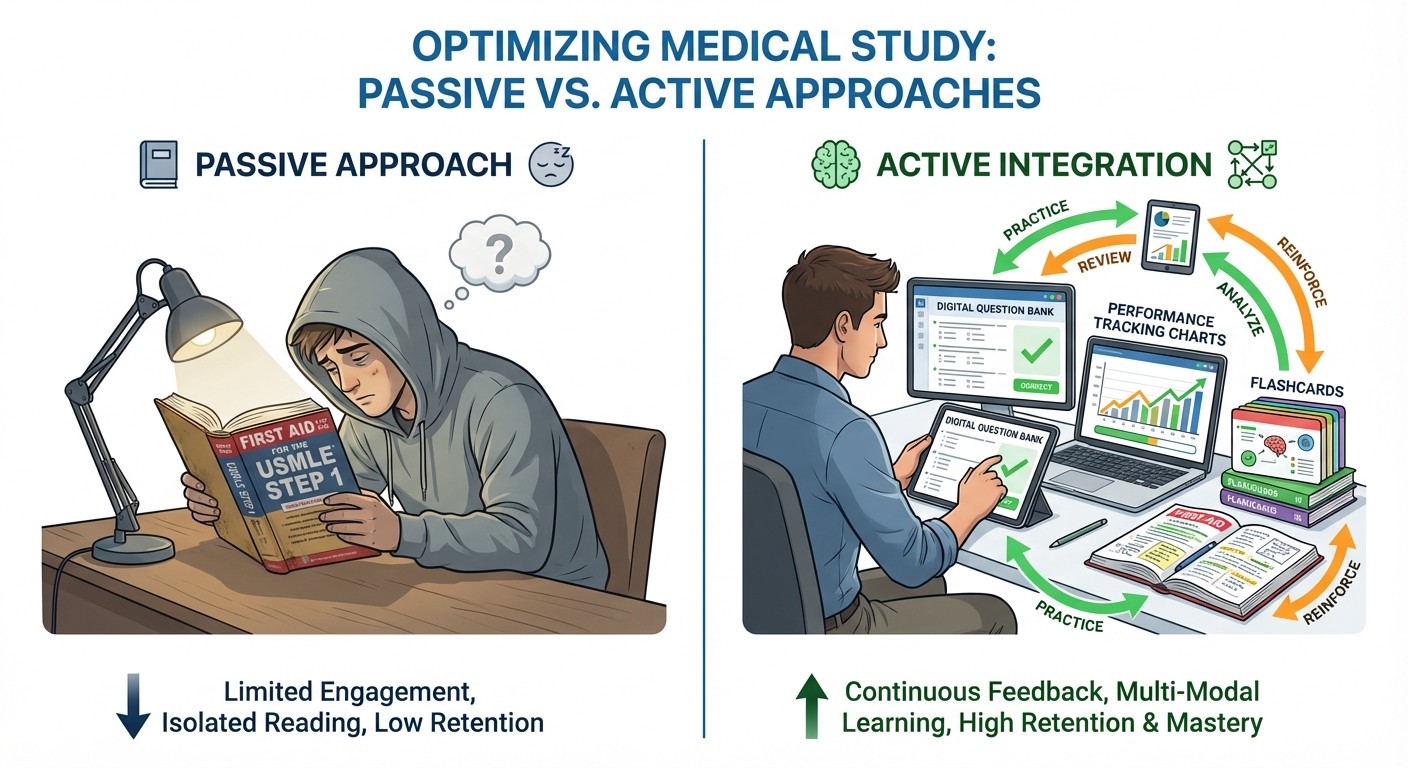
No Active Recall: Reading First Aid is passive. Highlighting is passive. Even annotating margins is relatively passive. Step 1 requires you to synthesize information under time pressure, not recall isolated facts. A research study on USMLE prep strategies found that interactive resources (question banks) consistently correlated with higher scores, while passive resources (textbooks, videos) showed weaker associations.
After reading about myocardial infarction pathophysiology, you can immediately test your understanding with targeted cardiology practice questions to surface gaps and reinforce concepts through active recall.
Surface-Level Integration: Modern Step 1 questions integrate physiology, pathology, and pharmacology in complex ways. First Aid presents these as separate bullet points. For example, you might know that ACE inhibitors cause hyperkalemia and that hyperkalemia causes peaked T-waves, but Step 1 will give you a vignette where you need to reason through why a patient on lisinopril developed EKG changes. Static Learning: First Aid doesnt adapt to your weak areas. If youre solid on cardiology but struggling with endocrine feedback loops, First Aid treats every page equally. Adaptive tools can focus your review time where it matters most.
How to Pair First Aid Effectively: The Active Integration Strategy
First Aid works when you integrate it with active recall systems. Here are the evidence-backed approaches:
1. Question-First Method
Start with questions, use First Aid for reinforcement. Heres the workflow:
Do a block of UWorld or practice questions on a topic
For incorrect or uncertain answers, look up the concept in First Aid
Annotate First Aid with the question stem or clinical vignette that tested that concept
Review those annotations during dedicated study periods
Oncourse's adaptive question bank makes this seamless — after drilling cardiology questions, you can immediately reference the topic areas where you missed questions and target those sections in First Aid for review.
2. Spaced Repetition Integration
First Aid facts stick better when reinforced through spaced repetition. Instead of re-reading chapters passively:
Extract high-yield facts from First Aid into flashcards
Use a spaced repetition system to review them at increasing intervals
Connect flashcard reviews to recent question performance
Oncourse's smart flashcard system automatically creates spaced repetition schedules for First Aid concepts, surfacing facts at optimal intervals based on memory science rather than arbitrary review schedules.
3. Performance-Driven Review
Use your question bank performance to determine which First Aid sections need attention:
Track your accuracy by topic (cardiology, pulmonology, etc.)
For topics below 70% accuracy, do focused First Aid review
For topics above 80%, skip detailed First Aid reading and stick to quick reference
Oncourse's performance analytics break down your accuracy by subject and subtopic, so you can see exactly which First Aid chapters deserve deep review versus quick passes.
4. Anki Integration (Advanced Users)
Many top scorers create Anki cards from First Aid, but this requires discipline:
Use cloze deletions for fact-based cards
Create image occlusion cards for diagrams and pathways
Tag cards by First Aid chapter for organized review
Suspend cards for topics youve mastered
The key is not to Anki-fy every sentence in First Aid. Focus on facts that repeatedly show up in your question bank errors.
When NOT to Use First Aid as Your Primary Resource
First Aid isnt right for everyone. Skip it or minimize it if:
You Learn Better Through Cases: Some students absorb information better through clinical reasoning than fact memorization. If you find yourself memorizing First Aid without understanding the underlying concepts, pivot to case-based resources like UWorld explanations or comprehensive USMLE lessons that build understanding first. You Have Limited Study Time: If youre doing a compressed prep schedule (8-12 weeks), question banks deliver better ROI than comprehensive content review. Use First Aid only for quick lookups, not cover-to-cover reading. You're Already Scoring Well on Practice Tests: If your NBME practice scores are consistently in your target range, dont add First Aid for completeness. Stick to maintaining your question bank momentum. You Prefer Conceptual Learning: First Aid is fact-heavy but concept-light. If you need to understand mechanisms before memorizing facts, start with Pathoma or Boards and Beyond for conceptual foundation, then use First Aid for high-yield details.
Alternative Strategies: What Top Scorers Actually Do
Based on score correlation data and student debriefs, heres what consistently high performers actually do with First Aid:
The Annotation Method: Buy a physical copy and turn it into your personal reference. Annotate UWorld explanations in margins, highlight patterns youve missed, add mnemonics that stick for you. The goal is creating a customized quick-reference, not memorizing every printed word. The Lookup Strategy: Keep First Aid as a secondary resource. When question explanations mention a concept you dont fully understand, look it up in First Aid for the condensed version. This is question-driven learning with First Aid as backup. The Final Week Strategy: Some students skip First Aid during their main prep phase and save it for the final 1-2 weeks before test day. They use it for rapid review of facts and mnemonics, not learning new concepts. This works if your question bank performance is solid and you just need fact reinforcement.
The Verdict: Yes, Still Worth It — But Only If You Use It Actively
First Aid remains valuable in 2026, but not as the centerpiece of your Step 1 prep. The data is clear: interactive resources (question banks, spaced repetition, adaptive learning) correlate with higher scores more strongly than passive content review.
Buy First Aid if: You want a comprehensive quick-reference guide, you learn well from bullet-point summaries, or you need a backup resource for question-driven learning. Skip First Aid if: Youre on a tight timeline, you prefer case-based learning, or your practice scores are already on target. Use First Aid right if: You integrate it with active recall, focus on weak areas identified through question performance, and treat it as a tool for reinforcement, not primary learning.
The 2026 edition includes useful updates, but the core value proposition hasnt changed. First Aid gives you high-yield facts efficiently organized. What moves your score is how actively you engage with those facts through questions, spaced repetition, and performance-driven review.
For most students, First Aid works best as part of a question-centric approach. Drill questions first, reference First Aid second, and let your performance data guide where to spend review time. That's the strategy that consistently correlates with score improvement — not passive reading, not matter how comprehensive the resource.
Frequently Asked Questions
Should I Buy First Aid 2026 or Use an Older Edition?
The 2026 edition includes updated clinical images and refined content alignment, but the core high-yield facts havent changed dramatically. If you already own the 2024 or 2025 edition, you dont need to upgrade unless youre specifically concerned about having the latest pharmacology updates. If you're starting fresh, buy the current edition for peace of mind.
How Long Should I Spend Reading First Aid?
Dont set a timeline for "reading First Aid cover to cover." Instead, use it reactively. When you miss questions in specific areas, reference the relevant First Aid sections. Most effective users spend 20-30% of their study time on content review (including First Aid) and 70-80% on question practice.
Can I Use First Aid Without UWorld?
You can, but research shows interactive question practice correlates more strongly with Step 1 success than content review alone. If budget is a concern, prioritize a question bank over First Aid. Free question resources exist, but comprehensive question banks like UWorld or adaptive alternatives provide better correlation with exam performance.
Should I Make Anki Cards From Every First Aid Page?
No. Creating comprehensive Anki decks from First Aid takes enormous time and often leads to memorization without understanding. Focus on making cards for facts you consistently miss in question practice, not for comprehensive coverage. Pre-made decks like AnKing exist if you prefer that route, but customize based on your weak areas.
Is First Aid Enough for IMG Students?
International medical graduates often need more foundational review than First Aid provides. Consider starting with conceptual resources (Pathoma, Boards and Beyond) before moving to First Aid for high-yield review. First Aid works best when you already understand underlying mechanisms and need fact reinforcement.
How Do I Know When to Stop Using First Aid?
When your question bank performance is consistently hitting your target scores across all subjects, you can minimize First Aid review. Keep it available for quick lookups, but dont feel obligated to complete comprehensive review if your practice performance indicates readiness.
Prepare smarter with Oncourse AI — adaptive MCQs, spaced repetition, and AI explanations built for USMLE Step 1. Download free on Android and iOS.