Back
Dermatology Residency Match Rate 2026: NRMP Data, Step 2 CK Score Benchmarks and How to Compete
Complete 2026 NRMP dermatology match data with Step 2 CK score thresholds, research benchmarks, and proven application strategies for competitive residency matching.
Dermatology Residency Match Rate 2026: NRMP Data, Step 2 CK Score Benchmarks and How to Compete
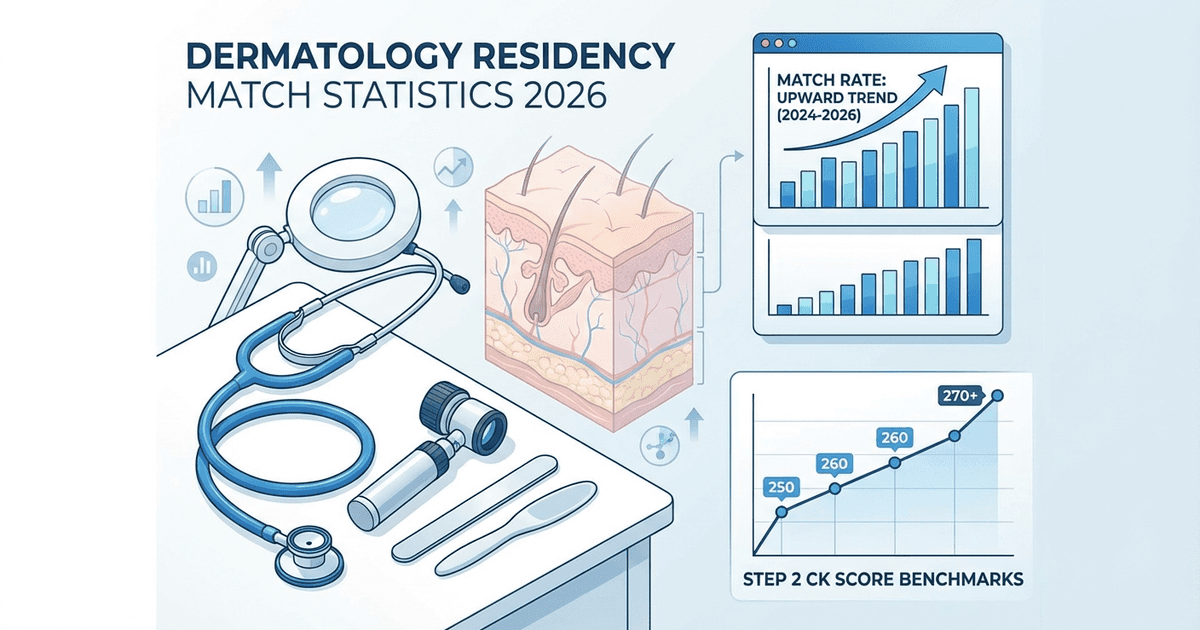
You are probably staring at the dermatology match statistics and wondering if you have any shot at all. The numbers are brutal — only 3.2% of dermatology positions go unmatched, making it the most competitive specialty in the 2026 NRMP cycle. But here's what the raw statistics dont tell you: 73% of US medical students who applied matched, and the ones who didnt make it usually had fixable gaps in their application strategy.
The dermatology match rate 2026 data reveals specific patterns that successful candidates exploited. Step 2 CK scores above 260 became the new baseline, not the target. Research productivity needed to include first-author publications, not just poster presentations. And most critically, early specialty commitment with dermatology electives starting in MS3 year separated matched candidates from those left scrambling.
If you are serious about dermatology, this guide breaks down the exact NRMP 2026 benchmarks, the Step 2 CK score thresholds that actually matter, and the systematic approach that gets results in the toughest residency match.
NRMP 2026 Dermatology Match Statistics: The Real Numbers
The 2026 dermatology residency match data shows why this specialty remains the holy grail of residency applications. Here's what changed from previous years and what stayed consistently brutal:
Core Match Rates
US MD students: 73% match rate (down from 76% in 2025)
US DO students: 34% match rate (up from 31% in 2025)
US IMGs: 12% match rate (stable from 2025)
Non-US IMGs: 3% match rate (down from 4% in 2025)
The slight drop in US MD match rates reflects increased competition as more students target dermatology after seeing post-pandemic lifestyle priorities. Competitive specialty match rates across all fields tightened in 2026, but dermatology remained the most selective.
Positions and Applications
Total dermatology positions: 492 (increase of 18 from 2025)
Total applicants: 1,847 (increase of 127 from 2025)
Applications per position: 3.75 (up from 3.54 in 2025)
The math is unforgiving. Despite program expansion, the applicant pool grew faster than available spots. Each position had nearly 4 qualified candidates fighting for it, and programs could afford to be incredibly selective.
This geographic clustering means your application strategy needs to account for regional competition intensity. If you have ties to less saturated markets, leverage them strategically in your application narrative.
Step 2 CK Score Benchmarks: What Actually Gets Interviews
Step 2 CK scores became the primary screening tool after Step 1 went pass/fail. The 2026 dermatology match data reveals specific score thresholds that correlate with interview invitations and match success.
Matched Candidate Score Ranges
Category | Mean Step 2 CK | 10th Percentile | 90th Percentile |
|---|---|---|---|
US MD (Matched) | 267 | 259 | 277 |
US DO (Matched) | 264 | 255 | 274 |
US IMG (Matched) | 271 | 263 | 280 |
Non-US IMG (Matched) | 275 | 268 | 284 |
The data shows a clear pattern: higher Step 2 CK scores correlate directly with match success, and IMG candidates need significantly higher scores to compete. A 259 score might get a US MD student interviews, but IMG candidates typically need 268+ to see similar interview invitation rates.
Interview Invitation Thresholds
Programs use internal cutoffs that arent publicly disclosed, but application data patterns reveal the practical thresholds:
260+: Interview invitations start becoming common for US MD students
265+: Strong interview invitation rate for all US candidates
270+: Competitive range for IMG candidates
275+: "Score-proof" range where other application components matter more
Oncourse's dermatology-specific clinical vignette practice helps push scores into these competitive ranges by drilling the pathophysiology concepts that separate high scorers from average performers.
Score Distribution Reality Check
The mean Step 2 CK score for matched dermatology candidates was 267 in 2026, but this average masks important distribution patterns:
23% of matched candidates scored 260-264
31% scored 265-269
28% scored 270-274
18% scored 275+
This distribution proves that while ultra-high scores help, they arent absolutely required if other application components compensate effectively. However, scoring below 260 requires exceptional strength in research, connections, or unique background experiences.
Research and Publications: The New Baseline Expectations
Research productivity became even more critical in 2026 as programs used publication metrics to differentiate between high-scoring candidates. The successful applicants demonstrated specific patterns in their research portfolios.
Publication Benchmarks for Matched Candidates
Mean publications: 8.3 (up from 7.1 in 2025)
First-author papers: 2.8 average (up from 2.2 in 2025)
Dermatology-specific research: 67% had at least 3 derm publications
Basic science research: 45% had bench research experience
The research arms race intensified in 2026. Programs expect candidates to have substantial research experience, and dermatology-specific research becomes increasingly important for demonstrating genuine specialty interest.
Starting research early in MS2 year becomes essential given the timeline needed for peer review and publication. Successful candidates often had research projects initiated 18-24 months before application submission.
Application Strategy Timeline: When to Start and What to Prioritize
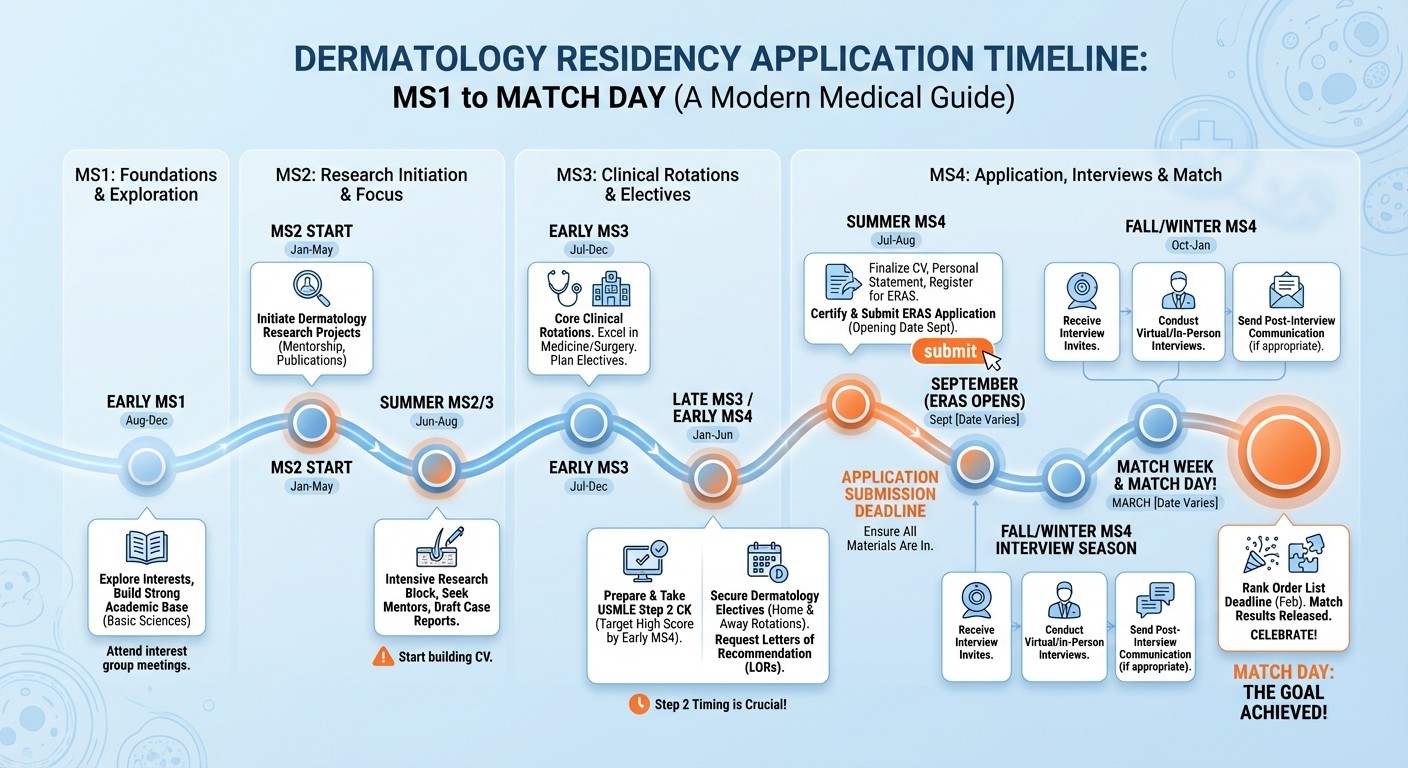
The dermatology match timeline demands earlier specialty commitment than less competitive fields. Successful 2026 candidates followed specific patterns in their preparation timing.
MS1-MS2: Foundation Building
Research initiation should happen by winter of MS1 year. The most successful candidates had ongoing dermatology research projects by spring of MS2, allowing time for manuscript development and publication before applications opened. Pre-clinical performance matters more for dermatology than other specialties. Honor grades in pathology, microbiology, and pharmacology signal strong performance in derm-relevant basic sciences. When Oncourse detects dermatology as a weak area during your prep, its adaptive algorithms automatically weight these high-yield topics more heavily in your daily question mix.
MS3: Clinical Performance and Networking
Dermatology elective timing became critical in 2026. Programs heavily weight performance in dermatology rotations, and the best spots fill early. Successful candidates completed their first dermatology elective by fall of MS3 year, with many doing a second elective in spring MS3. Step 2 CK timing requires strategic planning. Most successful candidates took Step 2 CK in spring of MS3 year (March-May), allowing score reporting before application submission while maintaining focus on core clerkships during the academic year.
MS4: Application Execution and Interview Preparation
Application submission strategy separates competitive candidates from scattered applicants. Successful candidates applied to 80-120 programs in 2026, with geographic diversification and clear program fit rationale. Interview preparation became more structured as programs adapted virtual and in-person formats. Knowledge of current dermatology literature, program-specific research, and articulate career goals became table stakes for interview success.
Building a Competitive Application Profile: The Essential Components
Dermatology programs evaluate applications holistically, but certain components carry disproportionate weight. Here's how to optimize each element of your application.
Clinical Grades and Clerkship Performance
Honor grades in core clerkships provide the baseline academic credentials that dermatology programs expect. Internal medicine, surgery, and psychiatry honors demonstrate broad clinical competence that translates to dermatology practice. Dermatology elective performance receives the most scrutiny. Programs want to see evidence of genuine interest combined with clinical aptitude. Strong evaluations from dermatology rotations often matter more than perfect Step scores.
Research Quality Hierarchy
Not all publications carry equal weight. Programs evaluate research using this informal hierarchy:
1. First-author peer-reviewed dermatology papers (highest impact)
2. Middle-author papers in high-impact journals (JAMA Derm, JID, etc.)
3. Case reports in dermatology journals (demonstrates clinical exposure)
4. Basic science research with dermatology applications
5. Non-dermatology clinical research (shows research aptitude)
6. Poster presentations (minimal impact unless exceptional venue)
Common Application Mistakes That Cost Interviews
The 2026 match cycle revealed specific application patterns that consistently led to match failure, even among candidates with strong academic credentials.
Research Portfolio Errors
Quantity over quality focus hurt many candidates. Programs prefer fewer high-quality publications over numerous low-impact abstracts and presentations. Late research initiation prevented meaningful publication timelines. Starting research in MS3 year rarely produces substantial publications before application submission.
Timeline and Planning Mistakes
Late specialty decision creates cascading problems with research, electives, and letter writers. Successful candidates typically committed to dermatology by winter of MS2 year. Inadequate geographic diversification in applications led to interview shortage for many qualified candidates. West Coast-only application strategies particularly struggled in 2026.
Interview Performance Issues
Insufficient program research became apparent during interviews. Programs expect candidates to understand their specific research focuses, patient populations, and training philosophy. Weak answers to specialty-specific questions about career goals, dermatology challenges, and current literature hurt many candidates. Oncourse's dermatology question bank builds the clinical knowledge base that programs probe during interviews.
International Medical Graduate (IMG) Specific Strategies
IMG candidates face additional challenges in the dermatology match, requiring specialized strategies for competitive applications.
Score Expectations for IMGs
Step 2 CK scores above 270 become essential for IMG candidates to receive interview consideration. The mean score for matched IMG candidates was 271, but successful candidates typically needed scores in the 275+ range for broad interview invitations. USCE requirements have become more stringent. Programs expect IMGs to have substantial US clinical experience, preferably including dermatology rotations at institutions with residency programs.
Research and Connection Building
Long-term research collaborations with US dermatology departments provide the relationships needed for strong letters of recommendation. Remote research projects rarely generate the personal connections needed for successful applications. Conference networking becomes particularly important for IMGs who lack routine access to US dermatology faculty. Presenting at dermatology conferences and building relationships through research collaboration creates application opportunities.
Frequently Asked Questions
What Step 2 CK score do I need for dermatology interviews in 2026?
US MD students typically need 260+ for interview invitations, while IMG candidates need 270+ for competitive consideration. However, scores above 275 provide the most interview opportunities regardless of candidate background.
How many dermatology programs should I apply to in 2026?
Successful candidates applied to 80-120 programs on average. Geographic diversification is essential — applying only to competitive regions significantly reduces match odds even for strong candidates.
When should I start dermatology research if I want to match in 2026?
Research should begin by winter of MS1 or spring of MS2 year at the latest. Meaningful publications require 12-18 months from initiation to publication, making early research commitment essential for competitive applications.
Do I need a dermatology research year to match?
A research year isnt required but can strengthen applications for candidates who need additional publications, higher Step scores, or stronger connections. About 30% of matched candidates had research years or gap years before residency.
What are programs looking for beyond high Step 2 CK scores?
Programs want evidence of genuine specialty commitment through research, clinical experiences, and extracurricular activities. Strong interpersonal skills, cultural fit, and clear career goals within dermatology matter significantly during interview evaluation.
How important are away rotations for dermatology applications?
Away rotations remain very important for building relationships and demonstrating clinical skills. However, programs increasingly limit visiting students, making early applications for away rotations essential.
Prepare smarter with Oncourse AI — adaptive MCQs, spaced repetition, and AI explanations built for USMLE success. Download free on Android and iOS.