Average Step 2 Score By Specialty: How Rezzy Tutor + Explanation Chat Changes USMLE Prep in 2026
Complete 2026 breakdown of average Step 2 CK scores by specialty with NRMP data. Learn how AI tutoring targets weak areas and transforms USMLE preparation for better residency match outcomes.
Average Step 2 Score By Specialty: How Rezzy Tutor + Explanation Chat Changes USMLE Prep in 2026
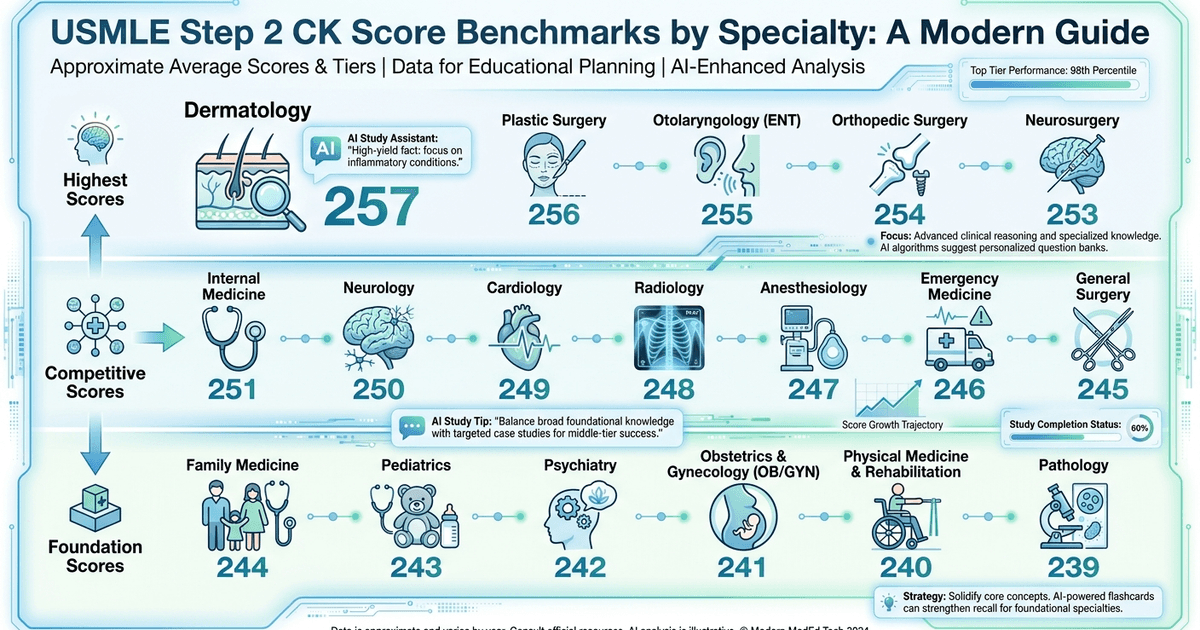
You stare at the NRMP data tables, trying to decode what Step 2 CK score you actually need for your dream specialty. Dermatology shows 257. Internal medicine sits at 251. Family medicine at 244. But what do these numbers really mean for your Match prospects?
Step 2 CK scores carry more weight than ever since Step 1 went pass/fail in 2022. Every point matters when programs are filtering thousands of applications. The difference between matching your preferred specialty and scrambling often comes down to how well you target your weak areas and master clinical reasoning.
Here's where most students get it wrong: they memorize these average scores without understanding the score distributions, match rates, or how to efficiently close knowledge gaps. This guide breaks down the 2024-2026 NRMP data by specialty and shows you exactly how AI-powered tutoring like Oncourse's Rezzy transforms weak-area remediation.
The Complete Step 2 CK Score Breakdown by Specialty
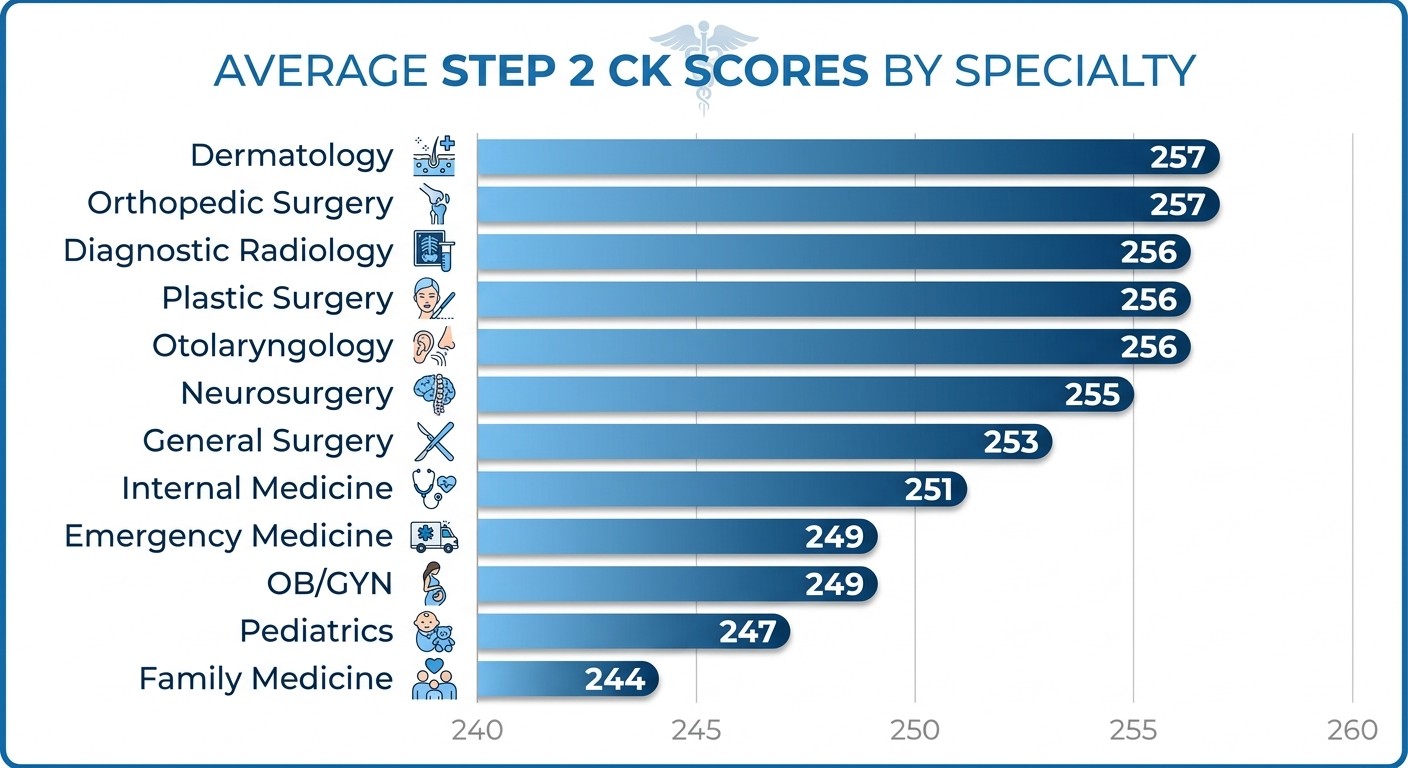
The 2024 NRMP Charting Outcomes data reveals stark differences in Step 2 CK performance across specialties. These aren't just numbers—they represent the clinical reasoning skills and knowledge base that programs expect from matched applicants.
Ultra-Competitive Specialties (255-257 Average)
Dermatology: 257 average Step 2 CK
25th percentile: ~250
75th percentile: ~265
Match rate for US MDs: 73%
Orthopedic Surgery: 257 average Step 2 CK
25th percentile: ~249
75th percentile: ~265
Match rate for US MDs: 77%
Diagnostic Radiology: 256 average Step 2 CK
25th percentile: ~248
75th percentile: ~264
Match rate for US MDs: 85%
Plastic Surgery: 256 average Step 2 CK
25th percentile: ~248
75th percentile: ~263
Match rate for US MDs: 64%
Otolaryngology: 256 average Step 2 CK
25th percentile: ~249
75th percentile: ~263
Match rate for US MDs: 70%
Highly Competitive Specialties (250-254 Average)
Neurosurgery: 255 average Step 2 CK
The most competitive surgical specialty demands excellence across all application components.
General Surgery: 253 average Step 2 CK
With 1,341 positions available, surgery programs can be selective about Step 2 CK performance.
Internal Medicine: 251 average Step 2 CK
The largest specialty by match numbers (8,303 positions) but competitive subspecialties require higher scores.
Moderately Competitive Specialties (247-250 Average)
Emergency Medicine: 249 average Step 2 CK
Clinical decision-making skills are paramount, reflected in the emphasis on Step 2 performance.
Obstetrics & Gynecology: 249 average Step 2 CK
Both clinical knowledge and procedural aptitude factor into program decisions.
Pediatrics: 247 average Step 2 CK
Strong clinical reasoning with children requires solid Step 2 CK foundation.
Primary Care Specialties (244-246 Average)
Family Medicine: 244 average Step 2 CK
The lowest average among specialties, but programs still expect passing scores and clinical competency.
Psychiatry: 246 average Step 2 CK
Clinical reasoning and therapeutic decision-making skills are evaluated through Step 2 performance.
What These Scores Actually Mean for Your Match Strategy
Raw averages tell only part of the story. The score distributions reveal critical insights most students miss.
The 25th-75th Percentile Reality Check
For dermatology's 257 average, the 25th percentile sits around 250. This means 25% of matched dermatology applicants scored below 250—they succeeded through exceptional research, clinical grades, or other application strengths.
The 75th percentile at ~265 shows the top quartile of matched applicants. If you're targeting 270+ for dermatology, you might be over-preparing on Step 2 CK at the expense of research productivity or clinical performance.
Score Gaps Between Matched and Unmatched Applicants
Specialty score gaps reveal how much Step 2 CK matters relative to other factors:
Narrow gaps (5-8 points): Orthopedic surgery, neurosurgery, dermatology. Other factors like research and connections carry significant weight.
Moderate gaps (8-12 points): Internal medicine, emergency medicine. Step 2 CK performance correlates strongly with match success.
Wide gaps (12+ points): Radiology, anesthesiology. Step 2 CK serves as a primary screening tool.
IMG and DO Considerations: Different Score Expectations
International medical graduates and DO students face different score benchmarks for the same specialties.
IMG Step 2 CK Patterns
US Citizen IMGs:
Average across matched specialties: ~248
Top specialties range: 231-248
Higher scores needed to compensate for clinical experience gaps
Non-US Citizen IMGs:
Average across matched specialties: 245-246
Range: 231-246
Must demonstrate exceptional clinical knowledge to overcome visa concerns
DO Student Patterns
Overall DO Average: 248 across all matched specialties Top DO Specialties by Step 2 CK:
Diagnostic Radiology: 252
Anesthesiology: 251
Orthopedic Surgery: 251
General Surgery: 248
DO students often need higher Step 2 CK scores than MDs for the same specialty due to historical biases and smaller match numbers in competitive fields.
How Weak-Area Analysis Changes Everything
Most students study Step 2 CK like Step 1—broad review with generic question banks. This approach wastes months on topics you already know while leaving critical gaps unaddressed.
Your Step 2 CK performance depends on clinical reasoning across multiple domains:
Diagnostic workup: History-taking, physical exam, lab interpretation
Management decisions: Treatment selection, monitoring, follow-up
Risk assessment: Prognosis, complications, preventive care
Systems integration: Multi-organ pathology, drug interactions
Traditional prep fails because it doesn't identify which domains are weak within each specialty area. You might excel at cardiology diagnosis but struggle with cardiology management—generic cardiology review won't fix this precision gap.
Rezzy AI Tutor: Precision Targeting for Step 2 CK Gaps
Oncourse's Rezzy AI tutor revolutionizes Step 2 CK prep through granular weak-area identification and personalized explanations. After each practice question, Rezzy analyzes your reasoning process and pinpoints exact knowledge gaps.
Instead of generic feedback like "review cardiology," Rezzy identifies specific deficits: "You missed the distinction between heart failure with preserved vs reduced ejection fraction management protocols." The AI then generates targeted explanations, comparison tables, and follow-up questions focused on that precise gap.
When you encounter a complex internal medicine vignette, Rezzy doesn't just explain the right answer—it walks through the clinical reasoning process that NBME expects. Why was echocardiography chosen over cardiac catheterization? What clinical signs triggered the workup sequence? How do you integrate multiple organ systems in your decision-making?
The Explanation Chat Advantage: Interactive Learning That Sticks
Traditional question banks provide static explanations. You read them once, maybe twice, then move to the next question. Critical nuances get lost in paragraph-heavy text blocks.
Rezzy's Explanation Chat transforms passive reading into active dialogue. You can ask immediate follow-ups: "Why wasn't CT chosen instead of MRI?" "Show me a comparison table of heart failure medications." "What would change this management if the patient had diabetes?"
The AI generates visual aids on demand—flowcharts for diagnostic algorithms, tables comparing similar conditions, mnemonics for complex pathways. These aren't generic resources pulled from a database; they're created specifically for your question and learning style.
For weak areas in internal medicine cardiology, Rezzy might generate a side-by-side comparison of ACE inhibitors vs ARBs vs beta-blockers, complete with contraindications, monitoring parameters, and clinical pearl annotations. The same depth applies across all specialties and clinical domains.
Strategic Score Targeting by Specialty Goals
Your Step 2 CK target score should align with your specialty choice and backup options.
For Ultra-Competitive Specialties (Derm, Ortho, Plastics)
Target: 260+ for competitive programs
Minimum: 255 to remain viable
Strategy: Perfect your strongest areas first, then address specific weak domains
Backup planning: Develop internal medicine or surgery applications
For Surgical Specialties
Target: 255+ for top programs
Minimum: 250 for most programs
Strategy: Focus on surgical decision-making and perioperative management
Weak areas: Often anatomy, pathophysiology integration, and post-op complications
For Internal Medicine and Subspecialties
Target: 255+ for competitive subspecialties (cardiology, GI, pulm-crit)
Minimum: 245 for general internal medicine
Strategy: Master diagnostic reasoning and chronic disease management
Common gaps: Drug interactions, complex multi-organ cases, preventive care protocols
For Primary Care Specialties
Target: 250+ for competitive family medicine programs
Minimum: 240 for most programs
Strategy: Breadth over depth—solid foundation across all systems
Focus areas: Preventive care, pediatrics integration, behavioral medicine
Timeline and Score Improvement Strategies
Most students underestimate how long meaningful score improvement takes. Step 2 CK tests integrated clinical knowledge—you can't cram your way to a 20-point increase in 4 weeks.
6+ Months Before Exam
Start with diagnostic assessment using USMLE Step 2 CK questions. Identify major knowledge gaps early. Use Rezzy to understand your learning patterns and create a personalized study timeline.
3-4 Months Before Exam
Focus on weak-area remediation. Target 2-3 major deficits per month rather than trying to fix everything simultaneously. Use spaced repetition for high-yield facts while dedicating focused time to clinical reasoning practice.
6-8 Weeks Before Exam
Transition to integrated practice with full-length assessments. Use Rezzy's explanation chat to clarify complex reasoning on practice questions. Don't learn new content—reinforce and integrate existing knowledge.
Final 2 Weeks
Review only your highest-yield weak areas. Focus on test-taking strategy and managing exam anxiety. Trust your preparation rather than attempting last-minute memorization.
Beyond the Numbers: What Programs Really Want
Step 2 CK scores open doors, but they don't guarantee match success. Programs use these scores as initial screening tools, then evaluate clinical performance, research productivity, and fit.
Score Thresholds vs Holistic Review
Most competitive programs set Step 2 CK minimums (often 10-15 points below their averages) then focus on other application components. Scoring 270 won't overcome poor clinical grades or lack of research in competitive specialties.
Clinical Correlation
Programs want evidence that your Step 2 CK performance translates to clinical competence. Strong shelf exam scores, excellent clinical grades, and faculty recommendations carry significant weight alongside standardized test performance.
Research Integration
High-scoring applicants often demonstrate how their clinical knowledge contributes to research productivity. Publications that show clinical insight and scientific rigor complement strong Step 2 CK scores.
Frequently Asked Questions
How much can I realistically improve my Step 2 CK score?
Most students see 10-20 point improvements with focused preparation over 3-4 months. Improvements above 25 points require addressing fundamental knowledge gaps and typically take 4-6 months of dedicated study.
Should I retake Step 2 CK if I scored below my target specialty's average?
Consider your overall application strength. If you're 5-10 points below the specialty average but have strong research and clinical grades, apply broadly within your specialty. If you're 15+ points below, consider retaking or expanding to less competitive specialties.
Do IMG candidates need higher Step 2 CK scores than the published averages?
Yes. IMGs typically need scores 5-10 points above US MD averages to compensate for clinical experience gaps and visa considerations. Focus on exceptional Step 2 CK performance combined with strong research.
How important are Step 2 CK scores compared to Step 1 (when it was scored)?
Step 2 CK now carries more weight than Step 1 did historically. Programs view Step 2 CK as a better predictor of clinical performance, making it the primary objective measure for many specialties.
Can AI tutoring really replace traditional prep methods?
AI tutoring like Rezzy complements rather than replaces traditional methods. Use AI for personalized weak-area identification and explanation, but combine it with clinical experience, question banks, and peer discussion for optimal results.
What if my Step 2 CK score doesn't match my clinical performance?
Some students excel clinically but struggle with standardized tests. Focus on test-taking strategies, timing, and anxiety management. Use clinical correlation to reinforce knowledge rather than isolated memorization.
The Future of Step 2 CK Preparation
Step 2 CK preparation is evolving beyond passive content review toward active clinical reasoning development. AI-powered tutoring represents the next evolution—personalized, adaptive, and focused on the clinical thinking skills that programs actually want to see.
The students who succeed in 2026 and beyond won't just memorize average scores by specialty. They'll understand their individual learning patterns, target their specific weak areas, and develop the clinical reasoning skills that translate to both exam success and residency performance.
Your Step 2 CK score matters, but it's just one component of your application. Use these specialty averages as guideposts, not absolute requirements. Focus on building the clinical knowledge and reasoning skills that will serve you throughout your medical career.
Prepare smarter with Oncourse AI—adaptive MCQs, spaced repetition, and AI explanations built for USMLE success. Download free on Android and iOS.