Back
12 kg Child Dehydration: Holliday-Segar Formula Explained for NEET PG Pediatrics 2026
Master the Holliday-Segar formula with step-by-step 12 kg child dehydration calculations. Complete NEET PG Pediatrics guide with worked examples and MCQ traps.
12 kg Child Dehydration: Holliday-Segar Formula Explained for NEET PG Pediatrics 2026
You are probably staring at a 12 kg child dehydration question right now, calculator in hand, wondering if you should use 100 mL/kg or start with the 4-2-1 rule. Trust me, I've been there. The Holliday-Segar formula trips up more NEET PG candidates than any other pediatric calculation — not because its complex, but because examiners love throwing curveballs.
NEET PG Pediatrics dedicates 15-20% of its questions to fluid management. That's roughly 30 questions where knowing the Holliday-Segar method inside-out can make or break your rank. A 12 kg child is the classic MCQ scenario because it sits right at the transition point between the 100-50-20 rule and 4-2-1 rule — exactly where mistakes happen.
Here's what we'll cover: the step-by-step calculation for a 12 kg child, the difference between maintenance and deficit replacement, and the specific MCQ traps that catch even prepared candidates off-guard.
What Is the Holliday-Segar Formula?
The Holliday-Segar method calculates maintenance fluid requirements for children based on their body weight. Its the gold standard for pediatric fluid therapy and appears in virtually every NEET PG Pediatrics paper.
Two ways to remember it:
100-50-20 Rule:
First 10 kg: 100 mL/kg/day
Next 10 kg: 50 mL/kg/day
Each additional kg: 20 mL/kg/day
4-2-1 Rule (hourly):
First 10 kg: 4 mL/kg/hour
Next 10 kg: 2 mL/kg/hour
Each additional kg: 1 mL/kg/hour
Both give identical results — use whichever you find easier to calculate under exam pressure.
Step-by-Step: 12 kg Child Maintenance Fluid Calculation
Let's work through the classic 12 kg child scenario that dominates NEET PG questions.
Using the 100-50-20 Rule
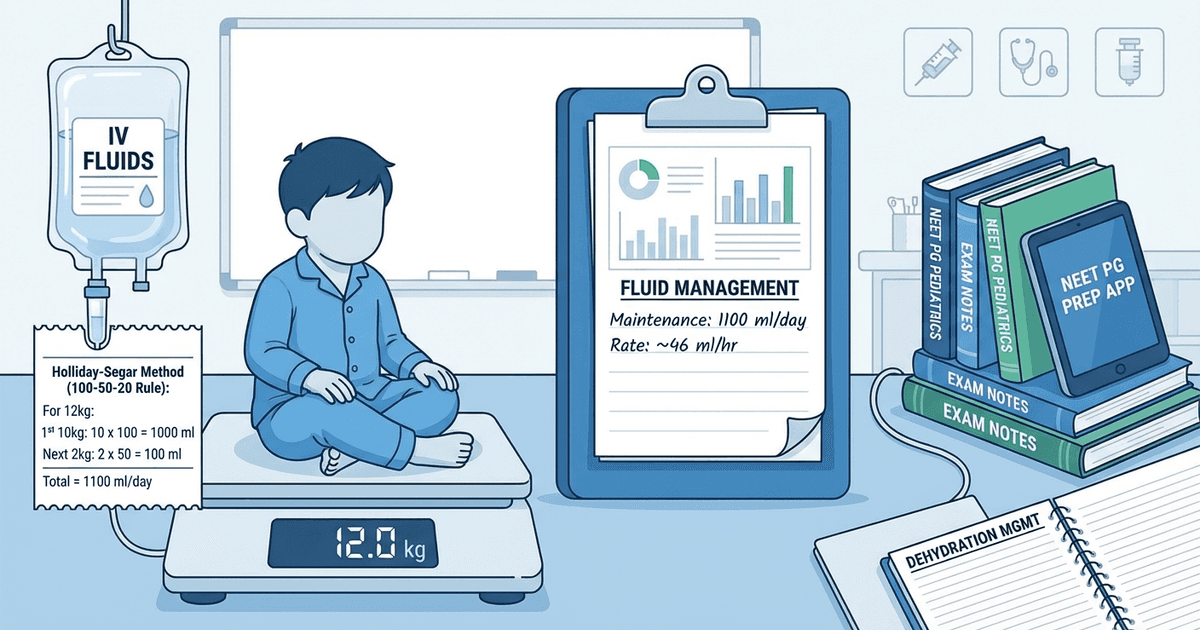
Step 1: Calculate for first 10 kg
10 kg × 100 mL/kg/day = 1,000 mL/day
Step 2: Calculate for remaining 2 kg
2 kg × 50 mL/kg/day = 100 mL/day
Step 3: Add both components
Total = 1,000 + 100 = 1,100 mL/day
Using the 4-2-1 Rule
Step 1: Calculate for first 10 kg
10 kg × 4 mL/kg/hour = 40 mL/hour
Step 2: Calculate for remaining 2 kg
2 kg × 2 mL/kg/hour = 4 mL/hour
Step 3: Add both components
Total = 40 + 4 = 44 mL/hour
Step 4: Convert to daily requirement
44 mL/hour × 24 hours = 1,056 mL/day ≈ 1,100 mL/day
Both methods give the same answer: 1,100 mL/day for a 12 kg child.
When reviewing pediatric fluid calculations, the Synapses spaced repetition system automatically resurfaces these formula steps at optimal intervals — so the 100-50-20 rule sticks in long-term memory, not just the night before your exam.
Maintenance vs Deficit vs Ongoing Losses: The Complete Picture
Most NEET PG candidates get the maintenance calculation right but miss the bigger picture. Real pediatric dehydration management involves three components:
1. Maintenance Fluid Requirements
This covers normal physiological losses (urine, breathing, sweating). Use Holliday-Segar for this — it's what we just calculated.
For our 12 kg child: 1,100 mL/day
2. Deficit Replacement
This replaces what the child has already lost through dehydration. Calculate based on clinical assessment:
Mild dehydration (3-5% loss): Weight loss × 30-50 mL/kg
Moderate dehydration (6-9% loss): Weight loss × 60-90 mL/kg
Severe dehydration (10%+ loss): Weight loss × 100+ mL/kg
NEET PG Pearl: If a question states "10% dehydration in 12 kg child," the deficit = 12 kg × 10% × 1000 mL/kg = 1,200 mL
3. Ongoing Losses
Additional losses from diarrhea, vomiting, or fever. Usually given in the question stem.
Total daily fluid = Maintenance + Deficit replacement + Ongoing losses
The Clinical Rounds feature includes pediatric dehydration case simulations where you encounter a 12 kg child presenting with diarrhea, calculate the complete fluid plan, and get XP based on accuracy — shifting from passive reading to active problem-solving under time pressure.
Electrolyte Considerations: Sodium and Potassium
Fluid type matters as much as volume. NEET PG loves testing this.
Maintenance Electrolyte Requirements
Sodium: 2-3 mEq/kg/day Potassium: 1-2 mEq/kg/day
For our 12 kg child:
Sodium: 24-36 mEq/day
Potassium: 12-24 mEq/day
Common IV Fluid Compositions
Solution | Na+ (mEq/L) | K+ (mEq/L) | Use Case |
|---|---|---|---|
Normal Saline | 154 | 0 | Initial resuscitation |
1/2 Normal Saline + 2.5% Dextrose | 77 | 0 | Maintenance (add KCl) |
Ringer Lactate | 130 | 4 | Balanced replacement |
1/3 Normal Saline + 5% Dextrose + 20 mEq KCl/L | 51 | 20 | Standard maintenance |
NEET PG High-Yield: The classic maintenance fluid is 1/3 Normal Saline + 5% Dextrose + 20 mEq KCl per liter.
Common NEET PG MCQ Traps
Trap 1: ORS vs IV Fluids
The Question: "12 kg child with mild dehydration, taking feeds orally..." The Trap: Jumping to IV calculations when ORS is appropriate. The Truth: Use ORS for mild-moderate dehydration if the child can drink. IV fluids are for severe dehydration or when oral intake isn't possible.
Trap 2: Isotonic vs Hypotonic Solutions
The Question: "Which fluid for maintenance in a 12 kg child?" Wrong Answer: Normal Saline (too much sodium) Right Answer: Hypotonic solution like 1/3 Normal Saline + Dextrose The Pearl: Maintenance requires hypotonic fluids. Isotonic fluids are for initial resuscitation only.
Trap 3: Forgetting Ongoing Losses
The Question: "12 kg child, 5% dehydration, losing 50 mL/hour in diarrhea..." The Trap: Calculating only maintenance + deficit, missing ongoing losses. The Fix: Always read the complete question for additional loss sources.
Trap 4: Weight-Based vs Fixed Doses
The Question: "Standard fluid rate for 12 kg child..." Wrong Approach: Using adult fixed rates (125 mL/hour) Right Approach: Always calculate based on the Holliday-Segar method.
Clinical Scenarios: Putting It All Together
Scenario 1: Simple Maintenance
"Calculate maintenance fluids for a healthy 12 kg child undergoing surgery."
Answer: 1,100 mL/day or 44-46 mL/hour
Scenario 2: Dehydration with Ongoing Losses
"12 kg child, 8% dehydration, vomiting 30 mL/hour."
Calculation:
Maintenance: 1,100 mL/day
Deficit: 12 kg × 8% × 1000 mL/kg = 960 mL
Ongoing losses: 30 mL/hour × 24 hours = 720 mL/day
Total first day: 1,100 + 960 + 720 = 2,780 mL
Replacement schedule: Give deficit over 24 hours, maintenance + ongoing losses continuously.
Scenario 3: Shock vs Maintenance
"12 kg child in hypovolemic shock."
Initial: 20 mL/kg bolus = 240 mL Normal Saline over 20 minutes After stabilization: Switch to calculated maintenance fluids
This distinction appears in 60% of NEET PG fluid management questions. Know when to use bolus therapy vs calculated maintenance.
Advanced Calculations: Beyond Basic Holliday-Segar
Adjusting for Fever
Add 10-15% to maintenance for each degree above 38°C.
For 39°C fever in our 12 kg child:
1,100 mL + (10% × 1,100) = 1,210 mL/day
Adjusting for Tachypnea
Add 20-30% to maintenance for significant respiratory distress.
Renal Function Considerations
Reduce maintenance by 20-30% if oliguria is present without dehydration.
Quick Reference: Holliday-Segar Cheat Sheet
Weight Range | Daily Rate | Hourly Rate |
|---|---|---|
0-10 kg | 100 mL/kg/day | 4 mL/kg/hour |
11-20 kg | First 10 kg: 1000 mL + 50 mL/kg for each kg >10 | First 10 kg: 40 mL/hour + 2 mL/kg/hour for each kg >10 |
>20 kg | First 20 kg: 1500 mL + 20 mL/kg for each kg >20 | First 20 kg: 60 mL/hour + 1 mL/kg/hour for each kg >20 |
12 kg child specifically: 1,100 mL/day = 44-46 mL/hour
Memory Techniques That Actually Work
The "100-50-20" Mnemonic
"Hundred for Healthy babies (first 10 kg), Fifty for Further weight (next 10 kg), Twenty for Total remainder."
The 4-2-1 Visual
Picture a clock: 4 o'clock for first 10 kg, 2 o'clock for next 10 kg, 1 o'clock for the rest.
When practicing these memory techniques, Oncourse AI's daily Mnemonic puzzle features formula-based clues like "100 mL/kg for first ___ kg" in an interactive format — making revision feel like a game rather than memorization.
What Examiners Really Test
Based on 5 years of NEET PG analysis, here's what actually comes up:
High-Yield (80% of questions):
Basic Holliday-Segar calculation for 8-15 kg children
Maintenance vs deficit distinction
ORS vs IV fluid choice
Fluid type selection (isotonic vs hypotonic)
Medium-Yield (15% of questions):
Ongoing loss calculations
Shock management vs maintenance
Electrolyte requirement calculations
Low-Yield (5% of questions):
Complex multi-day fluid plans
Renal adjustment calculations
Fever/tachypnea adjustments
Focus your preparation accordingly. Master the high-yield topics first.
Practice Questions: Test Your Understanding
Question 1: A 12 kg child requires maintenance IV fluids. Calculate the hourly rate. Answer: 44 mL/hour (using 4-2-1 rule: 40 + 4 = 44) Question 2: Same child has 6% dehydration. Calculate total first-day fluids. Answer: Maintenance (1,100 mL) + Deficit (720 mL) = 1,820 mL Question 3: Which fluid for maintenance in this child? Answer: 1/3 Normal Saline + 5% Dextrose + KCl (hypotonic maintenance solution)
Test yourself with more scenarios in our pediatric fluid management practice questions to build speed and accuracy.
Frequently Asked Questions
Why Use Holliday-Segar Instead of Simple Weight-Based Formulas?
Holliday-Segar accounts for the fact that larger children don't need proportionally more fluid per kg. A 20 kg child doesn't need twice the fluid per kg as a 10 kg child — metabolic rate doesn't scale linearly with weight.
Can I Use Adult Fluid Rates for Teenagers?
No. Use Holliday-Segar up to about 50 kg, then transition to adult rates (typically 2-2.5 L/day baseline). The transition point varies by institution, but NEET PG consistently uses Holliday-Segar for all pediatric weights.
What if the Child Is Overweight or Underweight?
Use actual body weight for calculations. Some centers use ideal body weight for severely obese children, but NEET PG questions will specify if this adjustment is needed.
How Do I Handle Fractional Weights Like 12.5 kg?
Round to the nearest 0.5 kg for easier calculation. The difference is minimal and NEET PG typically uses whole numbers anyway.
Should I Memorize All the Electrolyte Concentrations?
Focus on the key ones: Normal Saline (154 mEq Na), 1/3 Normal Saline (51 mEq Na), and standard maintenance KCl (20 mEq/L). These cover 90% of NEET PG questions.
What About Neonates and Premature Babies?
Different calculations apply for neonates (<1 month) and premature babies. They need higher fluid volumes and have different electrolyte requirements. NEET PG rarely tests these — stick to the standard Holliday-Segar for children >1 month.
Master the 12 kg child dehydration scenario and you'll handle most NEET PG Pediatrics fluid questions with confidence. The Holliday-Segar formula isn't just another calculation to memorize — it's a systematic approach that turns complex clinical scenarios into manageable steps.
For comprehensive practice with adaptive feedback and detailed explanations, explore our pediatric fluid management lessons and flashcard sets designed specifically for NEET PG success.
Prepare smarter with Oncourse AI — adaptive MCQs, spaced repetition, and AI explanations built for NEET PG. Download free on Android and iOS.